
In New York, leaving your family a multi-million dollar life insurance policy could inadvertently trigger a tax trap that consumes a staggering portion of their inheritance. You’ve worked tirelessly to build a sanctuary of security for your children, yet the notorious “estate tax cliff” remains a source of constant anxiety for many high-net-worth professionals. It’s unsettling to realize that the very tool meant to protect your loved ones might instead expose them to a 16% state tax rate if your estate exceeds the $7,350,000 exemption by even a small margin.
Establishing an irrevocable life insurance trust New York families can depend on is the bridge that turns this potential chaos into meticulous order. We understand the fear of losing control over your policy, but a well-structured ILIT actually creates a fortress around your legacy. This 2026 guide will show you how to shield your proceeds from the tax collector and ensure immediate liquidity for your estate. You’ll discover the precise steps to minimize liability while transforming your life insurance into a permanent sanctuary of financial security.
Key Takeaways
- Understand why holding a policy in your own name can trigger the New York estate tax cliff and how to avoid this common financial trap.
- Learn how an irrevocable life insurance trust New York residents establish can remove policy proceeds from your taxable estate while maintaining long-term security.
- Discover the dual benefits of shielding your children’s inheritance from creditors and providing immediate liquidity to cover estate costs.
- Master the 2026 Crummey notice requirements to ensure your premium payments qualify for the $19,000 annual gift tax exclusion.
- Identify why professional precision is essential to managing complex trust laws and protecting your loved ones from future uncertainty.
Why Your Life Insurance Might Be a ‘Hidden’ Tax Trap in New York
Many New Yorkers believe that life insurance proceeds are entirely tax-free. While it’s true that beneficiaries generally don’t pay income tax on the payout, the IRS and New York State view these funds through a different lens for estate tax purposes. If you own the policy or hold “incidents of ownership,” such as the right to change beneficiaries or borrow against the cash value, the entire death benefit is included in your taxable estate. This simple oversight can turn a gesture of love into a significant tax liability. An What is a Life Insurance Trust? serves as a dedicated legal entity designed to own the policy on your behalf, effectively removing those proceeds from your personal balance sheet.
The 2026 tax landscape makes this strategy more critical than ever. With the anticipated sunset of high federal exemptions, more families will find themselves vulnerable to heavy taxation. In New York, where the state tax threshold is significantly lower than the federal level, failing to use an irrevocable life insurance trust New York residents trust can result in the state claiming up to 16% of your hard-earned legacy. By moving the policy into a meticulously structured trust, you ensure that your family receives the full measure of protection you intended.
Understanding the NY Estate Tax Cliff in 2026
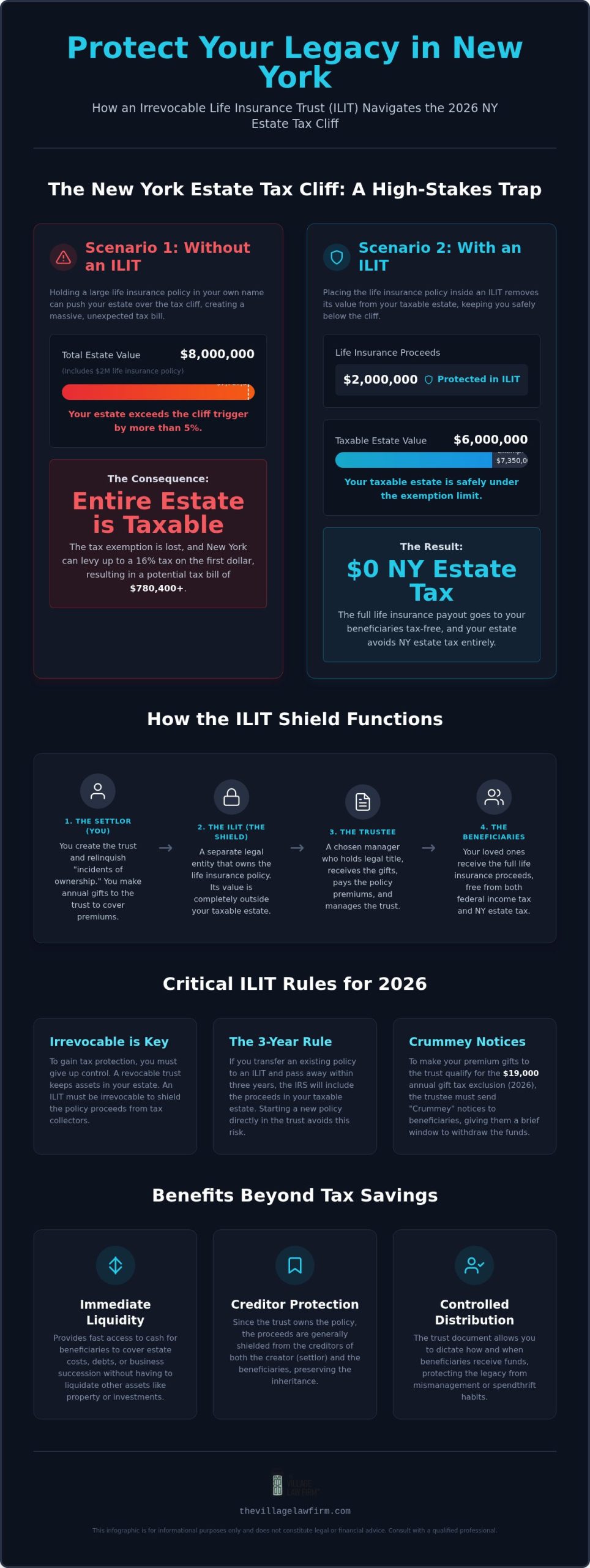
New York’s estate tax system is uniquely unforgiving due to what practitioners call the “tax cliff.” Most states tax only the amount that exceeds the exemption. New York is different. If your total estate exceeds the 2026 exemption of $7,350,000 by more than 5%, the state ignores the exemption entirely and taxes the first dollar of your estate. This means a relatively small policy payout can have catastrophic consequences. If a $2 million policy pushes your total assets just past that 5% threshold, your family could face a tax bill reaching into the hundreds of thousands. In 2026, the New York estate tax cliff effectively eliminates your entire exemption if your estate value exceeds $7,717,500.
Revocable vs. Irrevocable: Why ‘Irrevocable’ is the Key to Protection
Choosing the right trust structure is a balance between flexibility and security. A revocable trust allows you to maintain total control, but that control is exactly why the assets remain taxable. To achieve true tax exclusion, you must utilize an irrevocable structure. By relinquishing the power to personally manage the policy, you gain a powerful shield against the New York tax collector. If your primary goal is avoiding probate rather than tax mitigation, you might consult a revocable trust attorney New York families rely on for general estate management. However, for sophisticated life insurance planning, the irrevocable nature of an ILIT is the only way to ensure your proceeds remain a tax-free sanctuary for your children.
The Anatomy of a New York ILIT: How the Shield Functions
An irrevocable life insurance trust New York residents establish operates as a distinct legal entity. It effectively stands between your estate and the tax collector. Understanding The Legal Framework of an ILIT is the first step toward building this protection. This structure relies on three essential pillars. The Settlor is you, the creator of the trust. The Trustee is the manager who holds legal title to the policy and ensures compliance. Finally, the Beneficiaries are your loved ones who receive the proceeds. By separating yourself from the policy, you create a sanctuary that the state’s estate tax cannot reach.
To keep the death benefit out of your taxable estate, you must avoid what the IRS calls “incidents of ownership.” This means you can’t have the power to change beneficiaries, cancel the policy, or borrow against its cash value. You’re trading personal control for the absolute certainty that your family’s inheritance remains untouched by the New York estate tax cliff. Funding the trust is equally meticulous. You don’t pay the insurance company directly. Instead, you gift funds to the trust, and the Trustee pays the premiums from a dedicated trust bank account to maintain the legal boundary.
Transferring an Existing Policy vs. Starting New
Many professionals consider moving a current policy into a trust, but this path contains a significant hurdle known as the “three-year rule.” If you transfer an existing policy and pass away within three years of that transfer, the IRS ignores the trust and pulls the proceeds back into your taxable estate. This creates a period of vulnerability. Starting a brand-new policy where the trust is the original applicant and owner avoids this risk entirely. For those with existing coverage, meticulous documentation and a clean break from personal ownership are required to satisfy New York’s rigorous audit standards.
Choosing the Right Trustee for Your Family Sanctuary
The Settlor cannot serve as the Trustee of their own ILIT. Doing so would grant you too much control, collapsing the tax shield you’ve worked to build. Selecting the right partner to manage this entity is a decision that requires both technical precision and deep trust. While a family member can serve, many busy professionals opt for corporate trustees or professional fiduciaries to ensure long-term stability. A professional Trustee manages the complex administrative tasks, such as sending Crummey notices, which protects the interests of minor children. If you’re ready to move from financial chaos to a structured plan, exploring sophisticated estate planning can provide the clarity your family needs.
Strategic Benefits Beyond Tax Savings: Asset Protection and Liquidity
While the tax-saving mechanics of an ILIT are often the primary draw, this structure provides a multi-layered shield that extends far beyond the IRS. For many high-net-worth professionals in the city, an irrevocable life insurance trust New York families rely on serves as a critical asset protection tool. Because you no longer own the policy, the proceeds are generally beyond the reach of personal creditors and legal judgments. This creates a secure financial reservoir that remains untouched by the unpredictability of modern business or personal litigation. You can find a deeper dive into these structural advantages in this comprehensive guide to ILITs.
Beyond protection, an ILIT offers essential liquidity. New York estates are often rich in real estate but poor in cash. When the state’s estate tax bill arrives, your family might be forced to sell a cherished family home or a business interest to cover the debt. The ILIT provides immediate, tax-free cash to the estate; it allows your heirs to pay taxes and expenses without liquidating assets. Additionally, for those considering long-term care, removing the cash value of a policy from your personal balance sheet can simplify Medicaid eligibility in New York, as these funds won’t count toward your asset limit.
Protecting Your Children’s Future with Spendthrift Clauses
A significant concern for many parents is the risk of “too much, too soon.” Handing a multi-million dollar payout to a young adult can lead to impulsive decisions and financial instability. By including spendthrift provisions, you can dictate exactly how and when funds are distributed. You might choose to stagger payments or restrict use to specific needs like education, healthcare, or purchasing a first home. This ensures the inheritance remains a source of long-term security rather than temporary luxury. Working with a skilled estate planning attorney New York parents trust allows you to tailor these protections to your family’s unique dynamics.
The Role of ILITs in International Estate Planning
For New York residents with global footprints, estate administration can quickly descend into chaos. If you own assets in London, Paris, or Tokyo, coordinating different tax jurisdictions is a massive challenge. An ILIT can simplify this process by providing a centralized, US-based fund that isn’t entangled in foreign probate. Our firm frequently manages these complexities, including ancillary probate New York requirements for out-of-state assets. This global perspective ensures your legacy remains orderly, regardless of where your assets are located.
Maintaining Compliance: Crummey Notices and 2026 Gift Tax Rules
Funding an irrevocable life insurance trust New York isn’t as simple as writing a check to an insurance carrier. To ensure the IRS treats your premium payments as tax-free gifts, you must navigate a specific legal ritual known as the Crummey power. Without this mechanism, your contributions are considered “future interests,” which don’t qualify for the annual gift tax exclusion. By granting beneficiaries a temporary, 30-day window to withdraw the funds, you transform that contribution into a “present interest” gift. This legal fiction is the cornerstone of ILIT compliance. It allows you to fund large policies without eroding your lifetime estate tax exemption.
Precision in these steps is non-negotiable. A single missing notice can collapse the trust’s tax-shielding benefits, potentially exposing the entire death benefit to a 40% federal tax rate. NYC trustees in 2026 must maintain a meticulous paper trail that proves every beneficiary was informed of their rights. This isn’t just about paying bills; it’s about preserving the sanctuary you’ve built for your family. If you’re concerned about the administrative burden of these requirements, our team offers sophisticated estate planning support to ensure your legacy remains secure.
The 5-Step Crummey Notice Process
Executing a compliant notice requires a steady, methodical approach. Follow this sequence for every contribution to your irrevocable life insurance trust New York:
- Step 1: Transfer the exact premium amount from your personal account to the trust’s dedicated bank account.
- Step 2: Issue a formal, written notice to every trust beneficiary detailing the amount of the gift and their right to withdraw.
- Step 3: Observe the mandatory waiting period, typically 30 days, to allow beneficiaries time to exercise their withdrawal right.
- Step 4: Document the “lapse” of the withdrawal right once the 30 days have passed without a claim.
- Step 5: Pay the insurance carrier directly from the trust account using the now-cleared funds.
Gift Tax Limits and Generation-Skipping Transfers (GST)
For 2026, the federal annual gift tax exclusion has increased to $19,000 per recipient. Married couples can split gifts to contribute up to $38,000 per beneficiary without tapping into their lifetime exemption. If your trust includes grandchildren as beneficiaries, you must also account for the Generation-Skipping Transfer (GST) tax. Proper allocation of your GST exemption ensures that the policy proceeds aren’t taxed twice as they pass through multiple generations. Failing to file Form 709 to report these transfers can result in the permanent loss of your GST tax-exempt status and trigger avoidable penalties.
Designing Your Legacy: Why Professional Precision is Non-Negotiable
Designing an irrevocable life insurance trust New York residents can trust is a profound act of foresight. It’s more than a tax strategy; it’s a way to ensure your children’s lives remain stable even when you aren’t there to guide them. At The Village Law Firm, we believe in a “white-glove” approach that respects both the technical complexity and the emotional weight of your legacy. We move you away from the noise of financial chaos toward a structured, calming plan. Generic templates often fall short in New York’s strict legal environment. They lack the specific nuances required to satisfy local courts and the IRS. We partner with you to ensure your ILIT integrates perfectly with your will and other existing trusts. This alignment is what creates a truly impenetrable shield for your family.
The danger of a DIY approach in New York cannot be overstated. Our state’s courts are notoriously rigorous when it comes to trust interpretation and estate tax audits. A minor clerical error or a failure to properly sever “incidents of ownership” can lead to the entire policy being pulled back into your taxable estate. We provide the meticulous attention to detail that busy professionals require. By handling the heavy lifting of trust administration and design, we allow you to focus on what matters most: your family’s well-being. Our goal is to replace your current anxieties with a sense of permanent, well-ordered security.
A Partnership for Long-Term Security
Our firm operates on a foundation of transparency and directness. We know that legacy decisions are often stressful, so we aim to be your steady urban guide through every detail. We don’t just hand over a folder of papers; we build a long-term relationship. This includes supporting your trustees in their ongoing duties, from managing Crummey notices to coordinating with insurance carriers. If you’re ready to explore how these tools protect more than just insurance, our irrevocable trust attorney NYC resource provides deeper insights into sophisticated asset protection strategies for 2026.
Your Next Step Toward Order and Calm
True security starts with a clear understanding of your current position. A comprehensive review of your life insurance policies is the most effective way to spot hidden tax liabilities before they become permanent. We invite you to schedule a consultation to begin the process of building your family’s sanctuary. This is your opportunity to ask the hard questions and receive honest, professional answers. By taking action today, you replace the weight of uncertainty with the quiet confidence of a protected future. Let’s work together to turn your vision of a secure legacy into a meticulously crafted reality.
Securing Your Family Sanctuary for 2026 and Beyond
Building a legacy in a city as fast paced as New York requires more than just hard work; it demands technical precision and a protective mindset. You now understand how an irrevocable life insurance trust New York professionals rely on can neutralize the state’s estate tax cliff and provide your children with a debt free inheritance. By separating your policy from your personal estate, you replace financial chaos with a meticulously structured sanctuary. Compliance with 2026 gift tax rules and the careful execution of Crummey notices are the pillars that keep this shield strong.
Our firm provides the white glove service and compassionate planning necessary to manage these complexities for your family. We specialize in mitigating the unique risks of the New York tax landscape while ensuring your assets remain liquid and secure. Don’t leave your life insurance proceeds vulnerable to avoidable taxation or legal uncertainty. Secure your family’s future; schedule a sophisticated estate planning consultation with The Village Law Firm today. Your peace of mind is the ultimate gift to those you love most.
Frequently Asked Questions
What is the three-year rule for an irrevocable life insurance trust in New York?
The three-year rule states that if you transfer an existing life insurance policy into an irrevocable life insurance trust New York, you must survive for at least three years after the transfer. If you pass away within this window, the IRS pulls the death benefit back into your taxable estate. This is why many families choose to have the trust apply for a brand new policy instead; this strategy circumvents the waiting period entirely and ensures immediate tax protection.
Can I change the beneficiaries of my ILIT after it is created?
Because the trust is irrevocable, you generally cannot change the beneficiaries once the document is signed and funded. You relinquish “incidents of ownership” to gain significant tax benefits. However, a carefully drafted trust might include specific “powers of appointment” or allow a trust protector to make adjustments under very limited conditions. It is vital to ensure the initial design aligns with your long-term goals since modifications are legally difficult and complex.
How much does it cost to set up and maintain an ILIT in NYC?
The cost of establishing an ILIT depends on the complexity of your estate and whether you have international assets requiring specialized coordination. Maintenance involves annual administrative tasks like filing tax returns and sending Crummey notices to beneficiaries. While the initial investment reflects the sophisticated legal work required for white-glove service, it is often a fraction of the potential estate tax savings. Most families view these professional fees as a necessary expense for protecting a multi-million dollar legacy.
Can I borrow against the cash value of a policy held in an ILIT?
You cannot personally borrow against the cash value of a policy held within an ILIT. Doing so would constitute an incident of ownership, which would collapse the trust’s tax-shielding benefits and pull the proceeds into your taxable estate. While the Trustee may have the power to borrow against the policy for the benefit of the trust or its beneficiaries, the Settlor must remain entirely separate from these financial decisions to maintain strict legal and tax compliance.
Who should I choose as the trustee for my life insurance trust?
Choosing a trustee requires balancing personal trust with technical competence. You cannot serve as your own trustee. While a spouse or adult child is a common choice, many New York professionals prefer a corporate trustee or a professional fiduciary. These entities offer long-term stability and are intimately familiar with the meticulous record-keeping required for Crummey notices. A professional trustee ensures that administrative chaos never compromises the legal integrity of your family sanctuary.
What happens to the ILIT if I stop paying the insurance premiums?
If you stop gifting funds to the trust for premium payments, the policy may lapse; alternatively, the Trustee might use the policy’s internal cash value to keep the coverage active. In some cases, the Trustee may choose to surrender the policy or sell it in a life settlement. Because an ILIT is a separate legal entity, the Trustee has a fiduciary duty to act in the best interests of the beneficiaries when deciding how to handle a funding shortfall.
Is an ILIT necessary if my estate is below the federal tax threshold but above the New York threshold?
Yes, an irrevocable life insurance trust New York is often more critical for residents whose estates fall between the state and federal thresholds. In 2026, the New York estate tax exemption is $7,350,000. If your estate exceeds this by even 5%, the state taxes the entire amount from the first dollar. Even if you owe zero federal tax, the New York cliff can result in a massive tax bill that an ILIT effectively eliminates.
Can an ILIT be used for Medicaid planning in New York?
An ILIT can be a powerful tool for Medicaid planning in New York. Since the trust is the owner of the policy, the cash surrender value is not considered an available asset for Medicaid eligibility purposes. This allows you to preserve the death benefit for your children while still qualifying for long-term care assistance. It is a strategic way to ensure your legacy remains a sanctuary for your family rather than being consumed by significant healthcare costs.