
Imagine spending decades building a global legacy, only to have a foreign court decide who inherits your property because of a local law you didn’t know existed. For many New Yorkers with international interests, the dream of a seamless transition often hits a wall of forced heirship or sudden probate delays. If you own a vacation home in Italy or investments in London, you’ve likely realized that estate planning for foreign assets isn’t just a luxury; it’s a necessity to prevent legal chaos. You want your heirs to feel supported, not burdened by a maze of international red tape.
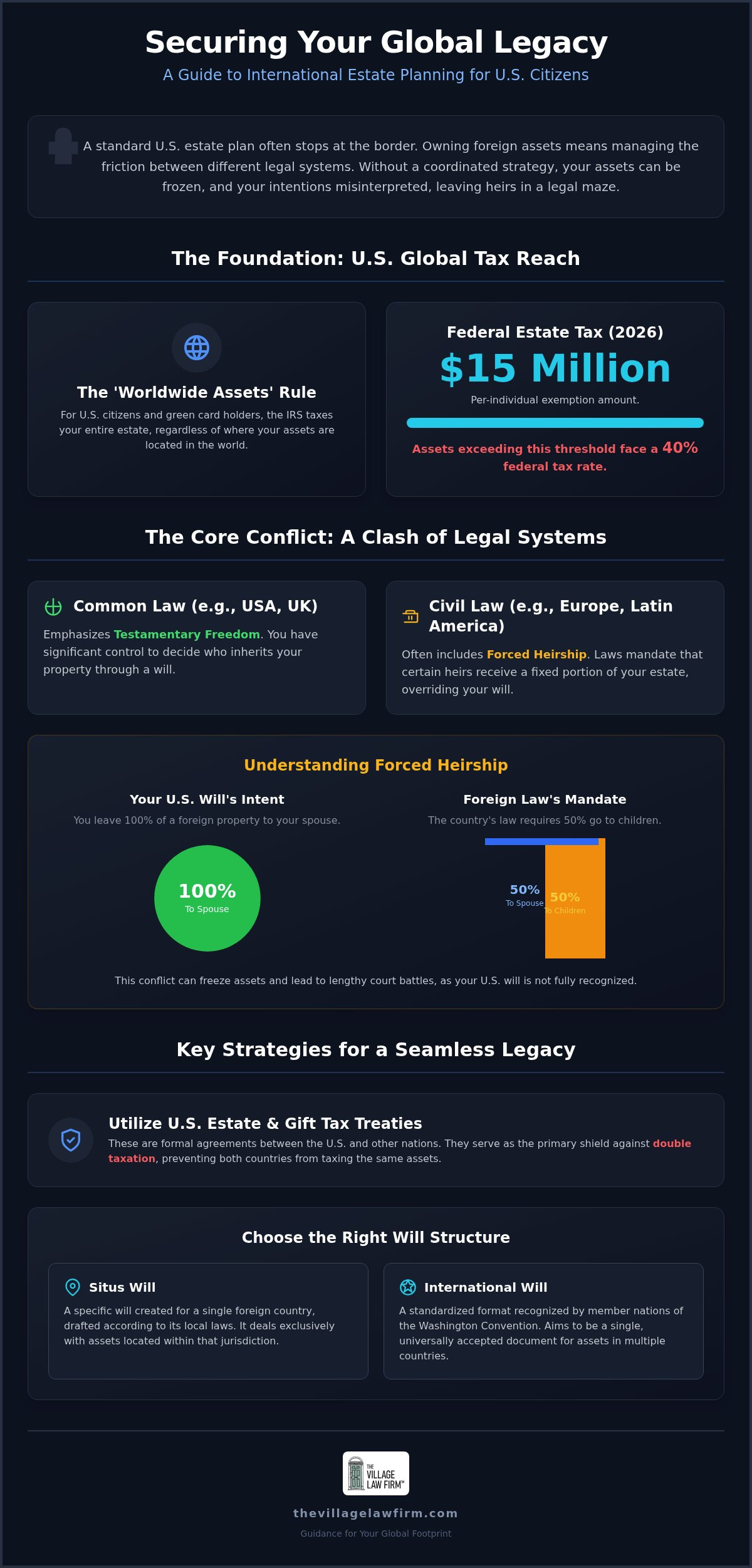
It’s natural to feel a sense of anxiety when you consider the threat of double taxation or the 40 percent federal tax rate on assets exceeding the $15 million exemption. You’ve worked hard for your success. You deserve the security of a plan that accounts for every border your wealth crosses. This 2026 guide will help you master these intricacies so your international properties pass to your chosen heirs exactly as you intended.
We’ll explore how a sophisticated dual-track strategy can harmonize your New York objectives with foreign requirements. From managing the $15 million federal exemption to understanding why a New York will might not be enough for your European real estate, you’ll gain the clarity needed to secure your global footprint.
Key Takeaways
- Understand the IRS “worldwide assets” rule to ensure your global portfolio remains compliant and protected from unexpected federal scrutiny.
- Learn how to utilize US Estate and Gift Tax Treaties as a primary shield against paying double taxes on the same international investments.
- Evaluate whether a local Situs Will or a Washington Convention International Will is the right instrument to secure your properties and accounts abroad.
- Discover strategies to navigate forced heirship laws that can dictate how your wealth is distributed in certain foreign jurisdictions, regardless of your personal wishes.
- Gain a clear, methodical roadmap for estate planning for foreign assets that coordinates between New York law and international legal requirements for a seamless legacy.
The Reality of Global Ownership: Why Your US Estate Plan May Stop at the Border
Owning property abroad is often the crowning achievement of a successful career. Whether it is a sun-drenched villa in Tuscany, a pied-à-terre in Paris, or a diverse portfolio of business interests in Singapore, these assets represent your hard work and global reach. However, there is a common misconception that a standard New York estate plan acts as a universal key. In reality, your local documents may have little to no authority once they cross international lines. When you engage in estate planning for foreign assets, you are not just managing wealth; you are managing the friction between two or more sovereign legal systems that may not speak the same language, literally or legally.
Foreign assets encompass far more than just physical real estate. They include bank accounts, brokerage holdings, life insurance policies issued by foreign carriers, and ownership stakes in international corporations. Without a coordinated strategy, these assets often fall into a legal vacuum. This creates a state of chaos where foreign courts may freeze your accounts or misinterpret your intentions, leaving your heirs to navigate a labyrinth of red tape while grieving. Understanding the reach of both the US government and foreign jurisdictions is the first step toward creating a sanctuary of order for your family.
The ‘Worldwide Assets’ Rule for US Citizens and Green Card Holders
The Internal Revenue Service maintains an expansive view of your wealth. If you are a US citizen or a green card holder, the IRS taxes you on your worldwide assets, regardless of where those assets are located or where you happen to reside at the time of your passing. For 2026, the federal estate tax exemption is $15 million per individual. While this is a generous threshold, the value of global real estate and business holdings can quickly bridge that gap. Non-disclosure is never a viable strategy. The penalties for failing to report foreign financial accounts or assets can be devastating, often resulting in fines that exceed the value of the asset itself. ‘For the US citizen, the IRS recognizes no borders when calculating the value of your global legacy.’
Common Law vs. Civil Law: The Root of International Legal Conflict
The primary source of “legal friction” lies in the fundamental difference between New York’s common law system and the civil law systems used throughout much of Europe, Latin America, and Asia. In New York, you have significant freedom to decide who inherits your wealth. Many civil law countries, however, operate under the principle of Forced Heirship. These laws mandate that a specific percentage of your estate must pass to certain heirs, such as children or spouses, regardless of what your will says. This clash can lead to years of delays as your New York executor struggles to gain recognition from a foreign judge. The emotional toll on your family is immense when assets stay frozen for months or years, effectively locking your loved ones out of their own inheritance.
Effective estate planning for foreign assets requires a partnership between your New York counsel and experts in the local jurisdiction. By addressing these conflicts now, you ensure that your global legacy remains a gift to your heirs rather than a legal burden.
Navigating International Taxation: Avoiding the Double Tax Trap
The prospect of losing a significant portion of your life’s work to competing tax authorities is a source of profound anxiety for many global citizens. When your wealth spans borders, the risk of double taxation isn’t just a theoretical concern; it’s a structural reality. Both the US government and a foreign jurisdiction may assert their right to tax the same piece of real estate or the same investment account. Without a meticulous approach to estate planning for foreign assets, your beneficiaries could find themselves caught in a financial tug-of-war that depletes their inheritance before they ever receive it.
How Estate Tax Treaties Shield Your Global Wealth
The most robust defense against double taxation is a formal bilateral agreement. The US currently maintains estate and gift tax treaties with several key nations, including the United Kingdom, France, Germany, Canada, and Japan. These documents serve as a vital roadmap for determining which country has the primary right to tax a specific asset. One of the most significant benefits of these treaties is the “tie-breaker” provision. This rule helps establish a single legal domicile, preventing two countries from simultaneously claiming you as a resident for tax purposes. By clarifying these boundaries, a treaty can often reduce or entirely eliminate the burden of foreign inheritance taxes. This level of coordination is a critical component of International Estate Planning, providing the stability and predictability you need to protect your family’s future.
The Foreign Death Tax Credit: A Safety Net for Non-Treaty Countries
When your assets are located in a country that doesn’t have a formal treaty with the US, you must rely on the Foreign Death Tax Credit. This credit is claimed on Form 706 and allows your estate to offset its US federal tax liability by the amount of inheritance tax paid to a foreign government. It acts as a necessary safety net, but it’s not without its limitations. The credit is typically restricted to the “lower” of the two tax rates. If the foreign jurisdiction imposes a 45 percent tax and the US rate is 40 percent, the credit will only cover the 40 percent, leaving your estate to absorb the difference. Claiming this credit effectively requires exhaustive documentation and seamless cooperation between your US and foreign legal teams. It’s a process that demands technical precision to ensure no dollar is lost to administrative oversight.
The complexity of international tax law can feel overwhelming, but you don’t have to navigate it alone. A tailored strategy for international estate planning in New York can replace this complexity with a sense of security, ensuring your global legacy remains intact for the next generation.
Structural Solutions: International Wills vs. Situs Wills
Building a global legacy requires a foundation of sound legal instruments. While we have already addressed the “why” and the tax implications of international wealth, we must now focus on the “how.” When you approach estate planning for foreign assets, you must decide whether to use a single, unified document or a collection of local instruments tailored to each jurisdiction. This choice is the difference between a seamless transition and a multi-year legal battle in a foreign court. Precision matters. A single word can undo years of planning.
The International Will: A Unified Approach Under the Washington Convention
For many New Yorkers, the most efficient tool is the International Will. This unique document is governed by the Washington Convention, a treaty designed to harmonize probate across international borders. To be valid, an International Will must meet strict formal requirements, including being signed in the presence of three witnesses and an authorized person who attaches a specific certificate of validity. When drafted correctly, this will is recognized in all signatory countries, from France to Italy to several US states. It provides a sanctuary of order by allowing one document to govern assets across multiple treaty nations. This is often the most streamlined path for busy professionals who value efficiency and want to avoid the complexity of managing multiple legal teams across different time zones.
When a Situs Will is the Only Secure Option
Despite the elegance of a unified plan, some jurisdictions remain resistant to foreign documents. In these cases, a “Situs Will” is the only secure option. A Situs Will is a local document drafted according to the specific laws of the country where the asset is located. This is particularly critical for real estate in non-treaty countries where local judges may refuse to recognize a New York executor. However, creating multiple wills introduces a significant risk: the revocation trap. Most standard New York wills include a boilerplate clause that revokes all prior wills. If you sign a new US will without specialized guidance, you might accidentally cancel your carefully drafted foreign will. We coordinate meticulously with local foreign counsel to ensure your documents are harmonious rather than contradictory.
Managing these structural layers also requires an understanding of how assets flow back into the United States. For example, if a foreign owner has interests in New York, their heirs may need to navigate ancillary probate in New York to gain control of local holdings. This process is deeply intertwined with the U.S. Estate Tax rules that govern non-resident assets. By aligning your global instruments with local probate requirements, you ensure that your estate planning for foreign assets provides a clear, unburdened path for your heirs, no matter where they or your assets are located.
Overcoming Jurisdictional Hurdles: Forced Heirship and Residency Risks
Your legacy is deeply personal. In New York, the law generally respects your right to leave your wealth to whomever you choose. However, when your portfolio includes international properties, you may encounter laws that treat your intentions as secondary to national statutes. This conflict is a central challenge in estate planning for foreign assets. It requires a strategic pivot from traditional US methods to a more nuanced, cross-border approach. Without this foresight, your carefully crafted plan could be dismantled by a foreign court before your heirs can even begin the probate process.
Navigating Forced Heirship in Civil Law Countries
Civil law jurisdictions, including France, Italy, and much of Latin America, operate under a system known as forced heirship. These laws mandate that a “reserved portion” of your estate must pass to specific heirs, usually children or a surviving spouse. Even a perfectly executed New York will cannot always override these local mandates. While trusts are a staple of American planning, many civil law countries don’t fully recognize them. They may view trust-held property as a direct inheritance subject to forced distribution rules. One effective strategy we use is “estate balancing.” This involves using your US-based assets to provide for heirs who might be excluded abroad. By coordinating your domestic and international distributions, we ensure your total legacy aligns with your original vision regardless of local restrictions.
The Residency Trap: How Living Abroad Changes Everything
Living abroad adds another layer of complexity that can jeopardize your US-based plan. Many foreign tax authorities use the “183-day rule” to determine residency. If you spend more than half the year in a country like Spain or Portugal, you may be deemed a tax resident. This shift can subject your entire worldwide estate to that country’s inheritance laws, not just the assets located within its borders. To protect your plan, you must maintain clear evidence of your New York domicile. Consider this checklist to preserve your status:
- Maintain a permanent residence and utility accounts in New York.
- Keep your New York driver’s license and voter registration active.
- Document your intent to return to the US through travel records.
- Limit the consecutive number of days spent in the foreign jurisdiction.
The stakes are even higher for those holding multiple passports. Managing dual citizen estate planning in New York requires a deep understanding of how treaties and local laws interact. Each citizenship can trigger distinct tax and probate requirements that must be harmonized within your master plan. If you are ready to secure your global interests against these jurisdictional hurdles, contact us today to begin your international estate planning consultation.
Orchestrating Your Global Estate: The Village Law Firm’s Meticulous Path
Complexity shouldn’t be the price of a global life. While the legal friction between common law and civil law systems is real, it doesn’t have to be your burden. We provide a sanctuary of order. Our firm specializes in estate planning for foreign assets by acting as the bridge between your New York objectives and the specific requirements of foreign jurisdictions. We replace the chaos of fragmented legal advice with a single, meticulous strategy. You’ve spent a lifetime building your wealth. We spend our time ensuring it remains protected.
Our white-glove approach means you have a centralized point of contact to manage every detail of your international portfolio. We don’t just draft documents; we orchestrate a global symphony of legal protections. This expertise extends to the delicate process of administering US estates for foreign beneficiaries, ensuring that cross-border wealth flows smoothly regardless of where your loved ones reside. By handling the heavy lifting of international coordination, we allow you to focus on the emotional significance of your legacy rather than the mechanics of foreign probate.
A Partnership Mindset for Global Citizens
We act as your steady urban guide through the fast-paced and often unpredictable world of international finance. Our role is to serve as a shield against foreign legal uncertainty. By focusing on a partnership mindset rather than a transactional one, we walk alongside you to remove the emotional weight of legacy planning. Every decision is made with transparency and directness. We invite you to a consultation to replace anxiety with a structured, secure legacy. It’s time to bring your global interests into a single, cohesive vision.
Next Steps: Your 2026 Global Estate Audit
The 2026 tax landscape, with its $15 million federal exemption per individual, makes this a critical moment to review your international holdings. Proactive planning today prevents legal battles tomorrow. Start your audit with these immediate actions:
- Inventory every global asset, including foreign bank accounts, digital holdings, and business interests.
- Verify how titles are held in foreign jurisdictions to ensure they align with your New York estate plan.
- Review existing wills for conflicting revocation clauses that could accidentally invalidate foreign documents.
- Identify any changes in your residency status that could trigger unintended foreign tax rules.
The transition from chaos to order begins with a single step. Secure your global legacy with a sophisticated New York estate plan.
Securing Your Global Footprint for the Future
The complexities of international wealth don’t have to lead to legal chaos for your heirs. By aligning your New York plan with foreign requirements, you ensure that vacation homes and global investments transition seamlessly. You’ve seen how avoiding the double tax trap requires a dual-track strategy involving specific treaties and meticulous documentation. Whether you’re navigating forced heirship in Europe or residency risks in Asia, the right structural solutions provide a sanctuary of order. Your global footprint is a testament to your success, and it deserves a plan that respects both your vision and the laws of the land.
Estate planning for foreign assets is a journey that requires a steady, authoritative guide. The Village Law Firm offers specialized expertise in cross-border estate administration, providing a calming, white-glove approach to even the most complex legal hurdles. As a premium New York practice focused on global wealth protection, we handle the intricacies so you can enjoy the peace of mind you’ve earned. Take the next step toward a unified, secure legacy.
Schedule a sophisticated consultation to protect your international legacy today. Your success deserves a plan that is as ambitious and meticulous as you are. We’re here to walk alongside you, replacing uncertainty with a clear, protected path forward.
Frequently Asked Questions
Do I need a separate will for my property in another country?
It depends on the specific jurisdiction, but a local “Situs Will” is often the most secure way to ensure foreign real estate transfers according to local laws. While a New York will can technically cover worldwide assets, many foreign courts refuse to recognize it for land and buildings. A local will prevents your heirs from facing years of probate delays in a foreign court system.
How does the US tax foreign property inherited by a New York resident?
The US taxes its citizens and residents on their worldwide estate, meaning foreign property is included in your total taxable value. For 2026, if your global assets exceed the $15 million individual exemption, the portion above that amount is subject to a federal tax rate of up to 40 percent. This applies regardless of whether the property is a flat in London or a bank account in Zurich.
What is an International Will, and is it valid in New York?
An International Will is a document drafted under the Washington Convention standards and it is recognized as valid in New York and other signatory jurisdictions. This instrument simplifies estate planning for foreign assets by creating a single document that meets the formal legal requirements of multiple countries. It requires specific witnessing and a certificate of validity to be enforceable across borders.
Can a New York trust hold title to foreign real estate?
A New York trust can technically hold title, but many civil law countries don’t recognize the concept of a trust or may impose punitive taxes on trust-held property. In jurisdictions like France or Italy, a trust might be viewed as a “look-through” entity or ignored entirely by local land registries. We often recommend local holding structures or Situs Wills to avoid these recognition hurdles.
What happens if a foreign country’s ‘forced heirship’ laws conflict with my will?
If a conflict occurs, the laws of the country where the real estate is located usually take precedence over your New York will. This means a portion of your foreign property may be legally mandated to go to children or a spouse, even if you intended otherwise. We manage this through “estate balancing,” where we adjust your US distributions to offset the mandatory allocations required by foreign statutes.
How do tax treaties between the US and other countries affect my estate plan?
Tax treaties act as a primary shield by clarifying which country has the right to tax specific assets and providing credits to prevent double taxation. These agreements are essential for estate planning for foreign assets because they establish “tie-breaker” rules for residency. They help ensure you aren’t taxed as a full resident by two different nations simultaneously.
What is the foreign death tax credit, and how do I claim it?
The foreign death tax credit is a federal credit that allows your estate to subtract taxes paid to a foreign government from its US estate tax bill. You claim this credit by filing IRS Form 706 and providing proof of the foreign tax payment. It is a vital safety net for assets in non-treaty countries, though it’s often limited to the lower of the two tax rates.
How can I avoid probate for my foreign assets?
Avoiding foreign probate typically requires using local legal structures such as usufruct agreements, joint ownership with rights of survivorship, or local holding companies. Because every country has unique rules for asset transfer, a standard New York revocable trust is rarely sufficient on its own. We coordinate with local counsel to implement jurisdiction-specific tools that allow your property to pass directly to your heirs.