
What if the first step in settling an estate isn’t filling out a court form, but determining which process applies? After a loss, it’s understandable to feel unsure about the paperwork, filing order, and decisions ahead. The Surrogate’s Court procedure Queens families face generally depends on whether there’s a will, which assets are part of the estate, and who is entitled to act.
This guide explains how probate with a will differs from administration without one, and outlines the usual steps, from organizing information and preparing a petition to responding to court review. You’ll also learn why some assets may pass outside the court process, what responsibilities come with managing an estate, and how family disagreements or property in another country can add complexity.
Knowing the basic sequence can help you organize records and identify questions that need case-specific attention. The Village Law Firm provides estate administration counsel, including probate support and complex cross-border estate administration, helping New York families bring order to a demanding process while respecting the family and legacy at its center.
Key Takeaways
- Whether an estate needs probate or administration depends in part on whether the person left a will and which assets are involved.
- The Surrogate’s Court procedure Queens families follow generally moves from identifying the case type to preparing and filing papers, then responding to court review.
- A will does not automatically resolve every issue; supporting documents, notice, and possible family objections can affect the process.
- Court appointment gives an executor or administrator authority with responsibilities, not unrestricted control over estate assets.
- Unclear records, disputes, or assets in other states or countries can make careful estate administration guidance especially valuable.
Queens Surrogate’s Court: When does an estate need probate or administration?
Managing practical details after a loss can feel overwhelming. Start by clarifying whether a will needs to be submitted for probate or whether someone must ask the court to appoint an estate representative without a will admitted to probate.
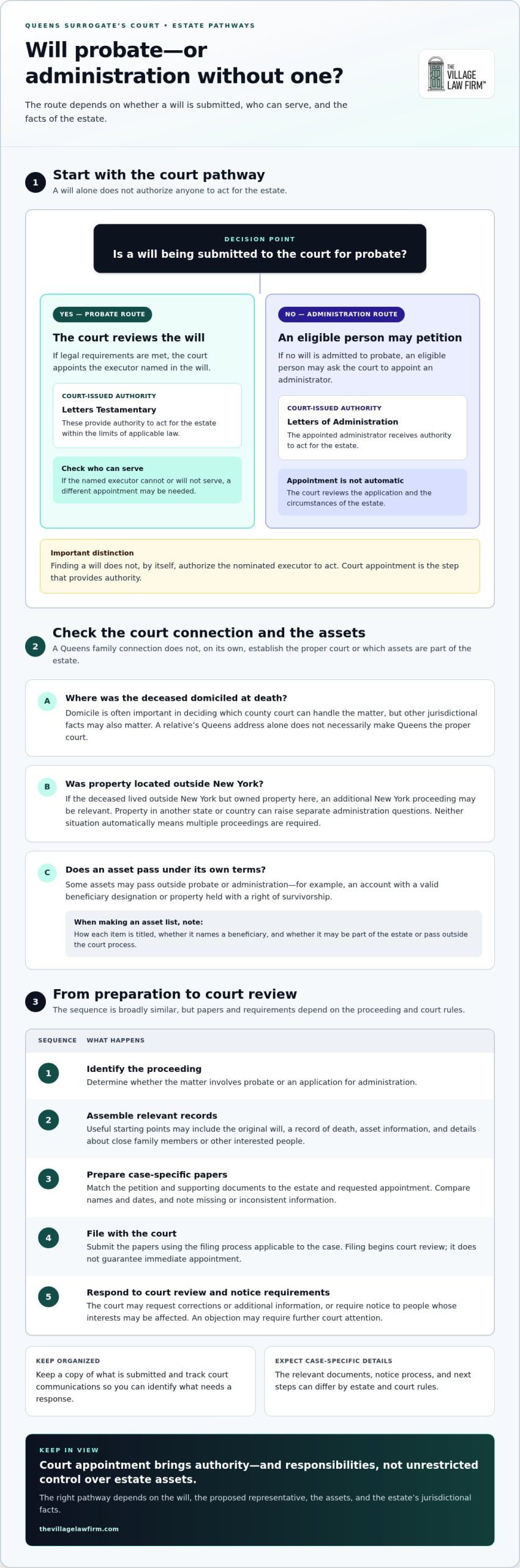
Probate is the process in which the Surrogate’s Court reviews a will and, if the legal requirements are met, appoints the executor named in it. Finding a will doesn’t, by itself, authorize the nominated executor to act. The New York Surrogate’s Court handles probate and other estate proceedings, but the appropriate route depends on the estate’s facts.
How do probate and administration differ in Queens?
In probate, the person named as executor asks the court to admit the will and issue Letters Testamentary. These letters provide court-issued authority to act for the estate within the limits of applicable law. If there’s no will admitted for probate, an eligible person may petition for appointment as administrator. If appointed, that person receives Letters of Administration.
The distinction isn’t always simply “will” versus “no will.” A will may name an executor who can’t or won’t serve, and a different appointment may be needed. Review the will, identify the proposed representative, and note any known issue that could affect the appointment. The court process and authority documents depend on the circumstances.
Why does the estate’s connection to Queens matter?
The Surrogate’s Court procedure Queens families encounter depends partly on venue, meaning which county court can handle the matter. The deceased person’s domicile at death is often important, but other jurisdictional facts may also matter. A relative’s Queens address alone doesn’t necessarily establish that Queens is the proper court.
For a Queens family, the deceased person’s residence and the location and ownership of property are useful starting points when identifying the proper court. If the deceased lived outside New York but owned property here, an additional New York proceeding may be relevant. Property in another state or country can raise separate administration questions too. Neither circumstance automatically means there must be multiple proceedings. The details of ownership, location, and the primary estate case matter.
Not every asset necessarily passes through probate or administration. For example, an account with a valid beneficiary designation or property held with a right of survivorship may pass under its own terms. As you make an asset list, note how each item is titled and whether it names a beneficiary. This helps distinguish assets that may be part of the estate from those that may pass outside the court process.
Queens probate procedure, step by step: From initial preparation to court review
Once you have a clearer sense of which court route may apply, organize the information that will support the filing. The Surrogate’s Court procedure Queens families follow isn’t a single checklist for every estate. The petition, supporting records, and next steps depend on the case and applicable court rules.
What information and records may be needed before filing?
Gather available records before preparing papers. Depending on the proceeding, useful starting points may include the original will, a record of death, information about assets, and details about close family members or other interested people. These materials help show what the court is being asked to do and who may need to receive notice.
As you gather documents, compare names and dates across records and make a note of anything that is missing or inconsistent. This is a starting point, not a universal document list. Court requirements and the documents relevant to a specific petition can differ. Uncertainty about family relationships or gaps in records may call for additional investigation or supporting information. Organizing what you have early can help identify those issues before filing.
What happens after papers are filed with the court?
Filing begins court review; it doesn’t guarantee immediate appointment. The court may examine the papers and supporting materials, request corrections or additional information, or require notice to people whose interests may be affected. Who must receive notice and how that process works depend on the proceeding and applicable rules. If someone raises an objection, the matter may require further court attention.
In broad terms, the sequence is: identify the proceeding, gather relevant records, prepare case-specific papers, file them, and respond to court requests or notice requirements. Keep a copy of what is submitted and track court communications so you can identify what needs a response. The exact steps and documents vary by estate and court rules.
- Identify the case type. Determine whether the matter involves probate or an application for administration.
- Assemble relevant records. Locate the will, death record, asset details, and family information that may apply.
- Prepare the papers. Match the petition and supporting documents to the specific estate and requested appointment.
- File with the court. Submit the papers using the filing process applicable to the case.
- Address court review. Respond to requests, correct issues, and complete any required notice or follow-up.
The court’s decision determines whether the proposed representative is appointed. Authority to act follows the court’s approval and issuance of the appropriate letters, not simply the act of filing. Careful preparation can help keep each stage organized, especially when records are incomplete or relatives are difficult to locate. The Village Law Firm provides estate administration counsel to help organize filings and estate responsibilities.
Queens Surrogate’s Court filing issues: Documents, notice, and family objections
Submitting a will is an important step, but it doesn’t automatically settle the estate or eliminate court review. The court may need to assess whether the papers are complete, whether interested people received required notice, and whether questions or objections need to be addressed. In the Surrogate’s Court procedure Queens families encounter, even a small inconsistency, such as different spellings of a name across records, can call for clarification.
Use this overview to spot issues that may need attention. It describes general considerations, not a prediction of how a particular estate will be handled.
| Issue | Why it matters | General response to consider |
|---|---|---|
| Missing or unclear records | The court may need reliable information to review the petition and supporting papers. | Keep a record of what is available, identify gaps, and determine what additional documentation may be relevant. |
| Inconsistent names or family details | Differences between documents can raise questions about identity or who may have an interest in the proceeding. | Gather records that help explain the discrepancy instead of assuming it will be overlooked. |
| Notice to interested people | Procedural rules may require notice, and incomplete notice can affect the court process. | Identify potentially interested parties and follow the requirements that apply to the specific matter. |
| Objection to the will or proposed representative | A dispute can require further court review and change how the proceeding moves forward. | Preserve relevant communications and records, and get case-specific legal guidance. |
| Assets outside New York | Property in another state or country may raise separate jurisdiction or administration questions. | Identify where each asset is held and assess whether additional proceedings may be needed. |
What if a family member challenges the will or appointment?
A challenge can shift a matter from routine document review to a contested proceeding. The significance of an objection, the response it calls for, and possible next steps depend on the specific facts and applicable law. Don’t rely on informal family conversations to resolve a court issue or assume you know the outcome.
Keep relevant documents and communications organized, including the will, court papers, and correspondence related to the objection. Case-specific legal guidance can help clarify what is being disputed and what the next steps may involve. A complete record helps make the issues easier to assess.
What if the estate includes assets outside New York?
Real property or other assets located elsewhere may require attention under another jurisdiction’s procedures. That doesn’t automatically mean a separate case is necessary; the answer depends on the asset and the estate’s circumstances. For context, see this guide to ancillary probate in New York.
Assets or family ties across national borders can add another layer of coordination. International estate planning in New York raises related considerations. For an individual estate, careful administration guidance can help organize the questions and distinguish general procedure from decisions that require case-specific analysis.
After Queens court appointment: Executor and administrator responsibilities
Appointment is a turning point, not the finish line. An executor or administrator receives authority through the court, but that authority is governed by the court’s instructions, applicable law, and the circumstances of the estate. It isn’t unrestricted control over property or permission to distribute assets however the representative chooses.
Court appointment authorizes estate administration; it does not complete it. The representative generally needs to gather information, keep reliable records, address valid obligations, and make any distributions in accordance with applicable law and court directions. The precise responsibilities can vary, so a general list should not be treated as a complete statement of duties for every estate.
What does an executor or administrator generally do?
A representative typically begins by organizing estate records and identifying assets and obligations relevant to the administration. That may include collecting financial statements, locating property information, documenting expenses, and keeping correspondence together. A clear record helps show what the representative has done and why.
Record transactions as they occur, preserve receipts and statements, and keep estate activity separate from personal finances. These steps support transparent accounting and make it easier to explain the administration. Before acting on a disputed obligation or making a distribution, consider how the will, court instructions, applicable law, and estate-specific facts may affect the decision. The details matter.
How can families keep the process organized?
Set up one secure central file, digital or physical, for court papers, correspondence, asset information, and expense records. Use a simple log to note important dates, communications, and actions taken. Share accurate updates with relevant family members, while taking care not to disclose sensitive information unnecessarily.
Respond promptly to court communications and keep copies of anything submitted. If records are incomplete or relatives disagree about an asset or expense, document what is known and seek guidance before acting on assumptions. A consistent record can reduce confusion and help preserve a clear account of the administration.
The Surrogate’s Court procedure Queens representatives follow continues after appointment, as they carry out the work under the authority granted by the court. The Village Law Firm provides estate administration support and guidance on fiduciary responsibilities.
For future planning context, explore this resource on estate planning for New York families. A thoughtful plan can help families clarify their wishes and prepare for responsibilities that may arise later.
Queens Surrogate’s Court procedure: When legal guidance can bring clarity
Estate proceedings move through connected stages: identifying whether probate or administration applies, preparing papers that fit the estate, responding to court review, and carrying out responsibilities after appointment. Uncertainty at one stage can affect the next. The Surrogate’s Court procedure Queens families follow may become more involved if records are unclear, relatives disagree, or assets are located outside New York.
When it’s difficult to determine the proper proceeding, understand court correspondence, or manage a representative’s responsibilities, tailored guidance can help bring the issues into focus. The Village Law Firm provides estate administration counsel and handles complex cross-border estate administration, including matters where assets may also be subject to proceedings outside New York.
When might a Queens family benefit from estate administration counsel?
Consider legal guidance if the will or family information is incomplete, the right court process is uncertain, or you’re unsure what a proposed executor or administrator is authorized to do. A family objection may require careful handling, while foreign or out-of-state property can raise questions about how separate jurisdictions interact. These are reasons for closer review, not a prediction that a dispute or extra proceeding will necessarily follow.
Estate administration counsel can help organize filing issues, clarify responsibilities, and identify questions that depend on the specific estate. The aim is to make the next steps more understandable, rather than assume every family needs the same approach.
What should readers prepare for an initial estate discussion?
Gather what’s readily available. You don’t need a complete file to begin organizing the questions. Helpful starting materials may include:
- Any will or other estate-planning documents you have located
- Court papers or correspondence already received
- A death record, if available
- A basic overview of known assets and obligations
- Notes about family questions, disagreements, or missing information
- Details of any known property or accounts outside New York or in another country
These materials can help frame the discussion, while the appropriate documents and legal steps depend on the circumstances. Bring questions, too. Clear answers about the proceeding, court papers, and representative’s role can help replace uncertainty with a more orderly plan.
For thoughtful guidance with probate, administration, or cross-border estate issues, discuss your estate administration needs with The Village Law Firm.
Take the Next Step With a Clearer Plan
The Surrogate’s Court procedure Queens families follow begins with identifying the right court process, then moves through preparing and filing papers, responding to court review, and carrying out the representative’s responsibilities. The details depend on the estate. Missing records, family objections, or assets outside New York can raise questions that benefit from careful, case-specific attention.
An executor’s or administrator’s appointment is an important step, but estate administration continues as assets and obligations are addressed under applicable law and court instructions. The Village Law Firm provides estate administration counsel and handles complex cross-border estate matters, helping families bring structure to a demanding process.
If you’re unsure which proceeding applies or what to do next, discuss your Queens estate administration needs with The Village Law Firm. A conversation can help clarify the questions ahead and support a more confident path forward.
Frequently Asked Questions
What is the difference between probate and administration in Queens?
Probate is the court process for reviewing a will and appointing the executor named in it, if the court accepts the will and approves the appointment. Administration generally applies when there’s no will admitted for probate and someone must ask the court to appoint an administrator. In either process, the representative’s authority comes from the court. The appropriate route depends on the will, the estate’s assets, and other case-specific facts.
How do I start a Surrogate’s Court case in Queens?
Begin by identifying whether the matter involves probate or administration, then gather available estate and family information. A petition and supporting papers are prepared and filed with the appropriate Surrogate’s Court. The court may review the submission, require notice to interested people, or request corrections or more information. The Surrogate’s Court procedure Queens families follow depends on the case and applicable rules, so filing steps should be tailored to the estate.
What documents are needed for Queens Surrogate’s Court?
Documents vary by proceeding, so there isn’t one universal checklist. Depending on the case, relevant records may include the original will, a death record, information about assets, and details about family members or other interested people. The court may also require supporting papers or information addressing a particular issue. Keep available records organized and note missing or inconsistent details. Requirements depend on the estate and current court rules.
Can a will avoid probate in Queens?
A will generally doesn’t avoid probate for assets that need a court-appointed representative to transfer or administer them. Instead, the will states how probate assets should be handled and names a proposed executor, subject to court review and appointment. Some assets may pass outside probate under a beneficiary designation or a right of survivorship. Whether a particular asset requires court involvement depends on how it is owned and the estate’s circumstances.
What happens if someone objects to a will in Queens Surrogate’s Court?
An objection may lead to additional court review and change how the proceeding moves forward. The court’s response depends on the issues raised, the records, and applicable law; an objection alone doesn’t determine the outcome. Keep relevant documents and communications organized, and don’t rely on informal discussions to resolve a court matter. Because the right response is case-specific, legal guidance can help clarify what the objection means and what steps may follow.
Do out-of-state or foreign assets affect a Queens estate proceeding?
They can. Property in another state or country may raise separate questions about jurisdiction, local procedures, or whether additional administration is needed. A separate proceeding isn’t automatic; the answer may depend on the asset’s location and ownership, as well as the main estate case. Make a record of known property and accounts outside New York, then assess how those assets fit into the administration. Cross-border matters can require careful coordination.
What happens after the court appoints an executor or administrator?
The appointed representative begins administering the estate within the authority granted by the court and applicable law. General tasks may include gathering estate information, maintaining clear records, addressing valid obligations, and distributing remaining assets as permitted. Appointment doesn’t mean the estate is settled or give the representative unrestricted control. Keep court papers, correspondence, asset information, and expense records together, and respond carefully to court communications as administration continues.