
What if the home you spent decades building could be claimed by a nursing home in just a few short months? It’s a question that keeps many New Yorkers awake, and for good reason. You’ve worked tirelessly to provide for your family, yet the shifting landscape of the Medicaid look back period NY often feels designed to create more chaos than clarity. You likely feel that the legal system is a maze of conflicting 30-month and 5-year rules; it’s a weight that leaves your legacy feeling vulnerable to the high costs of long-term care.
It’s understandable to feel overwhelmed, but you deserve a sanctuary of order in an unpredictable world. We’ll show you exactly how to master these complexities to ensure your home and savings remain where they belong, with your children and loved ones. This 2026 guide provides a clear timeline for asset transfers, explains the current non-enforcement of the community look-back, and explores the sophisticated mechanics of the Medicaid Asset Protection Trust. By the end, you’ll have the precise knowledge needed to move from uncertainty to total peace of mind, knowing your legacy is meticulously secured and your family’s future is shielded from the unexpected.
Key Takeaways
- Understand why the Medicaid look back period NY remains 60 months for nursing home care while the 30-month rule for home care remains in a state of delayed enforcement.
- Discover how a Medicaid Asset Protection Trust serves as a sophisticated shield, allowing you to start the eligibility clock while maintaining the right to live in your family home.
- Learn to identify which financial moves, from property deeds to international asset transfers, qualify as “uncompensated” and how to avoid inadvertent penalties.
- Shift from the chaos of hospital-bed crisis management to a proactive strategy that secures your legacy years before care is ever needed.
- Gain clarity on protecting complex or global assets, ensuring your family’s inheritance is preserved regardless of where your portfolio is held.
What is the Medicaid Look Back Period in New York?
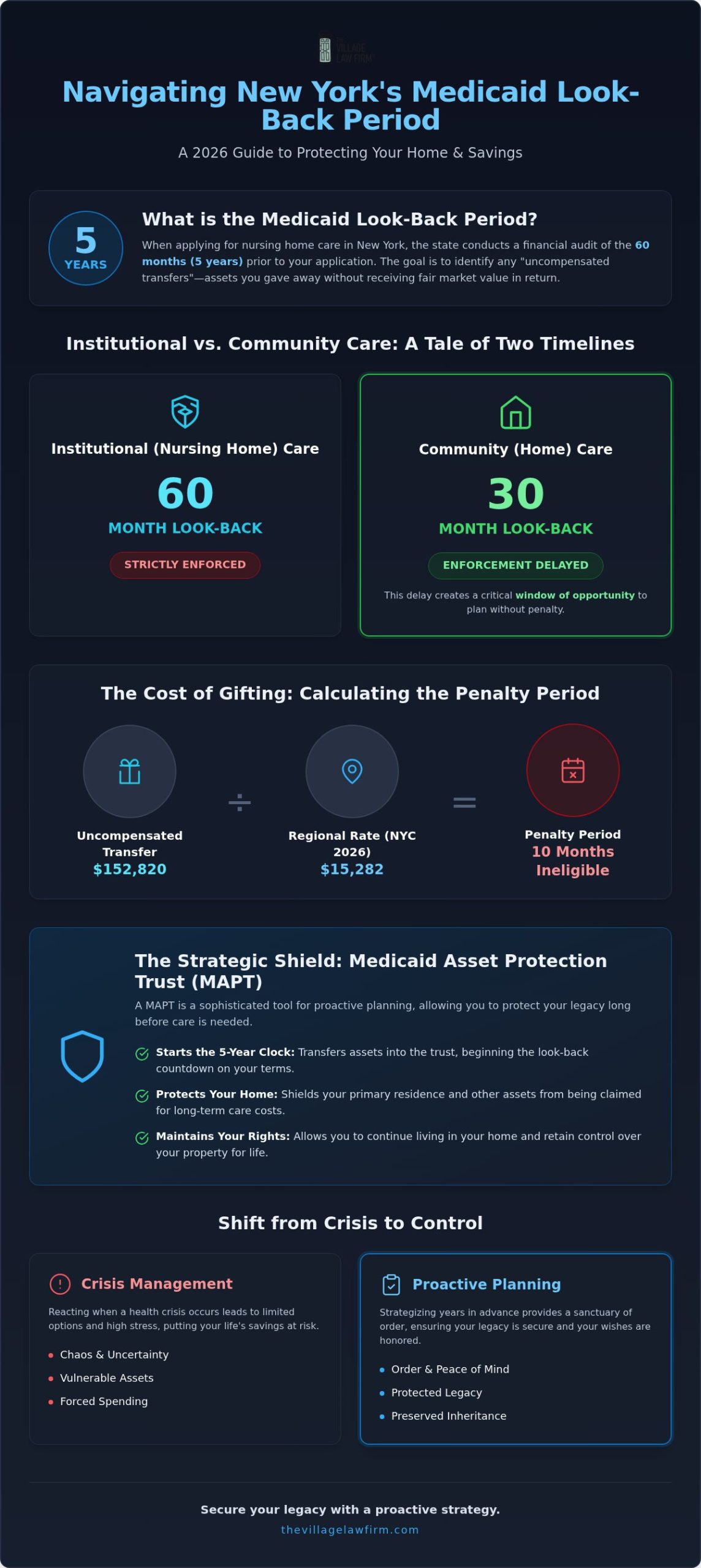
The Medicaid look-back period is essentially a financial audit conducted by the state when you apply for long-term care coverage. It’s a window of time, specifically the 60 months preceding your application, where the Department of Social Services examines every check you’ve written and every asset you’ve moved. In the context of the Medicaid look back period NY, officials are looking for “uncompensated transfers.” This is legal shorthand for giving away money or property without receiving fair market value in return. If you’ve gifted your home to your children or donated a significant sum to charity within this timeframe, the state may determine you’re ineligible for benefits for a specific duration.
Confusion often arises between the look-back period and the penalty period. Think of the Medicaid look back period NY as the investigation phase. It’s the search through your history. The penalty period, conversely, is the resulting period of ineligibility if they find transfers that violate the rules. Our role is to act as your steady guide through this meticulous process, replacing the chaos of uncertainty with a structured plan that protects your family’s future. We don’t just provide data; we offer a partnership that ensures every transaction is documented with the precision required to withstand state scrutiny.
The Purpose of the Five-Year Rule
New York enforces the five-year rule to ensure that individuals don’t simply divest themselves of all wealth the moment they require nursing home care. It’s a mechanism intended to preserve state resources for those who truly lack the means to pay. By understanding this rule early, you can start the “eligibility clock” long before care is necessary. Proactive planning allows you to move assets into protective structures today, so that five years from now, those assets are completely shielded from the high costs of institutional care. This transition from exposure to security is the foundation of a lasting legacy.
Calculating the Penalty Period
If a transfer is flagged, the state calculates a penalty using a specific formula. They take the total value of the uncompensated transfer and divide it by the “regional rate” for nursing home care. These rates change every year to reflect the rising costs of medical services. In 2026, the regional rate for New York City is $15,282. If you gave away $152,820, you would face a 10-month penalty period where you must pay for care out of pocket. This calculation determines exactly how many months of ineligibility you’ll face. It makes precision in your financial records absolutely vital for maintaining order during a stressful life transition.
Institutional vs. Community Medicaid: The 30-Month Debate
The distinction between institutional and community care is often the difference between a clinical facility and the comfort of your own living room. While the 60-month Medicaid look back period NY for nursing homes is a fixed reality, the rules for community care have been in a state of flux for years. This creates a sense of regulatory whiplash for many families. You want to stay home. You want to keep your NYC apartment or your family home in the suburbs. Understanding the 30-month debate is the first step toward creating a sanctuary of order amidst shifting legislation. We act as your steady guide, ensuring you don’t fall victim to the chaos of changing deadlines.
Current Status of NY Community Medicaid Rules
As of August 2026, the 30-month look-back for community-based long-term care remains in a unique state of suspension. Although the law has been enacted, it’s not currently being enforced by the Department of Social Services. This means that, for the moment, there is no penalty for transferring assets before applying for home care or other community services. It’s a critical window of opportunity. Transfers made before the eventual implementation date are expected to be “grandfathered” in, though the exact cutoff remains a moving target. This is why meticulous Medicaid planning is essential today. Waiting for the rule to be fully enforced often means losing the chance to protect your assets without penalty.
Strategic Advantages of Community Medicaid
Community Medicaid is the primary tool for New Yorkers who wish to age in place. It covers home health aides, personal care assistants, and adult day care, allowing seniors to remain in their familiar environments. The barrier to entry is significantly lower than that of institutional care. For an individual in 2026, the income limit is $1,836 per month, with an asset limit of $33,038. Because the 30-month look-back isn’t yet active, we can often implement “crisis management” strategies that wouldn’t be possible for nursing home care. This allows for a more flexible approach to asset protection. It’s about maintaining your independence while shielding your legacy from the high costs of private-pay home care. Professional guidance is the bridge between these complex rules and the long-term security your family deserves.
What Counts as a Transfer? Safeguarding Global Assets
When we discuss the Medicaid look back period NY, we’re specifically looking for uncompensated transfers. This technical term simply means giving away wealth without receiving something of equal value in return. It includes obvious moves like writing a large check to a family member, but it also encompasses more subtle actions like funding a trust or transferring a property deed. Many families worry that small gestures, like a holiday gift or a graduation present, will trigger a massive penalty. In reality, Medicaid caseworkers are generally looking for patterns of divestment rather than occasional, modest tokens of affection. The goal is to identify significant shifts in wealth that suggest an attempt to bypass care costs.
Establishing clarity around these transfers is the first step toward a secure legacy. We help you document every move with the precision required to satisfy state auditors. This replaces the stress of the unknown with a sanctuary of order. You don’t have to guess whether a past gift will haunt your application; we provide the directness and transparency needed to plan with confidence.
Common Transfer Pitfalls for NYC Families
For NYC families, the pitfalls are often found in well-intentioned gestures. Adding a child’s name to a bank account or a brownstone deed might seem like a simple way to help, but Medicaid views this as a gift of a partial interest. If this happens within the five-year window, it can create a period of ineligibility. Other common errors include:
- Selling property to a relative for less than its Fair Market Value (FMV).
- Transferring a vehicle title without a bill of sale reflecting the actual value.
- Engaging in uncoordinated gifting without a documented legal strategy.
This “chaos” of uncoordinated transfers often leads to a crisis when care is needed. By coordinating your gifting through a formal plan, you ensure that every transfer is intentional and protected.
Cross-Border Asset Considerations
Our expertise is particularly vital for the global citizens of New York. If you hold foreign real estate or offshore accounts, the complexity of the Medicaid look back period NY increases exponentially. Medicaid requires the disclosure of global assets. Failing to report an apartment in London or a family business in Tel Aviv can lead to severe eligibility delays. We specialize in International Estate Planning, ensuring that your cross-border transfers are handled with transparency. Reporting international transfers to local NY agencies requires meticulous documentation and specialized legal counsel. We act as your steady guide, bridging the gap between local requirements and your global portfolio to ensure your family’s future is shielded regardless of where your assets are located.
The Medicaid Asset Protection Trust (MAPT): A Sophisticated Shield
For many New Yorkers, the family home is more than just real estate. It’s an anchor of stability and the foundation of a legacy. However, under the 60-month Medicaid look back period NY, simply owning that home in your own name makes it a countable resource that could be depleted by the high costs of nursing home care. The Medicaid Asset Protection Trust (MAPT) serves as the gold standard for safeguarding this asset. It’s a sophisticated legal structure that allows you to start the five-year eligibility clock immediately while retaining the right to live in and enjoy your home for the rest of your life. This isn’t about hiding assets. It’s about utilizing a transparent, legal framework to replace the chaos of future uncertainty with a sanctuary of order.
A common point of confusion is the difference between revocable and irrevocable trusts. In the eyes of Medicaid, a revocable trust offers zero protection. Because you can “revoke” it and take the money back at any time, the state considers those funds fully available to pay for your care. To successfully navigate the Medicaid look back period NY, you must utilize an irrevocable trust. This specific designation is what removes the assets from your countable estate, effectively shielding them from being “spent down” on medical bills. To ensure these documents meet the rigorous standards of 2026 regulations, partnering with a seasoned Irrevocable Trust Attorney NYC is essential for meticulous execution.
Why an Irrevocable Trust is Necessary
The legal mechanism of an irrevocable trust works by technically relinquishing your individual ownership of the assets. While this sounds daunting, it’s actually a strategic partnership. You appoint a Trustee, often an adult child or a trusted family member, to manage the assets according to the rules you’ve established. This structure removes the assets from your personal balance sheet, which is exactly what Medicaid examines during the look-back audit. You maintain a sense of security because the trust is designed to benefit your heirs, ensuring the wealth you’ve built stays within the family. It’s a shift from “ownership” to “stewardship” that provides long-term protection.
Protecting the Family Home
One of the most significant benefits of the MAPT is its ability to prevent Medicaid from placing a lien on your property after you pass away. In New York, the state can often seek “estate recovery” to reimburse itself for the cost of your care. By placing the home in a trust, it’s no longer part of your probate estate, which shields it from these recovery efforts. Your home passes directly to your children or chosen beneficiaries, intact and unburdened. This emotional benefit cannot be overstated. Knowing your family’s legacy is anchored provides a level of peace that crisis-driven planning simply cannot match.
If you’re ready to move from anxiety to a position of strength, our team is here to help you design a custom Medicaid planning strategy that honors your hard work and protects your family’s future.
Proactive Planning vs. Crisis Management in New York
Planning for the future often feels like a luxury until it becomes an emergency. In New York, the difference between proactive strategy and crisis management is the difference between a peaceful transition and a frantic scramble. When you address the Medicaid look back period NY five years in advance, you’re building a fortress. You’re choosing order over the unpredictable chaos of a hospital-bed decision. Crisis management, while sometimes necessary, often limits your options and increases the emotional toll on your family. Proactive planning, conversely, allows you to dictate the terms of your legacy from a position of strength and clarity.
Our approach is rooted in transparency and meticulousness. We understand that busy professionals value efficiency and a high level of attention to detail. We don’t just fill out forms; we architect a sanctuary for your assets. This “white-glove” service ensures that every technical detail, from deed transfers to international reporting, is handled with precision. By partnering with a Medicaid Planning Attorney New York, you’re securing a guide who walks alongside you, replacing anxiety with a clear, logical path forward. We streamline the complex probate and Medicaid processes, allowing you to focus on what matters most: your family.
The Five-Year Window: Why Sooner is Better
The five-year window is your greatest asset. It provides the time necessary for the “clock” to run out on transfers, making your assets invisible to state auditors. 2026 is a critical time to review your plans. Legislative shifts are always on the horizon, and the current non-enforcement of certain community rules won’t last forever. Starting now ensures you’re protected before the next regulatory wave hits. There’s a profound peace of mind that comes from having a “shield” against future uncertainty. You won’t have to worry about the Medicaid look back period NY because the work will already be done, meticulously documented and legally sound.
Starting Your Journey to Security
Initiating a consultation is the first step in replacing anxiety with a methodical plan. It’s a shift from worrying about “what if” to knowing “what is.” During your first session, we conduct a comprehensive legacy audit. This isn’t just a financial review; it’s a deep dive into your goals for your children and your home. To make the most of this session, you should bring:
- Current deeds for all real estate holdings, including international properties.
- Recent statements for investment accounts and retirement funds.
- Details of any significant gifts or transfers made in the last five years.
- Your existing estate planning documents for a thorough gap analysis.
This organized approach ensures nothing is left to chance. We provide the technical precision and human touch needed to bridge the gap between today’s complexity and tomorrow’s security. Your legacy is too important to leave to the chaos of a crisis. Start your journey to a secure future today.
Securing Your Family’s Future Today
Mastering the Medicaid look back period NY is about more than just numbers; it’s about preserving the sanctuary of order you’ve spent a lifetime building. By utilizing sophisticated tools like the Medicaid Asset Protection Trust and understanding the current window of opportunity for community care, you can shield your home and global assets from the unpredictability of long-term care costs. We replace the stress of legal complexity with a methodical, “white-glove” strategy tailored to your unique family dynamics. This proactive approach ensures that your hard-earned wealth remains a legacy for your children rather than a payment to a facility.
At The Village Law Firm, we bring a calming, high-end approach to complex New York law. Our team offers specialized expertise in cross-border estate administration and dedicated strategies for protecting the next generation. We don’t just provide legal advice; we offer a partnership that ensures your legacy remains anchored and secure. You’ve worked too hard to leave your family’s inheritance to the chaos of a last-minute crisis.
Schedule a sophisticated strategy session with The Village Law Firm to protect your legacy.
Your journey toward total peace of mind starts with a single proactive step. Let’s begin building your shield today.
Frequently Asked Questions
Does New York have a look-back period for home care in 2026?
As of August 2026, New York has passed a 30-month look-back rule for community-based care, but it’s not currently enforced. This creates a critical window for families to engage in proactive planning. You can still transfer assets to qualify for home care without a penalty today. However, this situation is fluid. Monitoring the Medicaid look back period NY updates is essential to ensure your strategy remains valid before the state begins full implementation.
Can Medicaid take my home if I am in a nursing home in NY?
Medicaid generally can’t take your primary residence while you’re living in it, but they can place a lien on the property or seek recovery from your estate after you pass away. If the home equity is below $1,130,000 in 2026, it may be exempt for eligibility, but it remains vulnerable. Utilizing a Medicaid Asset Protection Trust prevents this by moving the home out of your probate estate entirely, providing a sanctuary for your legacy.
What is the regional rate for Medicaid in New York City for 2026?
The regional rate for New York City in 2026 is $15,282 per month. This figure is a cornerstone of planning because it’s used to calculate the length of your penalty period. If you transferred $152,820 during the Medicaid look back period NY, the state divides that amount by $15,282. This results in exactly 10 months of ineligibility for nursing home coverage. You’d need to pay privately during that time before benefits begin.
Can I give $15,000 to my children without affecting Medicaid eligibility?
No, Medicaid doesn’t recognize the IRS annual gift tax exclusion. While you can give away certain amounts without filing a gift tax return, any amount given for less than fair market value is an uncompensated transfer. If these gifts occur within the 60-month window, they trigger a penalty period. Every dollar counts when state auditors review your financial history. We help you distinguish between modest gifts and transfers that create legal chaos.
How does an irrevocable trust protect me from the look-back period?
An irrevocable trust protects you by legally removing assets from your countable estate. Once you transfer your home or savings into the trust, the 60-month clock begins. After this period concludes, those assets are no longer considered yours for Medicaid eligibility purposes. This sophisticated structure provides a sanctuary of order, ensuring that even if you require care later, the wealth you’ve placed in the trust remains shielded for your children and loved ones.
What happens if I need a nursing home before the 5-year look-back is over?
If you require institutional care before the five-year window closes, you’ll likely face a penalty period of ineligibility. The state calculates this by dividing the total value of assets transferred by the regional rate. During this period, you must find other ways to pay for care, such as private funds or insurance. We often use crisis management tools to mitigate the impact of these penalties, replacing fear with a methodical and reassuring solution.
Are foreign assets included in the New York Medicaid look-back?
Yes, New York Medicaid requires the disclosure of all global assets, including foreign real estate and offshore bank accounts. Many global citizens mistakenly believe that property held abroad is invisible to local agencies. In reality, failing to report these assets can lead to a denial of benefits. Specialized cross-border planning is necessary to ensure your international portfolio is integrated into your Medicaid strategy with total transparency and meticulous attention to every technical detail.
Who should be the trustee of my Medicaid Asset Protection Trust?
The trustee should be someone you trust implicitly, such as an adult child or a sibling, but it can’t be you or your spouse. Choosing a trustee is a significant decision that moves your plan from a transactional document to a long-term partnership. The trustee manages the assets for the benefit of your heirs while you retain the right to live in your home. This role requires meticulous attention to detail and unwavering integrity.