
In the high-stakes environment of New York, your professional success can ironically become your greatest financial vulnerability. You have spent decades building a legacy with meticulous care, yet a single high-claim lawsuit or an unexpected creditor could threaten to dismantle it all in an instant. It’s a heavy burden to carry, especially when the state’s strict rules around self-settled trusts make the path to security feel narrow and complex.
We understand that you aren’t just looking for a legal document; you are seeking a shield for your family’s future and the peace of mind that comes with knowing your work is safe. This guide will show you exactly how a sophisticated creditor protection trust New York professionals use can create an airtight barrier between your personal wealth and professional liability. You’ll learn how to navigate the 2026 estate tax landscape and utilize irrevocable structures that offer both stability and control. By the end of this article, you will have a clear, partner-led roadmap to replacing anxiety with a sense of absolute security.
Key Takeaways
- Discover why an irrevocable structure acts as a vital legal firewall, protecting your lifetime of work from the unpredictable nature of New York’s litigious professional environment.
- Learn how a creditor protection trust New York can strategically separate asset ownership to ensure your family’s wealth remains beyond the reach of future lawsuits.
- Understand the nuances of Medicaid Asset Protection Trusts and how they shield your most valuable assets, like your home, from the escalating costs of long-term care.
- Master the critical steps of funding your trust and navigating the five-year look-back period to establish a truly resilient barrier against financial threats.
- Gain clarity on how a partner-led, white-glove legal process removes complexity and provides the meticulous attention to detail your legacy deserves.
Why New York Professionals Prioritize Creditor Protection Trusts in 2026
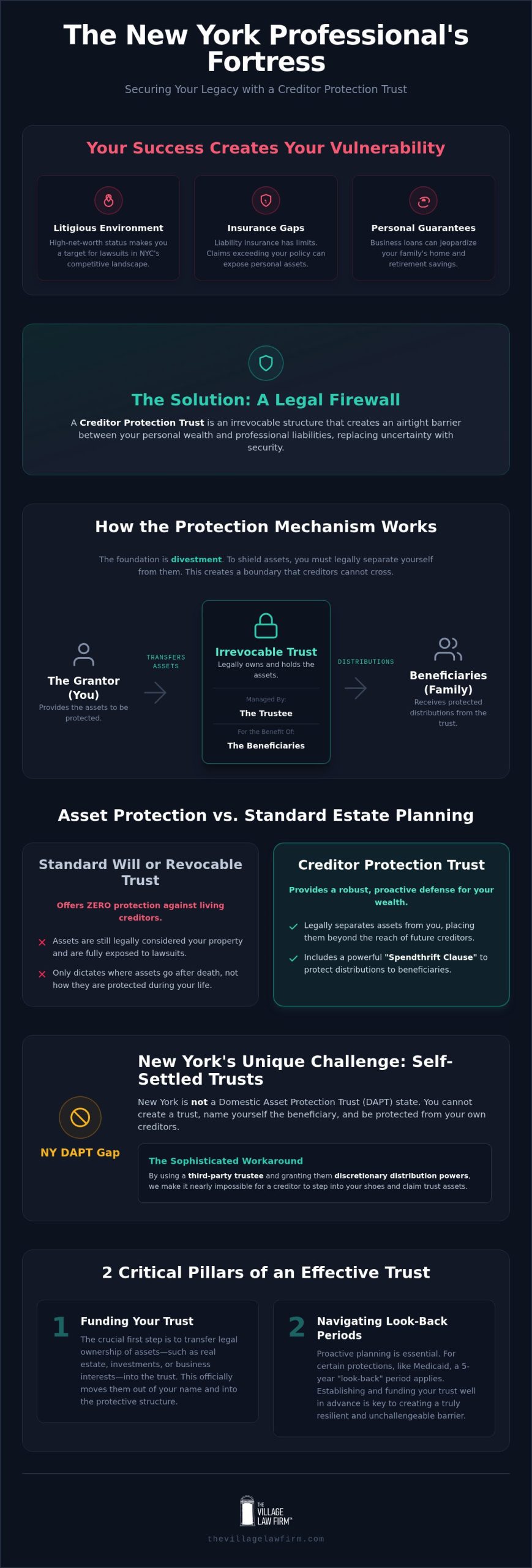
You’ve worked with relentless focus to build your career and your legacy in New York. However, high-net-worth status often brings a target you didn’t ask for. A Asset-protection trust acts as a sophisticated legal firewall, separating your personal wealth from the reach of future litigants. Unlike simple savings accounts or basic joint ownership, a creditor protection trust New York professionals rely on creates a clear boundary between your hard-earned achievements and potential liabilities. It replaces the chaos of legal uncertainty with a meticulously structured sanctuary of order.
The Litigious Reality of NYC High-Risk Professions
In the fast-paced corridors of Manhattan and Brooklyn, professionals like surgeons, architects, and developers face unique risks. While you likely carry professional liability insurance, it often has ceilings that don’t account for the astronomical claims common in 2026. If a claim exceeds your policy limit, your personal assets are the next stop for a judgment creditor. Many business owners also find that personal guarantees on commercial loans can jeopardize their family’s primary residence. Without a proactive strategy, your home and retirement funds are essentially exposed. High-net-worth individuals are often viewed as deep-pocketed targets for frivolous claims; this makes a robust defense essential rather than optional. For professionals who encounter corporate or federal misconduct, you can learn more about your options through Piacentile & Associates LLP. We view insurance as your primary defense, but a trust is your ultimate safeguard when those primary lines are breached.
Asset Protection vs. Simple Estate Planning
Many people mistakenly believe a standard Will or a basic revocable trust provides security against lawsuits. It doesn’t. A Will only dictates where assets go after you’ve passed away; it offers zero protection against living creditors. To truly safeguard your wealth, you need a structure that includes a “Spendthrift Clause.” This specific provision prevents creditors from attaching themselves to future distributions, ensuring the money stays within the family.
Moving toward a creditor protection trust New York requires transitioning from a transactional mindset to a long-term protective partnership. You aren’t just filing paperwork. You’re building a shield that grows with your career and adapts to the changing legal landscape. This shift provides the emotional intelligence to handle complex family dynamics while maintaining the technical precision required to keep creditors at bay. By choosing this path, you replace the weight of “what if” with the confidence of a well-defined plan.
How the New York Asset Protection Trust Mechanism Works
The foundation of a creditor protection trust New York rests on the principle of divestment. To shield your assets, you must technically step away from owning them. This architecture involves three distinct roles: the Grantor, who provides the assets; the Trustee, who manages the property; and the Beneficiary, who receives the benefits. Under the New York Estates, Powers and Trusts Law (EPTL), this separation creates a legal boundary that prevents a personal judgment from automatically reaching into the trust’s holdings. By moving assets into an irrevocable structure, you’re choosing permanence as your primary defense. Once the transfer is complete, those assets are no longer yours in the eyes of the law; they belong to the trust.
The ‘NY DAPT Gap’: Understanding Self-Settled Trusts
A critical challenge for local professionals is that New York is not a “DAPT state.” Unlike Nevada or South Dakota, New York law generally holds that any trust you create for your own benefit is void as to the settlor’s creditors. This means you cannot simply put money in a trust, name yourself the sole beneficiary, and expect to be safe from lawsuits. To navigate this gap, we utilize sophisticated workarounds like third-party trustees and discretionary distribution powers. By ensuring you don’t have an absolute right to the funds, we make it nearly impossible for a creditor to step into your shoes. Working with an Irrevocable Trust Attorney NYC allows you to structure these vehicles with the technical precision required to survive a courtroom challenge while still providing for your family’s long-term needs.
The Mechanics of the Spendthrift Provision
The spendthrift provision is the engine of your trust’s security. It acts as a legal set of “handcuffs” that prevents a beneficiary from pledging their interest in the trust to a third party. More importantly, it stops a creditor from seizing those assets before they reach the beneficiary. In 2026, we draft these provisions with maximum discretion. This allows the Trustee to completely withhold distributions if they sense a legal threat is looming. There’s a vital distinction between protecting the principal and protecting the income; a well-drafted trust shields both. When a trust is managed with this level of meticulousness, it creates a sanctuary of order that remains untouched by the chaos of professional litigation. If you’re ready to explore these structures, consider how a partnership-based approach can clarify your path forward.
Domestic, Medicaid, and International Trusts: Choosing for New York
Not all protective vehicles are created equal. In 2026, choosing the right structure depends entirely on your specific vulnerabilities and long-term goals. For many, a creditor protection trust New York professionals establish is a domestic irrevocable trust designed to maximize local tax benefits, such as the $7,350,000 state estate tax exclusion. Some individuals explore Domestic Asset Protection Trusts (DAPTs) in states like South Dakota or Nevada. You must be cautious here; the “Full Faith and Credit” clause of the U.S. Constitution creates a legal debate about whether a New York judge can reach assets held in another state’s trust. When the level of professional risk is exceptionally high, an offshore jurisdiction may offer the near-total separation required to ensure legal resilience.
Medicaid Planning for the New York Home
Your home is likely your most significant asset and the cornerstone of your family’s legacy. In 2026, New York’s Medicaid asset limit for an individual remains incredibly low at $33,038. Without a Medicaid Asset Protection Trust (MAPT), a lifetime of equity could be consumed by nursing home costs that now average over $15,500 per month in the New York City area. By structuring a trust properly, you can preserve the home for your children while still qualifying for essential care. It’s about more than just financial numbers. It’s about the deep emotional relief that comes from knowing your family’s sanctuary won’t be sold to pay for long-term care. Partnering with a Medicaid Planning Attorney New York allows you to navigate the mandatory five-year look-back period with the meticulous care your estate deserves.
International Assets and Cross-Border Protection
For global citizens, the complexity of wealth protection increases exponentially. Managing foreign real estate or international bank accounts requires a framework that respects both New York law and the tax treaties of other nations. We provide specialized expertise in International Estate Planning, ensuring your global holdings are integrated into a single, cohesive protective strategy. This white-glove approach removes the chaos of multi-jurisdictional rules, replacing it with a streamlined path to security. You shouldn’t have to feel anxious about the unpredictability of foreign legal systems. A sophisticated creditor protection trust New York acts as a bridge, securing your assets whether they’re located in Manhattan or across the globe.
5 Critical Steps to Funding and Maintaining Your NY Trust
Creating your trust document is only the first step toward security. Without proper funding, a creditor protection trust New York professionals rely on is merely a “fancy folder” with no legal power to shield your wealth. To transform that document into an active fortress, you must move your assets inside its legal walls. This process requires a level of meticulousness that mirrors the precision of your own professional life. If you leave the trust empty or fail to respect the administrative formalities, a court can easily set it aside, leaving your legacy exposed to the very risks you sought to avoid.
Properly Retitling Your NYC Assets
Funding involves the formal transfer of ownership for every asset you intend to protect. This means retitling real estate deeds, updating brokerage accounts, and assigning LLC interests to the trust’s name. It’s a methodical process that leaves no room for error. One common mistake is “commingling,” where a Grantor continues to use trust funds for personal expenses as if the transfer never happened. If you treat the trust like a personal piggy bank, a judge will likely do the same, shattering your asset shield. Choosing a professional or neutral third-party Trustee instead of a family member often adds a layer of credibility that is difficult for creditors to penetrate. This separation of control is the hallmark of a white-glove protective strategy.
Avoiding the Fraudulent Transfer Trap
Timing is everything when it comes to legal resilience. Under New York law, a “fraudulent conveyance” occurs if you transfer assets into a trust with the intent to hinder, delay, or defraud a known creditor. To survive a challenge, you must pass a “Solvency Test” at the time of the transfer. This means you must retain enough wealth outside the trust to satisfy your current obligations. If you wait until a lawsuit is filed or a malpractice claim is imminent, the transfer is highly vulnerable to being undone. Establishing a “peace of mind” timeline is essential. For example, New York’s five-year look-back period for Medicaid eligibility remains a strict requirement in 2026 for those seeking to protect their home from nursing care costs. The best time to start this process was yesterday; the next best time is now. If you’re ready to secure your assets with precision, contact The Village Law Firm to begin your partnership-led planning journey.
Securing Your Legacy with The Village Law Firm’s White-Glove Approach
Living and working in New York requires a unique level of resilience. You’ve navigated the complexities of your career with skill, but the legal landscape shouldn’t feel like another obstacle to overcome. At The Village Law Firm, our philosophy is rooted in the idea of providing a legal sanctuary. We act as your steady urban guide, transforming the high-velocity chaos of professional liability into a structured environment of order and calm. By establishing a creditor protection trust New York professionals can trust, we help you build a bridge between the unpredictability of the city and the long-term security of your family.
We understand that your time is your most valuable asset. Our partner-led process is specifically designed for busy professionals who demand efficiency without sacrificing technical precision. You won’t find a transactional atmosphere here. Instead, you’ll experience a high-end, white-glove service that prioritizes a deep emotional understanding of your goals. We don’t just hand you a document and walk away; we remain committed to your security as your life and the legal environment evolve. This ongoing partnership ensures that your protective structures remain as resilient as the legacy they’re designed to defend.
Estate Planning for Families with Children
When you have children, the stakes of your planning reach far beyond your own professional career. It’s about ensuring that the world you’ve built for them remains intact, no matter what external threats arise. We specialize in integrating creditor protection with essential guardianship provisions and minor’s trusts. This holistic approach is detailed in our NYC Estate Planning Parent’s Guide, which outlines how to secure a child’s future in an unpredictable city. A creditor protection trust New York families utilize can do more than shield your assets today; it can protect your children’s inheritance from their own future ex-spouses or potential creditors. We help you create a barrier that keeps their legacy safe from the volatility of life.
The Sophisticated Urban Guide
Our commitment to you is built on honesty, openness, and the complete removal of complex legalese. We believe that true expertise is demonstrated through clarity, not through hiding behind dense terminology. You deserve a legal partner who walks alongside you with compassion and unwavering integrity. We provide the technical precision required for high-stakes asset protection while maintaining a deeply human touch. If you’re ready to replace anxiety with a sense of absolute security, we’re here to lead the way. You can take the first step toward a more certain future today. Schedule your initial strategy call with The Village Law Firm to begin your journey toward proactive protection.
Building Your Sanctuary of Financial Order
You’ve worked too hard to leave your legacy to chance. By understanding the unique limitations of local law and the necessity of irrevocable structures, you’ve taken the first step toward true security. We’ve explored how a properly funded trust acts as a legal firewall, protecting your home and international assets from the unpredictability of a litigious city. Navigating the 2026 legal landscape requires more than just a document; it requires a partner who understands the nuances of a creditor protection trust New York professionals need to thrive.
At The Village Law Firm, we bring a meticulous, white-glove approach to every legacy we protect. Whether you’re managing complex cross-border assets or securing your family’s primary residence, our team provides the technical precision and emotional intelligence your future deserves. We pride ourselves on being a steady urban guide for busy professionals, replacing complexity with clarity and anxiety with peace of mind.
Secure your financial future; schedule a strategy call with The Village Law Firm today.
You have built something extraordinary. Now, let’s ensure it stays protected for generations to come.
Frequently Asked Questions
Can a creditor protection trust in New York protect my primary residence?
Yes, an irrevocable trust is a powerful tool for safeguarding your home. By transferring the deed into a creditor protection trust New York professionals use, you ensure the property is no longer in your name and thus unreachable by future judgment creditors. This is especially vital for Medicaid planning, where a home might otherwise be sold to cover nursing care. It provides a sanctuary of order for your family’s most important asset.
How much control do I lose over my assets once they are in an irrevocable trust?
You must relinquish direct legal ownership and the power to unilaterally dissolve the trust. While this sounds daunting, you can still receive benefits as a beneficiary or influence management through a carefully selected trustee. The loss of control is the trade-off for legal resilience. Think of it as placing your wealth behind a protective shield that you cannot simply lower on a whim, ensuring long-term stability for your legacy.
Is there a ‘look-back’ period for creditor protection in New York?
Yes, the most well known is the five-year look-back period for Medicaid eligibility. For general creditors, New York law allows creditors to challenge transfers made with the intent to defraud, often within a four-year window. This is why proactive planning is essential. You cannot wait for a legal storm to gather; you must build your defenses while the skies are clear to ensure the structure remains airtight and legally sound.
Can I be my own trustee for a New York asset protection trust?
You should generally avoid serving as your own trustee if your goal is robust asset protection. New York law is quite strict regarding self-settled trusts. If you maintain total control over the assets, a court may decide the trust is your “alter ego” and allow creditors to pierce the shield. Utilizing an independent or professional trustee provides the necessary legal separation to keep your wealth secure from professional liabilities and future lawsuits.
What is the difference between a revocable trust and an asset protection trust?
A revocable trust is primarily a tool for probate avoidance and privacy; it doesn’t offer protection from creditors because you still own the assets. An asset protection trust is irrevocable, meaning you’ve permanently moved assets out of your personal estate. This legal divestment is what creates the barrier against lawsuits. While a revocable trust offers flexibility, only an irrevocable creditor protection trust New York provides the sanctuary of security you truly need.
How does a Medicaid Asset Protection Trust differ from a general creditor trust?
A Medicaid Asset Protection Trust (MAPT) is specifically designed to help you qualify for long-term care while preserving your home for your children. It’s subject to the rigorous five-year look-back period. A general creditor trust focuses on shielding you from professional malpractice or business lawsuits. While both use irrevocable structures, the MAPT requires specific language to satisfy state health department rules while maintaining your right to live in your home during your lifetime.
Can a New York trust protect assets located in other countries?
Yes, a New York trust can be structured to include international assets, though it requires sophisticated cross-border coordination. You’ll need to ensure the trust complies with both New York law and the tax treaties of the foreign jurisdiction where the assets are held. This is where a partner-led, white-glove approach becomes invaluable. We help you manage these global complexities, ensuring your international legacy remains just as secure as your domestic holdings in Manhattan.
What happens if I set up a trust after I have already been served with a lawsuit?
If you transfer assets after being served, a court will likely view it as a fraudulent conveyance. Creditors have the legal right to ask a judge to undo the transfer, effectively “clawing back” the assets into your personal name for seizure. Asset protection is a proactive strategy, not a reactive one. To be effective, your shield must be in place long before a specific legal threat or claim is even on the horizon.