
What if the family home you’ve spent a lifetime building could be lost to nursing home costs because of a single, well-intentioned financial gift? For many New York professionals, the Medicaid look back period NY feels less like a regulation and more like a looming threat to everything they’ve worked to achieve. You likely feel the weight of this complexity, especially with the persistent talk of 30-month rules for home care. It’s natural to worry that a simple mistake today could lead to a massive penalty tomorrow, leaving your family’s legacy vulnerable to the rising costs of long-term care.
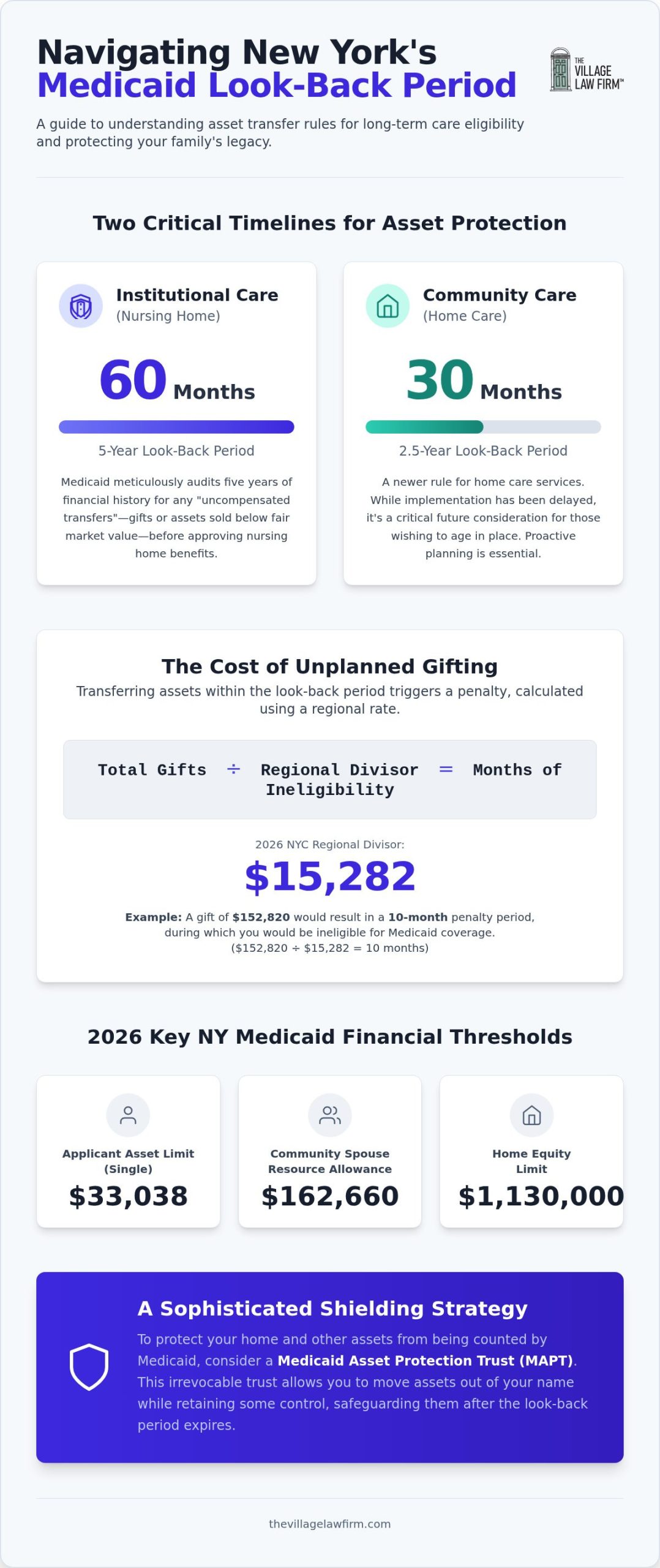
We’re here to replace that anxiety with the clarity of a sophisticated, meticulously crafted plan. You’ll gain a comprehensive understanding of how current 2026 regulations affect your specific assets, from the $1,130,000 home equity limit to the $15,282 NYC regional divisor used to calculate penalty periods. This guide provides a clear timeline for asset transfers and a framework for eligibility that protects your family legacy. We’ll walk through the five-year institutional window and the evolving status of community care rules, ensuring you move forward with the confidence of a partner who has already mapped the path ahead.
Key Takeaways
- Identify how the Medicaid look back period NY reviews five years of financial history to ensure your nursing home care application remains penalty-free.
- Distinguish between the 60-month institutional review and the 30-month community look-back rules to plan effectively for both home care and residential facilities.
- Calculate potential penalty periods using the 2026 New York City regional rate of $15,282 to understand the true impact of asset transfers.
- Explore sophisticated shielding techniques like the Medicaid Asset Protection Trust (MAPT) to safeguard your family home and long-term legacy.
- Replace the complexity of state regulations with a structured, professional framework that provides long-term security for your estate.
What is the Medicaid Look Back Period in New York?
The Medicaid look back period NY is a retrospective review of your financial history. When you apply for benefits through the Medicaid program, the state examines every transfer, gift, or sale of assets to ensure you didn’t intentionally impoverish yourself. Its primary purpose is to prevent individuals from giving away their wealth to family members just to qualify for public assistance. In New York, this review is rigorous. It requires a level of meticulous documentation that can feel overwhelming without a clear roadmap. It’s not just about the big numbers; even small, recurring gifts can trigger questions during the audit process.
The 60-Month Institutional Rule
If your goal is to secure a place in a high-end nursing facility, you must account for a five-year planning horizon. This 60-month window is the duration Medicaid examiners use to audit your records. They look for “uncompensated transfers,” which include everything from large checks written to relatives to the deed of a family home transferred to a child. Examiners scrutinize bank statements, brokerage accounts, and property records with clinical precision. They are looking for any evidence that assets were moved for less than fair market value. The 60-month rule remains the gold standard for NYC estate protection, demanding a meticulous and proactive approach to asset preservation. Failing to plan within this window often results in a penalty period where you must pay out of pocket for care that could have been covered.
The 30-Month Community Look-Back Update
For those who prefer to age in place, the landscape is shifting. Historically, New York allowed “community” or home care Medicaid without a look-back period. However, following the Medicaid Redesign Team (MRT) II proposals, a 30-month look-back for home care was enacted. As we move through 2026, the implementation of this rule has faced several administrative delays, yet it remains a looming reality for any long-term strategy. For NYC apartment owners, this change is a significant game-changer. It means the equity in your co-op or condo is no longer instantly protectable. You must now consider a two-and-a-half-year lead time before applying for home care services if you intend to transfer ownership to the next generation. This uncertainty makes early partnership with a professional essential to maintaining control over your living situation and your legacy.
Comparing Institutional vs. Community Medicaid in 2026
Institutional and community programs represent two distinct paths for long-term care in New York. While institutional Medicaid provides for high-level clinical care in a residential facility, community Medicaid focuses on Managed Long-Term Care (MLTC) to assist with daily living in your own home. The planning timelines for these programs differ drastically, requiring a strategic approach that respects the nuances of New York State Medicaid rules. In the high-stakes environment of NYC real estate and finance, understanding these distinctions is the first step toward a secure legacy.
Nursing Home Medicaid Requirements
To qualify for institutional care, an applicant must meet a functional “Level of Care” requirement, typically determined by a clinical assessment of their physical and cognitive needs. In 2026, the asset limit for a single applicant is $33,038. For married couples, the “Community Spouse” role is vital for asset preservation. The spouse staying at home can retain a maximum resource allowance of $162,660. This provision is designed to prevent the total depletion of family wealth, ensuring the non-applicant spouse isn’t left in financial ruin. Meticulous planning ensures these thresholds are met without sacrificing your family’s standard of living.
Home Care and Community-Based Services
MLTC plans are the primary vehicle for home care across the five boroughs, offering a way for seniors to age in place with dignity. The much-discussed 30-month Medicaid look back period NY for community services remains a point of significant focus for NYC families. Although the law was enacted years ago, as of early 2026, it’s still not being actively enforced for community-based applications. This creates a unique, albeit temporary, window for those who need to move assets quickly. However, relying on continued delays is a risky strategy. Proactive planning for home care has become the new priority for NYC seniors who want to avoid the stress of sudden regulatory shifts.
NYC’s high cost of living complicates the “spend down” strategy significantly. When income exceeds the $1,836 monthly limit for community care, New Yorkers often use Pooled Income Trusts to protect their surplus income for essential living expenses like rent or utilities. This approach transforms “countable” income into a tool for maintaining a high-quality lifestyle while still qualifying for necessary care. For those managing high-value estates, engaging in sophisticated Medicaid planning is the most effective way to navigate these diverging rules and maintain a sense of order amid the complexity.
Calculating the Penalty Period: The Cost of Unplanned Gifting
A penalty period is not a financial fine in the traditional sense. Instead, it’s a duration of time during which Medicaid will not pay for your care, even if you are otherwise eligible. This period is triggered when you transfer assets for less than fair market value during the Medicaid look back period NY. For many families, this realization comes too late, often after a well-meaning gift has already been made. Understanding the mechanics of this delay is essential for anyone looking to preserve their financial stability while securing long-term care.
The calculation is a straightforward but impactful piece of math. You take the total value of all uncompensated transfers made within the look-back window and divide it by the regional average private-pay nursing home rate. Because New York is geographically diverse, these regional rates vary significantly. New York City’s rate is historically the highest in the state, reflecting the premium cost of care in the five boroughs. This means the math for a Brooklyn resident differs greatly from someone in Western New York, where the 2026 regional rate is only $13,765.
Common mistakes often involve “uncompensated transfers” that families don’t view as traditional gifts. Helping a grandchild with law school tuition, providing a generous wedding present, or even titling a car in a relative’s name can all be flagged. Medicaid examiners don’t distinguish between a gift made out of love and one made to hide assets. They simply see a reduction in your net worth that occurred without you receiving something of equal value in return.
How New York Calculates Regional Rates
For 2026, the regional rate for New York City is $15,282. This figure serves as the “divisor” for your penalty math. If you gifted $100,000 to a family member, Medicaid would divide that $100,000 by $15,282, resulting in a penalty period of approximately 6.54 months. During those six and a half months, you would be responsible for the full cost of your care. Even small, well-intentioned gifts can trigger a comprehensive audit of your financial history. This makes meticulous record-keeping a necessity for any NYC professional.
Exempt Transfers: What Medicaid Doesn’t Penalize
Fortunately, not every transfer triggers a penalty. New York law allows for specific “exempt” transfers that protect family interests. Transfers made to a spouse or to a child who is blind or permanently disabled are generally exempt from the look-back rules. These provisions ensure that vulnerable family members aren’t left without support due to your care needs.
The “Caretaker Child” exception is a particularly powerful tool for NYC families. If a child lived in your home for at least two years prior to your institutionalization and provided care that allowed you to remain at home, you may be able to transfer the deed to them without penalty. Similarly, a sibling who has an equity interest in the home and has resided there for at least one year may also qualify for an exempt transfer. These exceptions provide a sophisticated framework for protecting the family home, provided the documentation is handled with precision.
Sophisticated Strategies for Medicaid Asset Protection
Protecting high-value assets in the five boroughs requires more than just spending down cash on basic expenses. It requires a structural shift in how your wealth is held to ensure long-term security. By implementing a “Start the Clock” strategy today, you ensure that the five-year Medicaid look back period NY begins as soon as possible. This proactive approach is the difference between a secure legacy and a frantic search for solutions during a health crisis. Working with a specialized irrevocable trust attorney NYC allows you to build a shield around your property that stands up to the most rigorous state audits. You’re not just qualifying for a program; you’re preserving a lifetime of achievement with meticulous care.
The Medicaid Asset Protection Trust (MAPT)
The Medicaid Asset Protection Trust (MAPT) is the premier vehicle for New Yorkers. When you transfer your home into an MAPT, you effectively start the five-year clock while retaining the legal right to live in your residence for the rest of your life. This trust is designed to be irrevocable, meaning it removes the asset from your “countable” estate. Crucially, a properly drafted trust ensures the property avoids Medicaid Estate Recovery after death, preserving the full value of your NYC real estate for your heirs.
Promissory Notes and Annuities
For those who didn’t plan five years in advance, the “Half-a-Loaf” strategy offers a sophisticated alternative. This involves gifting a portion of assets and using the remainder to purchase a Medicaid-compliant annuity or a promissory note. The income from these tools pays for care during the penalty period triggered by the gift. These mechanisms are technically complex and require precise legal drafting to avoid IRS scrutiny. They act as a bridge from chaos to order when time is not on your side.
International Assets and Cross-Border Considerations
High-net-worth New Yorkers often hold wealth across borders, which must be integrated into your international estate planning strategy. During the five-year audit of the Medicaid look back period NY, Medicaid requires full transparency regarding global holdings, including foreign real estate. Failure to report a flat in London or a bank account in Tel Aviv can result in immediate disqualification. We help you navigate these global complexities, ensuring your international footprint doesn’t become a liability during the application process.
To begin securing your family’s future and shielding your property from future uncertainty, you can schedule a consultation for Medicaid planning with our team today.
The Village Law Firm: A Reassuring Partner in Medicaid Planning
The transition from a high-stakes professional life to long-term care planning shouldn’t feel like a loss of control. While the technicalities of the Medicaid look back period NY often create a sense of chaos, we specialize in replacing that unpredictability with a structured, calming plan. Our white-glove approach to NYC estate and Medicaid administration is designed for busy professionals who value efficiency and meticulous attention to detail. We don’t just provide legal advice; we offer a sanctuary of order. By partnering with us, you transform a complex state requirement into a well-defined journey toward long-term stability. This isn’t just about financial eligibility. It’s about maintaining the lifestyle and legacy you’ve spent decades building.
A Shield Against Future Uncertainty
We walk alongside NYC families through every stage of the rigorous audit process. The 60-month institutional review requires a level of document gathering that can feel intrusive and overwhelming. Our team takes the lead, ensuring every bank statement, property deed, and gift record is organized with clinical precision. We understand that transparency and directness are essential when dealing with the Department of Social Services. By acting as your shield, we filter the complexity and handle the meticulous details of the five-year review, allowing you to focus on your family’s well-being. Our commitment to unwavering integrity means you’ll always have a clear, honest assessment of your standing and your options.
Your Next Step Toward Security
Proactive planning is a profound gift to your children. By executing a strategy now, you spare them the stress of a crisis-driven “spend down” or the fear of losing the family home to nursing home costs. We tailor our Medicaid planning attorney New York services to your specific family dynamics, accounting for everything from international holdings to NYC-specific real estate nuances. We move you from a state of worrying about “what if” to the confidence of knowing “it’s handled.” This partnership mindset ensures that your legacy is protected by a framework that is both legally sophisticated and deeply human.
Securing your family’s future requires a steady guide who understands the fast-paced nature of New York life. Don’t wait for a change in health to dictate your financial destiny. Take the first step toward a meticulously ordered legacy by choosing a partner dedicated to your long-term security. Secure your family’s future with a consultation today.
Securing Your Legacy with Clarity and Precision
Navigating the Medicaid look back period NY doesn’t have to be a source of constant anxiety. By understanding the 60-month institutional window and the evolving 30-month community rules, you’ve already taken the first step toward order. You now know how the $15,282 NYC regional rate dictates penalty periods and why tools like the Medicaid Asset Protection Trust are essential for urban professionals. This knowledge is your foundation for protecting what you’ve worked so hard to build.
True security comes from the meticulous execution of these strategies. Our specialized NYC Medicaid expertise and white-glove service ensure your family home remains a sanctuary, not a liability. We provide the compassionate legacy protection you deserve, replacing complexity with a clear, actionable roadmap. It’s time to transition from uncertainty to confidence. Schedule a sophisticated Medicaid planning consultation with The Village Law Firm today. Your future self and your heirs will thank you for the foresight and stability you provide right now.
Frequently Asked Questions
Is the 30-month look-back for NY home care finally in effect in 2026?
As of early 2026, the 30-month look-back for community-based services is not yet being actively enforced. While the law remains on the books, administrative delays have kept the “no look-back” status for home care in place for now. This creates a temporary window for families to secure services without a review of past transfers. You should verify the current enforcement status with a professional before filing your application to ensure your plan remains secure.
Can Medicaid take my home if I live in New York City?
Medicaid won’t take your home while you’re living in it, provided your equity is below the 2026 limit of $1,130,000. However, without a Medicaid Asset Protection Trust, the state may seek “estate recovery” after your passing to reimburse the cost of your care. Protecting your residence requires proactive planning to ensure it passes to your heirs rather than the state. It’s a vital step for preserving your family legacy in a high-value real estate market.
What happens if I gave money to my grandchildren within the last five years?
Gifts to grandchildren are considered uncompensated transfers and will trigger a penalty period for institutional care. During the Medicaid look back period NY, examiners audit all financial history to find these transactions. In New York City, every $15,282 gifted results in roughly one month of self-pay for nursing home care. Meticulous planning can help you address these past gifts and potentially mitigate the penalty before you submit your final application.
Do I have to sell all my assets to qualify for Medicaid in NY?
You don’t have to sell everything, as certain assets are considered “non-countable” by the state. While the 2026 asset limit for a single applicant is $33,038, your primary residence, personal effects, and one vehicle are generally exempt. Sophisticated strategies allow you to convert excess cash into protected assets or prepaid expenses. This approach ensures you meet eligibility requirements without sacrificing the financial security you’ve built over a lifetime of achievement.
How does the Medicaid look-back period work for married couples?
For married couples, the “Community Spouse” is allowed to keep a significant portion of assets known as the resource allowance. In 2026, the non-applicant spouse can retain up to $162,660 while the applicant qualifies for care. New York also recognizes “spousal refusal,” a unique legal strategy where the well spouse refuses to contribute their assets toward care. This maneuver requires precise legal execution to protect the family’s wealth from being entirely depleted by clinical costs.
Can I buy a new car or renovate my home to spend down my assets?
Purchasing a new vehicle or funding home improvements are both valid spend-down strategies. Because these are considered “exempt” or “non-countable” assets, spending excess cash on them doesn’t trigger a penalty period. This is an excellent way to improve your quality of life while moving toward the $33,038 resource limit. It replaces liquid cash with tangible value that Medicaid cannot reach during the eligibility process, provided the expenditures are for your own benefit.
What is the difference between a revocable and irrevocable trust for Medicaid?
A revocable trust offers no protection because you still maintain total control over the assets. Medicaid views those funds as fully available to pay for your care. In contrast, an irrevocable trust removes the assets from your countable estate. Once the five-year Medicaid look back period NY concludes, the property within an irrevocable trust is shielded from nursing home costs. This structure provides a sanctuary of order for your family’s most important assets.
How far back does Medicaid look at my bank statements in New York?
Medicaid requires a full 60 months of bank statements for any institutional care application. This five-year review is comprehensive, covering every account you’ve held during that window. Examiners look for withdrawals, transfers, or deposits that suggest asset gifting or “uncompensated” transfers. Providing these records in a structured and transparent manner is essential for a smooth audit. Meticulous documentation is the best defense against a denied application or an unexpected penalty period.