
In the heart of Manhattan, your private legacy can become a matter of public record the moment a will enters the Surrogate’s Court. While many assume a will is the final word, the reality is often a months-long wait for assets to be unfrozen and accessible. You’ve spent a lifetime building a sanctuary of order for your family. It’s only natural to feel anxious about that stability being disrupted by a complex legal process, which is why learning how to avoid probate in New York is a critical step for any meticulous professional.
We understand that you value efficiency and privacy over court-mandated delays. This guide reveals the sophisticated legal strategies New Yorkers use to bypass the Surrogate’s Court and ensure a private, efficient legacy for their families. We’ll examine the specific 2026 updates to living trusts, strategic asset titling, and New York’s unique estate tax “cliff” to ensure your wealth transfer remains a quiet, seamless transition rather than a public burden. By aligning your assets with precision today, you provide your survivors with immediate access to funds and the security of a well-ordered future.
Key Takeaways
- Learn to safeguard your family’s privacy by bypassing the public Surrogate’s Court, preventing your private affairs from becoming part of the public record.
- Master the art of how to avoid probate in New York by moving beyond simple wills to the strategic use of Revocable Living Trusts.
- Identify which assets can transfer immediately upon your passing through the precise use of beneficiary designations and joint ownership structures.
- Mitigate the risks of the New York estate tax “cliff” and the logistical hurdles of owning property across international borders.
- Transition from fragmented documents to a cohesive, professional estate plan that prioritizes efficiency and your family’s immediate access to funds.
Why New Yorkers Seek Alternatives to the Surrogate’s Court
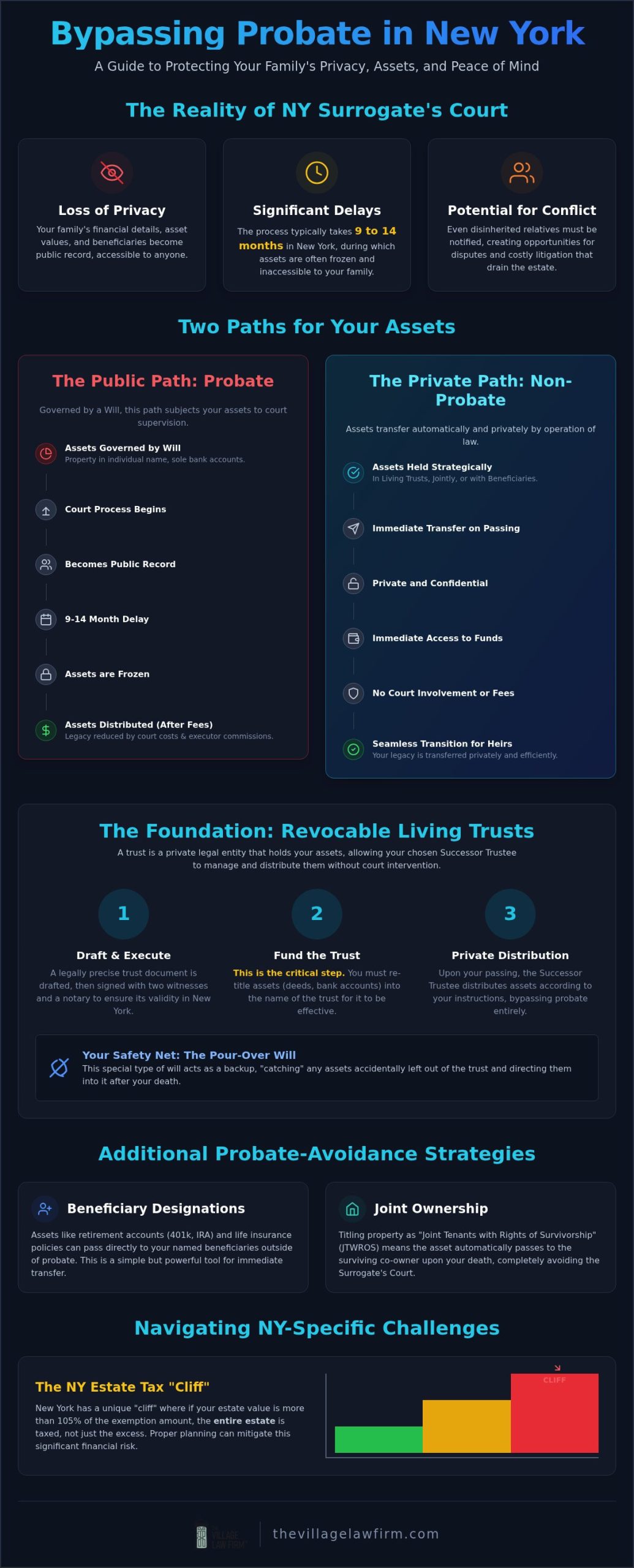
The probate process is the court-supervised validation of a Will and the subsequent distribution of assets. While it sounds like a standard legal formality, in New York, this procedure is far from a private family affair. Surrogate’s Court records are public. This means your family’s financial landscape, including specific asset values and the identities of beneficiaries, is open to anyone who cares to look. For many, this loss of privacy is the primary catalyst for learning how to avoid probate in New York.
Time is the other silent cost. In the five boroughs, you should expect the process to take anywhere from 9 to 14 months. It can take even longer if the court is backlogged or if a family member contests the Will. During this period, your assets are often frozen. Your family might wait nearly a year just to pay bills or manage your home. The cost of inaction is high. Between court filing fees and statutory executor commissions, a significant portion of your legacy can be eroded before a single dollar reaches your heirs.
The Reality of the NY Surrogate’s Court
New York law mandates that “distributees”-your closest living relatives-must be notified of the probate filing. Even if you intentionally excluded a relative from your Will, the court still requires they be served with notice. This procedural step often invites unnecessary family conflict and litigation. For a simple Will, the court’s oversight remains mandatory. It isn’t just about paperwork; it’s about the psychological toll on your survivors who are forced to navigate bureaucracy while they are grieving.
Probate vs. Non-Probate Assets
To master how to avoid probate in New York, you must categorize your wealth correctly. Understanding the distinction between these two categories is the first step toward a private legacy. For New York residents, probate assets specifically include any property or accounts that do not automatically transfer to another person upon the owner’s death. Conversely, non-probate assets pass by operation of law directly to a co-owner or beneficiary. Relying solely on a Will is a common mistake. A Will only governs the assets that the court must supervise, leaving your estate vulnerable to the very delays you wish to prevent.
Establishing a Revocable Living Trust: The Foundation of Probate Avoidance
A revocable living trust acts as a sophisticated, private entity that holds your assets during your lifetime and transfers them seamlessly after your death. Unlike a will, which only speaks once you’ve passed away, a trust is an active, living document. It functions as a private blueprint for your family’s financial security, keeping your affairs out of the public Surrogate’s Court. For many looking for how to avoid probate in New York, this structure is the most effective way to maintain control and confidentiality.
The true power of a trust lies in the “funding” phase. A trust is essentially an empty vessel until you re-title your assets into its name. If you leave your Manhattan condo or your savings accounts in your individual name, they remain subject to court intervention. Your Successor Trustee, the person you appoint to manage the trust after you, can only step in and distribute assets that the trust actually owns. This transition happens privately, without the 9 to 14 month delays typical of the New York court system.
Step-by-Step: Creating a Trust in New York
Creating a trust requires more than just a template; it demands technical precision. In New York, the document must be drafted with specific provisions that comply with state law. Once drafted, you must execute the document in the presence of two witnesses and a notary to ensure its validity. The final, and most critical, task is re-titling. This involves drafting new deeds for real estate and updating bank account ownership to reflect the trust as the owner. If you value a “white-glove” approach to these details, working with a dedicated partner can ensure nothing is overlooked.
The Pour-Over Will: Your Safety Net
Even with a robust trust, you still need a specific type of will. A “Pour-Over Will” acts as a legal safety net. It catches any “forgotten” assets, perhaps a newly opened account or a tax refund, and directs them into your trust upon your death. While these specific items may still briefly touch the probate process, the will ensures they reach the correct destination. More importantly, this document is where you officially name guardians for your minor children. If you’re planning for a young family, understanding how these documents interact is vital. You can explore more about protecting your children in our NYC Estate Planning: 2026 Parent’s Guide to Legal Security. Building this comprehensive structure provides the peace of mind that comes from total order. If you’re ready to secure your legacy, we invite you to discuss your estate planning needs with us.
Strategic Asset Alignment: Beneficiary Designations and Joint Ownership
Beyond the revocable living trust, there are several estate planning methods to secure your assets that function automatically. These tools focus on liquid assets and property titling to move wealth outside of the court’s reach. Transfer-on-Death (TOD) for investment accounts and Payable-on-Death (POD) for bank accounts allow funds to move directly to your heirs upon your passing. This is a powerful tactic for anyone researching how to avoid probate in New York because these assets never enter the Surrogate’s Court’s jurisdiction. However, the “set it and forget it” mentality is dangerous. If your designations are decades old, you risk leaving assets to an ex-spouse or a deceased relative, creating immediate legal chaos for your survivors.
Co-Ownership Strategies for NY Residents
New York real estate offers distinct ways to hold title, and your choice determines whether your home stays private or goes public. Joint Tenants with Right of Survivorship ensures that when one owner passes, their share transfers instantly to the survivor. For married couples, New York recognizes Tenancy by the Entirety. This provides a unique layer of protection, as neither spouse can sell the property without the other’s consent; it also shields the home from the individual debts of one spouse. Conversely, owning property as Tenants in Common offers no probate protection. Your share becomes part of your estate and requires court intervention. You must also be cautious, as joint ownership with a child or non-spouse can expose your property to their creditors or legal judgments. Understanding these nuances is a key component of how to avoid probate in New York while maintaining long-term asset protection.
The Hierarchy of Asset Distribution
Many New Yorkers are surprised to learn that their Will doesn’t control their retirement accounts. Beneficiary designations on 401(k)s, IRAs, and life insurance policies are legally binding contracts that override any instructions in your Will. If your Will says “everything to my daughter” but your IRA lists a sibling, the bank must pay the sibling. This hierarchy makes it essential to coordinate your forms with your overall estate plan. In New York, a valid beneficiary designation form carries absolute legal priority over the instructions found in a testamentary document like a Will. To maintain order, you should review these designations annually. This ensures your strategic alignment reflects your current life and protects your family from the stress of unintended disinheritance.
Navigating Cross-Border Assets and the New York Estate Tax ‘Cliff’
New York’s global nature means many residents own property far beyond the five boroughs. If you own a brownstone in Brooklyn but also a vacation home in Florida or a pied-à-terre in Paris, your family faces a double burden. This is known as “Ancillary Probate.” It’s an additional, separate court proceeding in another jurisdiction just to handle a single out-of-state asset. Mastering how to avoid probate in New York requires a strategy that accounts for these external holdings to prevent redundant legal fees and months of administrative gridlock. By placing out-of-state real estate into a trust, you bypass the need for multiple court interventions entirely, ensuring a unified transfer of your wealth.
The financial stakes are even higher when you consider the New York Estate Tax “cliff.” For dates of death in 2026, the state exemption is $7,350,000. Unlike the federal system, which only taxes the amount over the threshold, New York’s tax is punitive. If your estate’s value exceeds that $7.35 million mark by just 5%, the state “claws back” the entire exemption. You’re then taxed on every single dollar from the very first cent. This can result in a tax bill hundreds of thousands of dollars higher than if you’d stayed just below the limit. Meticulous planning allows you to “bracket” your estate value, using trusts to keep your legacy safe from this sudden tax exposure.
International Estate Planning for Global Citizens
Managing assets across international borders requires a specialized touch. A standard New York Will often fails to meet the formal requirements of foreign legal systems, leading to competing probate cases in different countries. Cross-border estate administration strategies, such as international trusts, allow you to manage multiple jurisdictions through a single, private entity. This removes the unpredictability of foreign courts and protects your family from the chaos of international bureaucracy. For a detailed roadmap on managing a global footprint, see our 2026 Guide: International Estate Planning in New York.
The 2026 NY Tax Landscape
Precision is your best defense against the 2026 tax landscape. Because New York doesn’t allow “portability” between spouses, you can’t simply inherit your partner’s unused exemption. You must use specific trust structures to maximize each individual’s $7.35 million limit. Strategic gifting-up to the $19,000 annual exclusion for 2026-can also help reduce your estate’s total value to stay safely below the cliff. You can find more detail on navigating these thresholds in our guide on the New York Estate Tax Exemption 2026 & 2026: Navigating the Cliff with Confidence. If your estate involves complex assets or high tax stakes, we invite you to schedule a consultation to secure your global legacy.
Creating Your Roadmap: From Legal Complexity to Family Security
The technical journey of how to avoid probate in New York often feels like a path through a dense urban forest. While the tools we’ve discussed, such as revocable trusts, strategic titling, and tax-bracket management, are powerful, they require a meticulous hand to implement correctly. A “Do-It-Yourself” approach frequently results in expensive litigation. A single un-funded asset or an improperly witnessed signature can collapse the entire structure, forcing your family back into the very court system you sought to avoid. In the high-stakes environment of Manhattan real estate and international holdings, precision is a necessity for your family’s protection.
True security is holistic. It isn’t enough to simply bypass the Surrogate’s Court; your plan must also account for Medicaid asset protection and the specific needs of your children. We move you from a state of anxiety to a state of order by creating a shield against future uncertainty. This isn’t a one-time transaction. It’s a partnership designed to evolve with your life and the changing New York legal landscape. By aligning your assets today, you ensure that your legacy remains a source of support rather than a source of stress.
The Value of White-Glove Legal Counsel
We replace the cold, clinical atmosphere of traditional law with a reassuring and empathetic experience. Our firm acts as your steady urban guide, streamlining the complexity of NYC probate into a manageable roadmap. We don’t just draft documents; we ensure your legacy is meticulously aligned with your values. This white-glove service allows busy professionals to delegate the legal heavy lifting, knowing every detail is handled with unwavering integrity. We bridge the gap between legal chaos and family security, providing a sanctuary of order in an unpredictable world.
Your Next Steps Toward Security
To begin your transition toward security, we recommend gathering a few key items for a comprehensive review. Having these details ready allows us to identify potential probate triggers immediately. Please consider the following:
- A list of all real estate holdings, specifically noting properties outside of New York or the U.S.
- Current beneficiary designations for all retirement and insurance accounts.
- A list of potential Successor Trustees who possess the stability to manage your affairs.
- Information regarding any assets held in foreign jurisdictions.
The first step is often the most vital. Schedule a calming consultation to protect your New York legacy.
Securing Your Family’s Sanctuary of Order
Navigating the transition from legal complexity to long-term security is a journey best taken with a steady partner. You now understand that the true path of how to avoid probate in New York relies on more than just a single document; it requires a meticulous alignment of trusts, beneficiary forms, and tax strategies. By shielding your assets from the public eye and the 2026 tax “cliff,” you ensure your legacy remains a private gift to your family rather than a public burden. It’s the difference between leaving behind a complex puzzle and a clear, well-lighted path.
At The Village Law Firm, we specialize in providing calming, authoritative legal guidance tailored to the unique needs of NYC professional families. Whether you’re managing domestic accounts or complex international holdings, our expertise in cross-border administration ensures no detail is left to chance. We invite you to replace uncertainty with a sense of profound protection. Schedule your white-glove estate planning consultation today and take the final step toward a future of absolute clarity. Your family deserves the peace of mind that comes from a legacy of perfect order.
Frequently Asked Questions
Does a Will avoid probate in New York?
No, a Will does not avoid probate; it actually serves as the primary document that initiates the court process. A Will is essentially a set of instructions directed to the Surrogate’s Court. It requires a judge to validate the document before any assets can be distributed. To bypass the public court system, you must utilize non-probate tools like trusts or specific beneficiary designations.
What is the small estate limit in New York for 2026?
The maximum value for a “Small Estate Proceeding” in New York for 2026 is $50,000 in personal property. This simplified voluntary administration is faster and less expensive than formal probate. However, it is important to note that this threshold only applies to personal property. If the decedent owned real estate in their individual name, a full probate proceeding is still required regardless of the property’s value.
Can I use a Transfer-on-Death deed for my NYC apartment?
No, New York law does not recognize Transfer-on-Death (TOD) deeds for real estate. While many other states allow this simple filing, New York residents must use alternative methods to keep their homes out of court. A revocable living trust is the most effective tool for this purpose. It allows your NYC apartment or home to pass to your heirs immediately and privately without court intervention.
What happens if I own property in another state or country?
Owning property outside of New York often triggers “Ancillary Probate,” which is a secondary court proceeding in that specific jurisdiction. This means your family must hire multiple attorneys and manage two separate court cases. International assets add even more complexity. By placing these global holdings into a single trust, you can consolidate your legacy and ensure a unified, private transfer of wealth across all borders.
Is a Revocable Living Trust better than a Will for avoiding probate?
Yes, a Revocable Living Trust is the gold standard for how to avoid probate in New York because it functions as a private entity. Unlike a Will, which remains dormant until you pass away, a trust is active during your lifetime. It allows for the immediate transfer of assets to your beneficiaries, bypassing the 9 to 14 month delays and public records associated with the Surrogate’s Court.
How much does it cost to avoid probate in New York?
The investment required to avoid probate depends on the complexity of your holdings and the level of protection you need. While professional estate planning involves upfront costs, these are typically far lower than the eventual expenses of probate. In New York, court filing fees alone can reach $1,250, and statutory executor commissions can consume approximately 3% of your estate’s total value if you don’t plan ahead.
Does avoiding probate also mean I avoid New York estate taxes?
Not automatically. Avoiding probate keeps your affairs private and out of court, but assets in a revocable trust are still considered part of your taxable estate. However, a professional plan provides the framework to mitigate tax exposure. For 2026, we use these structures to help you stay below the $7,350,000 New York tax cliff, preventing a small excess from triggering a massive tax bill.
Can I set up a trust without a lawyer in New York?
While you can find templates online, a DIY approach is exceptionally risky in the New York legal environment. A trust is only effective if it is properly “funded” and contains specific language compliant with state statutes. Errors in drafting or execution often lead to expensive litigation later. Professional guidance ensures your trust is a robust shield for your family rather than an invitation for future conflict.