
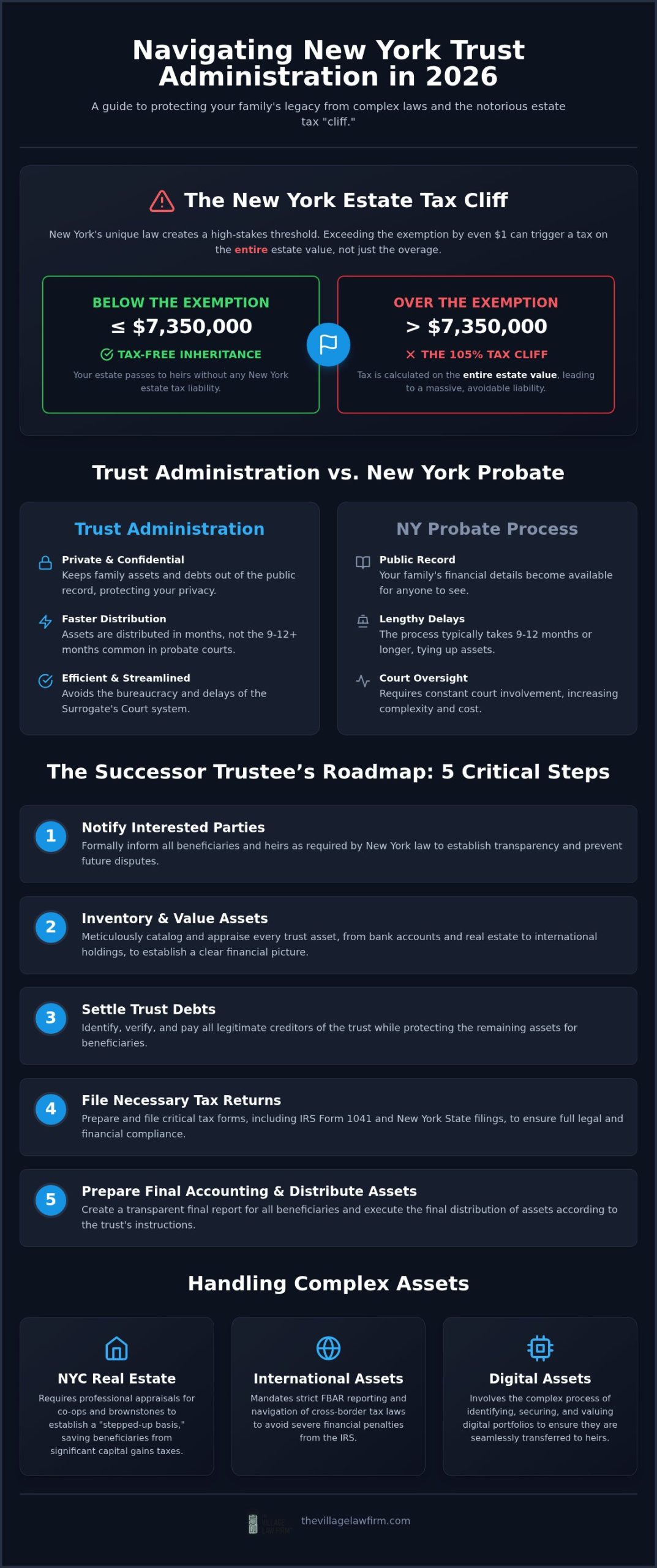
In 2026, a single dollar could be the difference between a tax-free inheritance and a multi-million dollar liability for your family. New York’s unique 105% tax cliff means that exceeding the $7,350,000 exemption by even a small margin triggers a tax on the entire estate. It’s a high-stakes environment where a single administrative oversight can jeopardize decades of hard work. Securing the guidance of a sophisticated trust administration attorney New York families trust is no longer just a luxury; it’s a vital shield against legal uncertainty.
We understand that you likely feel the weight of this responsibility. You want to honor a loved one’s wishes while protecting the family legacy from avoidable disputes and the complexities of cross-border taxes. It’s a heavy burden to carry alone during a time of personal loss. This article provides the expert clarity you need to navigate the administration process with confidence. We will walk you through the essential 2026 tax updates, the nuances of trustee commissions, and the precise steps required to ensure an efficient, error-free distribution of assets that preserves your family’s peace of mind.
Key Takeaways
- Learn the five essential steps every successor trustee must follow to ensure legal compliance and protect the family’s assets under New York law.
- Discover how a trust administration attorney New York families trust can navigate the state’s unique tax “cliff” and complex Surrogate’s Court procedures.
- Understand why trust administration provides a faster, more private alternative to the lengthy and public New York probate process.
- Gain clarity on managing international assets and meeting strict FBAR reporting requirements to avoid significant cross-border tax penalties.
- Identify the specific strategies needed to turn a complex inventory of NYC real estate and digital assets into a seamless legacy for your heirs.
Understanding Trust Administration in New York
Trust administration is the bridge between a legacy envisioned and a legacy delivered. It’s the meticulous fiduciary process of managing, protecting, and eventually distributing assets after a grantor passes away. While the legal document provides the instructions, the administration is the active execution of those wishes. Having a foundational Understanding Trust Law is helpful, but the reality of New York’s legal landscape requires much more than a general overview. It demands a partner who understands how to translate complex clauses into tangible security.
New York stands apart from other jurisdictions because of the specific, often rigid, procedures of the Surrogate’s Court. Even though trusts are designed to stay out of court, the laws governing them in the Empire State are dense and unforgiving. When a trustee is unprepared, the transition from order to chaos happens quickly. Missing a single filing or misinterpreting a distribution clause can turn a peaceful transition into a legal battleground. This is why partnering with a sophisticated trust administration attorney New York families rely on is essential. It replaces uncertainty with a structured, methodical roadmap that protects everyone involved.
The Role of the Successor Trustee
The mantle of a successor trustee is heavy. You aren’t just a paper-pusher; you’re a fiduciary. This means you must act with unwavering integrity, putting the interests of the beneficiaries above your own at all times. In New York, the law holds you to the highest standard of care, requiring meticulous record-keeping and total transparency.
Beyond the legal mechanics, this role requires immense emotional intelligence. You’ll often manage the expectations of grieving family members while balancing the technical requirements of the trust. Unlike an executor in probate, who is overseen by the court at every step, a trustee often operates independently. This freedom offers efficiency, but it also demands a higher level of precision to avoid personal liability. A trust administration attorney New York professional can provide the necessary oversight to ensure you fulfill these duties perfectly.
Why Private Trust Administration Matters
One of the most profound advantages of this process is privacy. Unlike the public probate process in New York City, where your family’s assets and debts become public record, trust administration remains confidential. It happens behind closed doors, protecting your family from unwanted scrutiny and the delays of the public system.
This privacy is paired with speed. Trusts facilitate a much faster distribution of assets, which is critical for Essential Estate Planning for New York Families who need to ensure their children are cared for immediately. By avoiding the 9-12 month delays common in NYC probate courts, you provide your loved ones with the security they need exactly when they need it most. This efficient flow of assets preserves the family legacy without the friction of unnecessary bureaucracy.
The Successor Trustee’s Roadmap: 5 Critical Steps
When the grantor passes, the legal clock begins to tick. Your first responsibility is the immediate notification of all beneficiaries and heirs as required by New York law. This isn’t a mere formality; it’s a vital step in establishing transparency and managing expectations from the outset. A trust administration attorney New York residents depend on will ensure these notices are drafted with meticulous care, preventing early friction that can lead to family disputes.
Following notification, the roadmap transitions into a rigorous phase of asset management and legal compliance. You must follow these five essential steps to protect the legacy:
- Notify all interested parties to meet New York’s strict transparency requirements.
- Inventory and value every asset, from local bank accounts to international holdings.
- Settle trust debts using a “white-glove” approach to identify and notify legitimate creditors.
- File necessary tax returns, including IRS Form 1041 and relevant New York State filings.
- Prepare a final accounting and execute the distribution of assets to beneficiaries.
Asset Valuation and NYC Real Estate
Valuing assets in a city like New York is rarely straightforward. Manhattan co-ops and Brooklyn brownstones require more than a simple market estimate; they demand professional appraisals. These valuations are critical to establish a “stepped-up basis,” which can save beneficiaries significant capital gains taxes when they eventually sell the property. Our firm coordinates these high-stakes valuations, ensuring that every piece of NYC real estate is documented with the precision required by tax authorities.
Fiduciary Accounting and Liability
Before any assets are distributed, you must provide an accounting of your actions. In New York, this can be a “formal” process filed with the Surrogate’s Court or an “informal” accounting agreed upon by all beneficiaries. Meticulous record-keeping is your primary shield against litigation. Fiduciary duties in trust administration require you to account for every penny that enters or leaves the trust, ensuring total honesty and openness. Fiduciary liability is the personal financial responsibility a trustee assumes for any errors or mismanagement, but partnering with professional counsel allows you to navigate these risks safely. If you are ready to begin this process, consulting a trust administration attorney New York expert can provide the sanctuary of order your family needs.
Trust Administration vs. New York Probate: Why Trusts Are Different
Many families mistakenly view probate and trust administration as interchangeable processes. They aren’t. Probate is a public, court-supervised procedure that validates a will and settles an estate under the watchful eye of the Surrogate’s Court. In contrast, trust administration is a private, sophisticated process that occurs entirely outside the courtroom. It represents a sanctuary of order where the grantor’s financial blueprint remains confidential. While the New York State Bar Association provides guidance on both, the choice between them often dictates how quickly a family can move from legal chaos to long-term security.
The differences are tangible and impact your family’s experience in several key areas:
- Privacy: Probate records are public; anyone can see what you owned and who you owed. Trust administration is entirely private.
- Cost: Probate requires mandatory Surrogate’s Court filing fees, which can reach $1,250 for larger estates. Trusts bypass these fees.
- Complexity: Trusts can help you avoid ancillary probate in New York if you own property in other states, provided those assets are properly funded into the trust.
Privacy and the New York Family
For high-profile professionals and business owners in NYC, privacy isn’t just a preference; it’s a necessity. Probate turns your personal financial life into a public document available for anyone to inspect. By choosing trust administration, you ensure that your legacy remains a private matter. This quiet, dignified approach provides immense emotional relief, allowing families to grieve without the intrusion of public record searches. It’s a cornerstone of NYC Estate Planning for Parents who want to shield their children from unnecessary attention during a vulnerable time.
Speed and Efficiency in Asset Distribution
Time is often the most critical factor after a loss. In New York City, the probate process frequently drags on for 9 to 12 months before an executor receives the “Letters Testamentary” needed to act. This delay can leave surviving spouses and children in a state of financial limbo. Trust administration offers a faster path. Because the successor trustee already has the authority to manage the assets, distribution can begin almost immediately. This automatic succession provides the liquidity needed for daily expenses and long-term care. A skilled trust administration attorney New York families trust will streamline these mechanisms, ensuring that assets move seamlessly from the trust to your loved ones without the friction of court delays.
Handling International Assets and New York Tax Compliance
Managing a trust becomes significantly more complex when the grantor’s footprint extends beyond the five boroughs. For global citizens, international estate planning and administration involve navigating a web of foreign treaties and IRS reporting requirements. If the trust holds foreign bank accounts or interests in overseas entities, you must comply with strict FBAR (Foreign Bank Account Report) and foreign trust reporting. Failure to disclose these assets can lead to staggering penalties that quickly erode the family legacy. A seasoned trust administration attorney New York expert ensures that every global asset is accounted for and reported with the meticulousness required by both domestic and international authorities.
Our firm provides the “white-glove” oversight necessary to handle these high-stakes requirements. We don’t just file paperwork; we provide a sanctuary of order for families whose lives span multiple continents. By coordinating tax compliance with asset protection strategies, we turn a chaotic international portfolio into a secure, well-documented distribution plan.
Navigating the 2026 New York Estate Tax Updates
New York’s tax landscape is famously unforgiving. For 2026, the NY estate tax exemption for 2026 is set at $7,350,000. This figure is more than a simple threshold; it’s the edge of a steep financial cliff. If the total value of the estate exceeds 105% of this amount, or $7,717,500, the entire exemption is lost. Suddenly, every dollar from the very first cent is taxed at rates ranging from 3.06% to 16%. For NYC property owners, whose primary residence alone may approach these figures, “Cliff” planning during the administration phase is vital. It’s a defensive strategy used to prevent a massive, unnecessary tax bill through precise distributions or disclaimers.
Cross-Border Asset Distribution
Transferring a flat in Europe or a family business in Asia involves more than just a signature. You’ll face logistical hurdles ranging from foreign probate requirements to complex treaty-based tax withholdings. These transitions require a steady urban guide who can coordinate with foreign legal counsel to ensure the distribution is seamless. Our firm specializes in cross-border estate administration, providing the technical precision needed to bridge the gap between New York law and international jurisdictions. We act as your shield against global uncertainty, ensuring that your family’s international wealth is protected and distributed according to plan. If you’re managing a trust with global reach, contact a trust administration attorney New York specialist to secure your legacy.
Securing Your Legacy with a New York Trust Administration Attorney
Professional trust administration serves as a vital shield against the unpredictability of the legal system. It’s the mechanism that prevents minor administrative oversights from escalating into costly litigation or devastating tax errors. Our “white-glove” service is built on a foundation of meticulous attention to detail and deep emotional intelligence. We recognize that behind every bank statement and property deed is a family story that deserves to be protected with the utmost care. By partnering with an experienced trust administration attorney New York families can rely on, you transform a period of potential legal chaos into a structured journey toward security.
This process is particularly critical for families with children. Ensuring that assets are distributed efficiently and held in protective structures is the final, essential step in a comprehensive legacy plan. We provide a clear, calming path forward, removing the burden of technical complexity so you can focus on what truly matters. Our approach is designed to be highly efficient, ensuring that the distribution of assets happens with the precision and speed your family deserves. We replace anxiety with a sense of total control.
A Partnership Mindset for Successor Trustees
The role of a successor trustee often feels like a solitary burden, but it doesn’t have to be. We walk alongside you at every stage, acting as a steady urban guide through the intricacies of New York law. This is a partnership defined by unwavering integrity and a commitment to excellence. We don’t just offer transactional advice; we provide the sanctuary of order that busy professionals require. By taking a proactive approach, we help you identify potential hurdles before they become obstacles, effectively shielding the trust from future uncertainty.
Take the Next Step Toward Order
Complexity vanishes when you have a competent partner leading the way. The first step toward a seamless distribution is a thorough review of the trust documents and an assessment of the current asset landscape. We invite you to experience a service level that prioritizes both your peace of mind and your family’s long-term stability. Let us help you turn the responsibility of trusteeship into a successful tribute to your loved one’s legacy. Schedule a consultation with a trust administration attorney in New York to begin your journey toward a secure and orderly distribution.
Transforming Legal Responsibility into Family Security
Managing a trust in 2026 requires a delicate balance of technical precision and emotional intelligence. You’ve seen how the New York tax cliff and complex international reporting requirements can turn a simple distribution into a high-stakes challenge. By choosing a private, methodical path over the public delays of probate, you provide your family with the immediate liquidity and lasting privacy they need to move forward. You aren’t just filing paperwork; you’re fulfilling a sacred promise.
Successor trustees carry a heavy mantle, but you don’t have to navigate these Surrogate’s Court procedures alone. Partnering with a sophisticated trust administration attorney New York professional provides the “white-glove” oversight necessary to protect your family’s interests. Our firm specializes in cross-border estate administration and dedicated planning for families with children, ensuring a sanctuary of order for busy NYC professionals. Secure your family’s legacy with a sophisticated trust administration partner. You’ve taken the first step toward clarity, and we’re here to guide you through the rest with unwavering integrity.
Frequently Asked Questions
How much does a trust administration attorney cost in New York?
Fees for a trust administration attorney New York families trust are typically determined by the complexity of the estate rather than a fixed flat rate. Some firms bill hourly, while others calculate a percentage based on the total value of the trust assets managed. It’s important to understand that these legal fees are generally paid directly from the trust principal. This ensures the burden of professional guidance is shared by the beneficiaries who benefit from the protection.
How long does the trust administration process take in NY?
Most trust administrations in New York are completed within six to eighteen months. While this is significantly faster than the NYC probate process, the timeline depends on the nature of the assets and the complexity of tax filings. If the trust holds international properties or requires a formal accounting, the process may extend. However, a well-structured trust allows for immediate partial distributions to cover a family’s urgent needs while the final steps are finalized.
Can a trustee be held personally liable for mistakes in New York?
Yes, a trustee can be held personally liable if they breach their fiduciary duty or mismanage trust assets. In New York, the prudent investor standard requires you to manage the portfolio with the same care a cautious professional would use. If you fail to file taxes correctly or favor one beneficiary over another, you may be required to repay the trust from your own funds. Professional counsel acts as your shield, ensuring every decision is legally sound.
Do I need to go to court for trust administration in New York City?
You generally don’t need to appear in court for trust administration in New York City. Unlike probate, which is a public court proceeding, trust administration is private and handled through legal documents and financial transfers. The only time the Surrogate’s Court becomes involved is if a beneficiary formally contests the trust or if the trustee fails to provide an adequate accounting. This privacy is why many NYC families prefer trusts as their primary legacy vehicle.
What happens if the trust contains international assets or foreign bank accounts?
International assets trigger strict reporting requirements, such as the FBAR and IRS Form 3520. You must report all foreign bank accounts if their combined value exceeds $10,000 at any point during the year. Managing these cross-border assets requires coordination between a trust administration attorney New York specialist and foreign legal experts. Failure to meet these deadlines can result in penalties that consume a significant portion of the inheritance, making meticulous compliance a non-negotiable priority.
Is a trust subject to New York estate taxes in 2026?
Yes, trust assets are included in the grantor’s taxable estate for New York estate tax purposes. In 2026, the state’s basic exclusion amount is $7,350,000. If the total estate exceeds the 105% cliff of $7,717,500, the entire exemption is lost and the entire value becomes taxable. This makes sophisticated post-death planning essential to ensure the trust is administered in a way that minimizes the impact of these high state tax rates.
Can I administer a trust without an attorney in New York?
While the law doesn’t strictly require you to hire a lawyer, administering a trust alone is risky given New York’s complex tax and fiduciary laws. A single error in valuation or a missed filing deadline can lead to personal liability or family disputes. Most trustees find that the cost of professional guidance is far lower than the potential cost of a legal mistake. It’s about replacing chaos with the security of a well-defined professional roadmap.
What is the difference between a revocable and irrevocable trust during administration?
The primary difference lies in when the administration begins and the level of asset protection provided. A revocable trust typically becomes irrevocable upon the grantor’s death, at which point the successor trustee takes over. In contrast, an irrevocable trust is often administered immediately upon its creation because the grantor has already relinquished control. Irrevocable trusts generally offer superior protection against creditors and can be specifically designed to assist with Medicaid qualification or estate tax reduction strategies.