
Could your family home, the very foundation of your legacy, be liquidated in a matter of months simply to cover the cost of a nursing home stay? For many, the “Medicaid Cliff” isn’t just a legal theory; it’s a looming source of profound anxiety that threatens to dismantle decades of hard work. You’ve likely heard that qualifying for help means spending down everything you own, but that doesn’t have to be your reality. Utilizing a Medicaid trust New York residents can trust allows you to preserve your independence while creating a sanctuary for your assets.
We understand that the complexity of state eligibility limits can feel overwhelming, especially when the rules seem to shift just as you’re seeking stability. It’s frustrating to feel like you’re being penalized for your success. This 2026 guide is designed to replace that confusion with a clear, methodical path forward. You’ll learn exactly how to navigate the five-year look-back rule, protect your home from estate recovery, and ensure your children inherit the future you intended for them. Let’s explore how meticulous planning turns uncertainty into a secured family legacy.
Key Takeaways
- Understand how a Medicaid Asset Protection Trust functions as a shield for your legacy while ensuring you meet eligibility requirements for long-term care.
- Master the nuances of New York’s 60-month look-back period and stay informed on the latest 2026 updates regarding Community Medicaid eligibility.
- Identify which assets are considered exempt and learn why transferring the family home into a Medicaid trust New York residents utilize is a critical step for estate preservation.
- Discover why early implementation is vital and explore the “half-a-loaf” strategy for protecting wealth even if the five-year window has already passed.
- Learn how a meticulous, white-glove approach to Medicaid planning replaces financial anxiety with the stability of a professionally managed estate.
Understanding the Medicaid Asset Protection Trust (MAPT) in New York
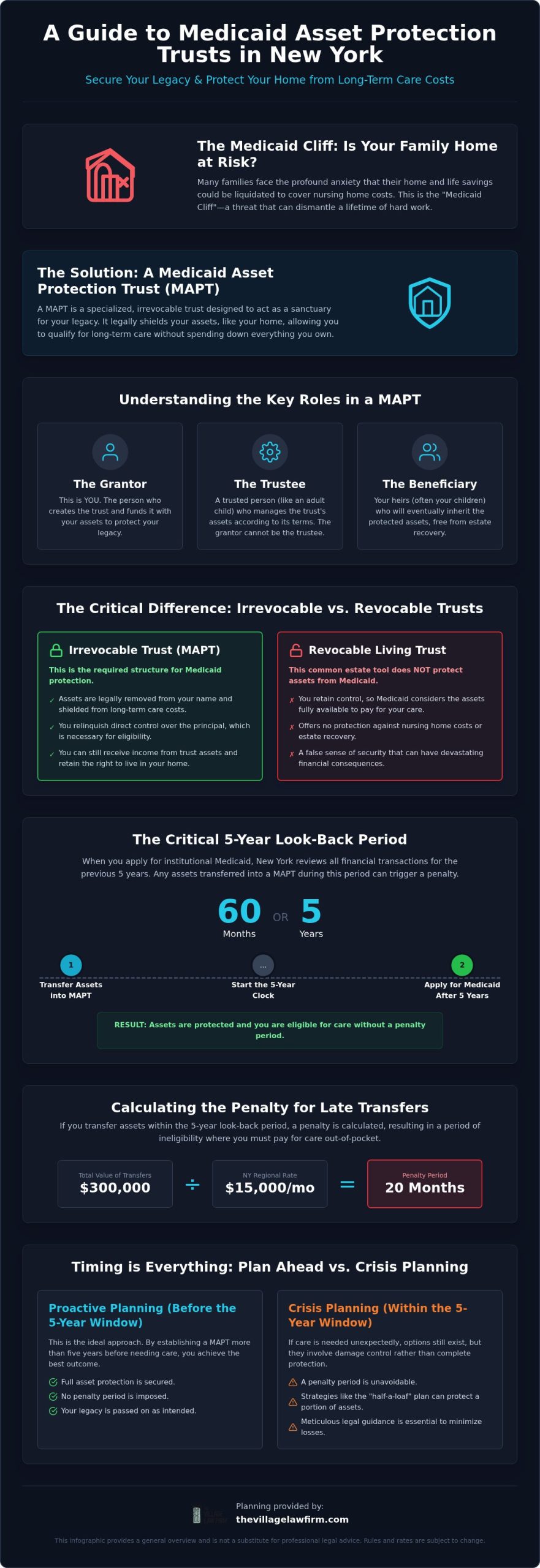
A Medicaid Asset Protection Trust, or MAPT, is a sophisticated legal instrument designed to safeguard your life’s work from the escalating costs of long-term care. In New York, this irrevocable trust acts as a sanctuary for your legacy. It ensures your assets aren’t consumed by nursing home bills before you can access the support you need. Unlike standard estate tools, this specific Medicaid trust New York families utilize is crafted with the singular purpose of securing eligibility without requiring financial ruin. It transforms potential chaos into a structured, predictable plan for the future. A Medicaid trust New York residents establish serves as the bridge between personal wealth and government-assisted care.
Irrevocable vs. Revocable: Why NY Medicaid Planning Requires Permanence
Many professionals mistakenly believe a standard revocable living trust provides protection. It doesn’t. Because you retain the power to dissolve a revocable trust and reclaim its contents, Medicaid views those assets as fully available to pay for your care. To secure your home and savings, New York rules require a shift toward permanence. You must relinquish certain controls to satisfy eligibility requirements. By choosing an irrevocable structure, you create a legal shield. You can no longer reach in and take the principal, which effectively removes those assets from your balance sheet in the eyes of the state. However, you don’t lose all benefits; you can still receive income generated by the trust or continue living in your home for the rest of your life.
The Role of the Grantor, Trustee, and Beneficiary
Structuring a MAPT requires a clear division of roles to maintain its integrity and effectiveness. As the grantor, you create the trust and fund it with your assets. Crucially, you cannot serve as your own trustee. This role is typically filled by adult children or a trusted family member who manages the assets according to the trust’s terms. While this transition requires a shift in mindset, it’s a partnership that preserves your family’s history. We frequently structure these as Intentionally Defective Grantor Trusts. This technical designation allows the grantor to remain responsible for income taxes, which preserves vital tax benefits like the primary residence capital gains exclusion and a stepped-up basis for heirs. Your beneficiaries, often your children, eventually inherit the protected legacy you’ve meticulously built without the threat of estate recovery.
The Mechanics of Medicaid Eligibility: NY’s Look-Back Rules in 2026
Understanding the “look-back” period is the first step in moving from financial vulnerability toward lasting security. When you apply for institutional Medicaid in New York, the state conducts a meticulous review of your financial history over the preceding 60 months. They’re looking for any assets you’ve gifted or transferred for less than fair market value. If they find these transfers, they won’t simply deny you care; they’ll impose a penalty period during which you must pay for your own nursing home costs. This is why a Medicaid trust New York families establish well in advance is so vital. It allows you to move assets out of your name and start the five-year clock before a crisis occurs.
Calculating the penalty period is a matter of simple but high-stakes math. The state takes the total value of assets transferred during the look-back and divides it by the regional monthly rate for nursing home care. These regional rates are set by the Department of Health and vary by location, such as New York City, Long Island, or Northern Metropolitan areas. If you gifted $300,000 in a region where the rate is $15,000, your penalty would be 20 months. During those 20 months, your legacy is unprotected. Meticulous planning ensures you never have to face that math under pressure.
To determine your potential penalty, follow these specific steps:
- Total the value of all non-exempt transfers made within the last 60 months.
- Identify the current regional rate for nursing home care in your specific New York county.
- Divide the total transfer value by that regional rate.
- The resulting number is the exact amount of months you’ll be responsible for your own care costs.
Community Medicaid vs. Institutional Medicaid in New York
There is a vital distinction between institutional care and home-based support. Institutional Medicaid covers nursing homes, while Community Medicaid provides for home health aides and adult day care. While the 60-month look-back currently applies only to institutional care, New York has long discussed implementing a 30-month look-back for community-based services. This implementation has faced repeated delays, but the threat of a new look-back remains a reality for 2026. Waiting for the rules to change is a gamble with your comfort and care. Consulting a Medicaid Planning Attorney New York ensures your strategy accounts for both facility-based and home-based possibilities.
The 2026 Medicaid Asset and Income Limits
New York sets strict thresholds for individual and couple eligibility, which are adjusted annually for inflation. If your resources exceed these limits, you’re typically expected to “spend down” your wealth on care costs until you reach the threshold. This process can be emotionally draining and financially devastating. A Medicaid trust New York residents use effectively removes these assets from the eligibility equation entirely. Instead of a frantic spend-down, you maintain your family’s financial order while securing the high-quality care you deserve. If you’re feeling overwhelmed by these calculations, we’re here to help you find clarity and protection for your future.
Strategic Asset Selection: What to Place Inside Your NY Medicaid Trust
Choosing which assets to shield is a delicate balance of logic and emotion. It’s the moment where abstract legal theory meets the tangible reality of your life’s work. In the eyes of the state, assets are categorized as either “exempt” or “countable.” While personal belongings and a modest vehicle are generally exempt, your brokerage accounts, secondary properties, and liquid savings are considered countable resources that must be spent down before you qualify for assistance. A Medicaid trust New York allows you to reclassify these countable assets as protected legacy pieces. It removes them from your personal balance sheet while keeping them within the family bloodline.
However, precision is vital. Certain assets should never be placed in a MAPT. Specifically, qualified retirement accounts like IRAs or 401(k)s must remain outside the trust. Transferring these accounts triggers an immediate and often devastating tax event because the IRS views the transfer as a total withdrawal. In New York, these accounts are frequently treated as exempt if they’re in “periodic payment status.” This means the state is satisfied as long as they can access the required distributions to offset care costs. Mixing these with trust assets creates unnecessary financial friction and tax liabilities that can be easily avoided with a sophisticated strategy.
Protecting the Primary Residence and the Right to Live There
The primary residence is usually the most emotionally significant asset you own. Transferring the deed to a trust can feel like a profound loss of control. We address this through a “Life Estate” or “Right of Occupancy” clause. This legal provision guarantees your absolute right to remain in the home for the rest of your life. You continue to pay the taxes and maintain the property, but the underlying ownership is secured. Most importantly, this structure is the most effective way to learn how to protect your home from Medicaid recovery in NY. Without the trust, the state could place a lien on the property after your death to recoup the costs of your care. The trust ensures the home passes directly to your heirs, untouched by state claims.
Managing International and Cross-Border Assets
For global citizens, the complexity of a Medicaid trust New York increases significantly. Standard local firms often lack the expertise to handle foreign bank accounts or real estate located abroad. We specialize in integrating these cross-border interests into your protective structure. This requires a meticulous understanding of treaty-based tax implications to ensure your international footprint doesn’t trigger unintended compliance penalties or double taxation. You can explore these nuances further in our 2026 Guide: International Estate Planning in New York. Managing global wealth requires a partner who understands that your legacy isn’t confined by borders.
Navigating the 5-Year Window: Timing, Implementation, and Risks
Time is the most valuable asset in Medicaid planning. Many families wait until a health crisis strikes to consider their options, but at that point, the 60-month clock becomes a formidable opponent. Proactive implementation of a Medicaid trust New York residents rely on is the only way to ensure assets are fully seasoned before they’re needed. If you find yourself already within that window without a plan, the “half-a-loaf” strategy offers a path forward. This involves gifting a portion of assets to heirs while retaining enough to pay for care during the resulting penalty period. It’s a complex maneuver that requires technical precision and a calm, methodical approach to execute correctly.
Beyond eligibility, the MAPT offers significant tax advantages that direct gifting cannot match. Executing the trust when you’re healthy allows the 5-year clock to run in the background of a well-ordered life. Meticulous drafting also mitigates litigation risks. The New York State Bar Association has identified cases where poorly structured trusts were challenged as fraudulent conveyances. We prevent these vulnerabilities by establishing a clear, long-term intent for asset protection, creating a legal shield that stands up to state scrutiny.
The Step-Up in Basis: A Hidden Gift to Your Heirs
Preserving the “Step-Up in Basis” is one of the most significant financial benefits of a Medicaid trust New York law permits. Imagine a property in Manhattan or Brooklyn purchased decades ago for $200,000 that’s now valued at $2 million. If you gift that house directly to your children today, they inherit your original $200,000 cost basis. When they eventually sell, they’ll face a staggering capital gains tax on the $1.8 million difference. By using a MAPT, the property’s basis “steps up” to its fair market value at the time of your passing. This single provision can save your family hundreds of thousands of dollars, ensuring the full value of your legacy remains in the bloodline.
Selecting a Trustee: Order vs. Chaos in Trust Management
Choosing a trustee is a decision that balances financial integrity with family dynamics. This individual must understand the boundary between trust assets and personal funds. A common mistake is “commingling,” where a trustee treats the trust account like a personal piggy bank. This chaos can lead to the trust being “pierced” by Medicaid, rendering the assets countable once again. We act as your steady guide, ensuring your trustee understands their fiduciary duties and the importance of meticulous record-keeping. To ensure your trust is drafted to withstand state scrutiny, schedule a consultation with our Medicaid planning team today.
Securing Your Legacy: The Village Law Firm’s Approach to Medicaid Planning
The weight of protecting a lifetime of achievement shouldn’t rest solely on your shoulders. We believe that true legal expertise is measured not just by the precision of the documents, but by the peace of mind they provide. Our philosophy centers on replacing the pervasive anxiety of the “Medicaid Cliff” with a structured, fail-safe sense of security. When you establish a Medicaid trust New York families depend on, you aren’t just filing paperwork; you’re building a fortress around your family’s future. We specialize in the meticulous details that busy professionals often don’t have the time to manage, ensuring every asset is accounted for and every regulation is met with technical excellence. This is about more than just numbers on a ledger. It’s about the home where you raised your children and the legacy you intend to leave behind.
Our approach extends beyond simple asset protection. For many of our clients, Medicaid planning is just one piece of a broader, more significant puzzle. We seamlessly integrate these strategies with estate planning for families with children NYC parents trust to secure their children’s inheritance. This holistic view is particularly vital for those with global footprints. While many local-only firms shy away from the complexities of foreign accounts or international real estate, we embrace them. We ensure your Medicaid trust New York structure remains compliant across borders, protecting your legacy no matter where your assets are located. We recognize that your life is complex, and your legal strategy should be sophisticated enough to match it.
The “White-Glove” Experience for New York Families
Moving through the bureaucratic maze of New York’s social services requires more than a map; it requires a guide who has walked the path a thousand times. Our “white-glove” service is designed to be a methodical and reassuring solution to an otherwise overwhelming process. We act as your steady urban guide, handling the friction of state requirements so you don’t have to. This is a partnership, not a transaction. We focus on long-term security, moving beyond the immediate filing to ensure your trust remains a functional shield for decades to come. You deserve a level of service that respects your time and honors your achievements.
Taking the First Step Toward Order
Transitioning from the acknowledgment of complexity to a methodical solution is the most important step you can take. It’s the moment where chaos begins to give way to order. During our initial consultation, we’ll review your financial landscape, your family goals, and any international considerations that require special attention. You don’t need to have every answer ready; you only need the willingness to begin. Bringing a summary of your assets and a clear vision of your legacy is all it takes to start. We’ll walk alongside you, providing the clarity you need to make informed decisions for your future. It’s time to replace uncertainty with a definitive plan. Contact The Village Law Firm to begin your Medicaid planning journey.
Transforming Uncertainty into a Protected Legacy
Protecting your home and savings requires more than just legal documents; it requires a strategic vision that accounts for New York’s specific 2026 regulations. By establishing a Medicaid trust New York residents can rely on, you effectively start the five-year clock while preserving vital tax benefits like the step-up in basis for your heirs. Whether you’re managing a family brownstone or complex international accounts, the key is to move from a state of reactive worry to proactive protection. Meticulous planning today ensures that a health crisis doesn’t become a financial crisis for your family tomorrow.
At The Village Law Firm, we provide a premium white-glove service tailored to the lives of busy NYC professionals. Our specialized expertise in cross-border estate administration and dedicated planning for families with children ensures that no detail is overlooked, no matter how global your reach. You don’t have to face the bureaucratic maze alone. We invite you to Schedule a Consultation with a New York Medicaid Planning Expert to begin crafting your sanctuary of order. Your legacy is the story of your life’s work. Let’s ensure it remains exactly where it belongs: with those you love.
Frequently Asked Questions
Can I still live in my house if it is in a Medicaid trust?
Yes, you can remain in your home for the rest of your life. We include specific “Right of Occupancy” provisions in every Medicaid trust New York residents establish with our firm. You continue to pay taxes and maintenance just as you did before. This ensures your daily life remains stable and unchanged while the underlying asset is shielded from future care costs and state claims. It’s a bridge to long-term security.
How much does it cost to set up a Medicaid Asset Protection Trust in NY?
We don’t provide flat pricing because every family’s financial footprint is unique. The cost of drafting a Medicaid trust New York families use is an investment in protecting your entire legacy. Consider it against the average monthly cost of a private-pay nursing home in New York City, which can quickly exceed ten thousand dollars. Meticulous planning prevents the total depletion of your life’s work and replaces anxiety with order.
What is the 5-year look-back rule for Medicaid in New York?
The 5-year look-back is a 60-month window where the state reviews all financial transfers. If you’ve gifted assets or moved them into a trust within this period before applying for nursing home care, a penalty period is triggered. This penalty delays when Medicaid begins paying for your care. Starting early is the only way to ensure your assets are fully seasoned and protected before a health crisis occurs.
Can a Medicaid trust be changed or revoked once it is signed?
While these trusts are technically irrevocable, New York law does provide a narrow path for changes. Under the Estates, Powers and Trusts Law, you may revoke or amend the trust if you obtain written consent from all living beneficiaries. This often requires the cooperation of your children or heirs. While the structure is designed for permanence to satisfy Medicaid rules, it isn’t an absolute prison if family circumstances shift; for instance, The Irrevocable Trust Doctor specializes in navigating the legal complexities of modifying irrevocable trusts through the court system.
You cannot serve as your own trustee if you want the assets to be protected. Most clients choose an adult child or a highly responsible family member. This individual should possess strong financial integrity and a clear understanding of their fiduciary duties. They’re responsible for managing the trust assets and ensuring they aren’t commingled with personal funds, which maintains the trust’s legal integrity against rigorous state scrutiny.
Will a Medicaid trust protect my assets from estate recovery after I die?
Yes, this is one of the primary benefits of the structure. New York Medicaid recovery typically only applies to assets that pass through your probate estate. Because assets held in a Medicaid trust New York law recognizes pass directly to your beneficiaries outside of probate, the state cannot place a lien on them. This ensures your home and savings stay within your family bloodline rather than being seized.
Can I sell my home if it is owned by a Medicaid trust?
You can certainly sell the property. The trustee handles the sale, and the proceeds are paid directly into the trust’s bank account. These funds remain protected and can even be used to purchase a new residence for you. This flexibility allows you to downsize or move closer to family without losing the “seasoned” status of the assets or resetting the five-year look-back clock for eligibility.
Does a Medicaid trust protect me from the New York estate tax cliff?
A standard Medicaid trust is primarily focused on asset protection for care eligibility rather than tax mitigation. However, we can integrate specific tax-planning provisions to address the New York estate tax cliff. This requires a sophisticated approach that balances the need for Medicaid eligibility with the goal of avoiding the state’s unique tax threshold. Meticulous drafting ensures your plan addresses both financial threats simultaneously.