
What if the city you love is the very thing that could separate your children from the family members you trust most? In the fast-paced energy of New York, it’s easy to assume your intentions for your family are obvious. However, without a precise legal framework, the state’s default systems often prioritize bureaucracy over your personal wishes. You want to ensure your legacy remains a sanctuary of order, not a source of legal chaos for the people you love. We understand that your children are your primary concern; the thought of them entering the foster care system or being assigned a court-appointed guardian is simply unacceptable.
This 2026 guide provides the clarity you need to master estate planning for families with children NYC. You’ll discover how to appoint guardians with surgical precision and protect your assets from the New York Tax Cliff, which can erode an inheritance once an estate exceeds the $7,350,000 exemption. We’ll walk through the critical differences between a simple Will and a Trust to ensure your wealth is a bridge to their future. By the end, you’ll have a roadmap to minimize tax burdens and secure the peace of mind that comes with a truly organized legacy.
Key Takeaways
- Discover why a standard Will often falls short in the complex New York legal environment and how to prevent the state from making default decisions for your family.
- Learn the vital distinction between a guardian of the person and a guardian of the property to ensure your children’s daily care and financial future are both secure.
- Understand how estate planning for families with children NYC uses Trusts to bypass court-supervised guardianship, keeping your family’s inheritance private and accessible.
- Identify the specific 2026 New York Estate Tax thresholds to avoid the “Tax Cliff” that can significantly erode your children’s inheritance.
- Explore a “white-glove” legal partnership designed to transform complex estate decisions into a calm, structured sanctuary for your legacy.
The Stakes of Estate Planning for NYC Families: Why a Will Isn’t Enough
Living in New York City requires a unique brand of resilience. You manage the subways, the competitive school applications, and the relentless pace of a high-stakes career. Yet, many parents leave their most vital responsibility to chance. Relying on a basic document, or worse, having no plan at all, invites the city’s complex legal machinery into your private family life. Effective estate planning for families with children NYC isn’t just about who gets the apartment; it’s about building a fortress around your children’s emotional and physical well-being. A custom plan replaces the constant, low-level anxiety of the unknown with a profound sense of security.
The Chaos of Intestacy in New York
If you pass away without a Will, you die “intestate.” In New York, this means the state follows a rigid, one-size-fits-all formula to distribute your assets. This default plan rarely accounts for the nuances of modern families or the high cost of urban living. Your co-op or condo could be tied up in years of red tape, leaving your surviving spouse or children in a precarious financial position. Even more distressing is the potential role of the Public Administrator. This government official can step in to manage estates that appear “unclaimed” or disorganized. This leads to delays and administrative costs that quickly eat away at your children’s future. You’ve worked too hard to let a bureaucratic formula decide your legacy.
Beyond the Will: The Protective Shield
A Will is a vital starting point, but comprehensive estate planning involves much more than a single document. For young parents in Manhattan or Brooklyn, documents like healthcare proxies and powers of attorney are equally essential. These tools ensure that if you’re incapacitated by an accident or illness, a person you trust can make medical and financial decisions on your behalf immediately. Without them, your family might have to petition a court for guardianship just to pay your mortgage or approve a medical procedure.
At The Village Law Firm, we view estate planning for families with children NYC as a partnership. We structure your plan to act as a shield against the unpredictable chaos of the Surrogate’s Court. In that environment, legal fees and public hearings can turn a private family matter into a public ordeal. We focus on removing complexity and providing a sanctuary of order. By organizing your legacy now, you ensure that your children are protected by your choices, not by the decisions of a judge who has never met your family. Our white-glove approach ensures that every detail, from asset protection to emergency medical directives, is handled with meticulous precision.
Securing Your Children’s Future: Guardianship and The New York Surrogate’s Court
The most profound decision in any estate plan for parents is the appointment of a legal guardian. This individual doesn’t just manage assets; they step into your shoes, assuming the daily responsibilities of parenting. In the context of estate planning for families with children NYC, this choice is layered with the specific complexities of urban life. Who will navigate the unique landscape of the NYC Department of Education? Who understands the pace and rhythm of your child’s life in the city? These are the questions that transform a legal document into a protective shield.
New York law distinguishes between a ‘Guardian of the Person’ and a ‘Guardian of the Property.’ The former makes decisions about health, education, and welfare, essentially providing the nurturing home your child needs. The latter manages the inheritance you leave behind. Splitting these roles can be a strategic move. You might choose a family member for their emotional connection to your children but appoint a financially savvy professional or friend to manage the assets. This ensures that the person raising your child isn’t overwhelmed by complex financial management while grieving.
To avoid the ‘Foster Care Trap,’ formal documentation is non-negotiable. Without a clear legal directive, the city may place children in the foster care system temporarily while the court searches for relatives or evaluates potential homes. This is a trauma no parent wants for their child. New York’s Standby Guardianship laws offer additional peace of mind for 2026. They allow you to designate a guardian who can step in immediately upon a specific triggering event, such as a serious illness or incapacity, without waiting for a lengthy court process to conclude.
Choosing the Right Guardian for Your NYC Life
Selecting a guardian requires a realistic look at lifestyle, geography, and values. Does your chosen guardian live in a city apartment or a suburban home? Are they prepared for the financial reality of raising a child in Manhattan or Brooklyn? Beyond the primary choice, naming a successor guardian is critical. People’s lives change. A primary guardian might move abroad, grow older, or face their own health challenges. Having a backup ensures your children never face a legal vacuum during a time of crisis.
The Role of the New York Surrogate’s Court
The Surrogate’s Court ultimately validates your choice of guardian. Judges use the ‘Best Interests of the Child’ standard to make their final determination, looking at the stability and suitability of the proposed home. However, naming a guardian in your will provides the court with a clear, legally binding expression of your intent, which significantly limits judicial interference. While the court oversees the process, your written wishes serve as the primary guide. If you’re ready to create this sanctuary of order, you can discuss your family’s unique needs with us to ensure every detail is meticulously planned. While we focus on the emotional side of care, understanding the New York Estate Tax is also vital for the ‘Guardian of the Property’ to protect the wealth you leave behind.
Wills vs. Trusts: Choosing the Right Vehicle for Your Children’s Inheritance
The choice between a Will and a Trust is the most significant financial decision you’ll make for your legacy. At its simplest, a Will dictates who receives your assets; a Trust dictates how and when they receive them. For high-achieving professionals, estate planning for families with children NYC requires more than just a list of beneficiaries. It requires a strategy that prevents the state from interfering with your family’s private financial matters. While a Will is a foundational document, it often lacks the sophisticated controls necessary to protect a minor’s long-term interests in a city as legally complex as New York.
One of the most overlooked risks for parents is the “minority” rule. In New York, children under the age of 18 cannot legally own significant property. If you leave assets directly to a child through a Will, the Surrogate’s Court must appoint a “guardian of the property” to manage those funds. This sounds helpful, but it’s often a bureaucratic hurdle. The court-appointed guardian is subject to strict oversight, requiring them to file annual reports and seek judicial permission for even basic expenditures. This process is public, expensive, and can drain the very inheritance you worked so hard to build.
The Pitfalls of Simple Wills for NYC Parents
A simple Will might feel efficient, but it often triggers a slow and public probate process. In the busy New York court system, probate can take months, or even years, during which your family’s assets may be effectively frozen. Beyond the delay, the court-supervised financial guardianship mentioned earlier remains in effect until the child turns 18. On that day, the court hands the entire inheritance to the young adult, regardless of their financial maturity or personal circumstances. You can learn more about the specific risks of this approach in our detailed guide on protecting children’s inheritance in New York.
Trust-Based Planning: The White-Glove Solution
A trust-based plan offers a sanctuary of order and privacy. By establishing a trust for minor children in New York, you bypass the probate process entirely. Your assets transfer privately and immediately according to your exact instructions. This “white-glove” approach allows you to appoint a Trustee, either a trusted family member or a professional, who shares your values and financial philosophy.
One of the most powerful features of a trust is the ability to stagger distributions. Instead of an 18-year-old receiving a windfall, you can release funds at milestones, such as ages 25, 30, and 35. This encourages financial responsibility while providing a safety net. Additionally, we often include a “spendthrift” clause. This provision protects your child’s inheritance from future creditors, lawsuits, or even potential divorce settlements. It ensures that your legacy remains a source of stability for your children, shielded from the unpredictability of the outside world. For families who need to coordinate long-term care for a child with disabilities, you can learn more about Planning for Two Lifetimes to ensure your financial strategy accounts for their unique future needs.
Navigating the 2026 New York Estate Tax and the ‘Cliff’ Update
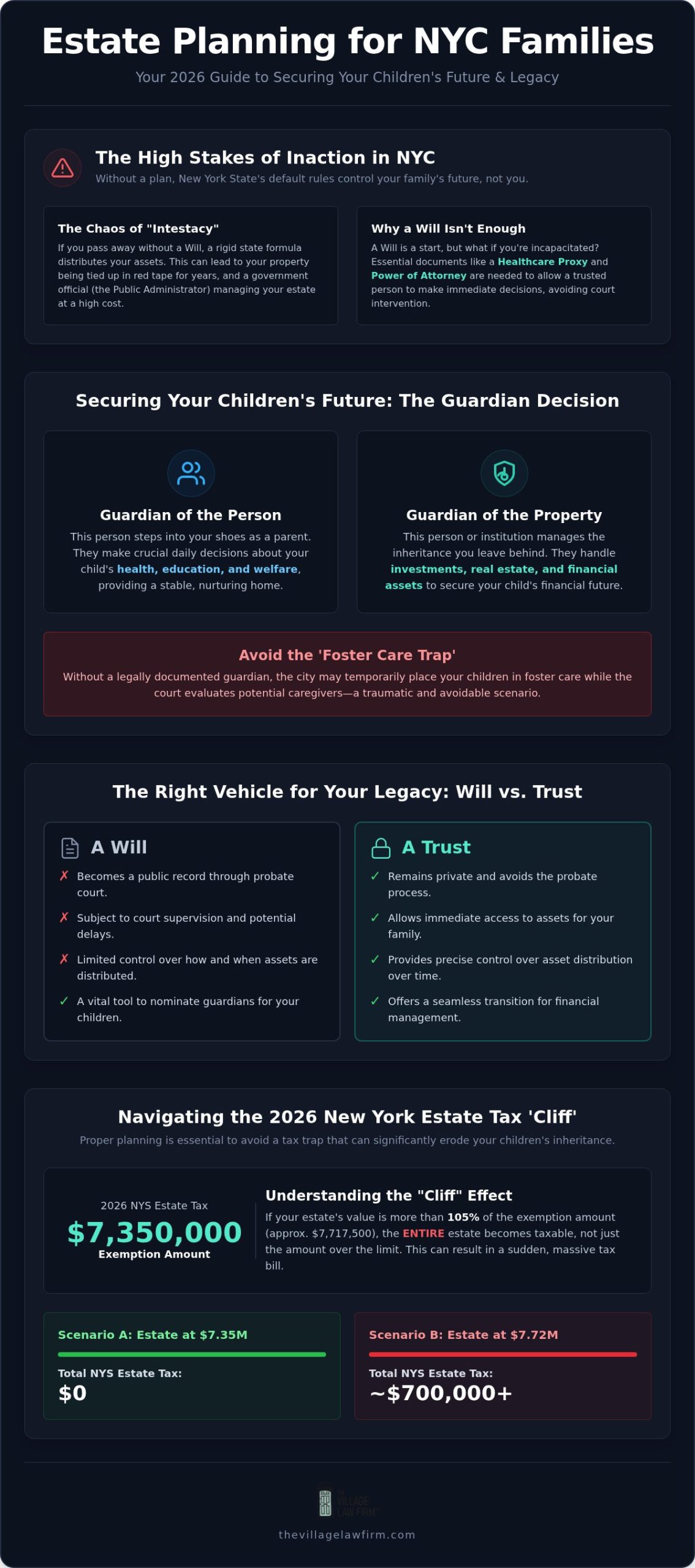
Protecting your family’s wealth requires a keen understanding of the shifting financial landscape. For 2026, the New York State estate tax exemption has been set at $7,350,000. While this figure may seem substantial, the high value of New York City real estate and professional investment portfolios means many families approach this threshold sooner than they realize. Effective estate planning for families with children NYC must account for these specific state-level taxes, which operate quite differently from federal law. If your assets are not structured correctly, a significant portion of your children’s inheritance could be diverted to tax payments rather than their future education or stability.
Managing the New York Estate Tax Cliff
The New York estate tax cliff is a unique legal mechanism where exceeding the exemption limit by just 5% causes the state to tax the entire estate from the first dollar, rather than just the overage. Specifically, if your estate value exceeds $7,800,000 in 2026, you lose the benefit of the exemption entirely. This “all or nothing” approach can result in a tax bill reaching hundreds of thousands of dollars for being only slightly over the limit. It’s a punitive structure that requires meticulous asset calculation and proactive gifting strategies.
Since New York does not allow for “portability” between spouses, married couples must be especially vigilant. Without a specific plan, the first spouse to pass away might “waste” their exemption, leaving the survivor with a much larger taxable estate. We often utilize Credit Shelter Trusts to capture both exemptions, effectively doubling the amount you can pass to your children tax-free. You can dive deeper into these strategies in our New York estate tax exemption 2026 guide.
Asset Protection for the Modern NYC Family
Modern families in Manhattan and Brooklyn often have complex lives that require more than standard templates. This is particularly true for blended families, where coordinating life insurance policies and trust distributions is essential to ensure all children are treated fairly. We also pay close attention to international assets. If you own property abroad or hold dual citizenship, those assets can complicate your New York tax calculations and trigger unexpected liabilities. 2026 is a critical year to review these arrangements, as federal exemptions are also in a state of flux, currently sitting at $15,000,000 per individual.
We invite you to schedule a comprehensive strategy session to ensure your asset protection plan is as resilient as the city you call home. By removing financial complexity now, you create a sanctuary of order for the next generation. Our white-glove approach ensures that your international holdings, life insurance, and local real estate all work in harmony to minimize the tax burden on your children.
Designing Your Legacy: The Village Law Firm Partnership
We believe that effective estate planning for families with children NYC requires more than just a series of signed documents. It requires a relationship built on unwavering integrity and a deep understanding of your family’s unique dynamics. Our “white-glove” service is designed to replace the chaos of uncertainty with a meticulously structured sanctuary of order. We don’t view our work as a transactional exchange of paperwork. Instead, we see it as a long-term partnership where we serve as the architects of your family’s future security. This approach ensures that every detail, from the complex asset protection discussed earlier to the emotional nuances of guardianship, is handled with both technical precision and human compassion.
Our process is intentional and highly structured. It begins with a direct engagement where we acknowledge the weight of the decisions you’re making. We then transition into a methodical journey, leading you from the initial discovery of your needs to the final execution of your documents. We handle the heavy lifting, allowing you to focus on what matters most: your family. By the time you sign your final documents, you won’t just have a plan; you’ll have the profound peace of mind that comes from knowing your legacy is fully organized and protected against the unpredictable nature of modern life.
The Steady Urban Guide for NYC Professionals
New York City moves at a relentless pace. We understand that your time is your most valuable asset. As your steady urban guide, we accommodate the high-pressure schedules of Manhattan and Brooklyn professionals, ensuring that the planning process is efficient without sacrificing depth. We offer a level of transparency and directness that is rare in the legal field. For our global citizens, we bring specialized expertise in international and cross-border planning. Whether you hold assets in London, Paris, or Hong Kong, we ensure your NYC estate plan integrates seamlessly with your global footprint. We prioritize honesty, stripping away the dense legalese that often makes legal protection feel alienating or overly complex.
Your Path to Peace of Mind
Your journey toward security begins with a focused design meeting. During this session, we don’t just talk about numbers or tax brackets. We talk about your values, your children’s personalities, and your vision for their adulthood. We walk alongside you as a competent partner, translating these deeply personal wishes into a robust legal framework. Because life is inherently unpredictable, we ensure your plan remains a living document. As your family grows or your career evolves, we help you update your strategies to maintain your shield against future uncertainty. To take the first step toward this lasting security, you can schedule a consultation with an estate planning attorney in New York. Let us help you transform your legacy into a sanctuary of order today.
Building Your Sanctuary of Order
The city’s unpredictability doesn’t have to extend to your family’s future. By moving beyond a simple Will, you prevent the Surrogate’s Court from making default decisions and ensure your children are protected by guardians you’ve chosen with care. You now understand how to navigate the 2026 tax cliff and why a Trust provides a level of privacy and control that a Will simply cannot match. This journey is about replacing parental anxiety with a sanctuary of order through comprehensive estate planning for families with children NYC.
At The Village Law Firm, we bring specialized expertise in complex NYC guardianship laws and international planning for global citizens. We offer more than just legal documents; we provide empathetic, partnership-focused counsel tailored to the specific needs of busy professionals. Your legacy is too important to leave to chance or bureaucratic formulas. We invite you to move forward with confidence and clarity.
Secure your family’s future with a custom NYC estate plan today.
Take the first step toward lasting security. Let us help you build a bridge between today’s complexity and tomorrow’s peace of mind.
Frequently Asked Questions
Do I really need an estate plan if I live in a NYC apartment and don’t own a house?
How do I choose between a friend or a family member as a legal guardian in New York?
You should prioritize shared values and lifestyle compatibility over biological relation. Consider who will best mirror your parenting style and who is prepared for the fast-paced reality of raising a child in the city. Discuss the responsibility with them openly before naming them. Integrity and a genuine bond with your children are often more important than a blood connection when seeking long-term stability for your family.
What is the difference between a Guardian of the Person and a Guardian of the Property?
A Guardian of the Person handles your child’s daily life, including their home, education, and medical care. Conversely, a Guardian of the Property manages the assets and inheritance your child receives. You can appoint the same person for both roles or split them to ensure a balance of emotional support and financial expertise. This division of labor provides a structured safety net for your child’s well-being and future success.
Can I appoint a guardian who lives outside of New York or the United States?
Yes, you can appoint a non-resident, but it requires careful coordination. New York law allows out-of-state guardians, though they must be prepared to navigate the NYC Surrogate’s Court process. If you choose someone living abroad, consider the logistical impact on your child’s stability. We specialize in international estate planning to help you navigate these cross-border complexities while ensuring your child’s transition is as seamless and calm as possible.
How often should NYC parents update their estate planning documents?
You should review your documents every three to five years or whenever a significant life event occurs. This includes the birth of another child, a marriage, a divorce, or a substantial change in your financial situation. The legal landscape, such as the 2026 tax updates, also shifts over time. Regular reviews ensure your plan remains a sanctuary of order that reflects your current family dynamics and the latest state regulations.
What happens if my chosen guardian is no longer able to serve?
If your primary choice cannot serve, the court will turn to the successor guardian named in your documents. This is why we emphasize naming at least one backup in your plan. If no successor is named, the Surrogate’s Court will decide based on the “best interests of the child” standard. This can lead to the very judicial interference and family conflict you are trying to avoid during a difficult time.
How does the 2026 New York Estate Tax affect my family’s inheritance?
The 2026 exemption is $7,350,000 per individual. If your estate’s value exceeds this amount by more than 5%, the “cliff” triggers a tax on the entire estate. This unique New York rule can significantly reduce the wealth you leave behind. Meticulous planning is required to stay below this threshold or utilize trusts to mitigate the tax burden, ensuring your legacy is preserved for the next generation without unnecessary loss.
Is it possible to set up a trust for my children without a large amount of cash upfront?
Yes, you don’t need a large sum of cash to establish a trust today. Many parents use a “standby” or “testamentary” trust that is funded later by life insurance proceeds or other assets upon their passing. This allows you to build a protective framework now without immediate liquidity. It’s a proactive way to ensure your children’s inheritance is managed with professional oversight and care from the very beginning of their adulthood.