
Did you know that while a U.S. citizen can pass $15 million to their heirs tax-free in 2026, a non-resident investor might see the IRS claim 40 percent of every dollar over a mere $60,000? This staggering $14.94 million disparity often catches international professionals and global families off guard, leaving their hard-earned legacy vulnerable to extreme taxation. We understand that managing wealth across borders feels like navigating a storm without a compass. It’s natural to feel anxious about how US estate planning for non-citizens interacts with your home-country assets or who would care for your children if the unthinkable happened while you are far from your extended family.
You deserve the certainty that your global footprint is protected by a sophisticated, meticulously crafted strategy. This guide provides a reassuring framework to help you minimize estate tax exposure and secure legal guardians for your children through New York’s specific standby provisions. We’ll walk you through the nuances of Qualified Domestic Trusts, the 2026 New York tax cliff, and the essential steps to ensure your international wills don’t clash with U.S. probate. By the end of this article, you’ll have a clear roadmap to replace jurisdictional chaos with a sanctuary of order and long-term security.
Key Takeaways
- Identify the critical difference between your immigration status and tax domicile to avoid unexpected IRS scrutiny of your global holdings.
- Learn how to navigate the 2026 exemption cliff and protect your legacy from the 40% tax rate through effective US estate planning for non-citizens.
- Discover why foreign-drafted wills often fail in New York courts and how to reconcile jurisdictional conflicts between US and home-country laws.
- Create a secure legal shield for your children by naming guardians who can act across borders, ensuring their care is never left to chance.
- Transition from the stress of legal complexity to a sanctuary of order with a partnership-driven approach to international asset protection.
The Non-Citizen’s Guide to US Estate Planning: Domicile vs. Residency
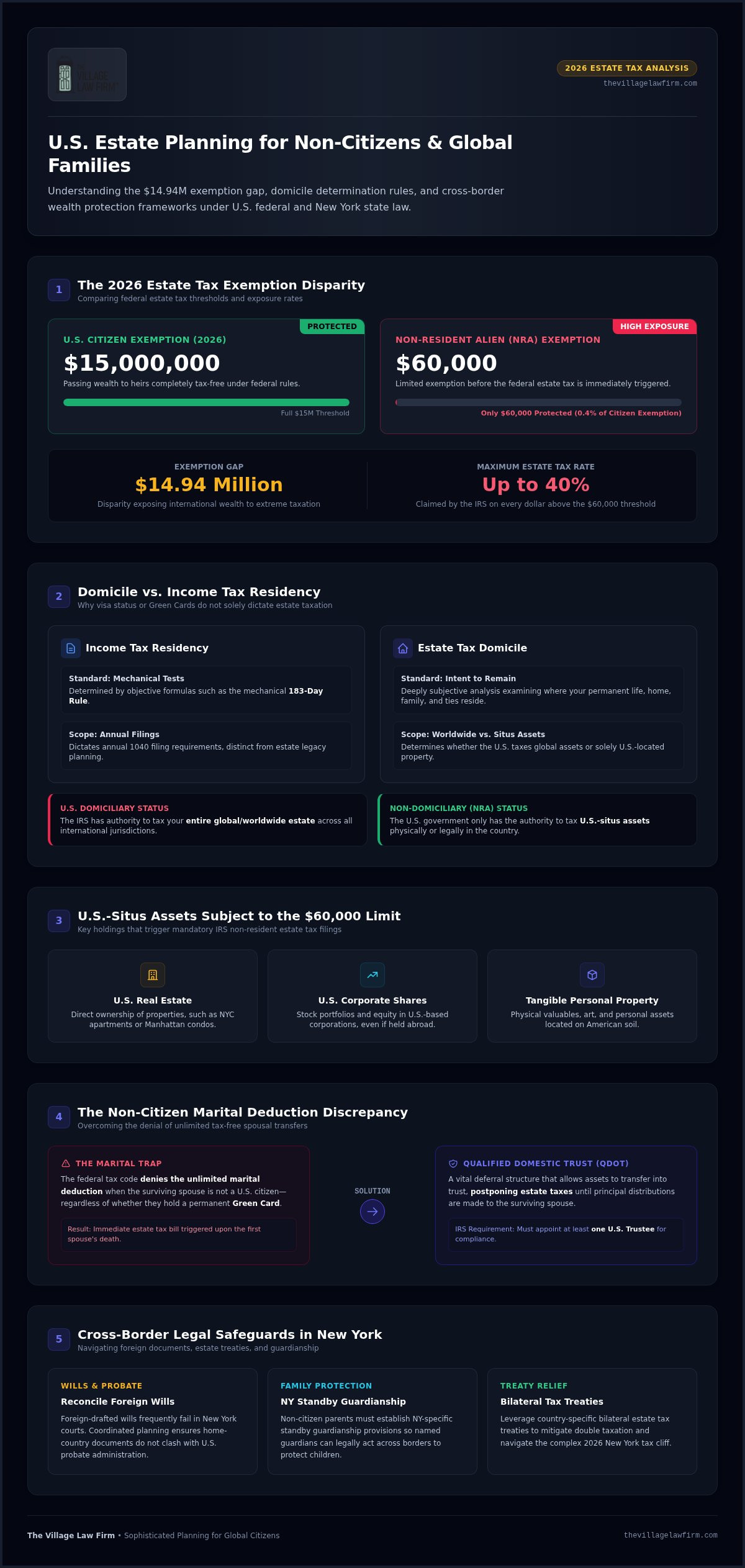
Many international professionals assume that their visa status or Green Card determines their tax obligations. This is a dangerous misconception. For income tax, the IRS uses mechanical tests like the 183-day rule. However, for the federal estate tax framework, the standard is “domicile.” You might be a resident for your annual 1040 filing while remaining a non-domiciliary for your legacy planning. This distinction is the cornerstone of effective US estate planning for non-citizens because it dictates whether the US government can tax your worldwide assets or only those physically located on American soil.
The stakes are high. If the IRS deems you a US domiciliary, your entire global estate is subject to federal taxes. If you are a non-domiciliary, only your “US-situs” assets are at risk. This includes items like New York real estate or shares in US corporations. Understanding where you stand is the first step toward creating a sanctuary of order for your family.
Defining Domicile for Estate Tax Purposes
Domicile is legally defined as the place where an individual lives with no present intention of leaving. Unlike income tax residency, which is often objective, domicile is deeply subjective and focuses on your “intent to remain.” The IRS examines your life through a microscopic lens to determine where your permanent interests lie. They look at where you own a home, where your family resides, and where you maintain your most significant social and professional ties. If you are classified as a non-domiciliary, the US only has the authority to tax your US-situated assets, providing a layer of protection for your global holdings.
The Hidden Risks for Non-Resident Aliens (NRAs)
The most significant danger for those not domiciled in the US is the $60,000 exemption trap. While US citizens enjoy a generous $15 million exemption in 2026, non-resident aliens are limited to a credit that covers only $60,000 in assets. Anything above this nominal amount is taxed at rates up to 40 percent. This creates a massive vulnerability for investors who own NYC real estate, tangible personal property, or shares in US-based corporations. Even if you don’t live here, owning a Manhattan condo or a significant US stock portfolio can trigger a devastating tax bill upon your passing. Bilateral estate tax treaties can sometimes offer relief from double taxation, but these agreements are complex and vary significantly by country. Successful US estate planning for non-citizens requires a meticulous approach that accounts for these invisible jurisdictional borders.
Navigating the US Estate Tax Trap for Non-Citizens
The federal tax code holds a sharp, often invisible edge for international families. While U.S. citizens breathe easier under the One Big Beautiful Bill Act (OBBBA), non-citizens face a landscape where the rules of inheritance can feel like a labyrinth. It is a source of profound anxiety for those building a life in America. Effective US estate planning for non-citizens isn’t just about drafting documents; it is about shielding your legacy from a tax system that treats you differently based on your passport.
In 2026, the contrast is stark. A U.S. citizen enjoys a $15,000,000 exemption, while a non-resident alien is limited to a mere $60,000 threshold on U.S.-situs assets. This $14.94 million disparity means that without a sophisticated strategy, the IRS may claim up to 40 percent of your assets almost immediately. Understanding the IRS non-resident estate tax filing requirements is the first step in identifying your specific exposure.
The Marital Deduction Discrepancy
Most married couples assume that assets transfer between them tax-free. However, the law denies the unlimited marital deduction when the surviving spouse isn’t a U.S. citizen, regardless of their Green Card status. To prevent an immediate tax bill, we utilize a Qualified Domestic Trust (QDOT). This vital deferral tool allows assets to pass into a trust, postponing federal estate tax until the surviving spouse receives distributions of principal. A QDOT must meet strict IRS compliance, including the requirement of at least one U.S. Trustee. If you are managing wealth across borders, our team provides the international estate planning expertise needed to implement these specialized structures.
2026 Tax Exemptions: Citizen vs. Non-Citizen
The permanent $15 million exemption for domiciliaries has shifted the focus for global asset holders toward state-level tax cliffs and spousal traps. For non-residents, the 40 percent top tax rate applies to everything over that stagnant $60,000 credit. We often recommend strategic lifetime gifting to reduce this exposure. In 2026, you can give up to $194,000 annually to a non-citizen spouse tax-free. Additionally, the standard annual gift exclusion is $19,000 per recipient. By methodically moving assets out of your taxable estate, you replace uncertainty with a sense of security, ensuring your family remains the primary beneficiary of your hard work.
Why a Home-Country Will Isn’t Enough in New York
Holding a will from your home country often provides a false sense of security. While you might assume your international documents are universal, the New York Surrogate’s Court is notoriously strict regarding legal formalities. Relying on a single document to cover global assets frequently leads to jurisdictional friction, where US law and foreign civil codes disagree on who truly inherits your estate. This is a central challenge in US estate planning for non-citizens. To avoid this, we often recommend ‘Situs Wills’, which are separate documents specifically tailored to the laws of each country where you own property. This approach streamlines the process of ancillary probate in New York, ensuring your local assets are handled without the delays inherent in cross-border disputes.
The Pitfalls of International Will Recognition
New York law generally requires the original will to be filed with the court. If your original is held by a notary in France or a court in Brazil, the process becomes a logistical nightmare. Handwritten ‘holographic’ wills, common in many European and Latin American jurisdictions, are rarely accepted here. You’ll likely face significant expenses for certified translations and the difficult task of locating witnesses from years ago to provide testimony. These procedural hurdles can freeze your New York accounts for months, leaving your heirs in a state of financial limbo and unnecessary stress.
The Power of a Revocable Living Trust
A Revocable Living Trust serves as a powerful alternative to the public and lengthy probate process. By transferring your New York real estate or brokerage accounts into a trust, you ensure these assets pass to your beneficiaries privately and immediately upon your death. This is especially valuable for global citizens who value discretion, as it keeps your global asset details off public records. While a Qualified Domestic Trust (QDOT) specifically manages tax deferral for non-citizen spouses, a living trust manages the practical transfer of wealth. For those seeking even higher levels of protection, consulting an irrevocable trust attorney NYC can provide a sophisticated framework to shield your legacy from future uncertainty and legal chaos.
Guardianship and Family Security for Non-Citizen Parents
For many international families, the greatest source of anxiety isn’t a tax bill. It’s the unsettling thought of what happens to their children if the unthinkable occurs in a country where they have no extended family. Without a proactive plan, your children could be placed with the NYC Administration for Children’s Services (ACS) while the court searches for relatives. Effective US estate planning for non-citizens replaces this fear with a sanctuary of order. We help you build a legal bridge between your life in New York and your support system back home, ensuring your children are never left in the care of strangers.
You need a plan that accounts for both sudden emergencies and long-term care. While New York law allows you to nominate a guardian who lives outside the United States, the practical reality of moving a child across international borders requires meticulous legal preparation. We focus on creating a comprehensive safety net that addresses jurisdictional conflicts before they arise.
Appointing a Foreign Guardian
You can legally name a relative in your home country as a guardian, but the process isn’t automatic. The New York Surrogate’s Court may require a non-resident guardian to post a bond or appoint a New York resident as a co-fiduciary to oversee the child’s assets. To prevent an immediate crisis, we utilize a Designation of Standby Guardian under SCPA § 1726. This document allows you to name a local friend or colleague who can take custody immediately upon a “triggering event.” In New York, this includes not just death or incapacity, but also “administrative separation,” such as immigration detention or removal proceedings. This standby guardian has exactly 60 calendar days of legal authority to care for your children while your family abroad travels to the U.S. or petitions the court for permanent guardianship.
Protecting the Inheritance for Minor Children
Leaving assets directly to a minor is a recipe for complexity. In New York, a child who inherits property outright will receive full control of those funds at age 18. For most parents, the thought of a teenager managing a significant inheritance is a major concern. We recommend using trusts to protect these assets until your children reach a more mature age. These structures also allow you to specify how funds should be used for their education and upbringing. Managing these assets across borders requires a steady guide who understands both local and international requirements. If you’re ready to secure your family’s future, our NYC estate planning for parents framework provides the sophisticated protection you need. Don’t leave your children’s security to chance; contact us today to begin your family protection plan.
The Village Law Firm: Sophisticated Planning for Global Citizens
Managing a life across borders is an achievement, but it comes with a unique set of burdens. The legal chaos of overlapping jurisdictions can feel overwhelming, especially when the stakes include your family’s financial security and your children’s future. At The Village Law Firm, we replace this anxiety with a sanctuary of order. We don’t view our work as a series of transactions; we see it as a partnership. Our goal is to serve as your steady urban guide, navigating the intricate reality of New York life while ensuring your global legacy remains protected through meticulous US estate planning for non-citizens.
Effective US estate planning for non-citizens in 2026 requires more than just a general understanding of federal law. It demands a deep familiarity with the specific traps found in the New York tax code. For instance, the New York “estate tax cliff” is a critical concern for our clients. If your taxable estate exceeds 105 percent of the $7,350,000 basic exclusion amount ($7,717,500), you forfeit the entire exemption. A marginal increase in asset value can trigger a tax bill of roughly $650,000 from dollar one. We provide the technical precision needed to navigate these cliffs, allowing you to focus on your career while we handle the complexity of international estate planning.
A White-Glove Approach to Complex Law
Busy professionals value efficiency and meticulousness. Our white-glove service is designed to remove the weight of cross-border administration from your shoulders. We don’t work in a vacuum. We actively coordinate with your financial advisors, accountants, and home-country counsel to ensure every piece of your global footprint is aligned. This transparency provides a calming sense of security. You’ll always know exactly where you stand, as we replace legal jargon with clear, empathetic guidance. We manage the intricate details of cross-border probate and asset titling, ensuring that your transition from chaos to order is seamless and professional.
Securing Your Legacy Today
The greatest risk to an international family isn’t a specific tax law; it is the decision to wait. “Someday” is a dangerous strategy when dealing with international custody and 40 percent tax rates. The first step toward certainty is a comprehensive review of your U.S. and global asset footprint. We help you identify hidden vulnerabilities before they become crises. Whether you are an expat on a work visa or a long-term Green Card holder, you deserve a plan that reflects your unique values and protects those you love most. Take the first step toward peace of mind. Schedule a consultation with The Village Law Firm to begin building your personalized shield against future uncertainty.
Protecting Your Global Legacy in an Unpredictable World
Managing wealth and family across international borders shouldn’t be a source of anxiety. By understanding the distinction between tax domicile and residency and preparing for 2026 tax law changes, you replace uncertainty with profound security. Specialized tools like QDOTs and standby guardianships serve as a shield for your assets and your children. These aren’t just legal mechanics; they are the bridge between chaos and order for your family.
The Village Law Firm provides a white-glove service for New York professionals with global footprints. Our specialized expertise in cross-border estate administration ensures every detail of your international footprint is addressed. Effective US estate planning for non-citizens is not a transaction. It is a partnership built on transparency and technical precision. You’ve worked hard to build a life in America. Now, ensure that legacy remains intact for those you love most.
Take comfort in knowing that with a steady guide, even the most complex landscape becomes a clear path forward.
Frequently Asked Questions
Do I need a US estate plan if I only have a Green Card?
Yes, you absolutely do. As a Green Card holder, you are generally considered a U.S. domiciliary for estate tax purposes, meaning your global assets are subject to the 40 percent federal tax rate. While the 2026 exemption is a generous $15 million, your international holdings and non-citizen spouse may trigger complex tax traps. Proper US estate planning for non-citizens ensures your cross-border assets are protected and your family avoids the public probate process.
Can a non-citizen be an executor of a will in New York?
A non-citizen can serve as an executor, but there are strict residency requirements under New York law. Specifically, SCPA § 707(1)(c) bars a non-domiciliary alien from serving as a sole executor. You must appoint a co-fiduciary who is a resident of New York State to serve alongside them. This rule ensures the court has jurisdiction over at least one person responsible for the estate’s administration and tax compliance, providing a sanctuary of order during probate.
What is the estate tax exemption for non-resident aliens in 2026?
The federal estate tax exemption for non-resident aliens remains fixed at a mere $60,000 for U.S.-situated assets. This threshold hasn’t changed since 1976 and doesn’t adjust for inflation. If you own property or stocks in the U.S. exceeding this amount, your estate could face a 40 percent tax rate. This massive disparity makes specialized US estate planning for non-citizens essential for foreign investors and temporary residents who hold significant American assets.
What happens to my US bank accounts if I die without a will?
If you die without a will, your U.S. bank accounts are subject to New York’s intestacy laws. The court determines distribution based on a rigid legal formula, which may not align with your wishes or your home country’s customs. This process often freezes your accounts for months. Interestingly, cash deposits in U.S. banks are generally not subject to federal estate tax for non-domiciliaries, but the legal headache of accessing them remains without a clear plan.
Does the US have estate tax treaties with other countries?
The United States maintains bilateral estate tax treaties with a limited number of countries, including the United Kingdom, Canada, Germany, and France. These treaties are designed to prevent double taxation and can sometimes provide a pro-rated portion of the larger $15 million federal exemption to non-citizens. However, treaty benefits are not automatic. They require specific IRS filings and a deep understanding of how two different legal systems intersect to protect your global footprint.
How does a QDOT help a non-citizen spouse avoid taxes?
A Qualified Domestic Trust (QDOT) doesn’t technically avoid taxes, but it allows for a crucial deferral. Under federal law, the unlimited marital deduction is unavailable if the surviving spouse isn’t a U.S. citizen. Without a QDOT, the IRS taxes the estate immediately upon the first spouse’s death. By using this trust, you postpone those taxes until the surviving spouse receives distributions of principal, providing essential financial stability and removing the complexity of an immediate tax burden.
Can I name my parents in my home country as guardians for my US children?
You can nominate your parents as permanent guardians, but the legal path to custody is complex. New York courts prioritize the child’s immediate safety. We recommend appointing a local standby guardian who can provide care for the first 60 days while the court processes the foreign guardian’s petition. This dual-layered approach ensures your children are never placed with state agencies while your family abroad navigates international travel and the required court supervision.
Is NYC real estate subject to US estate tax for non-residents?
Yes, New York City real estate is considered a “U.S.-situs” asset and is fully subject to the federal estate tax for non-residents. Because the exemption is only $60,000, a Manhattan condo or Brooklyn brownstone will almost certainly trigger a significant tax bill. Additionally, New York State imposes its own estate tax with a sharp “cliff” at $7,717,500 in 2026, making meticulous asset titling and trust planning a necessity for global investors.