
What if a single dollar of “excess” wealth could trigger a tax bill that wipes out hundreds of thousands from your family’s inheritance? You’ve worked hard to build a life in New York, navigating the city’s relentless pace and complexity. It’s only natural to feel a sense of unease when considering how the state’s unique legal landscape might impact your legacy. The fear of the notorious New York estate tax cliff or the thought of your children’s future being caught in a slow probate system is a heavy burden for any professional to carry. You deserve a strategy that replaces this anxiety with absolute certainty, ensuring you sidestep the most common estate planning mistakes to avoid New York families often encounter.
In this 2026 guide, you’ll discover the specific legal traps that jeopardize your assets, from cross-border tax complications to guardianship oversights. We’ll walk through a refined approach to protecting your wealth and your loved ones, providing you with a clear roadmap to a secure, white-glove legacy. By understanding these pitfalls now, you can transform a complex process into a streamlined plan that offers lasting peace of mind.
Key Takeaways
- Understand why New York’s strict execution requirements mean a DIY will often fails and how to ensure your documents are legally binding.
- Learn how to navigate the estate tax cliff to prevent a minor oversight from triggering a massive tax bill on your entire estate.
- Identify the most common estate planning mistakes to avoid New York families face so you can replace legal chaos with a meticulously structured sanctuary of order.
- Discover why global citizens in NYC must specifically address cross-border assets to avoid conflicting international laws and unforeseen tax traps.
The High Stakes of Estate Planning in New York
New York City moves at a pace that demands precision. For the busy professional, time is a finite resource, yet the complexity of local laws often creates a friction that’s difficult to ignore. Living here means dealing with a legal landscape that is uniquely intricate compared to almost any other jurisdiction. When you’re managing a career, a family, and a global portfolio, the margin for error is razor-thin. One of the primary estate planning mistakes to avoid New York residents often make is treating their legacy as a secondary task. Without a clear structure, you’re not just leaving behind assets; you’re leaving behind a puzzle that your loved ones may spend years trying to solve. This chaos isn’t just a legal issue. It’s a source of deep anxiety that can erode the very stability you’ve worked so hard to build. It’s about replacing the noise of legal uncertainty with the quiet confidence of a job well done.
Why ‘Good Enough’ Isn’t Enough in NYC
The New York Surrogate’s Court is notorious for its meticulous, and often slow, probate process. A simple document error, such as a missing witness or an unclear clause, can stall the distribution of your assets for months or even years. Generic online templates rarely account for the specific nuances of the New York Surrogate’s Court Procedure Act (SCPA). These “good enough” solutions often crumble under the weight of NYC’s strict execution rules, leading to family litigation that drains both emotional energy and financial resources. A white-glove strategy isn’t about filling out forms; it’s about anticipating these local hurdles before they become roadblocks. You need a plan that reflects the reality of your life, not a one-size-fits-all document that ignores the high stakes of New York law.
The Protective Shield of a Meticulous Plan
True comprehensive estate planning acts as a bridge between the current chaos of a fast-paced life and a future of guaranteed order. It’s a protective shield that ensures your family isn’t burdened by the weight of legal complexity during their most vulnerable moments. By partnering with a steady urban guide, you move away from a transactional mindset toward a long-term protective partnership, which is the cornerstone of the Village Law Firm approach. This method removes the mental load of “what if” scenarios, replacing anxiety with a sense of security. You deserve the certainty that your legacy is held in a sanctuary of order, shielded from the common estate planning mistakes to avoid New York families frequently encounter. Meticulous attention to detail today prevents total unpredictability tomorrow. We focus on the precision required to keep your family out of court and in the sanctuary you’ve built for them.
Mistake #1: The DIY Will and New York’s Execution Rules
The convenience of an online template is tempting for a busy New Yorker. However, using a generic form is one of the most common estate planning mistakes to avoid New York professionals make when they prioritize speed over precision. New York’s Surrogate’s Court operates under the strict mandate of the Surrogate’s Court Procedure Act (SCPA), which demands a specific “ceremony” for a will to be valid. If your document doesn’t meet these rigid standards, it’s essentially just a piece of paper. It won’t protect your family, and it won’t stand up in court. Precision is your only shield against the unpredictability of the probate process.
The Strict Requirements of NY SCPA Section 1404
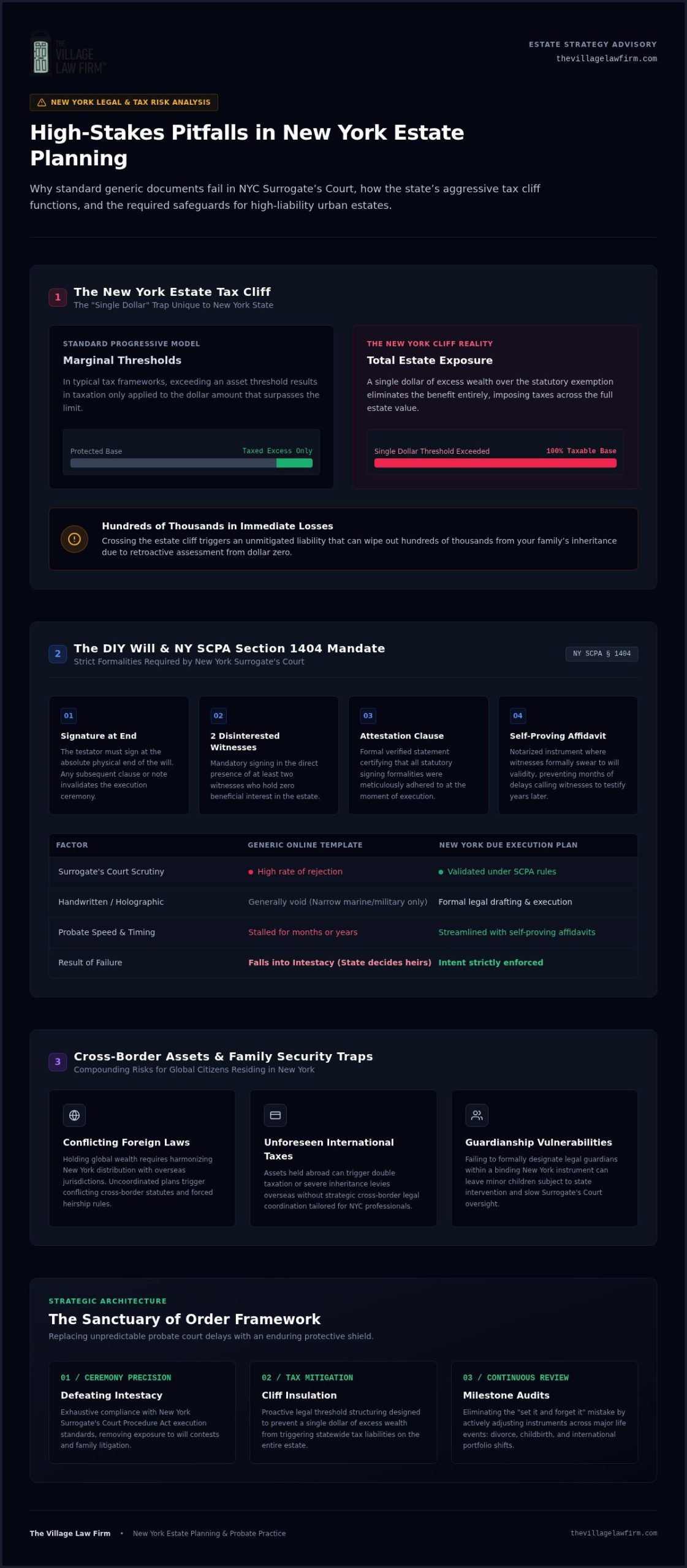
New York law requires that a testator sign their will at the very end in the presence of at least two disinterested witnesses who must also sign in the testator’s presence. This isn’t a suggestion; it’s a requirement for “due execution.” Handwritten or holographic wills are generally not recognized in New York unless they meet very narrow exceptions for military members or mariners at sea. To prevent future challenges, a well-drafted document includes a robust attestation clause. This clause serves as a formal statement by the witnesses that all legal formalities were observed during the signing. Additionally, including a self-proving affidavit, which is a notarized document where witnesses swear to the will’s validity, can save your family months of delays by removing the need for witnesses to testify in court years later.
The Chaos of an Invalid Document
When a court rejects a DIY will, your estate falls into intestacy. This means New York State, not you, decides who inherits your assets and who cares for your children. The emotional and financial cost of a will contest far outweighs the investment in professional drafting. A minor error in a template can spark years of family litigation, turning your legacy into a battleground. It’s also vital to remember that a will isn’t a “set it and forget it” task. Major life changes like a divorce, a new child, or acquiring property in the city require an immediate update to ensure your plan reflects your current intentions. While you might be looking at New York State estate tax guidelines to manage your wealth, the foundation of that protection starts with a validly executed document. If you’re unsure if your current papers hold up to NYC’s high standards, a protective partnership with a dedicated firm can ensure your sanctuary of order remains intact. We help you bridge the gap between a simple document and a comprehensive legacy.
Mistake #2: Falling Over the New York Estate Tax Cliff
NYC professionals often face a unique financial trap that exists in very few other states. While federal tax laws are relatively generous, New York’s tax code includes a punitive “cliff” that can catch even the most diligent savers off guard. This is one of the most expensive estate planning mistakes to avoid New York residents encounter. If your estate’s value exceeds the state’s exemption limit by just 5%, the entire exemption vanishes. Suddenly, you aren’t just taxed on the amount over the limit. You’re taxed on every single dollar from the very first cent. The state’s top tax rate of 16% applies quickly, making the financial impact of this mistake particularly severe for high-net-worth individuals who haven’t refined their strategy.
Understanding the NY Tax Cliff Mechanism
Most states and the federal government use a “bracketed” system. In those systems, you only pay tax on the portion of your wealth that exceeds the threshold. New York is different. According to the New York State Department of Taxation and Finance estate tax guidance, once your estate reaches 105% of the basic exclusion amount, the credit is completely phased out. This creates a literal cliff. A professional with a $7 million estate might pay nothing in state taxes, while someone with $7.5 million could see a tax bill in the hundreds of thousands. With NYC real estate prices consistently climbing, many families find themselves “accidentally” wealthy enough to fall over this edge without even realizing they’ve crossed the line.
Asset Protection Strategies for 2026
Navigating this risk requires more than just a simple will. You need a strategy that actively manages your taxable threshold to keep your legacy intact. One effective tool is the Credit Shelter Trust. These trusts allow married couples to effectively double their available exemption by carving out assets into a protected sub-trust upon the first spouse’s death. You might also consider a lifetime gifting strategy. By strategically reducing your estate’s size before 2026, you can stay safely below the cliff threshold. For a deeper look at these specific numbers and how they apply to your portfolio, see our guide on the New York Estate Tax Exemption 2026 & 2026: Navigating the ‘Cliff’ with Confidence. Meticulous planning isn’t just about saving money. It’s about ensuring your hard-earned legacy isn’t drained by avoidable state levies. We work as your partner to build a sanctuary of order that keeps your wealth where it belongs: with your family.
Mistake #3: Ignoring International Assets and Family Security
New York is the global center of business, and many of its residents live lives that span continents. You might have a pied-à-terre in Paris, a savings account in London, or family real estate in Hong Kong. Assuming a standard Manhattan will automatically covers these assets is a dangerous assumption. It’s one of the primary estate planning mistakes to avoid New York families encounter when their wealth crosses borders. International laws are often in direct conflict with U.S. statutes. Without a meticulous cross-border strategy, your foreign holdings could trigger double taxation or become trapped in years of foreign litigation. You’ve worked hard to build a global legacy; don’t let a lack of coordination dismantle it.
Cross-Border Assets and Multinational Planning
The legal concept of “conflict of laws” is a constant threat to international assets. Many European jurisdictions follow forced heirship rules, which mandate how property must be distributed regardless of what your will says. If your Manhattan-based documents don’t account for these local mandates, your intended heirs might be left with nothing. A sophisticated plan uses international trusts and jurisdiction-specific codicils to shield your wealth. For a detailed roadmap, read our 2026 Guide: International Estate Planning in New York. We act as your steady urban guide, bridging the gap between New York law and foreign requirements to ensure your sanctuary of order extends worldwide.
Protecting the Next Generation in NYC
Guardianship is perhaps the most emotionally charged aspect of any plan. Many parents make the mistake of naming only one guardian, failing to provide a backup if their first choice is unable to serve. In a city like New York, where parents frequently travel internationally, this oversight is critical. If something happens while you’re abroad, a caregiver or relative needs immediate legal authority to make medical or educational decisions. Temporary guardianship documents provide this vital protection. Our NYC Estate Planning: 2026 Parent’s Guide to Legal Security explains how to build a multi-layered shield for your children. Protecting your family isn’t just about money; it’s about the certainty that your children will always be in safe hands. If you own assets abroad or have young children, contact us today for a specialized international consultation to secure your global and family legacy.
Building a Sanctuary of Order: The Village Law Firm Approach
The weight of protecting a legacy in Manhattan can feel overwhelming. We understand that for a busy professional, the legal landscape often looks like a series of traps designed to complicate an already full life. Our firm doesn’t just file documents; we build a sanctuary of order that shields you from the most common estate planning mistakes to avoid New York residents often face. By replacing legal anxiety with a sense of meticulous security, we allow you to focus on what truly matters: your family and your future. We act as your steady urban guide, ensuring that every detail, from complex tax structures to international assets, is handled with white-glove precision.
A Partnership Mindset for NYC Families
We believe in a partnership mindset that goes far beyond transactional law. For NYC families, this means having a dedicated team that understands the emotional weight of legacy decisions. Whether you’re navigating the intricacies of cross-border estate administration or looking for long-term Medicaid planning, our approach is designed to remove complexity. We streamline these processes so you don’t have to carry the burden of administrative chaos. This empathetic, expert guidance is what transforms a standard legal service into a protective partnership. You gain the peace of mind that comes from knowing your plan is not just legally sound, but deeply aligned with your personal values.
Secure Your Legacy Today
There’s never a better time to audit your current strategy than right now. As we look toward the legal shifts of 2026, ensuring your plan is updated and robust is essential for maintaining your family’s security. Working with The Village Law Firm is a methodical journey toward clarity. We begin by identifying the specific estate planning mistakes to avoid New York law makes possible, then we meticulously craft a strategy to bypass them. It’s time to replace uncertainty with a sophisticated, protective plan that stands as a shield against the unpredictable. Take the first step toward a refined legacy today by scheduling a consultation to build your customized strategy. Let us handle the complexity while you enjoy the calm of a secure future.
Your Legacy Deserves a Sanctuary of Order
Your legacy is more than just a collection of assets; it’s the culmination of your life’s work and the foundation for your family’s future. Navigating the unique legal traps of the Empire State requires a partner who understands that precision is the only real protection. By addressing strict execution rules, the looming tax cliff, and the complexities of global holdings, you ensure your wishes aren’t lost in the friction of the Surrogate’s Court. Identifying the most common estate planning mistakes to avoid New York families face is the first step toward true security.
The Village Law Firm offers the white-glove service busy NYC professionals need to replace administrative chaos with lasting order. Our specialized expertise in cross-border estate administration ensures that your global footprint is protected, while our dedicated focus on local families provides the certainty your children deserve. You don’t have to navigate these complexities alone. Secure your family’s future with a sophisticated New York estate plan; schedule your consultation with The Village Law Firm today. You’ve built a remarkable life. Now, let’s make sure it’s protected for generations to come.
Frequently Asked Questions
What is the most common estate planning mistake in New York?
Failing to align beneficiary designations with your legal documents is a frequent error. While you may have a meticulously drafted will, assets like life insurance or 401(k) accounts pass directly to named beneficiaries regardless of what your will says. This lack of coordination often leads to unintentional disinheritance or tax inefficiencies. It’s one of the estate planning mistakes to avoid New York professionals frequently overlook when managing complex financial portfolios.
Does a will made in another state work in New York?
A will drafted in another state is typically recognized in New York if it was validly executed according to that state’s laws at the time. However, relying on an out-of-state document can lead to significant delays in the Surrogate’s Court. New York’s probate process is unique, and a document that doesn’t meet local standards might require additional affidavits or witness testimony, increasing the burden on your family during an already difficult time.
What happens if I exceed the New York estate tax exemption by a small amount?
Exceeding the threshold by even a small margin triggers the “cliff” mechanism. If your estate’s value is more than 105% of the basic exclusion amount, you lose the entire exemption. This results in a tax bill on the full value of the estate, not just the excess. Meticulous planning is required to ensure your assets remain below this limit or are structured within trusts to manage this specific New York tax liability and protect your wealth.
Can I appoint a guardian for my children if they live in another country?
You can certainly appoint a guardian who lives abroad, but it introduces logistical and legal hurdles. New York courts prioritize the child’s best interests, so you must clearly document your reasoning and ensure the transition is seamless. You should also consider appointing a local temporary guardian to provide immediate care while the permanent international guardian handles travel and legal requirements. This ensures your children are never left in a legal vacuum during a transition.
How often should I update my New York estate plan?
You should review your plan every three to five years to ensure it still aligns with current laws and your personal goals. Life moves fast in the city, and events like marriage, divorce, or the birth of a child require immediate adjustments. Significant changes in New York tax statutes or a substantial increase in your net worth also necessitate a professional audit to ensure you haven’t made common estate planning mistakes to avoid New York residents often face.
What is the difference between a revocable and irrevocable trust in NYC?
A revocable trust allows you to maintain full control over your assets and change terms at any time. It’s primarily used to avoid the lengthy probate process. In contrast, an irrevocable trust generally cannot be changed once established. While you give up control, it provides superior asset protection and can be a vital tool for Medicaid planning or reducing your taxable estate. Each serves a distinct purpose in a sophisticated, white-glove legacy strategy.
How does the New York probate process differ from other states?
New York’s probate process is overseen by the Surrogate’s Court and is known for its high level of scrutiny. Unlike states with more informal procedures, New York requires strict adherence to witness rules and formal notifications for all interested parties. Filing fees are also based on the estate’s value, which can be higher than in other jurisdictions. This complexity makes having a steady urban guide essential to avoid unnecessary delays and family friction during administration.
Do I need an international estate plan if I only have one bank account abroad?
Yes, even a single foreign account can complicate your estate administration. Foreign banks often refuse to recognize U.S. probate orders, requiring a separate legal process in that country to release the funds. An international strategy ensures that all your global assets are coordinated under one cohesive plan. This prevents the administrative chaos that often ensues when families have to hire multiple lawyers across different time zones to settle a single cross-border estate.