
A meticulously drafted will can quietly transform into your family’s greatest liability the moment your life changes or state statutes shift. If you are wondering when to update your estate plan New York law requires, you aren’t alone. It’s completely natural to feel uneasy about whether outdated paperwork might trigger painful probate gridlock in Surrogate’s Court, expose your assets to New York’s unforgiving estate tax cliff, or leave designations favoring an ex-spouse.
Your legacy is not a static archive; it’s a dynamic safeguard designed to evolve alongside you. In this guide, you’ll discover the critical life events, statutory changes, and timelines that require updating your New York estate plan. We’ll walk through the mandatory triggers for document revisions, unpack the crucial differences between simple amendments and complete restatements, and provide the clarity you need to ensure your wealth passes smoothly under current New York laws.
Key Takeaways
- Discover the standard benchmarks for when to update your estate plan New York legal advisors recommend, keeping your documents aligned through an essential three-to-five-year review cadence.
- Identify how critical milestones like marriage, welcoming children, or marital separation demand immediate adjustments before default statutory rules take over.
- Protect your wealth against New York’s punitive estate tax cliff and the shifting gap between state and federal thresholds through proactive trust structures.
- Conduct a thorough audit across wills, trusts, powers of attorney, and non-probate beneficiary designations to ensure every asset functions in complete harmony.
- Learn why estate planning practitioners favor complete document restatements over piecemeal codicils to prevent costly probate delays in Surrogate’s Court.
The Recommended Timeline: How Often Should You Review an Estate Plan in New York?
Estate planning is never a one-time transaction. The quiet passage of time erodes even the most meticulous legal strategies, turning what was once comprehensive protection into an administrative bottleneck. Understanding when to update your estate plan New York professionals advise requires distinguishing between routine calendar checkups and urgent, event-driven revisions. While rapid macroeconomic shifts continually alter property values across Manhattan and the outer boroughs, your foundational documents demand deliberate, structured oversight to remain effective.
The Three-to-Five-Year Benchmark Explained
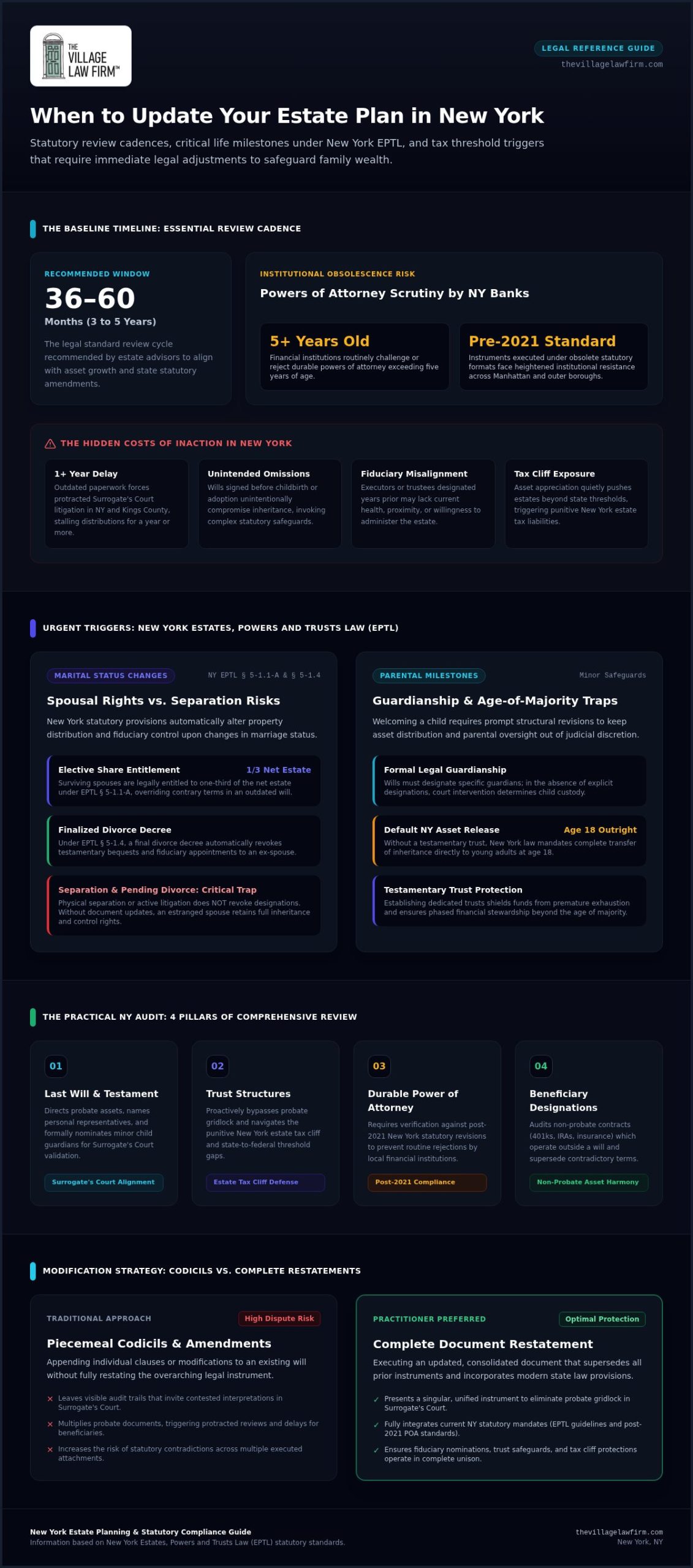
Experienced attorneys recommend a comprehensive review every thirty-six to sixty months. Over three to five years, gradual increases in personal wealth, changes in business equity, or real estate appreciation can quietly push an estate past critical statutory thresholds. Beyond asset growth, the instruments themselves face practical obsolescence. New York financial institutions routinely scrutinize aging durable powers of attorney; banks frequently reject forms older than five years or those executed under pre-2021 statutory standards. Refreshing these instruments ensures your designated fiduciaries can act without institutional resistance.
The Hidden Cost of Inaction for New York Families
Failing to review your documents creates friction where there should be stability. In New York County or Kings County, outdated wills routinely force families into protracted Surrogate’s Court litigation, where contested interpretations stall distributions for a year or longer. The human toll is equally steep:
- Unintended omissions: Wills drafted before the birth or adoption of a child can unintentionally limit their direct inheritance, triggering complicated statutory protections under New York law.
- Misaligned fiduciaries: Friends or family appointed a decade ago may no longer have the health, proximity, or willingness to serve as executors or trustees.
- Structural tax traps: Outdated trusts fail to account for current state thresholds, exposing family wealth to unnecessary taxation.
Grounding your strategy in estate planning fundamentals transforms document maintenance from an administrative burden into proactive protection. If you are assessing your current readiness and establishing clear timelines for when to update your estate plan New York statutes govern, reviewing trusted guidance from an Estate Planning Attorney New York: Protecting Your Legacy in 2026 provides the clarity and reassurance your family deserves.
Critical Life Events Demanding Immediate Estate Plan Revisions
Life in New York moves quickly. While a regular calendar review offers steady protection, sudden personal milestones alter your legal reality overnight. Knowing when to update your estate plan New York attorneys emphasize is critical because waiting for your next scheduled checkup can leave significant legal vulnerabilities wide open. When personal circumstances shift, your estate plan must pivot immediately to reflect your true intentions.
Marital Status Changes and the New York Elective Share
Under New York Estates, Powers and Trusts Law (EPTL) § 5-1.1-A, a surviving spouse is entitled to an elective share of one-third of your net estate, overriding conflicting terms in an outdated will. While a finalized divorce decree automatically revokes testamentary bequests and fiduciary appointments under EPTL § 5-1.4, physical separation or pending divorce litigation does not. If you pass away during separation proceedings without updating your documents, your estranged partner remains legally entitled to inherit and control your assets.
Welcoming Children and Appointing Legal Guardians
Welcoming a child demands prompt structural additions to your planning. You must formally designate legal guardians to ensure the courts do not choose who raises your children if the unthinkable happens. Equally important is establishing testamentary trusts. Without trust safeguards, New York law releases funds to young adults at age eighteen outright, exposing inheritances to poor financial decisions. For young parents seeking structured peace of mind, our NYC Estate Planning: 2026 Parent’s Guide to Legal Security outlines how to protect your family’s future.
Purchasing Real Estate and High-Value Business Milestones
Acquiring New York City property dramatically reshapes your balance sheet and introduces complex titling issues. Purchasing a brownstone, condo, or co-op requires proactive trust alignment to bypass protracted Surrogate’s Court delays. Co-ops present distinct hurdles because shares and proprietary leases require board approval before transfer into a revocable trust:
- Co-op transfer mechanics: Individual co-op shares held outside a trust force your family into full probate, irrespective of overall estate size.
- Tax threshold exposure: Escalating property values can suddenly propel your estate past the thresholds detailed in official New York State Department of Taxation and Finance estate tax guidelines.
- Entity governance updates: Launching a closely held business or commercial venture necessitates explicit succession terms and voting rights transfers.
If recent life shifts have changed your personal or financial standing, consulting with experienced counsel at The Village Law Firm can swiftly realign your foundational documents with your current intentions.
New York Legal and Tax Triggers That Mandate Document Updates
External statutory shifts often dictate changes long before personal milestones occur. Albany and Washington regularly adjust financial limits, creating clear benchmarks for when to update your estate plan New York taxpayers must respect. Even if your domestic life remains completely unchanged, shifting statutory frameworks can expose your hard-earned assets to immediate tax penalties or administrative refusal.
Navigating the New York Estate Tax Exemption and Cliff
New York maintains a unique, punitive estate tax structure. For 2026, the state basic exclusion amount is $7,350,000 per individual, but under New York Tax Law § 952, an aggressive “cliff” extinguishes the entire exemption if your taxable estate exceeds 105% of this baseline ($7,717,500). Crossing that limit by a single dollar taxes your estate from dollar one, generating rates up to 16%.
Unlike federal rules, New York does not recognize spousal portability. Without affirmative credit shelter trusts or disclaimer trusts, the first-to-die spouse’s state exemption disappears permanently. To evaluate your asset positioning against these rules, study our detailed analysis of the New York Estate Tax Exemption 2026 & 2026: Navigating the ‘Cliff’ with Confidence.
Statutory Power of Attorney and Healthcare Directive Changes
Substantive revisions to the New York General Obligations Law § 5-1513 completely overhauled statutory short-form powers of attorney. The law eliminated the separate, cumbersome Statutory Gifts Rider, introducing a consolidated form executed before two disinterested witnesses and a notary public. Financial institutions routinely challenge pre-June 2021 power of attorney instruments that rely on the old rider structure. Concurrently, advance directives and healthcare proxies must align with modern electronic health systems so medical personnel can verify decision-making authority instantly during a crisis.
Cross-Border Wealth and Multi-Jurisdictional Exposure
Global mobility creates unexpected legal complexity for cosmopolitan New Yorkers. When holding real property abroad or managing cross-border family interests, standard domestic instruments often fall short. A New York will cannot cleanly transfer foreign real estate without navigating foreign succession regimes, forced heirship rules, or parallel probate proceedings. Adhering to official New York Courts guidance on wills and probate ensures baseline domestic validity, but international holdings require tailored cross-border coordination to prevent administrative paralysis across jurisdictions.
How to Conduct an Estate Plan Audit: A Practical New York Checklist
A successful estate plan functions as an integrated ecosystem, not an isolated stack of documents. Disconnects between paper declarations and actual asset titling undermine even the most sophisticated strategies. Conducting an annual diagnostic audit reveals whether your financial architecture still reflects your goals, providing an unmistakable signal for when to update your estate plan New York professionals advise.
Reconciling Non-Probate Beneficiary Designations
Contracts govern non-probate transfers independently of your will. Beneficiary forms on 401(k) plans, traditional IRAs, and life insurance policies override conflicting terms drafted in your testamentary documents. If your will leaves everything equally to your children, but your primary retirement account names a former spouse or leaves secondary contingents blank, the financial custodian will distribute those funds directly to the listed individual or surrender them to standard probate defaults. Review every transfer-on-death (TOD) and paid-on-death (POD) designation across your financial institutions to guarantee absolute alignment.
Verifying Trust Funding and Property Ownership Titling
Executing a revocable living trust is merely the opening step. A trust only controls assets officially transferred into its name. An unfunded or partially funded trust offers zero protection against Surrogate’s Court delays. You should systematically confirm that:
- Real property deeds reflect trust ownership: Confirm your deed names the trust as owner, especially after refinancing or acquiring new properties.
- Co-op shares and proprietary leases are formally reassigned: NYC co-op boards require specific transfer approvals, stock certificates, and proprietary lease amendments to ensure shares avoid probate.
- Corporate governing documents match succession plans: Operating agreements for LLCs or shareholder agreements for closely held businesses must designate succession paths without court intervention.
Assessing Fiduciary Fitness and Successor Selections
Relationships evolve over time. The executor, trustee, or healthcare agent you chose years ago may no longer be the best fit today due to relocation, aging, or personal conflicts. Reassess your designated fiduciaries honestly to ensure they maintain the health, financial acumen, and availability required by New York law.
Take control of your legacy today. If your audit reveals misaligned assets or outdated fiduciary choices, schedule an estate planning consultation with The Village Law Firm to restore balance and complete protection across your entire portfolio.
Modifying Your Plan: Codicils, Amendments, or Complete Restatements?
Deciding when to update your estate plan New York attorneys advise is only the first step. You must also determine the proper legal mechanism for executing those changes. Many individuals mistakenly believe modifying an estate plan involves penning marginal notes or drafting an informal memo. Under New York law, informal alterations can invalidate an entire document, turning an intended revision into an expensive legal crisis.
The Dangers of Codicils Versus Comprehensive Restatements
Historically, attorneys used codicils to amend wills without retyping lengthy pages. Today, modern estate practice strongly disfavors piecemeal codicils. In New York Surrogate’s Court, presenting a will alongside multiple codicils invites contentious interpretation, complicates citations, and increases the likelihood of objections from disappointed heirs. For revocable living trusts, a comprehensive trust restatement completely replaces prior provisions while preserving the trust’s original execution date and tax identification. This approach avoids retitling funded assets and prevents conflicting clauses from muddying your intent.
Strict Execution Ceremonies Under New York Law
New York Estates, Powers and Trusts Law (EPTL) § 3-2.1 enforces rigid formal execution standards. Strikethroughs, margin notes, or handwritten changes on an executed will are legally void; worse, they can trigger an evidentiary hearing regarding whether the testator intended partial or total revocation. Validly updating a New York will or trust amendment requires:
- Two disinterested witnesses: Observers must witness your signature, hear you declare the instrument as your will, and sign within thirty days of each other.
- Affidavits of attesting witnesses: Contemporaneous notarized self-proving affidavits streamline future probate proceedings.
- Supervised execution: An attorney-supervised ceremony creates a legal presumption that all statutory formalities were properly satisfied.
Partnering with The Village Law Firm for Lasting Security
True peace of mind comes from knowing your legal documents work harmoniously under current statutes. Transitioning an outdated estate plan into a modern, robust legal framework requires tailored precision. Rather than treating updates as an administrative hurdle, view them as an ongoing commitment to your family’s enduring protection. Schedule a consultation with The Village Law Firm to conduct a thorough review and ensure your legacy remains secure, structured, and legally unassailable.
Take Command of Your Future: Realigning Your New York Estate Plan
A static legal document cannot shield a dynamic life. Deciding when to update your estate plan New York statutes govern isn’t just an administrative chore; it is an enduring act of family stewardship. Whether you must navigate New York’s unforgiving estate tax cliff, align newly acquired real estate, or replace an aging power of attorney, timely adjustments prevent devastating Surrogate’s Court disputes before they take root.
As a boutique Manhattan practice, The Village Law Firm offers compassionate, white-glove estate counsel tailored to fast-paced professionals, young families, and cross-border property owners. We look past isolated clauses to deliver holistic protection, harmonizing wills, living trusts, and beneficiary designations into an integrated shield. Schedule a comprehensive estate plan review with The Village Law Firm to replace vulnerability with total clarity and enduring peace of mind.
Frequently Asked Questions
How do I know if my New York estate plan is legally out of date?
Your estate plan is likely out of date if your documents are more than five years old, rely on pre-June 2021 statutory power of attorney forms, or fail to reflect major life transitions. Identifying when to update your estate plan New York statutes govern also depends on your assets. Significant portfolio appreciation, purchasing real estate, or structural changes to tax laws require immediate professional legal verification.
Can I make changes to my New York will by writing notes in the margins?
No, handwritten alterations, margin notes, and strikethroughs on an executed will are completely invalid under New York law. Attempting informal edits can trigger intense Surrogate’s Court litigation and potentially invalidate the entire instrument. Any modification requires a formally executed amendment or an updated will drafted under statutory execution rules, witnessed by two independent parties, and executed before a notary public.
Does divorce automatically remove my former spouse from my New York estate plan?
Yes, a finalized divorce judgment revokes testamentary bequests, fiduciary appointments, and revocable beneficiary designations under New York EPTL § 5-1.4. However, physical separation or ongoing divorce proceedings provide zero automatic protection. Until the court issues a final decree, your spouse retains legal rights to inherit and manage your estate unless you affirmatively execute updated documents disinheriting them to the extent permitted by law.
How often should I review my designated guardians, executors, and trustees?
You should review all appointed fiduciaries every three to five years, or immediately if someone moves away, faces health issues, or experiences altered personal circumstances. Serving as an executor or trustee requires substantial time and administrative focus. Ensuring your nominated representatives possess the current willingness, capacity, and geographic proximity to handle estate administration avoids severe procedural delays in New York courts.
What is the New York estate tax cliff and will it impact my updated plan?
The New York estate tax cliff is a statutory threshold that extinguishes your entire state estate tax exemption if your taxable estate exceeds the basic exclusion amount by more than five percent. For 2026, crossing 105% of the $7,350,000 threshold ($7,717,500) taxes the entire estate from the very first dollar. Factoring this cliff into when to update your estate plan New York tax strategies require prevents devastating tax liabilities.
What happens if I purchase a new home or apartment after finalizing my trust?
If you purchase a new property in your individual name rather than the name of your trust, that specific asset remains subject to probate. A revocable trust only governs real estate formally transferred into its title. Leaving a new condo, brownstone, or co-op outside your trust entity forces your estate into Surrogate’s Court, defeating the core privacy and asset protection benefits of your trust.
Do beneficiary designations on retirement accounts override my New York will?
Yes, non-probate beneficiary designations on assets like 401(k) plans, traditional IRAs, brokerage transfer-on-death accounts, and life insurance policies always override conflicting instructions in your will. Financial institutions distribute funds strictly according to the beneficiary form on file. Failing to coordinate these external forms with your overarching legal framework can inadvertently disinherit intended beneficiaries or cause serious settlement discrepancies across your estate.