
Could a single dollar of additional wealth actually cost your family over $500,000 in unnecessary taxes? You’ve spent a lifetime building a legacy in a city that demands excellence, so it’s natural to feel uneasy when you hear whispers of the infamous New York tax cliff. It feels inherently wrong that the new york estate tax exemption 2025 level of $7,160,000 isn’t a simple safety net, but a rigid boundary where a minor calculation error can trigger a massive tax bill on your entire estate.
We believe that your hard work deserves a steady hand and a sophisticated plan to replace complexity with absolute order. This guide will provide the clarity you need to shield your family’s future and manage these unique state laws with confidence. You’ll gain a thorough understanding of the 105% rule, the impact of the three-year gift add-back, and the actionable strategies required to protect your global assets before the 2026 exemption shift to $7,350,000.
Key Takeaways
- Identify the exact thresholds for the new york estate tax exemption 2025 and 2026 to establish a clear baseline for your legacy planning.
- Uncover the mechanics of the punitive tax cliff, where exceeding the exemption by just 5% can subject your entire estate to significant taxation.
- Learn how to manage the three-year gift add-back rule and residency nuances to prevent unexpected increases in your taxable estate value.
- Explore advanced strategies like charitable bequests and Credit Shelter Trusts designed to lower your estate’s value and secure your family’s wealth.
- Transition from the stress of complex tax laws to a state of calm through a meticulous plan that protects your global assets and family’s future.
Understanding the New York Estate Tax Exemption: 2025 and 2026 Thresholds
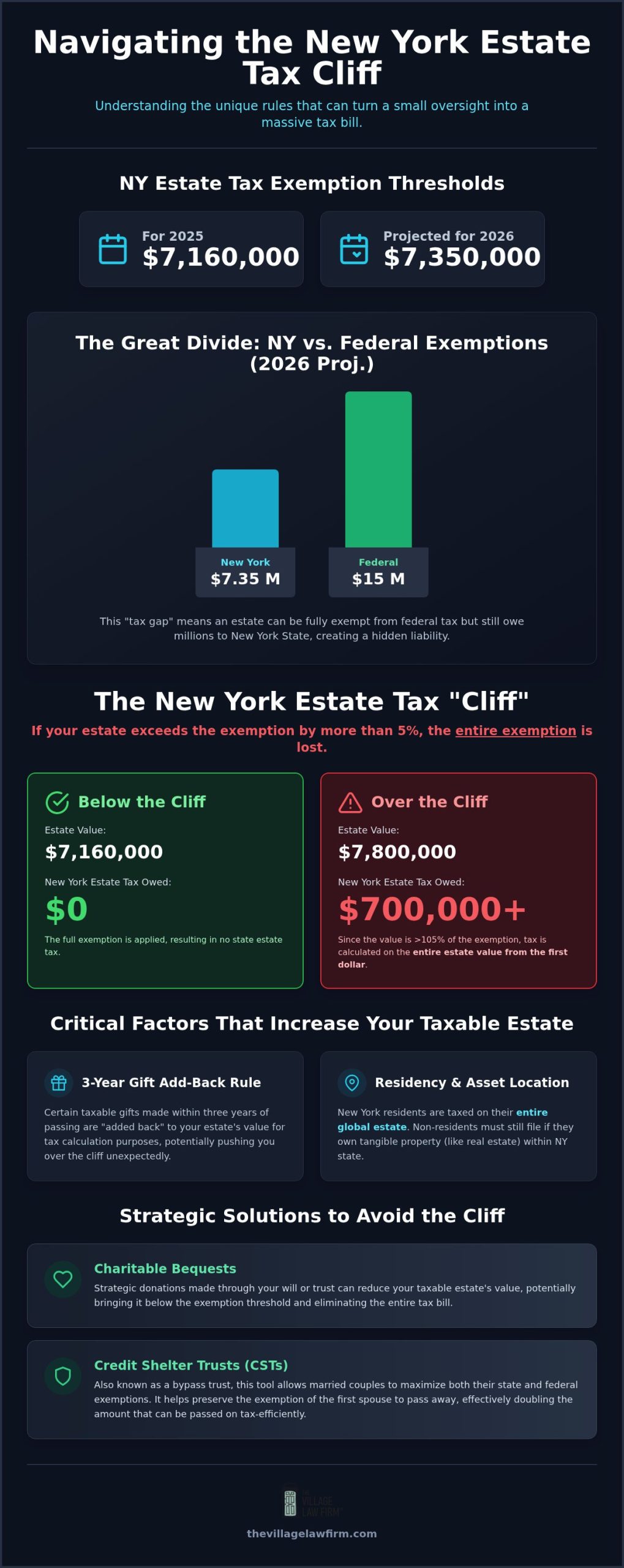
The New York Estate Tax is a levy on your right to transfer property at the time of your passing. It’s an assessment of everything you’ve built, from your primary residence in Manhattan to your global investment accounts. For many families, this tax represents a significant hurdle in the transition of wealth. Understanding the new york estate tax exemption 2025 is the first step toward moving your family from financial chaos to legal order. For the 2025 calendar year, the basic exclusion amount is set at $7,160,000. Looking further ahead, this figure is scheduled to increase to $7,350,000 in 2026.
Residency plays a pivotal role in how these numbers apply to you. If you’re a New York resident, the state exerts its reach over your entire global estate, regardless of where your assets are physically located. This state-level tax operates independently from the Estate tax in the United States, and the discrepancy between the two is where most families find themselves vulnerable. While federal law offers a much wider safety net, New York remains one of the more aggressive jurisdictions in the country.
Who Must File a New York Estate Tax Return?
Filing requirements are triggered by the total value of your “Federal Gross Estate” plus any taxable gifts made during your lifetime. You must file a New York estate tax return if you fall into these categories:
- You’re a New York resident whose gross estate, when combined with certain lifetime gifts, exceeds the state’s exemption threshold.
- You’re a non-resident who owns tangible property, such as real estate or business equipment, located physically within New York State.
- Your estate exceeds the new york estate tax exemption 2025 limit of $7,160,000, even if no federal tax is owed.
The calculation begins with your federal gross estate, which includes life insurance proceeds, retirement accounts, and jointly held property. Precision is required here. Even if you don’t live in the state, owning a high-value condo in Brooklyn can necessitate a complex filing process for your heirs.
The Widening Gap: New York vs. Federal Exemptions
There is a massive disconnect between state and federal tax thresholds. While the federal exemption is projected to reach $15 million per person in 2026, New York’s limit remains less than half of that amount. This creates a dangerous “tax gap” where an estate might be completely exempt from federal taxes but still owe millions to Albany. Planning only for federal limits leaves your family exposed to state-level liabilities that can reach a top rate of 16%.
The tax gap for NYC residents with high-value property is the hidden financial liability that exists between the $7.16 million New York threshold and the $15 million federal limit, often resulting in a six-figure tax bill that standard federal-only planning fails to address.
The New York Estate Tax Cliff: Why Precision Planning is Mandatory
Most tax systems function like a ladder where you only pay higher rates on the dollars that exceed a certain threshold. New York’s estate tax is different. It’s built with a structural trap known as the “cliff” that can penalize an estate for even a minor overstep. If the value of your assets exceeds the new york estate tax exemption 2025 by more than 5%, the state revokes the entire exemption. This isn’t just a tax on the excess; it’s a tax on every single dollar you intend to leave behind. For families with estates valued between $7 million and $10 million, this “Danger Zone” requires meticulous attention to detail to avoid a catastrophic financial outcome.
Consider the stark reality of two hypothetical estates. Family A meticulously plans their estate to remain at $7.1 million, just under the 2025 limit. They pay $0 in New York estate tax. Family B, perhaps through a slight increase in property value or a small unrecorded gift, leaves an estate of $7.8 million. Because they’ve fallen off the cliff, their tax bill doesn’t just apply to the extra $700,000. It applies to the full $7.8 million, resulting in a tax liability that can exceed $700,000. Proactive legal intervention is the only way to ensure your family doesn’t face this unnecessary burden.
The 105% Rule Explained
The “Cliff” is governed by what tax professionals call the 105% rule. According to the New York State Department of Taxation and Finance, the estate tax credit is completely eliminated once the taxable estate reaches 105% of the basic exclusion amount. If you’re even one dollar over that 105% mark, the state calculates tax starting from the very first dollar. The rates escalate rapidly, starting at 3.06% and climbing to 16%. This aggressive stance makes New York one of the most challenging environments for wealth transfer in the country, turning what should be a moment of legacy into a complex mathematical hurdle.
Visualizing the Impact: The Cost of a $1 Overstep
The financial consequences of the cliff are best understood through direct comparison. When an estate is near the edge, the “marginal tax rate” on that final dollar can effectively exceed 100%. In simpler terms, earning or keeping an extra dollar of wealth could actually cost you several dollars in additional taxes. This is why a partnership with an experienced estate planning attorney New York is vital for those who value precision.
| Estate Value | Exemption Status | Estimated NY Tax |
|---|---|---|
| $7,100,000 | Fully Exempt | $0 |
| $7,400,000 | Phase-out Zone | ~$250,000 |
| $7,800,000 | Off the Cliff | $700,000+ |
Navigating these waters requires more than just a transactional approach; it demands a strategy that views your assets through a protective lens. If you’re concerned your estate might be hovering near these thresholds, it’s time to seek a steady urban guide who can help you find a sanctuary of order amidst New York’s legal complexity.
Beyond the Exemption: The 3-Year Gift Add-Back and Residency Rules
Planning for the inevitable shouldn’t feel like a cold, clinical transaction. It’s a deeply personal act of protection for those you love. While the new york estate tax exemption 2025 provides a clear target, New York law includes a specific mechanism designed to capture assets transferred shortly before death. This is known as the “3-year lookback” or gift add-back rule. It ensures that the state can tax wealth that was technically given away, preventing families from using “deathbed gifting” to drop their estate value below the cliff at the last moment.
According to the New York State Department of Taxation and Finance, any taxable gifts made within the three-year period prior to a decedent’s death are added back to the value of the gross estate. There are notable exceptions to this rule. Gifts of real or tangible property located outside of New York are generally excluded. Additionally, gifts made while the donor was not a resident of New York State do not fall into this trap. Navigating these nuances requires a protective legal partner who views your legacy as a partnership, not just a set of numbers on a ledger.
How Gift Add-Backs Trigger the Cliff
Residency and the ‘Situs’ of Your Assets
New York’s reach depends heavily on where you call home and where your property sits. For residents, the state taxes everything. For non-residents, the tax only applies to “tangible” property located within state lines. This creates a unique danger for expats or professionals who have moved abroad but kept their West Village apartments. While your stocks and bonds might be safe from New York’s grasp, that physical real estate remains firmly in the “situs” of New York taxation. If you own property across state lines or international borders, you may need to consider ancillary probate in New York to manage these out-of-state assets with the meticulous attention they deserve.
Strategic Solutions: Avoiding the Cliff with Sophisticated Planning
For married couples, Credit Shelter Trusts are essential. New York does not allow for portability of the exemption between spouses, meaning the first spouse’s unused exemption is lost if not captured immediately. These trusts allow each person to fully utilize their individual credit, effectively doubling the amount you can pass down tax-free. Additionally, irrevocable trusts serve as powerful instruments to remove appreciating assets from your taxable estate entirely. These structures provide a sense of security, ensuring that your NYC real estate or business interests aren’t swallowed by state levies.
The Charitable Savings Clause: A Safety Net
This clause acts as a vital safety valve for estates hovering near the threshold. If your assets appreciate unexpectedly before your passing, the Santa Clause ensures your family isn’t penalized for that growth. It replaces the anxiety of a $700,000 tax bill with the peace of mind that comes from a purposeful legacy. It’s a methodical solution to a chaotic legal trap. Beyond the financial benefits, there is a profound psychological reward in knowing that your wealth is either staying with your family or doing good in the world, rather than being lost to a structural tax quirk.
International Assets and Cross-Border Considerations
Global citizens face an even higher level of complexity that standard planning often ignores. When your assets span multiple countries, you must account for foreign tax credits and specific treaty protections to avoid double taxation. Structuring an estate with international components requires a specialized NYC attorney who understands the interplay between local laws and global treaties. For a comprehensive overview of how to unify your worldwide holdings under a single protective strategy, our 2026 guide to international estate planning in New York provides the sophisticated framework global citizens need. We act as your steady urban guide, ensuring your worldwide legacy is meticulously protected. Whether you own property in Europe or business interests in Asia, your plan must be as dynamic as your life.
Protecting a complex, multi-jurisdictional estate requires more than just a transactional relationship. If you’re ready to secure your family’s future across all borders, partner with an expert who understands the intricacies of international wealth and New York law.
Securing Your Legacy: Moving from Financial Chaos to Legal Order
Legacy isn’t a spreadsheet. It’s the quiet assurance that your children are provided for and your life’s work is protected from arbitrary thresholds. While we’ve discussed the mechanics of the new york estate tax exemption 2025, the true goal of planning is to move your family from a state of unpredictability to a sanctuary of order. New York’s laws are designed to be complex, but they don’t have to be overwhelming. By viewing these regulations through a lens of protection rather than just compliance, you can ensure that your transition of wealth is seamless and dignified.
The Village Law Firm acts as a steady urban guide for professionals who value meticulous attention to detail. We understand that your life is fast-paced and your assets are often complex. Whether you’re concerned about Medicaid planning for an aging parent or navigating the intricacies of international estate planning in New York, our approach is rooted in a partnership mindset. We don’t just draft documents; we build shields against future uncertainty. Our firm specializes in replacing the stress of the unknown with the stability of a well-crafted plan.
The Village Law Firm Difference: A Partnership Mindset
Our “white-glove” service model is specifically tailored for busy New York families who require efficiency without sacrificing depth. We specialize in cross-border estate administration, ensuring that international assets are managed with the same precision as a Manhattan co-op. This is particularly vital for families with children, where the stakes of planning extend far beyond tax savings. For parents who want to ensure their children are protected by a precise legal framework — including guardian appointments and inheritance safeguards — our NYC estate planning guide for families with children outlines the critical steps every New York parent should take. We provide dedicated strategies for:
- Cross-border estate administration and international probate for global citizens.
- Medicaid planning to protect assets from the rising costs of long-term care.
- Specialized guardianship and trust planning for families with minor children.
- Comprehensive reviews of the new york estate tax exemption 2025 and its impact on your specific holdings.
Next Steps: Your 2026 Estate Audit
The most effective way to address the tax cliff is through a proactive audit of your current holdings. During an initial consultation, we’ll review your asset lists, existing wills, and any life insurance policies to identify potential vulnerabilities. This process isn’t just about identifying risks; it’s about creating a roadmap for long-term security. Coming prepared with a clear picture of your global assets allows us to craft a plan that is truly “cliff-proof.” You’ll walk away with a clear understanding of how to stay within the safe harbor of the law.
You deserve the peace of mind that comes from knowing every detail has been accounted for. Don’t leave your legacy to the whims of shifting state thresholds. Take the first step toward a more secure future and schedule a consultation with The Village Law Firm today.
Your Path to a Secure and Orderly Legacy
The complexities of the new york estate tax exemption 2025 shouldn’t be a source of constant anxiety for your family. You’ve spent a lifetime building a legacy in a city that moves at lightning speed; your estate plan should reflect that same level of excellence and precision. By understanding the $7,160,000 threshold and the punitive nature of the tax cliff, you’ve already taken the first step toward moving from chaos to absolute order. Whether you’re managing high-value NYC real estate or navigating the intricacies of cross-border estate administration, a protective strategy is your best shield against future uncertainty.
At The Village Law Firm, we pride ourselves on being the steady urban guide for busy professionals. Our white-glove service is designed to handle your global assets with the empathetic, sophisticated care they deserve. We replace confusion with transparency, ensuring your wealth reaches the next generation intact. Secure your family’s legacy and avoid the NY estate tax cliff; schedule your consultation today. You have the power to protect what you’ve built, and we’re honored to walk alongside you every step of the way.
Frequently Asked Questions
What is the New York estate tax exemption for 2025 and 2026?
For 2025, the basic exclusion amount is set at $7,160,000, and it is scheduled to increase to $7,350,000 in 2026. These figures are adjusted annually for inflation to help families preserve the value of their legacy against rising costs. Understanding the new york estate tax exemption 2025 is essential for any resident whose total assets, including real estate and life insurance, approach these specific state thresholds.
How does the New York estate tax ‘cliff’ work?
The “cliff” is a unique and punitive rule where the entire estate tax credit is lost if the taxable estate exceeds 105% of the exemption amount. If your estate’s value is even slightly over this 105% limit, the state taxes the entire estate starting from the very first dollar. This mechanism can result in a tax bill of several hundred thousand dollars triggered by just a small amount of excess wealth.
Does New York have a gift tax?
New York does not currently impose a standalone gift tax on lifetime transfers. You can give away assets during your life without paying a state-level tax at the time the gift is made. However, these transfers are often added back to the value of your estate if they occur within three years of your death, which can unexpectedly push your estate over the tax cliff.
What is the 3-year gift add-back rule in New York?
This rule requires that any taxable gifts made within three years of a decedent’s death be included in the total value of the gross estate. It’s designed to prevent “deathbed gifting” used to bypass state taxes at the last moment. If these recent gifts push your total estate value over the new york estate tax exemption 2025 limit, your heirs could face the full weight of the tax cliff.
Can I avoid the NY estate tax cliff by giving to charity?
You can use a “Santa Clause” or charitable savings clause to direct any amount over the exemption limit to a qualified charity. This formula-based strategy effectively pulls your estate value back from the cliff’s edge before the tax is triggered. It ensures that your family stays within the tax-free threshold while also fulfilling your philanthropic goals and protecting your hard-earned assets from unnecessary levies.
Are non-residents subject to New York estate tax?
Non-residents are only subject to New York estate tax on tangible property, such as real estate or business equipment, located physically within the state. Intangible assets like stocks, bonds, or bank accounts are generally not subject to NY tax for those living elsewhere. If you own a high-value apartment in NYC but maintain residency in another state, your estate may still be required to file a New York return.
What happens if my estate exceeds the NY exemption but is below the federal exemption?
You will owe New York estate tax even if you owe zero federal estate tax. This “tax gap” exists because the federal exemption is significantly higher, reaching $15 million per person in 2026. Many New York families find themselves in this middle ground, requiring state-specific planning to avoid losing a large portion of their inheritance to state taxes despite being federally exempt.
Do I need a trust to avoid the New York estate tax cliff?
While not strictly required by law, trusts are the most effective and sophisticated tools for managing the cliff and New York’s lack of spousal portability. Credit Shelter Trusts and Irrevocable Trusts allow you to maximize individual exemptions and remove appreciating assets from your taxable estate entirely. A well-structured trust provides a sanctuary of order and long-term security for your family’s future legacy.