
What if your family’s most private financial details became a matter of public record for any curious neighbor or creditor to browse? In the fast-paced environment of New York, the probate process isn’t just a legal formality. It is a public and often grueling marathon that can freeze your assets for nine to eighteen months. You’ve spent a lifetime building a legacy with meticulous care; yet, without a specific architecture for your assets, that legacy can be stalled by bureaucratic delays and eroded by court fees. Achieving the goal of avoiding probate in New York is about more than just saving money. It’s about maintaining a sanctuary of order and ensuring your family’s transition remains a private, dignified matter.
We recognize that the unpredictability of the Surrogate’s Court system feels like an unnecessary weight during an already emotional time. You deserve a partner who acts as a shield, providing your heirs with immediate access to funds and the security that comes with total transparency. This strategic 2026 guide will show you how to bypass the courtroom entirely. We’ll walk through the sophisticated tools available to you, from living trusts to precise asset titling, so you can replace potential chaos with a seamless, professional transfer of your life’s work.
Key Takeaways
- Recognize the timeline and public nature of the Surrogate’s Court process, which can freeze New York estates for nine to eighteen months.
- Explore how a Revocable Living Trust functions as a private sanctuary, allowing for the immediate and seamless transfer of assets to your heirs.
- Master the strategic asset titling and beneficiary designations required for avoiding probate in New York while maintaining total family privacy.
- Identify the specialized methods needed to protect international property and prevent the complications of secondary court proceedings in foreign jurisdictions.
- Discover how a meticulous audit of your asset architecture creates a shield against future uncertainty for your family.
The Reality of the New York Probate Process
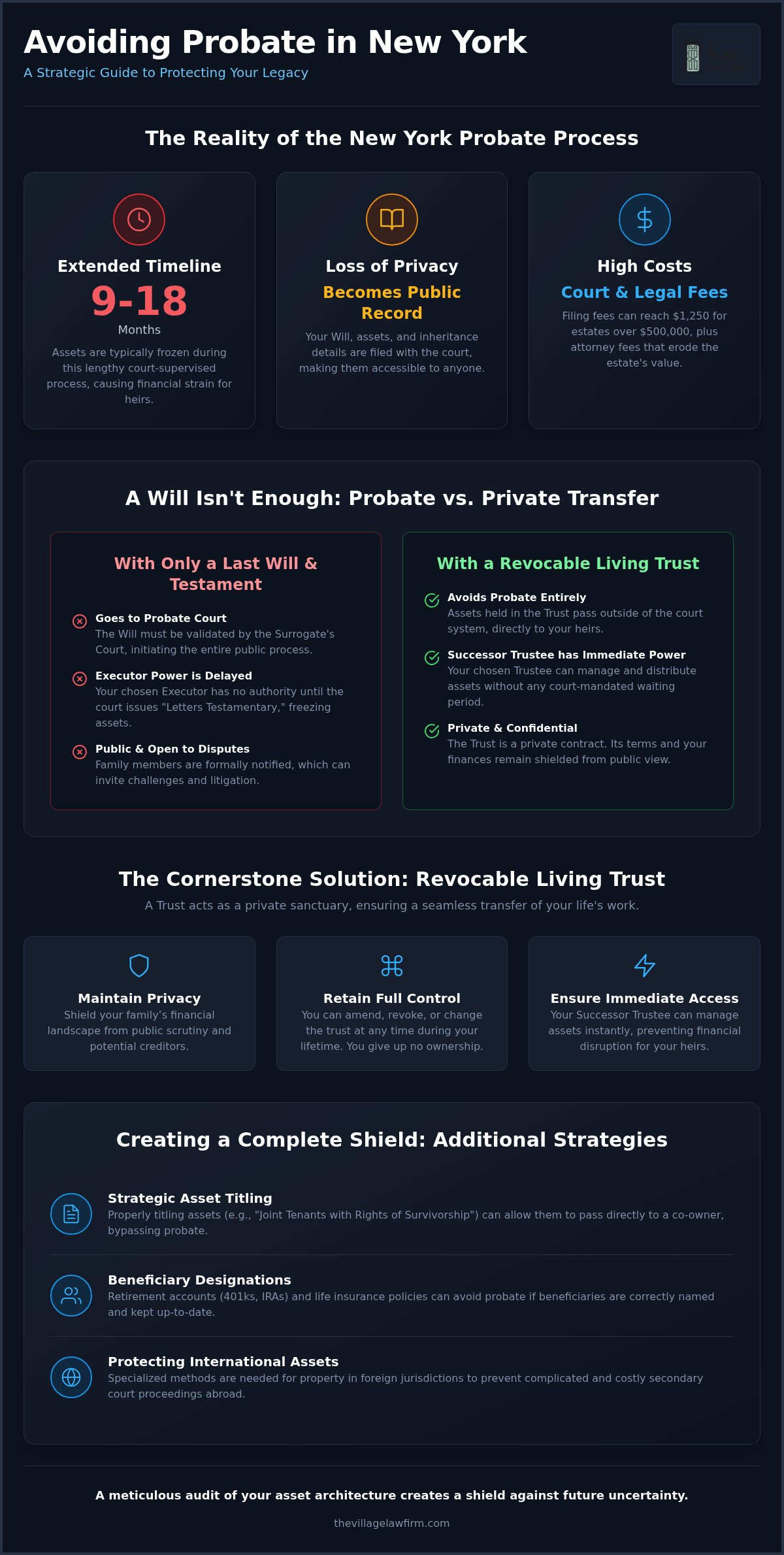
The Reality of the New York Probate Process is often quite different from what families expect during their time of loss. It’s the court-supervised procedure for validating a Last Will and Testament, settling outstanding debts, and eventually distributing assets to beneficiaries. While the intent is to provide order, the New York Surrogate’s Court system is frequently characterized by chronic delays and a lack of privacy. For high-net-worth professionals in Manhattan or Brooklyn, the public nature of these proceedings is often the primary motivation for avoiding probate in New York. Once a Will is filed, it becomes a public record. This means your family’s financial landscape, your asset list, and your specific inheritance instructions are available for anyone to browse.
Beyond the loss of privacy, the financial and procedural hurdles are significant. Filing fees in New York are calculated based on the value of the estate, reaching as high as $1,250 for estates exceeding $500,000. The “Notice of Probate” requirement presents another challenge. New York law mandates that all “distributees,” or legal next-of-kin, must be officially notified of the proceeding. This requirement often serves as an unintended invitation for family litigation, potentially stretching the typical nine to eighteen-month timeline into years of courtroom disputes. By understanding these mechanics, you can begin the work of avoiding probate in New York through more sophisticated, private asset structures.
The New York Surrogate’s Court Experience
Each of New York’s counties, from the busy halls of the Manhattan Surrogate’s Court to the chambers in Queens or Brooklyn, operates under its own local rhythms. A common frustration for families is the gap in authority that occurs immediately after a death. Even if you’ve named an Executor in your Will, that person has no legal power to manage your assets until the court issues “Letters Testamentary.” This waiting period can freeze bank accounts and halt property sales, creating an immense emotional and financial toll during a period of grief. Our goal is to help you bypass this state of limbo entirely.
Probate vs. Intestacy: Why a Will Isn’t a “Get Out of Court Free” Card
There’s a persistent myth that simply having a Will allows your family to skip the court system. This isn’t the case. If you die without a Will, your estate is governed by New York’s intestacy laws, which distribute your property according to a rigid, state-mandated formula. However, even with a valid Will, your family must still petition the court to prove its authenticity. Probate is the legal process of proving a Will, not avoiding it. It’s a bridge between your wishes and their execution, but it’s a bridge that often requires a significant toll of time, money, and transparency.
The Revocable Living Trust: Your Sanctuary from Surrogate’s Court
The Revocable Living Trust is the cornerstone of any sophisticated strategy for avoiding probate in New York. Unlike a Will, which must be validated in a public forum, a trust operates as a private contract. This distinction is vital for those who value discretion. It creates a sanctuary where your family’s financial details and specific inheritance instructions remain confidential, shielded from the eyes of creditors or the public. Because you retain the power to amend or revoke the trust at any time, you maintain total control over your assets during your lifetime. You aren’t giving up ownership; you’re simply changing the way your legacy is held to ensure it remains protected.
A primary benefit of this structure is the role of the Successor Trustee. As we explored previously, the Surrogate’s Court process often creates a painful gap between a loss and the legal authority to act. A trust removes this friction. Your Successor Trustee steps in immediately, ensuring that mortgage payments are made and funds are accessible to your loved ones without a single day of court-mandated waiting. Researching New York Living Trusts reveals how this mechanism provides a level of stability that a simple Will cannot match. If you’re ready to build this shield for your family, our team can help you design a customized estate plan that prioritizes privacy and efficiency.
Funding Your Trust: The Meticulous Step Most People Skip
A trust is only as effective as the assets it holds. Many people create the legal document but forget the critical final step: re-titling their bank accounts, real estate, and brokerage portfolios into the name of the trust. An empty trust provides no protection from the court system. At The Village Law Firm, we take a white-glove approach to asset alignment, guiding you through the meticulous process of funding your trust to ensure every piece of your wealth is accounted for. We also implement a “Pour-Over Will” as a safety net. This document ensures that any forgotten or newly acquired assets are “poured” into the trust upon your passing, though these specific items may still face limited court oversight. This double-layered approach is essential for avoiding probate in New York effectively.
Trusts for Families with Children
For parents, a trust is an indispensable tool for long-term security. It allows you to bypass the need for court-appointed guardians to manage a child’s inheritance, a process that can be both intrusive and expensive. Instead, you choose a trusted individual to manage those funds according to your specific values. You can also establish staggered distributions, ensuring your children receive their legacy in stages rather than a lump sum at age eighteen. This prevents the risks associated with sudden wealth and provides a guided path for their financial future. For a deeper look at these protections, see our NYC Estate Planning: 2026 Parent’s Guide to Legal Security.
Strategic Asset Titling and New York Designations
Titling is precision. While a living trust provides the overarching architecture for your legacy, the way you title individual accounts and real estate acts as the final lock on the door. Strategic titling is one of the most direct methods for avoiding probate in New York because it allows assets to bypass the court’s jurisdiction entirely through operation of law. When an asset has a designated survivor or beneficiary, it doesn’t wait for a judge’s signature. It moves instantly.
One common tool is Joint Tenancy with Right of Survivorship. Under this structure, property passes immediately to the surviving owner upon your death. Similarly, bank and brokerage accounts can utilize Payable-on-Death (POD) or Transfer-on-Death (TOD) designations. These are private arrangements with your financial institution that ensure a seamless transition. For residential real estate, a significant 2026 update in New York law now allows for Transfer on Death (TOD) Deeds. This enables homeowners to name a beneficiary who will inherit the property without the need for probate, providing a streamlined alternative to traditional transfers. This evolution reflects a broader shift toward removing complexity from the inheritance process, much like the distinction between Revocable and Irrevocable Living Trusts.
The Risks of “Simple” Joint Ownership
Simplicity can be deceptive. Many New Yorkers add a child to their home’s deed as a quick fix, but this often backfires. Once you add a co-owner, your property becomes vulnerable to their financial life. If your child faces a lawsuit, a divorce, or a bankruptcy, their creditors may place a lien on your home. You also lose total control; you cannot sell or mortgage the property without their explicit consent. From a tax perspective, joint ownership can be costly. Heirs may lose a portion of the “step-up in basis,” potentially resulting in higher capital gains taxes compared to assets held within a trust. Meticulous planning protects both your equity and your peace of mind.
Maximizing Beneficiary Designations
Life insurance and retirement accounts like 401ks or IRAs require their own attention. These assets are governed by contract law, meaning your Will doesn’t control them. To ensure these funds remain outside the court’s reach, follow these meticulous steps:
- Designate Contingents: Always name a secondary beneficiary to account for the “what if” scenarios.
- Avoid the “Estate” Trap: Never name your estate as a beneficiary, as this subjects the funds to creditor claims and court delays.
- Audit Regularly: Life changes like marriage or birth require immediate updates to your forms.
It’s vital to coordinate these designations with your estate planning attorney New York to ensure your entire portfolio works in harmony. This alignment creates a robust shield against the delays and costs of the public probate system.
International Assets and Cross-Border Probate Avoidance
Owning a pied-à-terre in Paris or a family home in Tel Aviv is a hallmark of the modern New York professional. However, these international ties introduce layers of legal complexity that a standard Will often cannot resolve. When you own property in multiple jurisdictions, your heirs may face “Ancillary Probate.” This is a secondary, separate court proceeding required in the location where the real estate is situated. If your primary estate is in Manhattan, but you own a cottage in the Cotswolds, your family could be forced to navigate two different court systems simultaneously. This doubling of bureaucracy is a primary reason why avoiding probate in New York through a comprehensive global strategy is so critical.
Strategic planning often involves choosing between an International Will or a “Situs Will.” An International Will follows specific treaty standards to be recognized across borders, while a Situs Will is drafted specifically for the laws of a single country. For global citizens, Medicaid planning also becomes a delicate balance. You must protect your international assets while ensuring you remain eligible for care here at home. If you’re navigating these complexities, our team offers specialized cross-border estate administration to ensure your global legacy remains intact and accessible.
Managing Cross-Border Estate Administration
The role of international estate planning is to simplify these global transfers before they become a burden. Common law countries like the UK or Canada generally recognize trusts, but civil law jurisdictions such as France or Italy often have rigid “forced heirship” rules. These rules can conflict with your New York trust, leading to unexpected tax consequences or legal blocks. We act as your steady guide, coordinating with foreign counsel to ensure your New York strategy aligns with international requirements without compromising your privacy.
The NYC Small Estate Exception
New York provides a streamlined process for smaller estates, but it has strict limitations. In 2026, the threshold for a “Small Estate” proceeding, known as Voluntary Administration, remains $50,000 in personal property. While the filing fee is a nominal $1.00, this simplified path is unavailable if the decedent owned real estate in their individual name. For most NYC professionals, the value of a co-op or condo immediately disqualifies the estate from this exception. Even if your personal property falls below the limit, the paperwork involved in Voluntary Administration can still cause frustrating delays. Relying on this exception is rarely a substitute for the proactive work of avoiding probate in New York through meticulous asset titling and trust design.
The Village Law Firm: A White-Glove Approach to Order
At The Village Law Firm, we believe estate planning is a journey of partnership, not a mere transaction. We don’t just hand you a stack of documents; we provide a shield against future uncertainty by meticulously auditing every facet of your financial architecture. This process is the final, essential step in avoiding probate in New York, ensuring that your titling, beneficiary designations, and trust funding are in perfect alignment. Our goal is to remove the administrative burden from your grieving loved ones, replacing the potential chaos of the Surrogate’s Court with a sanctuary of order. By addressing the mechanics of your legacy today, you ensure a private and seamless transition for those you love most.
The peace of mind that comes from a well-structured plan is invaluable. We recognize that for busy professionals, efficiency is just as important as technical precision. Our “white-glove” service level is designed to respect your time while providing the deep emotional intelligence required for sensitive family decisions. We move beyond the clinical nature of standard legal services, offering instead a transparent and direct relationship that replaces anxiety with a sense of security.
Sophisticated Asset Protection
For high-net-worth families, protection requires a deeper level of legal precision. As a specialized irrevocable trust attorney NYC, we design strategies that go beyond simple probate avoidance. We focus on the New York estate tax exemption 2025 and 2026 limits to protect you from the “tax cliff.” In 2026, if an estate exceeds 105% of the $7,350,000 exemption ($7,717,500), the entire exemption is lost. We meticulously customize your plan to navigate these thresholds, ensuring your children and heirs receive their full inheritance without unnecessary tax erosion. This high-end approach is a cornerstone of avoiding probate in New York while simultaneously optimizing your tax profile.
Your Next Steps Toward Peace of Mind
Your journey toward a secure legacy begins with a calming, empathetic review of your global footprint. We take the time to understand the nuances of your life, from international property to the specific needs of your children. During the implementation phase, we walk alongside you to ensure your assets are correctly aligned with your new legal structure. We don’t just draft; we deliver results. Take the first step toward replacing anxiety with certainty and Schedule a sophisticated consultation with The Village Law Firm today.
Designing Your Sanctuary of Order
The Surrogate’s Court doesn’t have to be the final chapter of your story. By implementing a revocable trust and meticulously auditing your asset titling, you replace public delays with private, immediate transitions. This is the essence of avoiding probate in New York. It’s about protecting your children from the intrusion of court-appointed oversight and ensuring your global assets remain a cohesive, accessible legacy. You’ve spent a lifetime building your wealth; it deserves a sanctuary of order that reflects your values and your hard work.
You don’t have to navigate these legal complexities alone. As your steady urban guide, we bring specialized expertise to cross-border estate administration and the unique needs of Manhattan and Brooklyn families. We invite you to transition from the weight of uncertainty to a position of absolute clarity and security. Secure your legacy with a white-glove estate plan at The Village Law Firm today. Your family’s peace of mind is the most meaningful gift you can leave behind, and it’s within your reach through proactive, meticulous planning.
Frequently Asked Questions
Does a Will avoid probate in New York?
No, a Will doesn’t allow you to bypass the court system; instead, it serves as the primary map the Surrogate’s Court uses during the probate process. To achieve the goal of avoiding probate in New York, you must utilize tools like living trusts or strategic asset titling. A Will only becomes effective once a judge validates it, which means your family still faces the public filings and chronic delays inherent in the court system.
How long does the probate process typically take in New York City?
The typical probate timeline in New York City ranges from nine to eighteen months, though complex or contested estates can take years. Factors such as the heavy backlog in county Surrogate’s Courts and the requirement to notify all legal next-of-kin contribute to these durations. This waiting period often freezes assets, making it difficult for heirs to access funds for immediate needs like property taxes or family expenses.
What is the “Small Estate” threshold in New York for 2026?
For 2026, the threshold for a “Small Estate” proceeding in New York remains $50,000 in personal property. This simplified process, known as Voluntary Administration, is designed for estates without real property. If you own a house, condo, or co-op in your individual name, you cannot use this exception regardless of the dollar value. Proactive planning is still necessary to protect real estate from the full probate process.
Can I use a Transfer on Death (TOD) deed for my NYC apartment?
Yes, a 2026 update to New York law allows the use of Transfer on Death (TOD) deeds for residential real estate. This tool permits you to name a beneficiary who inherits the property automatically upon your passing without court intervention. While this is a powerful method for avoiding probate in New York for your home, it’s vital to ensure the deed is recorded with meticulous precision to prevent title issues for your heirs.
What happens to my foreign assets if I die in New York?
Your foreign assets are generally subject to the laws of the country where they’re located, which often necessitates a secondary court process called ancillary probate. To prevent this, we recommend using Situs Wills or international trust structures. These strategies ensure your global holdings are managed according to your wishes without forcing your family to navigate multiple, conflicting legal systems in jurisdictions like London, Paris, or Tel Aviv.
Is a Revocable Living Trust private in New York?
A Revocable Living Trust is a private contract and doesn’t become a matter of public record. Unlike a Will, which anyone can view at the Surrogate’s Court once it’s filed, your trust document remains confidential. This privacy extends to the list of your assets, their values, and the identities of your beneficiaries. It’s a sophisticated way to keep your family’s financial affairs behind closed doors while ensuring a seamless transfer of wealth.
How much does it cost to avoid probate in New York?
The cost of avoiding probate is an investment in proactive legal planning rather than reactive court fees and litigation. While we don’t provide flat quotes without a consultation, you should consider that the Surrogate’s Court charges filing fees up to $1,250 based on estate value. When you factor in the lengthy delays and potential legal fees for executors, a well-structured trust often saves families significant resources and emotional stress while avoiding probate in New York.
Do I need a lawyer to avoid probate, or can I do it myself?
While you can set simple beneficiary designations on your own, a comprehensive strategy for a complex New York estate requires professional guidance. Mistakes in trust funding or improper titling can inadvertently trigger the very probate process you intended to skip. A specialized attorney acts as a steady guide, ensuring every asset is aligned. This partnership provides a level of technical precision and long-term security that DIY templates simply cannot offer.