
Most people assume that settling a loved one’s estate requires months of grueling court appearances and thousands in legal fees, but New York law provides a hidden “express lane” for those who know where to look. It’s natural to feel overwhelmed by the $50,000 limit or the technical demands of the Surrogate’s Court. You want to honor your loved one’s legacy without getting lost in a maze of paperwork. We understand that this transition is about more than just numbers; it’s about finding a sanctuary of order during a time of profound change.
Our 2026 guide to the small estate affidavit New York is designed to replace that anxiety with a sense of security. We’ll help you navigate this streamlined process so you can transfer assets quickly and close the estate with meticulous precision. You’ll discover how to calculate the estate’s value correctly, leverage the modest one dollar filing fee, and handle the specific exemptions that keep your family’s future protected. We’ve structured this journey to lead you from initial confusion toward a successful, legally sound resolution that respects both your time and your family’s needs.
Key Takeaways
- Determine if your loved one’s estate meets the specific $50,000 personal property threshold required for this streamlined legal path.
- Navigate the filing of a small estate affidavit New York with a clear, step-by-step roadmap that simplifies Surrogate’s Court requirements.
- Identify the “No Real Estate” rule and other critical eligibility factors that dictate whether you can use Voluntary Administration.
- Protect the estate from common pitfalls, such as inaccurate asset valuations or mismanaged creditor priorities, that cause unnecessary delays.
- Learn to spot red flags, including international assets or Medicaid complexities, that signal when professional oversight is essential for your family’s security.
What is a Small Estate Affidavit in New York?
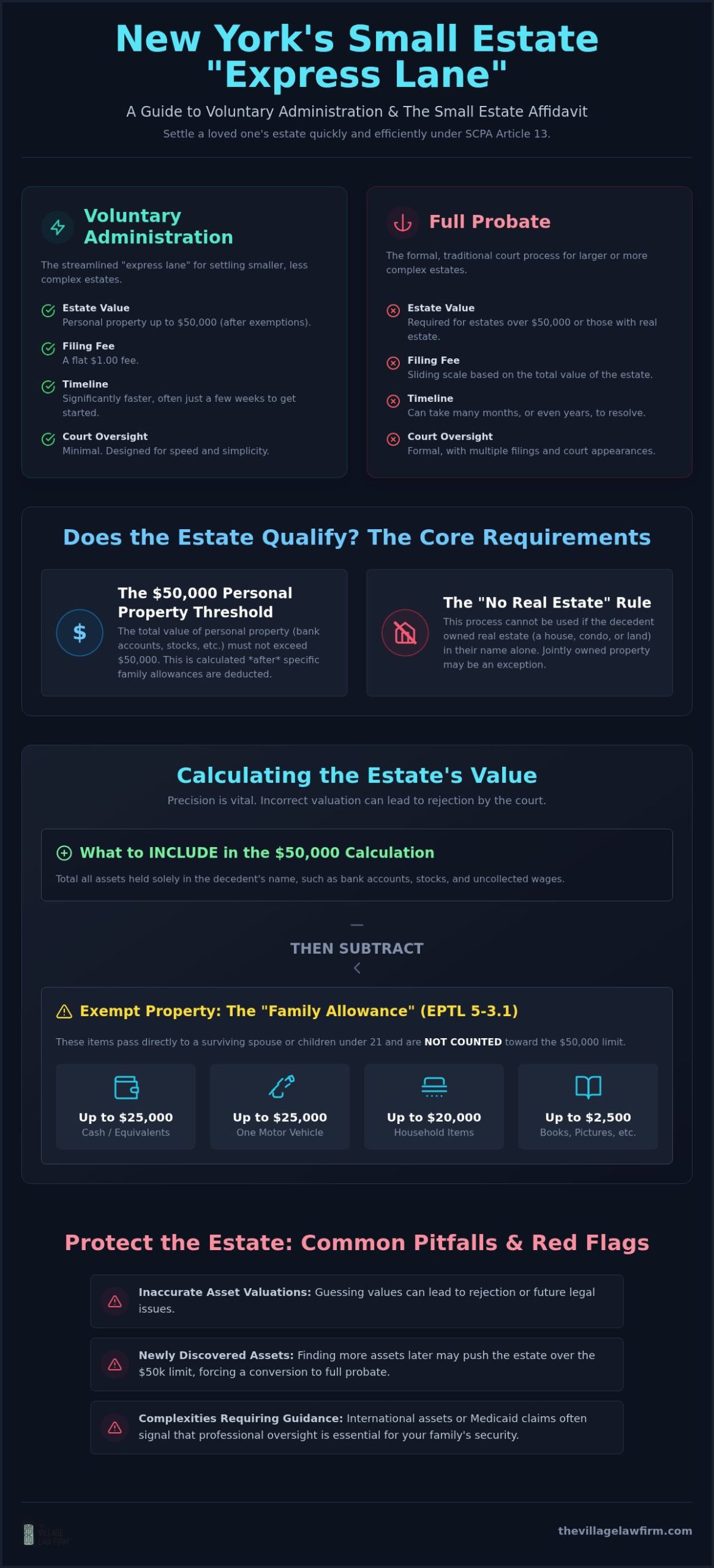
Losing a loved one is inherently chaotic, but the legal resolution of their affairs doesn’t have to be. For many families, the prospect of entering the Surrogate’s Court feels like a descent into a labyrinth of bureaucracy. New York legislators recognized this burden and established Article 13 of the Surrogate’s Court Procedure Act (SCPA). This specific law creates a simplified procedure officially called Voluntary Administration. It’s a compassionate legal shortcut designed to settle estates where the decedent’s personal property is valued at $50,000 or less.
The person who steps forward to manage this process is known as the Voluntary Administrator. This individual holds a position of trust, tasked with collecting assets, paying final debts, and distributing what remains to the rightful heirs. Unlike traditional executors who might spend months waiting for court authorization, a Voluntary Administrator can often begin their work in a matter of weeks. It’s a role defined by efficiency and a commitment to closing a life’s final chapter with dignity.
Voluntary Administration vs. Full Probate
The primary distinction between these two paths lies in the level of court oversight required. Traditional probate is the formal legal process of probate used for larger estates or those involving real property. It often requires multiple court filings, formal notices to all interested parties, and potentially long wait times. In contrast, the small estate affidavit New York process is significantly faster. Because the court views these estates as less complex, the administrative hurdles are lowered to prioritize speed and family peace.
Cost is another significant factor. While full probate fees are calculated on a sliding scale based on the estate’s value, the filing fee for a Small Estate Affidavit is a flat $1.00. This ensures that the assets left behind go toward the family’s future rather than court costs. The paperwork is similarly streamlined, replacing dozens of pages of legal forms with a concise affidavit that focuses on the essentials of asset distribution.
When the Affidavit is the Right Choice
This path is ideal for families dealing with liquid assets, such as bank accounts, stocks, or personal belongings. It offers a psychological benefit that shouldn’t be underestimated. By reducing the time spent in a courtroom environment, families can find a sense of closure more quickly. Article 13 of the Surrogate’s Court Procedure Act serves as the express lane for New York estate settlement, providing a sanctuary of order in a difficult time.
However, the small estate affidavit New York is only available if the decedent did not own real estate in their name alone. If a home or land is involved, the court usually requires a more formal proceeding to ensure the title is transferred correctly. For those who qualify, this process transforms a daunting legal obligation into a manageable, respectful task.
Eligibility Requirements: Does the Estate Qualify for Article 13?
Determining eligibility is the first step toward reclaiming a sense of order. The small estate affidavit New York process is only available if the decedent’s personal property doesn’t exceed $50,000. This calculation is often where confusion begins. You must distinguish between what the court sees and what is legally set aside for the family. Precision here is vital; an incorrect valuation can lead to the court rejecting your filing and requiring a more complex probate proceeding.
Calculating the $50,000 Threshold
When totaling the estate, you must include bank accounts, stocks, and uncollected wages held solely in the decedent’s name. However, New York law provides a generous “Family Allowance” under EPTL 5-3.1 that shields certain assets from this $50,000 limit. These exempt items pass directly to a surviving spouse or children under 21 and don’t count toward the estate’s value:
- Up to $25,000 in cash or cash equivalents.
- One motor vehicle valued at up to $25,000.
- Household furniture, appliances, and electronics up to $20,000.
- Books, pictures, and family instruments up to $2,500.
If these exemptions bring the remaining personal property below $50,000, you qualify for the simplified path. The NY Courts DIY Small Estate Affidavit Program can guide you through basic asset entry, but remember that discovering more assets later might force you to convert to full probate.
The Real Estate Exception in New York
Real property is the most common disqualifier for Voluntary Administration. If the decedent owned a home, condo, or land in their name alone, you cannot use Article 13. This rule exists because transferring a deed requires the higher level of scrutiny found in full probate. However, if the property was held jointly with “rights of survivorship” or as “tenants by the entirety” with a spouse, it passes outside of probate and doesn’t count toward the threshold. NYC co-ops represent a unique trap. While technically personal property (shares in a corporation), many co-op boards and courts still require full probate to transfer ownership. If you’re unsure how a specific property interest is classified, consulting an expert in estate administration can prevent costly filing errors.
Standing is not just about who wants to help, but who the law permits. The surviving spouse always has the first right to file the small estate affidavit New York. If no spouse exists, the priority shifts to the children, then grandchildren, then parents. This hierarchy ensures a clear line of authority, providing a protective shield against family disputes during an already emotional time. Only one person can serve as the Voluntary Administrator, and they must be a New York resident or a close relative to be appointed by the court.
How to File a Small Estate Affidavit in New York: A Step-by-Step Guide
Organizing a loved one’s financial legacy while navigating grief is a profound responsibility. It requires a transition from emotional weight to methodical action. To successfully file a small estate affidavit New York, you must approach the Surrogate’s Court with precision and all required documentation in hand. This process is your bridge to a sanctuary of order, ensuring that assets are protected and distributed according to the law.
Documentation Checklist for 2026
Your first step is obtaining a certified copy of the death certificate; photocopies are rarely accepted by the court or financial institutions. If the decedent left a Will, you must locate the original. Even in a simplified Article 13 proceeding, the original Will must be filed to prove who the decedent intended to inherit their property. You’ll also need a comprehensive list of assets. This includes bank names, the last four digits of account numbers, and the exact balances on the date of death. While the NY Courts Small Estate Affidavit Program offers a helpful digital interface for generating the forms, it cannot replace the meticulous work of auditing these private records. Finally, you must identify all legal heirs, known as distributees, because the law requires you to send them a formal Notice of Voluntary Administration to ensure transparency throughout the process.
Filing and Post-Filing Responsibilities
Once your affidavit is complete, you will file it with the Surrogate’s Court in the county where the decedent lived. The filing fee for the small estate affidavit New York is remarkably accessible, set at just $1.00 in 2026. After the clerk processes your application, the court will issue Certificates of Voluntary Administration. Think of these as your official keys. You will receive one certificate for each specific asset listed in your affidavit, such as a single bank account or a specific stock holding. You must present these original certificates to the relevant institutions to collect the funds.
Being a Voluntary Administrator is more than just a title; it’s a fiduciary duty. You don’t simply take the money and distribute it immediately. Your first priority is to pay any valid funeral expenses and debts of the estate. Only after these obligations are met can you distribute the remaining assets to the beneficiaries. This methodical flow ensures you remain protected from personal liability while fulfilling your loved one’s final wishes with the highest level of integrity.
Common Pitfalls and Objections in Small Estate Filings
Even the most straightforward path can have hidden obstacles. While the small estate affidavit New York process is designed for simplicity, minor errors in asset valuation can derail your progress. If you discover assets after filing that push the estate’s value over the $50,000 limit, the court will likely require you to restart with a full probate proceeding. Precision is your best defense against such delays.
Another critical area involves creditor priority. As a Voluntary Administrator, you’re legally obligated to pay the decedent’s debts before distributing any funds to heirs. New York law mandates a specific order for these payments, starting with funeral expenses and administration costs. Ignoring a legitimate creditor isn’t just a mistake; it can lead to personal liability. If a family member objects to your appointment or the proposed distribution, the court may pause the voluntary administration to hold a hearing, transforming a quick process into a contested legal battle.
Medicaid Recovery and Small Estates
One of the most overlooked risks in New York is the state’s right to asset recovery. If the decedent received Medicaid benefits after age 55 or for long-term care, the Department of Social Services may file a claim against the estate to recoup those costs. This claim often takes precedence over distributions to most heirs. Before you file the affidavit and distribute funds, it’s wise to consult a Medicaid planning attorney New York to determine if the state has a lien. Protecting the family legacy requires understanding these nuances before the court issues your certificates.
Wrongful Death and Legal Actions
It’s a common misconception that a small estate affidavit New York grants the power to initiate a lawsuit. If your loved one passed away due to negligence and the family intends to pursue a wrongful death claim, this affidavit is insufficient. To sue on behalf of an estate, you must obtain “Limited Letters” through a formal administration or probate proceeding. This allows the court to oversee the litigation and any resulting settlement. When legal action is on the horizon, partnering with an estate administration attorney New York ensures you have the correct authority to seek justice without compromising the estate’s standing.
If you’re facing complex creditor claims or potential litigation, our team is here to provide a sanctuary of order for your family’s future.
When to Seek Professional Legal Guidance
Choosing to handle a small estate affidavit New York independently is often a decision driven by a desire for efficiency. However, even a simplified process can quickly become intricate when unusual variables emerge. Recognizing the red flags that signal a need for professional oversight is the best way to protect yourself from personal liability and ensure your family’s legacy remains intact. When the path forward becomes clouded by technicalities, seeking an authoritative partner can provide a sanctuary of order that allows you to focus on healing rather than paperwork.
Cross-Border and International Complications
New York is a global hub, and it’s common for residents to hold assets that span across borders. If the decedent owned property, bank accounts, or investments in another country, the voluntary administration process faces significant hurdles. Traditional DIY tools rarely account for the complexities of international estate planning or the tax implications of global asset distribution. In these cases, you may need to ancillary probate New York to harmonize the legal requirements of different jurisdictions. A white-glove approach ensures that every international detail is handled with meticulous precision, preventing costly delays or diplomatic errors that could stall the distribution of assets for years.
Finalizing the Estate with Peace of Mind
The responsibility of a Voluntary Administrator doesn’t end when the certificates are issued. You must ensure the long-term security of the beneficiaries, especially when dealing with families with children in NYC. If the decedent’s assets are intended for minors, a simple affidavit might not provide the protective framework needed to manage those funds until the children reach adulthood. A professional review of your filing acts as a shield against future uncertainty, confirming that every debt was prioritized correctly and every heir was treated fairly under the law. Once the administration is complete, it is often the ideal moment to transition from settling the past to securing the future through your own legacy planning. We invite you to schedule a consultation to replace your current anxiety with a sense of lasting security and purposeful direction.
Securing Your Family’s Financial Legacy with Confidence
Settling a loved one’s affairs shouldn’t feel like a burden you carry alone. By understanding the eligibility rules and the step-by-step filing requirements, you’ve already taken the first step toward reclaiming order. Success with the small estate affidavit New York depends on your meticulous attention to detail and an honest assessment of the estate’s complexity. Whether you’re managing simple bank accounts or identifying the red flags of Medicaid recovery and global assets, you deserve a partner who values your family’s security as much as you do.
The Village Law Firm offers a sanctuary of order during these unpredictable moments. Our team brings deep expertise in complex NYC Surrogate’s Court proceedings and specialized knowledge in international and Medicaid planning. We provide a calming, professional approach that replaces administrative chaos with a clear, methodical path forward. Don’t let legal uncertainty delay your family’s healing or the distribution of their inheritance. Schedule a Consultation with The Village Law Firm today to ensure your loved one’s legacy is closed with the dignity and precision it deserves. You have the power to turn this transition into a foundation for future stability.
Frequently Asked Questions
What is the maximum estate value for a Small Estate Affidavit in New York?
The maximum value is $50,000 in personal property held solely in the decedent’s name. This limit is more flexible than it first appears because New York law allows you to exclude “exempt property” set aside for a surviving spouse or minor children. This includes up to $25,000 in cash and a vehicle valued at $25,000 or less. If the remaining assets fall under the threshold, you qualify for this streamlined path.
Can I use a Small Estate Affidavit if the decedent owned a house in New York City?
Generally, you cannot use this process if the decedent owned real estate solely in their name. Real property, including houses or condos, requires a full probate or administration proceeding to transfer the title legally. However, if the property was held jointly with rights of survivorship, it passes automatically to the co-owner. In that specific scenario, you may still use the small estate affidavit New York for other personal assets.
How long does it take for the Surrogate’s Court to process a Small Estate Affidavit?
Processing times typically range from a few days to several weeks depending on the specific county’s current caseload. While much faster than full probate, which can last a year or more, you should still account for clerical review times in busy boroughs like Manhattan or Brooklyn. Once the court approves your filing, they issue the certificates immediately, allowing you to access bank accounts and distribute funds without further delay.
What is the difference between probate and a Small Estate Affidavit in NY?
The primary differences are speed, cost, and the level of court oversight. Probate is a formal process for estates exceeding $50,000 or those containing real estate, involving higher filing fees and more complex documentation. The small estate affidavit New York is an “express lane” with a flat one dollar filing fee. It requires less paperwork and is designed for families who need to settle smaller financial affairs with minimal bureaucracy.
Do I need to notify the New York State Department of Health (Medicaid) when filing?
You are legally required to notify the Department of Social Services if the decedent received Medicaid benefits after age 55. The state has a right to recoup certain costs through Medicaid recovery, and these claims often take priority over distributions to heirs. Failing to address these claims before distributing assets can lead to significant legal complications. Consulting a specialist ensures you handle these sensitive state interactions with the necessary transparency and care.
What happens if I find more assets after the Small Estate Affidavit is filed?
If you discover additional assets, you must file an amended affidavit with the Surrogate’s Court to include the new items. If the total value of all personal property remains at or below $50,000, the court will simply issue new certificates. However, if the new discovery pushes the total estate value over the $50,000 limit, you must convert the proceeding into a formal probate or administration case immediately to remain in legal compliance.
Can a Voluntary Administrator be held personally liable for estate debts?
Yes, a Voluntary Administrator can face personal liability if they fail to follow the legal order of priority for payments. You must pay funeral expenses and valid creditor claims before any money is distributed to the family. If you distribute assets to heirs while leaving legitimate debts unpaid, creditors can sue you personally for the missing funds. This is why meticulous record-keeping and a methodical approach are essential for your protection.
Is a lawyer required to file a Small Estate Affidavit in New York?
A lawyer isn’t legally required, but professional guidance is highly recommended for estates involving complex family dynamics or Medicaid liens. While the court provides DIY tools for simple cases, an attorney acts as a protective shield against procedural errors that could delay asset distribution. For families dealing with international assets or potential disputes, a “white-glove” legal partnership provides the sanctuary of order needed to navigate these decisions with total confidence.