
The silence of a New York night often brings the loudest questions: what happens to your child when you are no longer there to be their advocate? You’ve built a life of security, yet you know that a simple inheritance could inadvertently trigger a “benefits cliff,” stripping away the Medicaid and SSI they rely on. It’s a heavy burden to carry alone. A specialized special needs trust attorney New York acts as your steady guide through these complexities, ensuring your legacy provides comfort rather than complication.
We understand that you want more than a document; you want a sanctuary for your child’s future. This guide reveals how a meticulously structured trust preserves essential government benefits while funding the quality of life your loved one deserves. We’ll explore the updated 2026 asset limits, the significant expansion of ABLE accounts, and the precise legal strategies required to turn your anxiety into a lasting, orderly plan for protection. You’ll discover how to navigate the 2026 legal landscape with confidence, ensuring your child is shielded by a plan that balances technical precision with a deeply human touch.
Key Takeaways
- Understand why a direct inheritance can trigger a “benefits cliff” and how to safeguard your child’s eligibility for SSI and Medicaid under 2026 New York regulations.
- Partnering with a specialized special needs trust attorney New York ensures your estate plan complies with the rigorous EPTL 7-1.12 statutes while shielding your child’s assets from resource limits.
- Differentiate between Third-Party and First-Party trusts to identify the most effective way to manage family legacies, settlements, or international assets.
- Learn the essential criteria for choosing a trustee who can manage financial complexities while honoring your child’s unique long-term care and lifestyle needs.
- Move beyond generic legal templates with a bespoke planning process that transforms complex disability laws into a clear, orderly path for your family’s future.
The Challenge of Disability Planning in New York
Planning for a child with a disability in New York requires a delicate balance of legal precision and deep emotional foresight. You aren’t just managing money; you’re architecting a lifetime of care. In a city where the cost of living and the complexity of social services are equally high, the margin for error is razor-thin. Many parents feel a lingering sense of dread about the “cliff” their child might face once parental support is gone. This anxiety is a natural protective instinct, but left unaddressed, it can lead to paralysis. A dedicated special needs trust attorney New York helps you channel that protective energy into a structured, legal shield that preserves your child’s dignity.
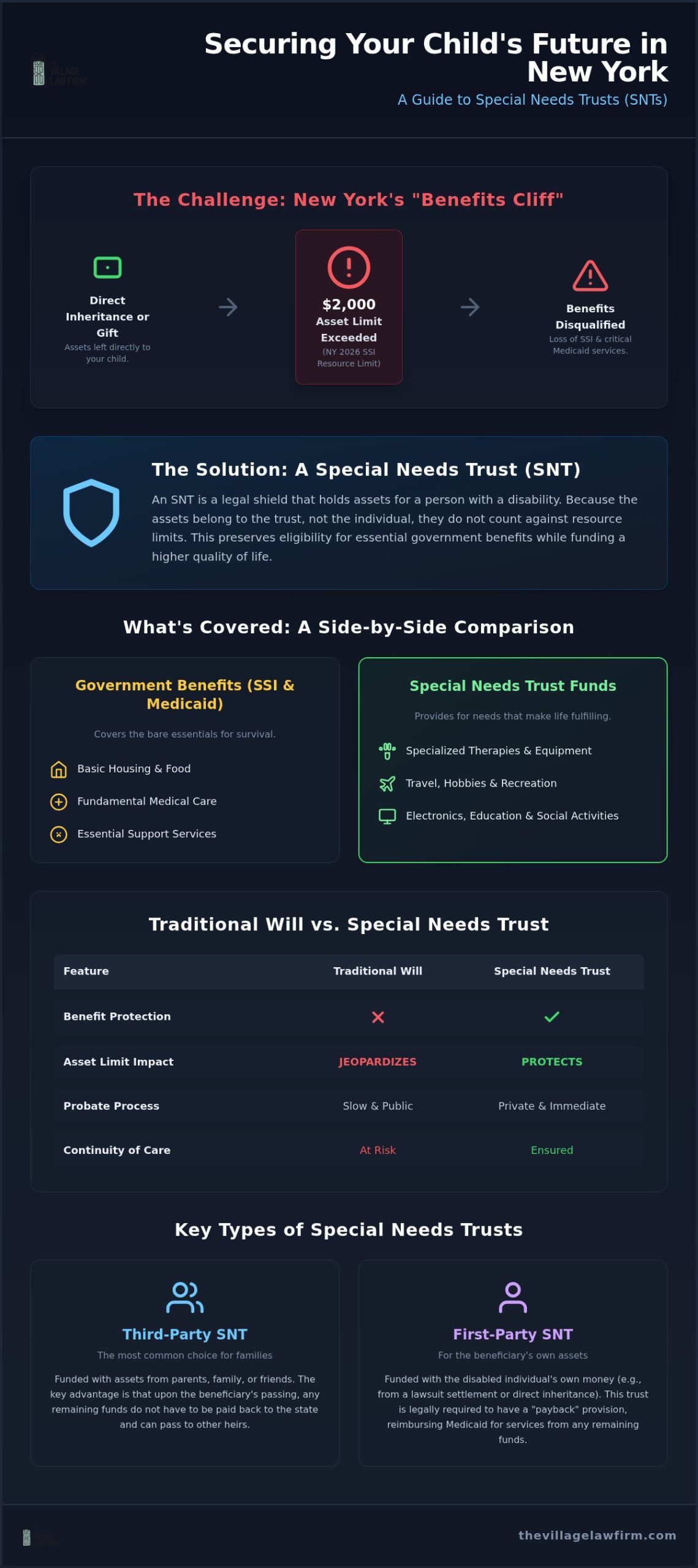
The primary obstacle is often what we call the “Benefit Trap.” Most government programs designed to support individuals with disabilities are strictly means-tested. For 2026, the Supplemental Security Income (SSI) resource limit for an individual remains a mere $2,000. If your child receives a direct inheritance that pushes them over this threshold, they don’t just lose their monthly check; they risk losing Medicaid, which often funds their housing, home care, and medical supplies. Understanding What is a Special Needs Trust? is the first step in avoiding this trap. These legal vehicles allow you to set aside funds that aren’t counted toward these restrictive asset limits, ensuring your child remains eligible for the support they need.
There’s a profound difference between providing enough to survive and providing enough to thrive. Government benefits typically cover the bare essentials: basic shelter and fundamental medical care. A meticulously crafted trust fills the gap. It pays for the things that make life worth living, such as specialized therapies, travel, electronics, and social activities. By working with a special needs trust attorney New York, you ensure your legacy isn’t just a safety net, but a springboard for a joyful, independent life.
Why Traditional Wills Often Fail Special Needs Families
A standard “simple” will is often the greatest threat to a special needs family. If you leave assets directly to your child, those funds must go through the New York probate process, which can be slow and public. During this time, your child’s care could be disrupted or their benefits suddenly suspended. In New York, a direct inheritance exceeding $2,000 immediately jeopardizes a beneficiary’s eligibility for Supplemental Security Income and essential Medicaid-funded services. We replace this risk with a private, immediate transfer of resources that bypasses the court’s delays and protects your child’s continuity of care.
The Emotional Weight of Legacy Planning
The transition from chaos to order is a powerful emotional experience. We don’t view our role as merely drafting documents; we’re your partners in securing a future you won’t be there to oversee. This process addresses the haunting question of “who will care for them?” by establishing a clear framework for financial management and advocacy. We help you choose a trustee who understands the nuances of your child’s needs, creating a sanctuary of stability. This professional guidance replaces the weight of uncertainty with the peace of a well-defined plan, allowing you to focus on the present while knowing the future is secure.
What is a Special Needs Trust? A Guide for New Yorkers
A Special Needs Trust (SNT) is much more than a collection of legal clauses. It is a sophisticated protective shield designed to hold assets for a person with a disability without those resources counting against them. In the eyes of the law, the assets belong to the trust, not the individual. This distinction is vital for effective Disability Planning in New York. By shielding these funds, your child can maintain their eligibility for means-tested government programs while still having access to resources that enhance their daily life.
The Trustee serves as the guardian of this financial sanctuary. This person or professional entity manages the trust’s assets and decides how to distribute funds based on the beneficiary’s needs. They act as a bridge between the complex world of fiduciary duty and the personal well-being of your loved one. Because these trusts are intended to provide support over a lifetime, they must be resilient. A well-drafted SNT adapts as your child ages, ensuring the transition from youth to adulthood and eventually into senior care is handled with grace and continuity.
In New York, we distinguish between “essential” and “supplemental” needs. Government benefits are designed to cover the basics of survival. The trust exists to provide everything else. This includes the “white-glove” standard of care that government programs simply cannot offer. These funds can pay for life-enhancing quality of life items such as specialized physical therapy, accessible travel, or even the latest adaptive technology. If you are feeling overwhelmed by these choices, reaching out to an estate planning expert can provide the clarity you need to move forward with confidence.
How SNTs Preserve Medicaid and SSI Eligibility
The New York State Department of Health (DOH) maintains strict oversight of these legal structures. To remain valid, the trust must adhere to the “sole benefit” rule. This means every dollar spent must directly benefit the person with the disability. By working with a special needs trust attorney New York, you ensure the trust document contains the precise language required to satisfy both state and federal auditors. This meticulous attention to detail prevents the “benefit trap” where a simple clerical error could result in a sudden loss of medical coverage or income support.
The Legal Mechanics of a New York Trust
The strength of an SNT lies in its discretionary language. The document must state that the trustee has absolute authority over how funds are used. If the beneficiary had the power to demand money, the government would view those assets as “available” and disqualify them from benefits. Selecting the right trustee is a critical decision for NYC families. You must weigh the emotional intuition of a family member against the technical precision of a professional fiduciary. A special needs trust attorney New York helps you evaluate these options, ensuring your child’s future is managed by someone who understands both the law and the human heart.
First-Party vs. Third-Party Special Needs Trusts
The distinction between trust types depends entirely on the source of the funding. While the legal definition of a special needs trust remains consistent in its goal of preserving benefit eligibility, the operational mechanics and long-term legacy implications differ significantly. Understanding which vehicle fits your family’s financial profile is the first step toward creating a lasting sanctuary of order. A specialized special needs trust attorney New York provides the clarity needed to navigate these choices, ensuring your assets are positioned for maximum protection.
Third-Party SNTs are widely considered the gold standard for parent-led estate planning. These are funded with assets that never belonged to the beneficiary, such as your life insurance, retirement accounts, or real estate. Because the money originates from you, New York law does not require a Medicaid “payback.” When the beneficiary passes away, the remaining funds stay within your family bloodline, moving to siblings or other heirs. This structure allows you to protect the family legacy for future generations while providing a high-end quality of life for your child.
First-Party SNTs, conversely, manage assets that already belong to the individual with a disability. This often occurs following a personal injury settlement, a retroactive social security payment, or an unplanned inheritance. These trusts are vital for maintaining benefits, but they carry a mandatory “payback provision.” Upon the beneficiary’s death, any remaining funds must first reimburse the State of New York for Medicaid expenses incurred during their lifetime. We help families manage these windfalls with technical precision, ensuring that a sudden increase in wealth doesn’t lead to a sudden loss of care.
Choosing the Right Path for Your Family
Selecting the correct trust is a cornerstone of any sophisticated estate planning attorney New York strategy. If you are planning for your child’s future today, the Third-Party SNT is almost always the preferred choice. It avoids the Medicaid clawback and keeps assets under family control. Proactive planning ensures you never have to rely on a First-Party trust’s more restrictive rules. We walk alongside you to identify the most tax-efficient way to fund these vehicles, replacing future uncertainty with a methodical plan.
International Assets and Special Needs Trusts
New York is a global hub, and many families we serve manage assets across international borders. Handling a cross-border inheritance within a New York SNT requires specialized expertise to avoid unintended tax consequences or treaty conflicts. Our experience in international estate planning allows us to shield global assets within a domestic trust framework. We address the complex tax implications for foreign beneficiaries, ensuring that your global legacy remains a stable source of support for your loved one, regardless of where the assets originated.
The Village Law Firm Process: Meticulous Planning
The process begins with a conversation. We don’t start with forms or checklists. Instead, we host a calm, deep dive into your family’s unique dynamics to understand the specific rhythms of your child’s life. This initial consultation is designed to replace your anxiety with a sense of immediate order. As a dedicated special needs trust attorney New York, we recognize that your child’s future is too important for a generic template. We move beyond standard legal forms to draft a bespoke protective shield that reflects your family’s values and your child’s specific medical and social needs.
Our commitment doesn’t end when the ink is dry. We provide comprehensive trustee mentorship to ensure the people you choose are fully prepared for their responsibilities. Managing a trust under New York’s EPTL 7-1.12 statutes is complex. We walk alongside your chosen trustees, explaining the nuances of the “sole benefit” rule and the technicalities of fiduciary duty. Because laws evolve, such as the 2024 rule change that prevents trust payments for food from reducing SSI benefits, we maintain an ongoing partnership with our clients. We review your plan regularly to ensure it remains a robust defense against future uncertainty.
A White-Glove Approach to Legal Security
We provide a premium service level for busy professionals who value efficiency and meticulous attention to detail. Our firm acts as your steady urban guide. We handle the friction of the NYC legal environment so you don’t have to. You receive direct access to sophisticated counsel who understands both the cold mechanics of the law and the warm emotional weight of your decisions. This white-glove approach ensures every detail is handled with absolute precision.
Integration with Your Broader Estate Plan
A special needs trust must work in harmony with your entire financial portfolio. We ensure your SNT is perfectly aligned with NYC estate planning for parents, creating a cohesive strategy for all your children. This includes coordinating with Medicaid planning to protect assets like the family home, which in 2026 has a New York home equity interest limit of $1,130,000. We bridge the gap between guardianship and trust management, ensuring your legal framework is comprehensive.
To begin architecting a secure future for your loved one, schedule a consultation with our team today.
Securing Your Legacy: Why Expertise Matters
Choosing a generic estate plan is a gamble your family cannot afford to take. While automated templates and “DIY” legal forms might seem efficient, they often lack the technical precision required by New York’s rigorous EPTL 7-1.12 statutes. A single misplaced clause can collapse the entire protective shield you’ve tried to build. This leads to the very “benefit trap” we work so hard to avoid. A specialized special needs trust attorney New York ensures that your documents are not just legally valid, but practically functional within the unique landscape of local court systems and social service agencies.
The complexity increases significantly for families with global interests. If your legacy includes assets in London, Paris, or Tel Aviv, your trust must account for international tax treaties and foreign inheritance laws. Generic planning ignores these nuances. We bridge the gap between sophisticated international law and the deeply personal requirements of disability planning. Our role is to act as your steady urban guide, replacing the chaos of complex regulations with a methodical, orderly sanctuary for your child’s future. When the plan is finalized, that lingering weight of anxiety is replaced by a lasting sense of security.
The Village Law Firm Advantage
Our firm is built on a foundation of unwavering integrity and meticulous attention to detail. We don’t view our work as a series of transactions. Instead, we view it as a partnership. Your family’s security is our highest professional goal. We provide a white-glove service level that respects your time and honors the emotional weight of your decisions. By removing complexity and providing direct access to sophisticated counsel, we allow you to take the next logical step toward a defined, peaceful future. Order replaces chaos. Clarity replaces confusion.
Next Steps for New York Families
Preparing for your first meeting with a special needs trust attorney New York doesn’t have to be overwhelming. You don’t need to have every answer today. You only need the willingness to begin. To build a robust SNT that stands the test of time, we suggest gathering the following information:
- A comprehensive list of all assets, including domestic real estate and any foreign holdings.
- Current award letters for SSI, Medicaid, or other government benefits your child receives.
- A list of potential trustees who possess the empathy and financial literacy to serve your child.
- A summary of your child’s specific medical, therapeutic, and lifestyle requirements.
Your child’s future deserves more than a “standard” solution. It deserves a plan as unique as they are. Take the first step toward replacing uncertainty with a bespoke legal shield. Schedule a consultation with The Village Law Firm to begin architecting a legacy of protection and dignity today.
Architecting a Future of Certainty and Care
Your child’s future is a legacy of love that deserves the highest level of protection. By establishing a meticulously crafted trust, you move beyond the “benefit trap” to create a life of genuine dignity and joy. We’ve explored how these legal shields preserve eligibility for SSI and Medicaid while providing the supplemental funds that allow a loved one to truly thrive. Whether you’re managing local assets or navigating complex cross-border inheritances, technical precision is your greatest ally against future uncertainty.
Partnering with a specialized special needs trust attorney New York replaces parental anxiety with a sanctuary of order. At The Village Law Firm, we combine authoritative legal expertise with a white-glove service model tailored for busy NYC professionals. Our unique experience in international estate administration ensures that every facet of your family’s global footprint is protected. You don’t have to navigate these complexities alone. Take the next logical step toward a defined, peaceful future for your child.
Secure your child’s future with a sophisticated New York Special Needs Trust. Contact The Village Law Firm today. Your commitment to your child’s well-being is their greatest security; we’re here to help you make it permanent.
Frequently Asked Questions
What can a Special Needs Trust pay for in New York?
An SNT pays for supplemental items that enhance your child’s quality of life beyond basic government support. This includes specialized medical equipment, vocational training, electronics, and travel. Since the September 2024 rule change, trust payments for food no longer reduce SSI benefits. A special needs trust attorney New York ensures your trustee understands how to make these distributions without jeopardizing essential Medicaid coverage or monthly income support.
Can I be the trustee of my own child’s Special Needs Trust?
You can certainly serve as the initial trustee of your child’s trust. This allows you to maintain direct control over distributions while you are able. However, the true value of the trust lies in its longevity. You must appoint successor trustees, such as a professional fiduciary or a trusted family member, who can step in when you aren’t there. We help you mentor these successors to ensure a seamless transition.
Does a Special Needs Trust end when the beneficiary dies?
The trust typically terminates upon the death of the beneficiary. For a First-Party SNT, the State of New York must be reimbursed for Medicaid expenses from any remaining funds. In a Third-Party SNT, there is no such “payback” requirement. You can direct the remaining assets to your other children or favorite charities. This distinction makes the Third-Party trust the preferred choice for families who want to preserve their long-term legacy.
How much money do I need to start a Special Needs Trust in NYC?
There is no legally mandated minimum balance required to establish a Special Needs Trust in New York. The decision depends on your family’s financial goals and the specific needs of your child. While some families fund trusts immediately, others use a “standby” trust that is only funded upon their passing through life insurance or retirement assets. We focus on creating a structure that provides maximum protection regardless of the initial amount.
Can I put a New York home into a Special Needs Trust?
Yes, a New York residence can be placed into a Special Needs Trust to protect it from being counted as a resource. In 2026, the home equity interest limit for Medicaid eligibility in New York is $1,130,000. Transferring the home to a trust can shield it from Medicaid recovery while ensuring your child has a stable place to live. It is a sophisticated strategy that requires meticulous legal drafting to avoid unintended tax consequences.
What happens if the trustee of an SNT dies or becomes incapacitated?
If a trustee is unable to serve, the trust document should clearly name a successor to take their place immediately. Without a named successor, the court may need to appoint a trustee, which can cause significant delays in your child’s care. We design our trusts with multiple layers of backup to ensure the sanctuary of order you’ve built never collapses. This provides you with a sense of lasting emotional security.
Is a Special Needs Trust the same as an ABLE account in New York?
They are different but complementary tools. An ABLE account has a 2026 annual contribution limit of $20,000 and is managed by the beneficiary. An SNT has no contribution limit and is managed by a trustee. Effective January 1, 2026, the ABLE Age Adjustment Act raised the age of disability onset to 46. A special needs trust attorney New York often recommends using both to provide your child with maximum financial flexibility.
How does an SNT interact with New York Medicaid planning?
An SNT is a cornerstone of Medicaid planning. It allows you to set aside assets for your child without disqualifying them from medical coverage. For 2026, the single individual asset limit for Medicaid in New York is $33,038. By moving “excess” assets into a trust, you ensure your child stays below these thresholds. This strategy protects your family’s wealth from being depleted by high medical costs while securing your child’s long-term care and dignity.