
With over 40% of American households now operating as blended families, the traditional, simple will is no longer enough to protect those you love. You want to ensure your current spouse is cared for, but you likely carry a quiet anxiety that your biological children might one day be sidelined or accidentally disinherited. This complexity is exactly why standard estate planning for blended families often fails to address the unique nuances of your life. It is a delicate balance that feels like walking a tightrope between love and logic. Your legacy deserves a professional shield against future uncertainty.
Effective planning acts as the bridge between potential family chaos and a lasting sanctuary of order. You can provide for your spouse and protect your children simultaneously without forcing them into a future of legal infighting. This guide provides a clear roadmap for 2026, showing you how to manage complex New York probate rules and use sophisticated trust strategies to secure your assets. We will explore how to provide for your partner while ensuring your children’s future is never left to chance. Peace of mind is within reach.
Key Takeaways
- Learn why traditional wills often fall short for the 40% of American households in blended structures and how to address the unique needs of both your spouse and biological children.
- Understand the specific risks of accidental disinheritance under New York law and why relying on a partner’s future choices isn’t a viable legal strategy.
- Discover how to use specialized trusts as a protective shield in estate planning for blended families to bypass probate and provide immediate clarity for all heirs.
- Master the white-glove approach to family communication to ensure your intentions are understood and your family’s emotional bond remains intact.
- Move from legacy anxiety to a methodical, reassuring solution that secures your family’s long-term stability and protects your children’s inheritance.
The Modern Landscape: Why Blended Families Require Specialized Estate Planning
The modern family is no longer defined by a single, rigid structure. In 2026, the legal reality for blended families encompasses a complex web of stepchildren, half-siblings, and multi-generational care requirements. While your family is built on love, the law often views these relationships through a cold, binary lens. This disconnect creates a significant emotional weight. You want to honor your commitment to your current spouse while ensuring your biological children’s legacy remains protected. A standard “simple will” is frequently insufficient here. It lacks the nuance required to navigate non-traditional structures; instead, it often serves as a unintentional blueprint for future litigation. We believe in replacing this potential chaos with a sanctuary of order.
Effective estate planning for blended families requires more than just a list of assets and beneficiaries. It demands a sophisticated understanding of how family dynamics and New York law intersect. Without a tailored strategy, the default legal mechanisms can lead to results that no one intended. We approach this complexity with a white-glove service that prioritizes your family’s unique architecture. By building a robust legal shield, we allow you to focus on the relationships that matter most, knowing the technical details are handled with meticulous precision.
The Statistics of the Modern Family
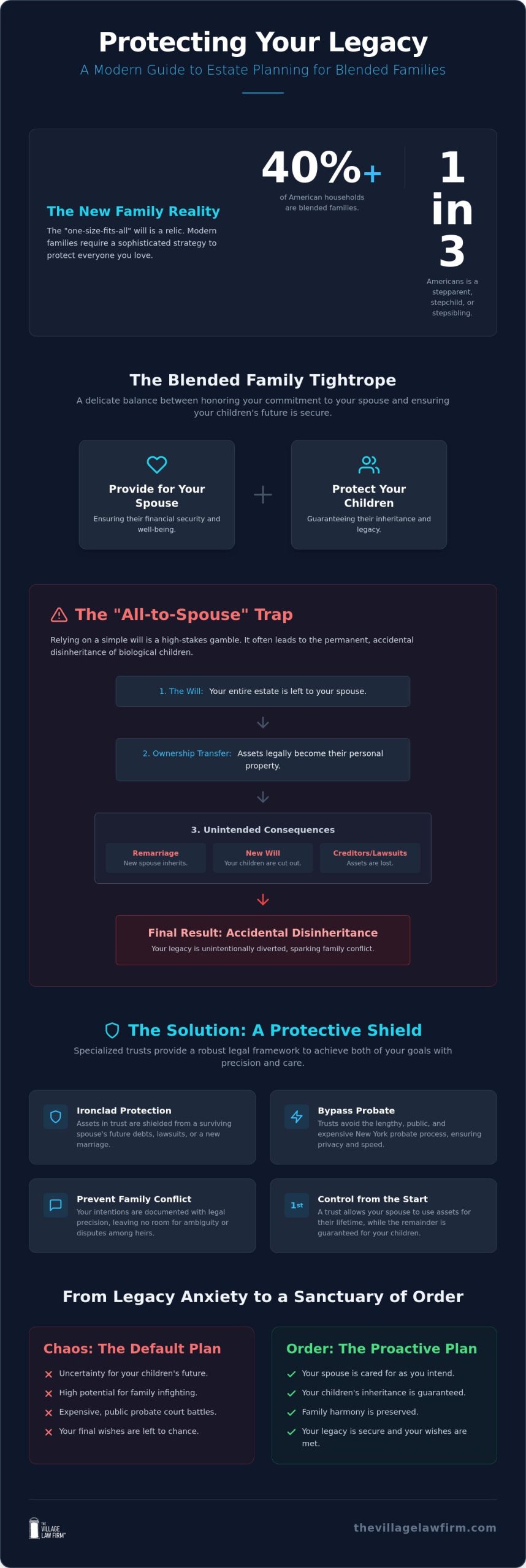
Current data reveals that over 40% of families in the United States are now considered blended. In fact, one in three Americans is a stepparent, stepchild, or stepsibling. Despite these numbers, many people still rely on boilerplate documents that fail to account for the unique friction points of a second or third marriage. Estate planning is not a one-size-fits-all endeavor. Traditional templates often ignore the reality that stepchildren have no automatic inheritance rights under New York law. Meticulous planning is an act of love. It removes the burden of uncertainty from your survivors and ensures that every member of your family is recognized according to your specific wishes.
Chaos vs. Order: The Emotional Stakes
The fear of accidental disinheritance is a heavy burden for many parents. Without a tailored strategy, your assets might pass to a surviving spouse who then remarries or experiences creditor issues, leaving your biological children with nothing. This anxiety often leads to fractured relationships and costly courtroom battles that can last for years. Partnering with a sophisticated estate planning attorney New York provides the shield you need to guard against these outcomes. We act as your steady guide through this complexity, replacing confusion with a methodical, reassuring plan. Legacy is the preservation of both your financial security and your family harmony.
The Danger of Default: Understanding Accidental Disinheritance
Many parents believe their spouse will naturally “do the right thing” and care for stepchildren if they pass away first. This assumption is a high-stakes gamble. Without a proactive strategy, you are essentially leaving your children’s future to chance. In New York, the legal system doesn’t recognize moral obligations; it recognizes titles and statutory rights. If you leave your entire estate to your spouse, those assets become their personal property. They are then free to change their own will, remarry, or lose those assets to creditors. This “all to spouse” trap is the most common way biological children are permanently disinherited in a second marriage. It’s a quiet tragedy that often ends in the New York Surrogate’s Court, where families are torn apart by public, expensive litigation.
The probate process for contested blended family estates is notoriously complex. When intentions aren’t documented with precision, the court must follow rigid statutes that rarely align with modern family dynamics. This legal chaos creates deep-seated resentment between surviving spouses and biological children. To prevent this, estate planning for blended families must be intentional and transparent. You can build a legal shield that provides for your partner while guaranteeing your children’s inheritance. Securing your legacy requires moving beyond assumptions toward a methodical, professional plan. If you’re ready to remove the guesswork from your family’s future, you can consult with our team to begin crafting a tailored solution.
New York Intestacy Laws and Stepchildren
Under New York intestacy law, stepchildren have no legal right to inherit from a stepparent unless they have been legally adopted. If you die without a will, the state’s default distribution rules will prioritize your spouse and biological children, completely excluding stepchildren you may have raised as your own. Additionally, New York provides a surviving spouse with an “Elective Share,” which is a statutory right to at least one-third of your net estate. This right can take precedence over specific bequests you’ve made to your children. If your plan isn’t carefully structured, your spouse’s legal claim could significantly deplete the funds you intended for your biological children.
The “Unintended Beneficiary” Problem
Assets often flow in directions you never imagined. If your spouse inherits your estate and later remarries, your hard-earned assets could eventually end up in the hands of a third spouse or that spouse’s children. This “leakage” of the family legacy is often caused by outdated beneficiary designations. Life insurance policies and 401k accounts pass directly to the named beneficiary, regardless of what your will says. If you haven’t updated these documents since your first marriage or your most recent nuptials, you risk leaving your legacy to an ex-spouse or leaving your current family in a state of financial instability. Estate planning for blended families must include a meticulous review of every asset to ensure no one is left behind.
Essential Legal Tools: Trusts Designed for Family Architecture
A trust is more than a legal document; it is a meticulously crafted sanctuary for your wealth. In the context of estate planning for blended families, trusts serve as a sophisticated shield that protects your legacy from the unpredictability of the future. Unlike a will, which must pass through the public and often cumbersome New York probate process, a trust provides immediate clarity and privacy. It allows assets to flow to your beneficiaries without the delay of court intervention. This speed is vital for maintaining family harmony and ensuring that your spouse and children aren’t left in a financial vacuum during an already emotional time.
Choosing the right person to manage these assets is a critical decision that requires deep emotional intelligence. While it’s tempting to name a family member, selecting a neutral, professional trustee is often the most compassionate choice you can make. In blended structures, appointing a stepchild to manage a stepparent’s inheritance can create a power imbalance that leads to lifelong resentment. A professional trustee removes this emotional burden. They act as a steady, objective partner who ensures your wishes are followed with unwavering integrity, preventing the family infighting that often arises from perceived bias.
Beyond family dynamics, trusts offer a robust layer of asset protection. They can safeguard your children’s inheritance from a future spouse’s creditors or even from Medicaid recovery should your surviving spouse require long-term care later in life. For blended families that include a child with disabilities, working with a dedicated special needs trust attorney New York is essential to ensure that an inheritance does not inadvertently disqualify your child from critical SSI or Medicaid benefits. Sophisticated estate planning for blended families utilizes these tools to ensure that wealth intended for your biological children remains exactly where you placed it. It replaces the chaos of potential loss with a methodical and reassuring solution for multi-generational security. For a deeper look at the specific strategies available, our guide on protecting children’s inheritance in New York outlines the key legal structures every parent should understand.
The QTIP Trust: Protecting Both Spouse and Children
The Qualified Terminable Interest Property (QTIP) trust is a cornerstone tool for modern families. It allows you to provide a lifetime of income for your surviving spouse while “locking in” the final destination of the remaining principal for your biological children. In 2026, the federal estate tax exemption reaches $15 million per individual; a QTIP trust leverages the unlimited marital deduction to defer these taxes while ensuring you, not your surviving spouse, decide who ultimately inherits the remaining principal. This mechanism offers the perfect balance of care and control.
Credit Shelter and Bypass Trusts
Credit Shelter or Bypass Trusts are essential for families looking to maximize their tax efficiency and protect wealth for the next generation. By funding these trusts up to the 2026 exemption limit of $15 million, you can shield assets from being taxed again when your surviving spouse passes away. These tools create a financial sanctuary that is protected from a spouse’s future creditors or subsequent marriages. Meticulous drafting is required to ensure these trusts function seamlessly under current New York law and provide the long-term security your family deserves.
The Human Element: Navigating Emotional Complexity
Even the most sophisticated trust cannot fully heal a family fractured by silence. In estate planning for blended families, legal documents serve as the shield, but transparency is the bond that holds the structure together. Many professionals focus solely on the mechanics of asset transfer while ignoring the emotional architecture that supports it. We believe in a different approach. By addressing potential friction points with honesty today, you remove the seeds of resentment that often bloom into litigation tomorrow. Our role is to act as your steady urban guide, facilitating these delicate conversations with compassion and meticulous clarity.
Directness is a form of protection. When intentions are left to the imagination, beneficiaries often fill the void with anxiety or suspicion. Providing a sanctuary of order means ensuring your spouse and children understand the “why” behind your “what.” This proactive communication replaces the stress of the unknown with a sense of security. It allows your family to focus on their relationships rather than the technicalities of their inheritance. We help you transition from legacy anxiety to a methodical, reassuring solution that honors everyone involved.
Communicating Your Intent
A successful transition of wealth requires a structured, white-glove approach to communication. It’s not just about the numbers; it’s about the values you wish to pass down. Following a clear process can prevent future legal chaos.
- Step 1: Define your goals privately. Sit down with your spouse to align on your vision for the future before involving others. This ensures a united front.
- Step 2: Hold a structured family meeting. Introduce the plan in a calm, neutral setting. Setting expectations early prevents surprises during the probate process.
- Step 3: Document your “Letter of Intent.” This personal document accompanies your legal files. It explains your motives and the love behind your choices in your own words.
Addressing Wealth Disparity Between Spouses
It’s common for one spouse to enter a marriage with significantly more assets than the other. This disparity can create a quiet tension, especially if biological children from a previous relationship fear their inheritance is being diluted. In these cases, prenuptial and postnuptial agreements are not just defensive measures; they are foundational tools for estate planning for blended families. These agreements establish a clear baseline of order, ensuring that both sides of the family feel seen and protected from the start. When everyone knows the rules of the game, the focus remains on building a life together rather than worrying about future uncertainty. If you are ready to begin this process with a partner who values both technical precision and a deeply human touch, schedule a consultation with our team today.
Building Your Shield: The Village Law Firm’s Approach
The journey through estate planning for blended families often begins with a heavy sense of underlying stress. You carry the weight of protecting multiple generations, balancing the needs of a spouse with the future of your children. This complexity doesn’t have to lead to chaos. At The Village Law Firm, we specialize in transforming that anxiety into a methodical, reassuring solution. We act as a shield against future uncertainty, combining technical precision with a deeply human touch. Our NYC-based practice focuses on removing the friction from your life, allowing you to step into a sanctuary of order.
We understand that busy New York professionals value efficiency as much as excellence. Your time is a premium resource. Our white-glove service is designed to handle the heavy lifting, ensuring that every detail of your legacy is addressed with meticulous attention. We don’t just draft documents; we build a foundation for long-term security. By replacing confusion with transparency, we ensure that your family’s emotional and financial bonds remain intact for decades to come. Estate planning for blended families is about more than assets; it’s about the people you love.
A Partnership, Not a Transaction
We walk alongside our clients through every life stage, acting as a steady urban guide in an unpredictable world. Our focus is on building a long-term partnership rather than a one-time transaction. This mindset ensures your plan evolves as your family grows or as New York laws shift. We prioritize honesty and openness, removing the complexity of legal mechanics so you can feel the thoroughness of our approach. Your legacy is your life’s work. It deserves a partner committed to unwavering integrity and excellence.
Next Steps to Secure Your Legacy
Securing your family’s future starts with a single, intentional step. Moving from the chaos of uncertainty to a completed plan provides a profound sense of relief. When you are ready to begin, we are here to lead the way. To make your first meeting as productive as possible, consider gathering the following items:
- A clear list of your current assets and account types.
- Current beneficiary designations for life insurance and retirement accounts.
- A list of your primary goals for both your spouse and your children.
- Any existing prenuptial or postnuptial agreements.
Your family’s stability is too important to leave to the default rules of the state. Take control of your narrative and ensure your children are protected. Protect your family’s future today.
Transitioning from Uncertainty to a Lasting Sanctuary
Your family structure is a modern masterpiece of love and complexity. It deserves more than a boilerplate legal document. By moving beyond New York’s rigid default laws and utilizing sophisticated trusts, you ensure that every member of your household is truly protected. Effective estate planning for blended families isn’t just about assets; it’s about the peace of mind that comes from knowing your spouse is cared for and your children’s inheritance is secure.
The Village Law Firm offers a dedicated focus on families with children and a white-glove service designed specifically for busy New York professionals. We provide the specialized expertise in New York family law necessary to turn potential chaos into a methodical, reassuring plan. You don’t have to navigate these emotional waters alone. Secure your family’s sanctuary; schedule a consultation with The Village Law Firm.
Taking this step today creates a shield for your legacy that will last for generations. You have the power to build a future defined by order and harmony. It’s a gift of stability that your loved ones will appreciate forever.
Frequently Asked Questions
Do stepchildren have inheritance rights in New York if I die without a will?
No, stepchildren have no automatic legal right to inheritance under New York intestacy law unless you have legally adopted them. If you pass away without a valid plan, the state’s default distribution formula prioritizes your surviving spouse and biological children, effectively leaving stepchildren with nothing. This rigid legal reality often contradicts the emotional bonds of a modern family, making proactive documentation essential to include every loved one in your legacy.
How can I ensure my second spouse is taken care of without disinheriting my kids?
You can achieve this balance by using specialized trusts that define exactly how and when your assets are distributed. Instead of leaving everything to your spouse outright, you can provide them with life-long access to income or the family home while legally reserving the remaining principal for your biological children. This methodical approach removes the risk of a spouse accidentally diverting the family legacy and provides a reassuring sanctuary for all your heirs.
What is a QTIP trust and is it right for my blended family?
A Qualified Terminable Interest Property (QTIP) trust is a sophisticated tool that provides income for a surviving spouse while locking in the final beneficiaries of the principal. It is an ideal choice for estate planning for blended families because it allows you to utilize the marital deduction to defer taxes while maintaining control over the ultimate destination of your wealth. In 2026, this remains a primary strategy for protecting children from a previous marriage.
Can my second spouse change my will after I pass away?
Your spouse cannot change your will after you pass, but they can change their own will regarding any assets you left to them outright. If you leave property to your spouse without the protection of a trust, those assets become their personal property to distribute as they wish. To prevent your children from being sidelined, you must use irrevocable trust structures that dictate the final destination of your wealth regardless of your spouse’s future choices or remarriage.
How do I handle life insurance beneficiaries in a blended family?
You should coordinate your life insurance beneficiaries with your overall estate plan rather than relying on simple, direct designations on the policy. Naming a trust as the beneficiary allows you to control how the proceeds are managed and distributed among your spouse and children according to your specific wishes. This prevents a lump sum from being diverted away from your intended heirs or being lost to a surviving spouse’s future creditors or legal complications. Understanding the full scope of protecting children’s inheritance in New York is essential when coordinating these designations with your broader estate strategy.
Is a prenuptial agreement necessary for estate planning in a second marriage?
While not strictly required, a prenuptial agreement is a foundational tool that provides essential clarity and order from the very start of the marriage. It allows both partners to waive certain statutory rights, such as the New York elective share, which could otherwise disrupt the specific bequests you intended for your children. We view these agreements as the first layer of your family’s protective shield, replacing potential future conflict with transparency and mutual respect.
What happens to our family home if it is owned jointly with my second spouse?
If the home is owned as “joint tenants with rights of survivorship,” it passes automatically to your surviving spouse and bypasses your will entirely. This means your children may have no legal claim to the property even if you intended for them to inherit a portion of its value. Estate planning for blended families often involves retitling the home or using a trust to ensure your spouse can remain in the residence while your children eventually inherit the asset.
How often should I update my estate plan as my blended family grows?
You should review your plan every three to five years or whenever a major life event occurs, such as a birth, marriage, or significant change in asset value. With the federal estate tax exemption reaching $15 million in 2026, it is also vital to ensure your plan remains tax-efficient under current regulations. Regular updates with a professional partner ensure your plan remains a steady sanctuary that reflects your current intentions and protects your family’s long-term security.