
Naming your child as a direct beneficiary on a life insurance policy or bank account feels like a protective act, but it’s often a legal dead end. Without a strategic bridge, those assets could be handed over to an eighteen-year-old on their birthday or swallowed by the complexities of the New York Surrogate’s Court. When it comes to protecting children’s inheritance New York families often find that the simplest path is actually the most dangerous. You’ve worked hard to build a legacy; the last thing you want is for that wealth to vanish because of a lack of structure or a court-appointed stranger taking control.
We understand the deep anxiety that comes with imagining your children’s future without your guidance. It’s natural to worry about how they’ll handle a sudden windfall or whether their inheritance might be lost in a future divorce. This guide offers a clear roadmap to shield your family’s assets from creditors and legal chaos. You’ll discover why a Trust often outperforms a simple Will, how to ensure a trusted person manages the money, and the specific steps required to keep your hard-earned assets firmly within the bloodline for 2026 and beyond.
Key Takeaways
- Avoid the “18th birthday problem” by understanding why naming a minor as a direct beneficiary on life insurance often leads to a legal dead end.
- Discover how specialized trusts serve as the ultimate shield for protecting children’s inheritance New York, keeping assets out of the Surrogate’s Court and away from creditors.
- Learn why a basic Will isn’t enough and how Spendthrift Provisions create a permanent barrier against future lawsuits or marital disputes.
- Clarify the distinction between a guardian who provides care and a trustee who manages money to ensure professional oversight of your legacy.
- Move from anxiety to security with a clear roadmap designed to keep your family’s assets firmly within the bloodline through meticulous planning.
The Risks of Direct Inheritance Under New York Law
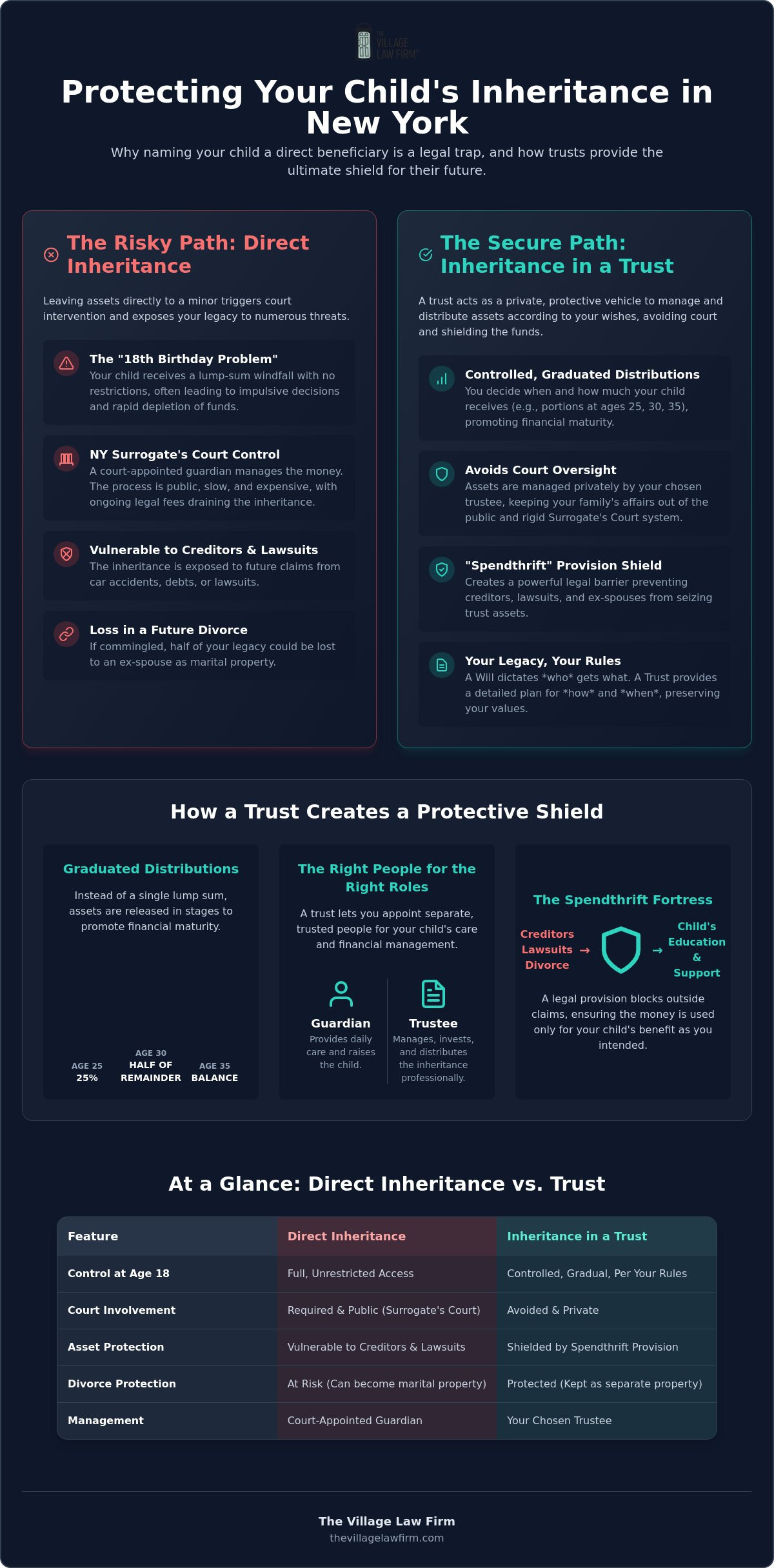
Naming your minor child as a direct beneficiary on a life insurance policy or retirement account is a common 2026 mistake. It feels like a quick fix. In reality, it’s a legal dead end. New York law is clear: minors cannot legally own substantial assets. This triggers the “18th Birthday Problem.” On the day your child turns eighteen, they receive full, unrestricted access to every penny. For most young adults, this sudden windfall is a recipe for disaster rather than a foundation for success. A comprehensive guide to estate planning reveals that without a trust, the court must step in to manage these assets, often leading to a loss of control for the family.
When assets are left directly to a minor, the New York Surrogate’s Court must intervene. This process is often slow, public, and expensive. Beyond the immediate logistical hurdles, direct inheritance creates long-term vulnerabilities. If your child eventually marries and commingles these funds with a spouse, the inheritance could be classified as marital property. In the event of a future divorce, half of your legacy could walk out the door with an ex-spouse. Protecting children’s inheritance New York requires moving beyond these basic beneficiary designations toward a more resilient structure that preserves the bloodline.
The Court-Supervised Guardianship Trap
If you haven’t named a trustee through a formal plan, the court will appoint a “Guardian of the Property” to oversee the funds. This role is strictly monitored and often cumbersome. The guardian must file an annual accounting with the court, a tedious process that incurs ongoing legal fees and administrative burdens. To understand how these costs are typically evaluated, you can explore Legal Service Fees for Estate and Probate Administration options to see examples of fee structures in probate matters. Most funds are placed in court-mandated joint control accounts, meaning every withdrawal for your child’s needs requires a judge’s specific approval. This lack of financial flexibility is both frustrating and costly, often requiring expensive bond premiums that drain the very assets you intended to preserve.
Creditors and the “Spendthrift” Vulnerability
Outright gifts are low-hanging fruit for external claims. If your child is involved in a car accident, faces a lawsuit, or struggles with debt in adulthood, their entire inheritance is exposed to creditors. There is also a significant psychological risk. Sudden, unearned wealth can derail a young adult’s ambition, replacing a drive for education or career with the complacency of a “trust fund” lifestyle. A Spendthrift Provision acts as a legal barrier that prevents creditors from seizing trust assets before they reach the beneficiary. Utilizing such a provision is a cornerstone of protecting children’s inheritance New York families can rely on to ensure their legacy remains a source of support, not a target for litigation or a source of youthful distraction.
Trusts: The Essential Shield for New York Legacies
A trust serves as a sophisticated bridge between your current success and your child’s future maturity. While a Will simply dictates who gets what, a trust provides a structure for how and when they receive it. This distinction is vital for protecting children’s inheritance New York families often find that the Surrogate’s Court process is not only public but also rigid. By utilizing a Minor’s Trust, you bypass this court oversight entirely. Your assets remain private; your chosen trustee maintains control according to your specific values rather than a judge’s default rules. This creates a sanctuary of order that shields your legacy from the unpredictability of the legal system.
One of the most effective ways to avoid the “18th birthday problem” is through graduated distributions. Instead of a lump sum, you might release 25% at age twenty-five, half of the remainder at thirty, and the balance at thirty-five. This phased approach to distributing trust assets allows your children to make mistakes on a smaller scale while they are still learning financial responsibility. Within this structure, a Spendthrift Provision acts as a permanent barrier. It prevents creditors or litigants from seizing trust assets, ensuring the money is used for your child’s education, health, and support rather than settling their external debts.
Revocable vs. Irrevocable Trusts for Children
Most parents begin with a Revocable Living Trust because it offers maximum flexibility during their lifetime. You can change the terms, move assets in or out, and maintain total control. However, for those with complex estates or high-risk profiles, consulting an irrevocable trust attorney NYC can unlock advanced levels of asset protection. An irrevocable trust can remove assets from your taxable estate and provide a more robust shield against future claims. Balancing this lifetime control with long-term protection is a core part of our partnership with you.
The Bloodline Trust: Protecting Against Divorce
Protecting your legacy also means looking beyond your children to your grandchildren. A Bloodline Trust ensures that assets remain “separate property” under New York law. This is critical. It prevents an inheritance from being split in a child’s future divorce, keeping the wealth within your family tree. By appointing a co-trustee, you provide a layer of professional oversight that guides your child without stripping them of their autonomy. If you are ready to move from anxiety to a sense of order, we can help you design a tailored estate plan that reflects your family’s unique needs and provides a clear roadmap for the future.
Beyond Basic Wills: Advanced NY Protection Strategies
A basic Will provides a foundational map, but it rarely offers the sophisticated armor required for complex modern lives. For families with significant assets or unique dynamics, protecting children’s inheritance New York requires a shift from simple distribution to strategic preservation. This is especially true for those managing estate planning for blended families, where the risk of accidental disinheritance is high. Without specific language, assets intended for your biological children could inadvertently pass to a surviving spouse’s heirs from a previous marriage. We provide the meticulous oversight needed to ensure your intentions remain the final word.
International considerations add another layer of complexity for the global families who call New York home. If your children hold foreign citizenship or reside abroad, a standard domestic plan may trigger unforeseen tax penalties or legal hurdles in their country of residence. We act as your steady urban guide, helping you account for cross-border treaties and foreign inheritance laws. By looking at the global picture, we ensure that your hard-earned wealth doesn’t get caught in a web of international bureaucracy, keeping the path clear for the next generation.
UTMA vs. Trusts: Which is Right for Your 2026 Plan?
Uniform Transfers to Minors Act (UTMA) accounts are a frequent starting point for parents. They’re simple to open, but they lack the robust protection of a trust. In New York, UTMA assets must be handed over to the child at age twenty-one. For many, this is still too early to manage a significant windfall. Tax implications are also a concern; income generated by UTMA assets is taxed at the child’s rate, which can trigger the “kiddie tax.” When creating a trust, you maintain control over how the money is spent, ensuring it supports education and health rather than a lifestyle that outpaces their maturity.
Protecting the Family Home and Real Estate
NYC real estate is often a family’s most valuable asset. While a Life Estate can transfer property quickly, it may leave your children with a home they can’t afford to maintain or taxes they can’t pay. A trust offers a more flexible solution, allowing for funds to be set aside specifically for property upkeep. Additionally, working with a Medicaid planning attorney New York can help shield the family home from being depleted by long-term care costs. This double-layered protection ensures that your children inherit not just a building, but a sustainable legacy they can actually afford to keep.
Selecting the Right Guardian and Trustee in New York
One of the most critical decisions you’ll make isn’t just who will raise your children, but who will protect their financial future. New York law makes a sharp distinction between the Guardian of the Person and the Guardian of the Property. The former provides the emotional and physical care your children need; the latter manages the assets they inherit. While it’s tempting to name the same person for both roles, this often creates an unnecessary burden. Your sister might be the perfect person to provide a loving home, but she may not have the professional precision required to manage a complex investment portfolio or navigate the technical requirements of the New York Surrogate’s Court.
By separating these roles, you build a vital system of checks and balances. The Trustee acts as the gatekeeper of the “purse strings,” ensuring that funds are used exactly as you intended. This separation is a cornerstone of protecting children’s inheritance New York families depend on to prevent mismanagement or emotional spending. It ensures that the person making parenting decisions isn’t also the one trying to balance a trust’s investment strategy. This structure provides a sanctuary of order, replacing the potential for financial chaos with a clear, professional division of labor. For families with a child who has special needs, working with a special needs trust attorney New York is equally essential to ensure that inherited assets don’t inadvertently disqualify your child from critical government benefits like SSI or Medicaid.
Criteria for Choosing a New York Trustee
When selecting a Trustee, look for financial literacy, emotional stability, and a high level of organization. They don’t need to be an investment banker, but they must be meticulous in their record-keeping. Geographic proximity is also helpful in New York’s fast-moving legal environment. If your estate is particularly large or includes complex international assets, a Corporate Trustee offers an institutional level of security and continuity. These professional institutions don’t get sick or move away, providing a permanent shield for your legacy. Always name at least one successor; planning for the “what if” is the hallmark of a sophisticated estate plan.
Legal Guardianship: More Than Just a Name in a Will
New York offers a unique tool called the “Standby Guardian” designation. This allows you to name a guardian who can step in immediately if you become incapacitated, avoiding a legal vacuum and keeping your children out of the court system. To guide your guardian’s daily decisions, we recommend drafting a “Letter of Wishes.” This document outlines your parenting philosophy, from educational goals to religious preferences, providing a steady roadmap for your children’s upbringing. Understanding the full scope of legal guardian responsibilities New York parents must fulfill ensures your chosen guardian is fully prepared to step into this role with confidence. Most importantly, ensure your plan provides enough liquidity so the guardian can raise your children without facing financial hardship. If you’re ready to secure your family’s future with this level of detail, contact us today to begin your planning journey.
Crafting a Calm Future with The Village Law Firm
The journey through New York’s legal landscape can feel like a descent into complexity, but it doesn’t have to be your reality. We believe that protecting children’s inheritance New York should be a process defined by clarity rather than chaos. Our firm acts as your steady urban guide, offering a white-glove service that handles the meticulous details so you don’t have to. We understand that for the busy New York professional, time is the most precious asset. Our approach is designed to replace the weight of “what if” with the steady confidence of a plan that is built to last. We don’t just provide documents; we provide a sanctuary of order.
Families in the city often manage lives that cross borders, with international assets and global connections that require more than a standard template. We specialize in integrating these complex elements into a seamless, protective strategy. Whether you’re navigating the nuances of foreign citizenship or ensuring that a Manhattan property remains a sustainable family legacy, our methodical planning process accounts for every variable. We move you from a state of anxiety to a position of absolute security. This transition is achieved through a partnership mindset that prioritizes your family’s long-term stability over a simple transaction.
A Partnership for Your Legacy
Legacy planning is a deeply human endeavor that requires as much emotional intelligence as it does legal expertise. It’s about more than just tax exemptions and probate avoidance; it’s about the values you wish to pass down. Working with a New York estate planning attorney who understands the unique pressures of urban life ensures that your plan is both practical and sophisticated. We take the time to listen to your fears and your dreams, translating them into a legal structure that acts as a shield against future uncertainty. We invite you to experience a sanctuary of order and calm where your family’s future is our primary focus.
Taking the Next Step
Your journey toward a secure legacy begins with a legacy strategy session. This is not a high-pressure sales meeting, but a focused conversation designed to map out your goals and identify potential vulnerabilities in your current arrangements. To make the most of our time together, we recommend preparing a few key items. Consider this your starting checklist:
- A list of all major assets, including real estate, retirement accounts, and international holdings.
- Current life insurance policies and their existing beneficiary designations.
- A preliminary list of individuals you trust to serve as guardians or trustees.
- Your specific thoughts on at what ages your children should receive their distributions.
By bringing these details to the table, we can begin the work of protecting children’s inheritance New York with the precision your family deserves. The path from complexity to calm is well-defined, and we’re here to walk it with you. Secure your child’s inheritance with a custom estate plan and gain the peace of mind that comes from knowing your legacy is in expert hands.
Securing a Legacy of Stability and Calm
Your children’s future shouldn’t be left to the rigid defaults of state law or the unpredictability of the Surrogate’s Court. By moving beyond simple Wills and embracing the structure of a trust, you ensure that your legacy serves as a sustainable foundation rather than a sudden, overwhelming windfall. Protecting children’s inheritance New York requires this level of meticulous planning, especially when navigating the complexities of international assets or the delicate dynamics of a blended family. You’ve worked hard to build your success; your estate plan should reflect that same level of excellence and care.
At The Village Law Firm, we specialize in providing a white-glove service that simplifies these high-stakes decisions for busy NYC professionals. Our dedicated “Planning for Families with Children” tier ensures that every detail, from guardianship designations to comprehensive international asset protection, is handled with both technical precision and deep empathy. We’re here to act as your steady urban guide, replacing chaos with a sanctuary of order. Take the first step toward lasting security today. Secure your children’s future with a sophisticated New York estate plan and gain the confidence that comes from a perfectly executed legacy.
Frequently Asked Questions
What is the ’18th birthday problem’ in New York estate planning?
The 18th birthday problem refers to the legal requirement that children receive full, unrestricted access to their inheritance once they reach the age of majority. Without a trust, a teenager could suddenly control a significant windfall, which often leads to financial mismanagement. It’s a cornerstone issue when protecting children’s inheritance New York families face, as it removes any parental or professional oversight exactly when it is needed most.
Can I protect my child’s inheritance from their future spouse in NYC?
Yes, you can ensure assets remain “separate property” by using a Bloodline Trust. If assets are left directly to a child and then commingled in a joint bank account or used to purchase a marital home, they become vulnerable in a divorce. By keeping the inheritance within a trust structure, the assets stay in your family’s bloodline, shielding them from being split with an ex-spouse during a New York divorce proceeding.
Is a Will enough to protect my minor children’s assets in New York?
A Will is a starting point, but it’s rarely enough for comprehensive protection. While a Will names a guardian, it doesn’t provide the sophisticated structure needed to manage how and when money is spent. Without a trust, the New York Surrogate’s Court must oversee the assets, often requiring burdensome annual accountings and restricting how funds are used for your child’s education or health.
What happens if I don’t name a guardian for my children in my Will?
The New York Surrogate’s Court will decide who raises your children if no guardian is named. This process can lead to family disputes and may result in a judge choosing someone you wouldn’t have preferred. The court’s primary focus is the “best interests of the child,” but they lack the intimate knowledge of your family values that you possess. Naming a guardian ensures your choices are honored. To fully understand what this role entails, reviewing the legal guardian responsibilities New York law imposes can help you select the right person with confidence.
How does a spendthrift trust work for a child in New York?
A spendthrift trust includes a specific provision that prevents a beneficiary from voluntarily or involuntarily transferring their interest in the trust. This means creditors, litigants, or even a child’s own poor financial decisions cannot drain the assets. It creates a permanent barrier that ensures the money remains available for the child’s essential needs rather than being seized to settle external debts or lawsuits.
Should I name my child as a beneficiary on my 401(k) or life insurance?
Naming a minor as a direct beneficiary is generally a mistake that leads to court intervention. Financial institutions cannot legally pay large sums directly to a minor. Instead, the court will appoint a “Guardian of the Property” to manage the funds under strict supervision. A more effective strategy for protecting children’s inheritance New York involves naming a trust as the beneficiary, allowing your chosen trustee to manage the funds immediately.
What is the difference between a guardian of the person and a guardian of the property?
The Guardian of the Person is responsible for your child’s daily care, including housing, education, and medical decisions. The Guardian of the Property is responsible for managing the child’s inherited assets under court supervision. You can name different people for these roles to ensure your child has a loving home while a financially savvy individual or institution manages the “purse strings” with professional precision.
How often should I update my children’s inheritance plan in New York?
You should review your plan every three to five years or whenever a major life event occurs. Births, deaths, marriages, or significant changes in your financial situation all warrant an update. Additionally, tax laws like the 2026 federal exemption changes mean that a plan created years ago might no longer be the most efficient way to protect your family’s legacy in the current legal landscape.