
If you haven’t named a guardian in your Will, the New York Surrogate’s Court doesn’t know your family’s heart; it only knows the law. You’ve worked tirelessly to build a life of stability for your children, so it’s natural to feel a sharp sense of anxiety when considering the “what ifs.” You don’t want a judge who has never met your family making the most intimate decision of your children’s lives. Understanding the legal guardian responsibilities New York requires is the first step in replacing that fear with a concrete plan for protection.
You deserve the peace of mind that comes from knowing your children will stay with the people you’ve chosen, rather than being left to the discretion of the court or facing the uncertainty of temporary foster care. This guide provides the precise legal roadmap to naming a guardian in 2026, ensuring your Will is an airtight shield for your family. We’ll walk through the specific instructions needed for the Surrogate’s Court, how to handle out-of-state or international guardians, and the vital steps to keep your children’s future firmly in your hands.
Key Takeaways
- Discover why verbal agreements with family hold no legal weight in New York and how to use the Surrogate’s Court Procedure Act to make your wishes binding.
- Learn the critical difference between a testamentary guardian and a standby guardian to ensure your children are protected during temporary incapacity, not just after death.
- Understand the specific legal guardian responsibilities New York mandates so you can grant your chosen guardian the precise authority they need for medical and financial care.
- Navigate the unique legal hurdles for naming international and out-of-state guardians, a vital step for New York City’s global and expat families.
- Follow a methodical step-by-step process to name primary and successor guardians, ensuring your family’s future remains in your hands rather than the court’s.
The Legal Reality of Guardianship in New York
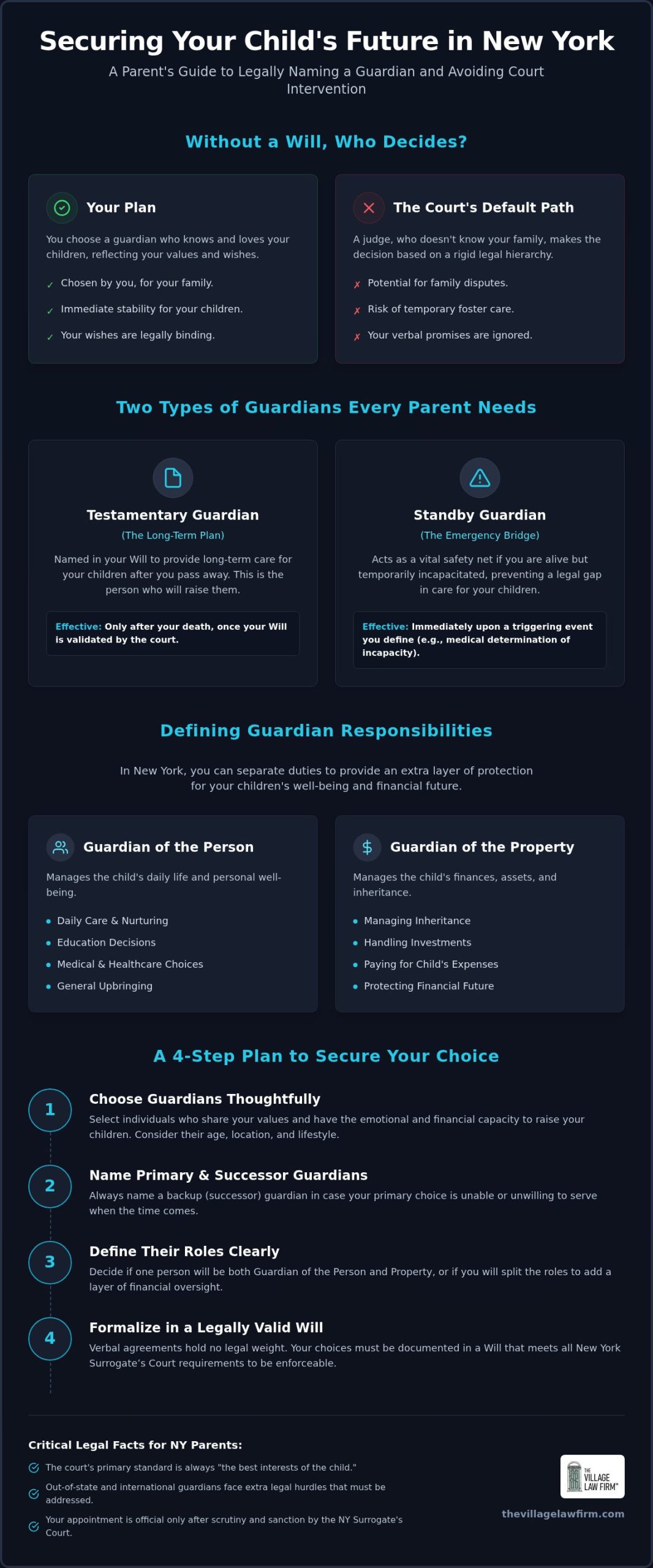
A conversation with a sibling or a handshake with a close friend feels like a promise, but in New York, it carries no legal weight. When you name a Legal guardian in your Will, you are appointing what the law calls a “Testamentary Guardian” under Article 17 of the Surrogate’s Court Procedure Act (SCPA). This isn’t just a title. It’s a formal legal designation that grants a person the right to step into your shoes. Without this specific documentation, your verbal wishes are effectively invisible to the state.
Understanding the legal guardian responsibilities New York law imposes is essential for any parent. These duties range from making daily medical decisions to managing a child’s inheritance. If you die intestate, or without a Will, you forfeit your right to choose who assumes these burdens. Instead, the court follows a rigid hierarchy of kinship that might not align with your family’s values or your child’s needs. The law prioritizes blood relatives, but the person next in line according to the state might be the last person you would ever choose to raise your children.
The Surrogate’s Court: Your Intent vs. Legal Validity
The New York Surrogate’s Court operates on a single, unwavering standard: the best interests of the child. While your intent matters, the court requires a legally valid Will to confirm that your choice meets this high bar. Without a formal document, the court must investigate every potential relative, a process that is often slow and emotionally draining. The Surrogate’s Court acts as the final protector, ensuring that every appointment of a guardian is scrutinized and officially sanctioned by the state.
The Danger of the Default Path
When no plan exists, chaos often fills the void. In the fast-paced environment of New York City, the absence of a clear directive can lead to heartbreaking outcomes, including temporary placement in foster care while the court sorts through competing family claims. Grandparents and siblings may find themselves locked in expensive, public legal battles that fracture the very family unit you worked so hard to build. These disputes often arise because the specific legal guardian responsibilities New York recognizes were never clearly assigned to one individual. We view a meticulously drafted Will as more than just a document; it’s a protective shield that prevents your children from becoming subjects of a court-mandated experiment. By choosing a methodical path now, you ensure that your children remain in a sanctuary of order and family love, rather than being caught in the gears of a cold legal system.
Permanent vs. Standby Guardianship: Ensuring Immediate Protection
Many parents assume that naming a guardian in a Will is the final step in their planning journey. It’s not. A Will only speaks after you pass away. If you face a sudden medical emergency or temporary incapacity, that Will remains silent and ineffective. This creates a dangerous gap where your children could be left in legal limbo during the very moments they need stability most. Understanding the full scope of legal guardian responsibilities New York recognizes means preparing for every possibility, including the times you might be alive but temporarily unable to care for your family.
Testamentary Guardians: The Long-Term Solution
A testamentary guardian is the individual you designate in your Will to take over long-term care. In New York, you have the flexibility to split this role into two distinct categories: the guardian of the person and the guardian of the property. The guardian of the person handles daily life, education, and medical needs, while the guardian of the property manages the assets your children will inherit. Deciding whether one person can handle both or if you need a financial specialist is a key part of Protecting Children’s Inheritance in New York. This separation often provides an extra layer of protection, ensuring that your children’s financial future is managed with professional-grade meticulousness.
Standby Guardians: The Emergency Bridge
A Standby Guardian acts as a vital safety net for the unexpected. Unlike a testamentary guardian, their authority can be triggered by a specific event, such as a written determination of your incapacity by a physician. This allows your chosen person to step in immediately, bypassing the need for an instant court order. In the fast-paced environment of New York City, this immediate transition is what prevents the involvement of Child Protective Services during a family crisis. It ensures your children remain with family, not with the state.
Once the “triggering event” occurs, the standby guardian has a 60-day window to petition the court for permanent status. This 60-day rule is a cornerstone of New York law, providing a bridge of stability while the formal legal system catches up. Drafting a Designation of Standby Guardian alongside your Will ensures there is never a second where your children are left without a protector. If you want to ensure your plan is truly airtight, partnering with an estate planning expert can help you navigate these nuances. By addressing both the immediate and the permanent, you fulfill the most critical legal guardian responsibilities New York requires of a parent, replacing potential chaos with a sanctuary of order.
Strategic Challenges: Out-of-State and International Guardians
New York City is a global crossroads. For many of the professionals we serve, the most trusted family members live in different time zones, from the suburbs of London to the high-rises of Hong Kong. While New York law allows you to name a guardian who lives outside the state or even the country, doing so requires a higher level of strategic planning. The legal guardian responsibilities New York mandates don’t disappear just because your chosen protector lives thousands of miles away. Distance shouldn’t dictate your child’s safety, but it does change the legal mechanics of your Will.
Naming Guardians Outside of New York State
New York courts generally prefer a guardian who is physically present in the state. This proximity makes court supervision and the filing of annual reports much simpler. To overcome this preference, your Will must be explicit. It should detail why an out-of-state guardian is the best choice for your child’s emotional and physical well-being. For families with relatives in Florida, for instance, Flex Legal, PLLC can offer guidance on how Florida probate laws might interact with your New York estate plan. We often include specific travel and relocation clauses that empower the guardian to legally move your children to their home state without facing a lengthy court battle over jurisdiction.
A significant hurdle for out-of-state guardians is the requirement for a fiduciary bond. This is essentially an insurance policy that protects the minor’s assets from mismanagement. New York judges frequently require these bonds for non-residents unless your Will specifically waives the requirement. If your estate includes property in multiple locations, you should also consider how Ancillary Probate in New York might impact the guardian’s ability to manage out-of-state assets. Meticulous drafting ensures your chosen guardian spends their time caring for your children rather than navigating red tape.
International Considerations for Global Citizens
Naming a non-US citizen living abroad introduces a layer of complexity that standard estate plans often ignore. Immigration status is the primary concern. A foreign guardian doesn’t receive automatic legal status to live in the United States. You must decide if the children will move abroad to live with the guardian or if the guardian will attempt to relocate to NYC. Each path has significant visa and residency implications that must be addressed long before the need arises.
New York recognizes the 1996 Hague Convention on the Protection of Children, which helps facilitate the international recognition of guardianship orders. However, the process is far from automatic. It requires careful coordination between your New York Will and any estate plans you hold in other jurisdictions. We work to ensure these documents speak the same legal language, providing a seamless transition across borders. This cross-border expertise acts as a protective shield, ensuring that your children remain with family, no matter where in the world that family calls home.
Step-by-Step: How to Legally Name a Guardian in Your Will
The transition from identifying your chosen guardian to legally cementing that choice requires meticulous attention to detail. In New York, the Surrogate’s Court requires clarity above all else. When drafting your Will, use the full legal names of your chosen individuals. Nicknames or informal references can lead to identity confusion during probate, causing delays that your children cannot afford. You are not just naming a caregiver; you are defining the legal guardian responsibilities New York law will eventually enforce. This technical precision is what transforms a simple wish into a binding legal shield.
Drafting the Guardian Clause
Successor Guardians: The Essential Backup
A single point of failure is a luxury you don’t have. Life is unpredictable, and your primary guardian may be unable to serve when the time comes. We structure your documents with a robust order of succession, ensuring there is always a “Plan B” and “Plan C” in place. This is especially critical in Estate Planning for Blended Families, where the interplay between biological parents and step-parents can create unique legal friction. A clear hierarchy of successors ensures the court never has to guess who should step in next.
Finally, the document must be executed with high-end precision. New York law is strict. You need at least two witnesses who are not beneficiaries and a self-proving affidavit signed before a notary. This formal ceremony ensures the court accepts the Will as valid without requiring the witnesses to testify years later. Once signed, store the original in a secure location and ensure your guardians know where to find it. If you are ready to secure your family’s future, partner with our team to draft your legally airtight Will and gain the peace of mind you deserve.
The Village Law Firm: A Reassuring Path to Family Security
Planning for your child’s future shouldn’t be a source of persistent dread. At The Village Law Firm, we’ve refined a white-glove experience that replaces legal anxiety with a sense of profound security. We understand that your life is complex. Whether you’re navigating the intricacies of a blended family or managing the global logistics of an expat lifestyle, we provide a protective shield against the unpredictable. Our firm doesn’t just draft documents; we build a sanctuary of order that respects the full scope of legal guardian responsibilities New York law demands.
A plan created when your child is an infant may not serve them as they grow into their teenage years. Guardians age, family circumstances shift, and New York statutes evolve. We emphasize the importance of regular, methodical updates to ensure your protective strategy never becomes obsolete. This isn’t a transactional service. It’s a long-term partnership designed to preserve your legacy and protect your children’s well-being through every stage of life.
Our Sophisticated Approach to Family Planning
We believe a Will is only one piece of a broader legacy strategy. Our team tailors guardianship clauses to reflect your specific parenting values and geographical needs, ensuring your intent is never lost in translation. For families requiring specialized care, we coordinate seamlessly with a Special Needs Trust Attorney New York to protect your child’s eligibility for essential benefits while securing their inheritance. By integrating trusts with your guardianship designations, we ensure that the financial side of the equation is just as stable as the emotional one. We remove the complexity, leaving you with a clear, actionable roadmap.
Next Steps: Securing Your Peace of Mind
Your journey toward clarity begins with an initial consultation where we listen more than we talk. We’ll explore your unique family dynamics and identify the precise legal structures needed to keep your children with the people they love. We replace confusion with transparency, walking you through the Surrogate’s Court expectations with meticulous attention to detail. The Village philosophy is rooted in a partnership mindset. We walk alongside you, combining technical precision with the deep compassion your family deserves. It’s time to move from uncertainty to action. Schedule a consultation with The Village Law Firm today to secure the future your children deserve.
Taking the Final Step Toward Family Stability
Your children’s future is too precious to leave to the default settings of the law. By moving beyond verbal agreements and formalizing your intent through a meticulously drafted Will, you ensure that your voice is the only one the Surrogate’s Court hears. You’ve learned the critical difference between long-term testamentary care and the emergency bridge provided by standby guardianship. Whether your family is rooted in Manhattan or spread across international borders, the key to protection lies in addressing the specific legal guardian responsibilities New York requires with absolute technical precision.
At The Village Law Firm, we specialize in navigating these complex family dynamics and cross-border estate planning with a white-glove touch. We replace the weight of uncertainty with a methodical plan that respects both your parenting values and the strict procedures of the New York courts. It’s about more than just documents; it’s about the deep peace of mind that comes from knowing your children remain in a sanctuary of family love. Secure your children’s future with a sophisticated New York estate plan. Contact The Village Law Firm today.
You’ve taken the first step by educating yourself. Now, let’s build the shield that protects your legacy for generations to come.
Frequently Asked Questions
Can I name a non-US citizen as a guardian in my New York Will?
Yes, you can legally name a non-US citizen living abroad as a guardian. New York law doesn’t strictly prohibit this choice, but it does introduce significant practical hurdles. The person you choose must be able to fulfill their duties, which often means navigating complex visa and immigration issues to either move the children abroad or relocate to the United States themselves.
What is the difference between a guardian of the person and a guardian of the property?
The guardian of the person is responsible for your child’s daily care, including their education, health, and general welfare. In contrast, the guardian of the property is strictly tasked with managing the child’s assets and inheritance. These distinct roles represent the different legal guardian responsibilities New York mandates, and you have the flexibility to appoint the same person for both or split the duties between two different individuals.
Do I need my chosen guardian’s permission before naming them in my Will?
You aren’t legally required to obtain a guardian’s consent before naming them in your Will. However, failing to have this conversation is a significant risk to your family’s stability. If the person you’ve chosen is unwilling or unable to serve when the time comes, the court will be forced to look for a successor or make its own choice, potentially leading to the exact legal uncertainty you’re trying to avoid.
Can I change the guardian named in my Will later on?
Yes, you can update your choice of guardian at any time as long as you have the mental capacity to do so. Your life and relationships will inevitably evolve, and your estate plan should reflect those changes. To make a change, you must execute a new Will or a formal amendment known as a codicil, ensuring the document follows New York’s strict signing and witness requirements.
What happens if both parents name different guardians in their respective Wills?
If parents name different individuals in their Wills, the New York Surrogate’s Court will have to step in to resolve the conflict. The judge will hold a hearing to determine which appointment serves the best interests of the child. This process can be emotionally draining and expensive for your family, which is why we always recommend that parents coordinate their estate plans to present a united front to the court.
Does a named guardian automatically get control of my child’s inheritance?
No, a guardian doesn’t receive automatic control over a child’s inheritance simply by being named in a Will. The court must formally appoint them as the guardian of the property before they can manage any assets. Without a trust or specific language in your Will, the court will closely monitor how the money is spent, often requiring the guardian to seek permission for even minor expenditures.
Can a New York judge reject the guardian I named in my Will?
Yes, a judge has the authority to reject your chosen guardian if they find the person is unfit or that the appointment doesn’t serve the best interests of the child. While New York courts give immense weight to a parent’s written wishes, they aren’t a rubber stamp. The court’s primary duty is to ensure the child’s safety, stability, and emotional well-being.
Is a handwritten note naming a guardian legally binding in NYC?
Generally, a handwritten note or a verbal agreement isn’t legally binding in New York. The Surrogate’s Court requires documents to be executed with specific formalities, including the presence of two witnesses and a notary. To ensure your choice is recognized by law, your guardianship designation must be part of a properly drafted Will or a formal standby guardian designation form.