
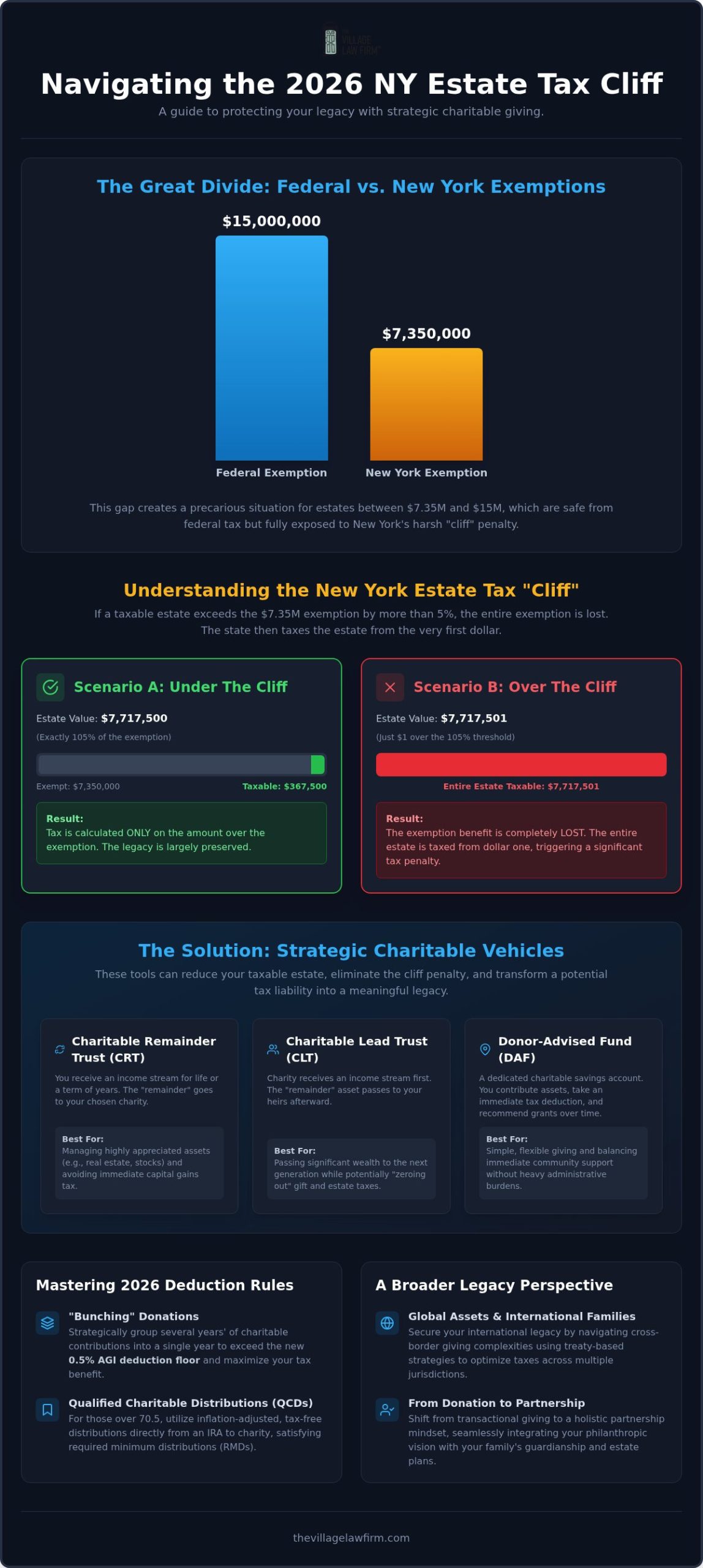
What if a single dollar of growth in your portfolio triggered a tax bill that reached back to claim your entire estate? For many New York families, this isn’t a hypothetical fear but a mathematical reality known as the estate tax “cliff.” It’s natural to feel a sense of urgency as we move through the 2026 tax year; you’ve spent a lifetime building a legacy, and you want to ensure it’s protected from unnecessary erosion. While the federal exemption has stabilized at $15 million under the One Big Beautiful Bill Act, the New York state threshold remains much tighter at $7,350,000. Navigating this gap requires more than just a standard will.
By implementing sophisticated charitable giving strategies NYC residents can use to shield their assets, you can transform a potential tax liability into a meaningful family mission. You’ll discover how to eliminate the “cliff” penalty entirely while maximizing your income tax deductions under the new 2026 rules. We will also explore how to manage the 0.5% AGI deduction floor and use tools like charitable trusts to create a sanctuary of order for your global and local assets alike. This is your guide to replacing uncertainty with a structured, impactful legacy.
Key Takeaways
- Understand how to navigate the 2026 New York estate tax “cliff” where exceeding the $7,350,000 exemption by even a small amount can trigger a significant tax penalty.
- Discover sophisticated charitable giving strategies NYC residents use to balance immediate community support through Donor-Advised Funds with the lifetime income benefits of Charitable Remainder Trusts.
- Learn to master the 2026 deduction rules by “bunching” donations to exceed the new 0.5% AGI floor and utilizing inflation-adjusted Qualified Charitable Distributions.
- Secure your international legacy by navigating the complexities of cross-border giving and using treaty-based strategies to optimize taxes across multiple jurisdictions.
- Shift your perspective from transactional donations to a partnership mindset that seamlessly integrates your philanthropic vision with your family’s guardianship and estate plans.
The 2026 NYC Tax Landscape: Navigating the New York Estate Tax Cliff
The New York estate tax landscape is shifting, and for many high-net-worth families, the ground beneath them feels increasingly uncertain. You’ve built your success in a city that rewards ambition, but the state’s tax code can be unforgiving to those who don’t plan with precision. The passage of the One Big Beautiful Bill Act (OBBBA) in 2025 brought clarity to federal rules, yet it also highlighted the stark divide between national exemptions and local New York realities. Choosing a “wait and see” approach isn’t just passive; it’s often the most expensive choice you can make. Every day without a structured plan is a day your legacy remains vulnerable to a tax structure designed to capture wealth rather than preserve it.
Understanding the ‘Cliff’ Penalty
In 2026, the New York estate tax exclusion is set at $7,350,000, and crossing this line by even a fraction creates what practitioners call the “cliff.” If your taxable estate exceeds 105% of that amount, you lose the benefit of the exclusion entirely. This means the state taxes the whole estate from the very first dollar, not just the portion over the limit. It effectively creates a 100% tax rate on that narrow “cliff” zone. The New York estate tax cliff is a provision where an estate exceeding $7,350,000 by more than 5% loses its tax credit entirely, resulting in the entire estate being taxed from the first dollar. To protect your family, charitable giving strategies NYC professionals recommend often focus on bequests that pull the taxable value back under the threshold. By directing that “excess” dollar to a cause you care about, you can save your heirs hundreds of thousands in state taxes. Understanding the nuances of U.S. charitable contribution deductions is the first step in turning a potential penalty into a powerful philanthropic statement.
The Federal Sunset and Your Legacy
While the OBBBA made the $15 million federal exemption permanent, many families with estates valued between $7 million and $14 million remain in a precarious middle ground. They are safe from federal taxes but fully exposed to the New York cliff. This is where the expertise of an irrevocable trust attorney NYC becomes essential. These legal structures allow you to lock in current rates and remove assets from your taxable estate before they appreciate further. Moving from a state of chaotic uncertainty to one of organized protection requires proactive document updates. It’s about more than just numbers; it’s about the peace of mind that comes from knowing your intentions are secure. Effective charitable giving strategies NYC allow you to act as a shield for your family, ensuring that the wealth you’ve generated serves your values rather than disappearing into the state’s coffers.
Sophisticated Charitable Vehicles: Trusts vs. Donor-Advised Funds
Choosing the right vehicle for your charitable giving strategies NYC isn’t just a financial decision; it’s an architectural one. You’re building a structure that must support your family’s needs while reaching out to the community you love. For many New York professionals, the choice often comes down to the control of a trust versus the simplicity of a Donor-Advised Fund (DAF). While a private foundation offers the highest level of control for massive estates, most families find that trusts or DAFs provide the perfect balance of tax efficiency and personal fulfillment without the heavy administrative burden of a dedicated entity.
CRTs and CLTs: The Technical Difference
The distinction between a Charitable Remainder Trust (CRT) and a Charitable Lead Trust (CLT) lies in the timing of the gift. If you own highly appreciated NYC real estate or stock, a CRT can be a sanctuary. You contribute the asset, avoid immediate capital gains tax, and receive an income stream for life. The “remainder” goes to charity later. Conversely, a CLT is often the preferred tool for families with children. It pays the charity first for a specific term of years. Because the charity receives the “lead” interest, the eventual transfer to your children can often “zero out” gift taxes. This allows you to pass significant wealth to the next generation while supporting local causes today. Deciding which aligns with your cash flow requires a partnership mindset; you’re looking for a strategy that provides stability now and protection later.
DAFs: The Modern Philanthropic Workhorse
Donor-Advised Funds have become the modern workhorse for New Yorkers who value efficiency. They are remarkably simple to establish and allow you to “bunch” several years of donations into a single high-income year. This is particularly useful under the 2026 rules, where only giving above 0.5% of your AGI is deductible for itemizers. By contributing a large sum to a DAF today, you secure the deduction immediately while recommending grants to charities over the coming decade. Adhering to the IRS guidelines for charitable contributions ensures these deductions remain secure. Integrating a DAF with the help of a revocable trust attorney New York provides a seamless bridge between your living expenses and your eventual legacy. It’s a way to keep your estate organized and your impact consistent. If you’re unsure which vehicle fits your specific asset mix, The Village Law Firm can help you design a plan that feels as meticulous as it is meaningful.
Strategic Timing: Bunching, QCDs, and 2026 Deduction Rules
Timing is often the invisible thread that holds a successful estate plan together. In 2026, the calendar becomes your most significant tax-planning tool. The One Big Beautiful Bill Act introduced a new 0.5% Adjusted Gross Income (AGI) floor for charitable deductions. This means that if you itemize, only the portion of your annual giving that exceeds 0.5% of your AGI is actually deductible. For many, small and frequent gifts will lose their tax edge. Successful charitable giving strategies NYC residents employ now focus on the “bunching” blueprint. By concentrating three to five years of planned giving into a single tax year, you can easily surpass the standard deduction and the AGI floor, creating a powerful tax shield when you need it most.
Meticulous record-keeping is no longer optional; it’s a requirement for those who value their legacy. As year-end deadlines approach, the pressure to finalize gifts can lead to rushed decisions. We encourage a more deliberate pace. By planning your contributions in the first half of the year, you ensure that every asset, from cash to complex securities, is transferred with precision. This methodical approach replaces the chaos of December with a sense of calm and purpose.
Maximizing the QCD Strategy
For New Yorkers aged 70½ and older, the Qualified Charitable Distribution (QCD) remains the most efficient way to give. In 2026, the limit for these tax-free transfers from an IRA has adjusted for inflation to $111,000 per person. Transferring these funds directly to an NYC non-profit is far superior to writing a personal check after taking a Required Minimum Distribution. Because the money never enters your taxable income, it bypasses the AGI floor entirely. It’s a clean, direct, and highly effective way to satisfy your philanthropic goals while keeping your tax profile lean.
The 2026 Deduction Squeeze
High-income earners must also navigate a new cap on the value of their deductions. If you’re in the 37% tax bracket, the tax benefit of your charitable contributions is now capped at 35%. This 2% difference might seem small, but on a substantial gift, the impact is significant. Strategies to “pre-fund” your philanthropy through trusts or DAFs can help you lock in benefits before rules tighten further. It’s also vital to coordinate these gifts with a Medicaid planning attorney New York. Large charitable transfers can sometimes trigger look-back penalties if not structured correctly. We ensure your generosity today doesn’t compromise your access to long-term care tomorrow. Integrated charitable giving strategies NYC families use must look at the whole picture, balancing altruism with long-term security.
Advanced Strategies for Global Assets and International Families
New York City is a global crossroads, and for many of our clients, wealth is rarely confined to a single zip code. If your portfolio includes a flat in London, shares in a family business in Hong Kong, or real estate in Tel Aviv, your philanthropic vision likely extends beyond the five boroughs. However, the borderless nature of your life often clashes with the rigid boundaries of tax law. Effective charitable giving strategies NYC families utilize must account for the complexities of international regulations to prevent your generosity from being consumed by dual-taxation or administrative friction. We act as your steady guide, ensuring that your global footprint leaves a lasting, positive mark without compromising the security of your estate.
One of the most frequent hurdles is the IRS requirement that a charitable deduction only applies to gifts made to U.S. registered 501(c)(3) organizations. If you wish to support a cause in your home country, you cannot simply write a check to a foreign entity and expect a tax benefit. Instead, we often utilize “friends of” organizations. These are U.S. based non-profits specifically designed to support foreign charitable work. This allows you to fulfill your global mission while remaining firmly within the safety of U.S. tax compliance.
Giving with Foreign Assets
Donating non-U.S. real estate or securities requires a meticulous touch to avoid massive tax leakage. When you gift foreign property, you may face capital gains taxes in the country where the asset is located, even if the gift is charitable by U.S. standards. International estate planning is the primary tool used to shield global family wealth from these overlaps. We also pay close attention to “Ancillary Probate.” If you leave a foreign property to a charity in your NYC will, that charity may still have to navigate a secondary probate process in the foreign jurisdiction. This can be slow, expensive, and emotionally draining for your heirs. By using international trusts, we can often bypass this hurdle entirely, moving assets from chaos to a state of sanctuary and order.
Philanthropy for the Global Citizen
For the global citizen, a legacy is often a bridge between two worlds. We focus on structuring trusts that satisfy the requirements of both the IRS and foreign tax authorities, ensuring your intentions aren’t lost in translation. This is particularly vital for non-citizen residents in New York, who face unique challenges regarding the marital deduction and estate tax exemptions. Supporting your home country while living in NYC carries a significant emotional weight; your plan should reflect that depth. Navigating the labyrinth of cross-border probate requires specialized counsel to ensure that your international charitable intentions are legally enforceable in every jurisdiction involved. If you are managing assets across borders, our team specializes in international estate planning that bridges the gap between your NYC life and your global interests.
Building Your Meticulous Philanthropic Legacy
True philanthropy isn’t a series of isolated transactions; it’s a dialogue between your values and your vision for the future. Moving from a transactional approach to a partnership mindset allows you to see your estate plan as a living extension of your life’s work. You’ve spent years building your success in New York, and your legacy deserves a structure that reflects that same level of care. By integrating your charitable giving strategies NYC with your guardianship and family plans, you ensure that your altruism never comes at the expense of your children’s security. It’s about creating a sanctuary where your family’s needs and your community’s growth exist in perfect harmony.
A critical, often overlooked tool in a sophisticated NYC will is the “Santa Claus” clause. This provision acts as a final safeguard, directing assets to a chosen charity in the unlikely event that all named beneficiaries are unable to inherit. It prevents your hard-earned wealth from being absorbed by the state, ensuring that even in an ultimate disaster scenario, your assets serve a purpose you believe in. This level of meticulous detail is what separates a standard document from a premium estate plan.
Protecting the Next Generation
Philanthropy is one of the most powerful teaching tools available to a parent. By establishing a family Donor-Advised Fund, you can involve your children in the grant-making process, teaching them the value of stewardship and the impact of a well-placed gift. This approach balances a significant charitable legacy with a robust inheritance, showing the next generation that wealth is a tool for both family stability and social good. The Village Law Firm acts as your shield against future uncertainty, walking alongside you to ensure that your gifts are structured to protect your heirs while amplifying your impact. We bridge the gap between complex tax mechanics and the deeply human desire to provide for those you love.
Your 2026 Readiness Audit
As we approach the 2026 tax cliff, a passive approach is no longer an option. Your current plan must be audited to ensure it addresses the specific nuances of the New York estate tax threshold and the new federal rules. Consider the following steps to secure your legacy:
- Review your taxable estate to ensure it sits safely below the $7,350,000 New York “cliff” through strategic bequests.
- Evaluate whether you have optimized your life insurance through an irrevocable life insurance trust New York to provide liquidity without increasing your tax burden.
- Confirm that your charitable giving strategies NYC utilize the most current deduction rules, including the 0.5% AGI floor.
- Update your international asset structures to avoid probate friction across multiple jurisdictions.
The transition from the current tax environment to the 2026 landscape requires an authoritative guide who understands both the numbers and the emotions involved. Schedule a consultation with The Village Law Firm to secure your legacy.
Securing Your Vision for 2026 and Beyond
The 2026 tax cliff doesn’t have to be a source of anxiety. By looking ahead, you can transform a complex legal requirement into a profound family mission. We’ve explored how sophisticated charitable giving strategies NYC families rely on can neutralize the state’s estate tax cliff and optimize federal deductions. Whether you’re managing cross-border assets or teaching your children the value of stewardship, the goal remains the same. Stability is possible. Protection is within reach. You’ve built a remarkable life in this city; your legacy should reflect that strength rather than being diminished by predictable tax shifts.
Our firm provides specialized expertise in cross-border estate administration and a calming, white-glove approach to the most intricate tax laws. We focus exclusively on NYC families and global citizens, acting as a shield against the unpredictability of modern life. You don’t have to navigate these shifting rules alone. Secure your wealth and define your legacy with a personalized charitable strategy. Your legacy is a bridge between the success you’ve built and the future you want to create. Let’s ensure it stands strong and serves your family for generations to come.
Frequently Asked Questions
What is the New York estate tax cliff in 2026?
The “cliff” is a unique New York tax provision where an estate exceeding the 2026 exemption of $7,350,000 by more than 5% loses the benefit of the exclusion entirely. This means the state taxes the entire estate from the very first dollar rather than just the amount over the limit. It effectively creates a 100% tax rate on assets within that narrow “cliff” zone, making precise planning essential for families near this threshold.
Can I use a charitable gift to bring my estate below the NY tax threshold?
Yes, charitable bequests are a primary tool used to “level” the cliff by reducing the taxable value of your estate. By directing the portion of your wealth that exceeds the $7,350,000 limit to a qualified non-profit, you can pull your estate back under the cliff. This strategy ensures that your assets support a cause you value rather than being consumed by a disproportionately large state tax bill.
How does ‘bunching’ charitable donations work under the OBBBA?
Bunching involves concentrating multiple years of planned giving into a single tax year to surpass the new 0.5% AGI deduction floor and the standard deduction. Under the One Big Beautiful Bill Act, only the portion of annual giving exceeding 0.5% of your adjusted gross income is deductible for itemizers in 2026. By contributing several years’ worth of gifts to a Donor-Advised Fund at once, you maximize your tax shield during high-income years.
Are donations to international charities tax-deductible for NYC residents?
Direct donations to foreign charitable organizations are generally not tax-deductible under U.S. law. To receive a deduction, NYC residents typically use “friends of” organizations, which are U.S. based 501(c)(3) entities designed to support specific foreign causes. This allows you to fulfill your global philanthropic goals while ensuring your gifts remain compliant with IRS regulations and eligible for estate tax deductions.
What is the difference between a Charitable Remainder Trust and a Lead Trust?
The primary difference lies in the timing of the charitable gift and the income stream. A Charitable Remainder Trust (CRT) provides you or your heirs with income for a set term, with the remaining assets going to charity later. A Charitable Lead Trust (CLT) pays the charity first for a specific period, after which the remaining assets pass to your family, often with significantly reduced gift and estate taxes.
How do Qualified Charitable Distributions (QCDs) help with my NYC taxes?
QCDs allow individuals aged 70½ or older to transfer up to $111,000 directly from an IRA to a charity tax-free in 2026. This is one of the most effective charitable giving strategies NYC seniors can employ because the distribution doesn’t count as taxable income. By bypassing your income entirely, the gift is not subject to the 0.5% AGI floor, providing a cleaner tax benefit than a standard donation.
Will my charitable giving affect my Medicaid eligibility in New York?
Large charitable gifts can potentially trigger a Medicaid look-back penalty if they occur within five years of an application for long-term care. New York’s Medicaid program scrutinizes asset transfers made for less than fair market value. It’s vital to structure your philanthropy carefully with a legal partner to ensure your generosity today doesn’t inadvertently disqualify you from receiving essential healthcare benefits in the future.
How can I involve my children in my charitable giving strategy?
Establishing a family Donor-Advised Fund is a sophisticated way to integrate your children into your charitable giving strategies NYC. You can grant them advisory roles, allowing them to research non-profits and recommend grants. This approach transforms estate planning from a dry legal process into a shared family mission, teaching the next generation about stewardship while building a meticulous and lasting philanthropic legacy.