
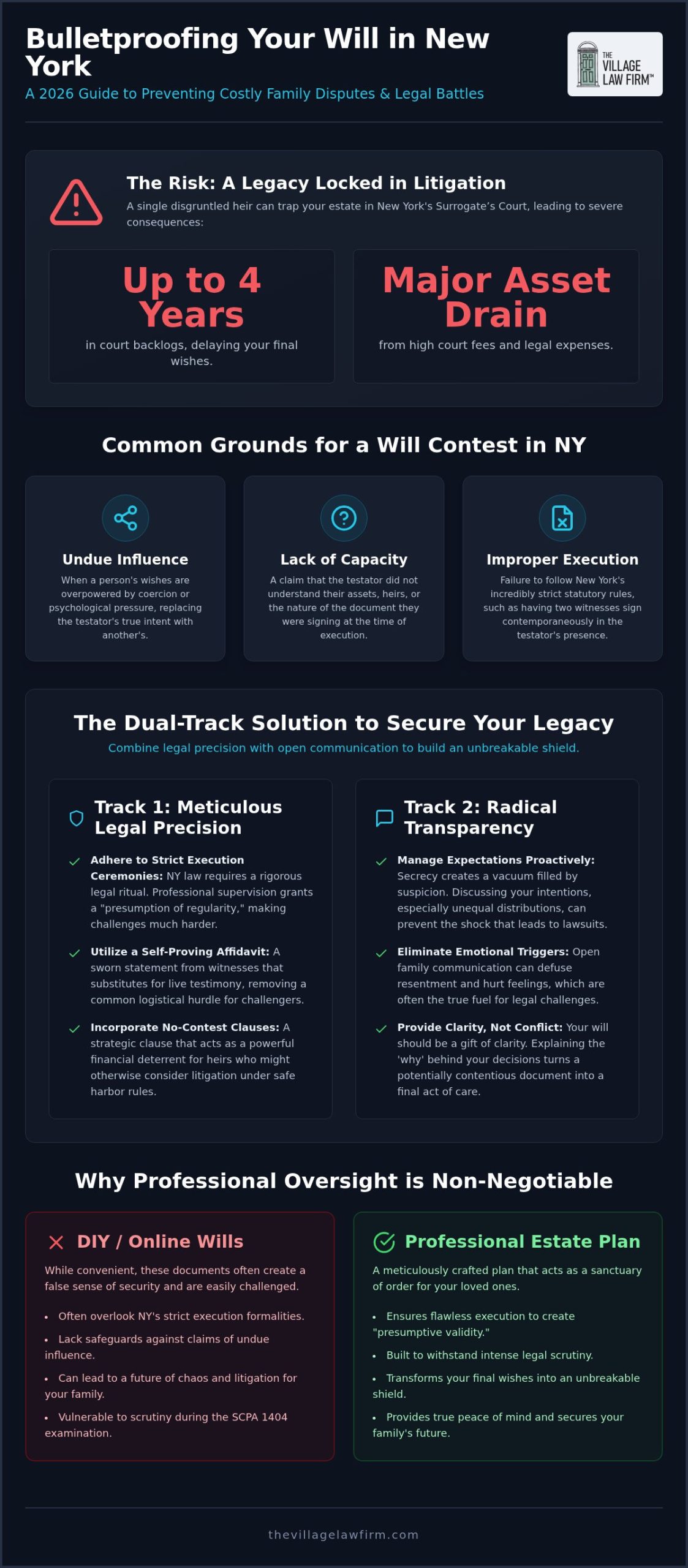
A single disgruntled heir can lock your legacy in a New York Surrogate’s Court backlog for up to four years, draining the very assets you worked a lifetime to protect. You want your final wishes to be a gift of clarity, not a catalyst for a family feud that ends in expensive litigation. It’s natural to feel anxious that a complex decision, such as disinheriting a relative or distributing assets unequally, might trigger a messy probate battle. We understand that your goal isn’t just to sign a document; it’s to secure your family’s future. This 2026 guide reveals exactly how to prevent a will contest in New York by using a dual-track approach of meticulous legal precision and radical transparency. You’ll learn how to bulletproof your estate plan against claims of undue influence or lack of capacity while minimizing the risk of high court fees. We will explore the strategic use of no-contest clauses under current safe harbor rules, the impact of new electronic will legislation, and the specific procedural safeguards required to ensure your plan stands as an unbreakable shield for those you love most.
Key Takeaways
- Learn why New York’s strict execution ceremonies are the first line of defense against challenges to your testamentary capacity and intent.
- Discover how to prevent a will contest in New York by utilizing strategic no-contest clauses that act as a powerful financial deterrent for litigious heirs.
- Understand the inherent risks of DIY legal documents and how professional oversight replaces potential chaos with a sanctuary of order.
- Explore how radical transparency and proactive family communication can manage expectations and eliminate the emotional triggers that lead to lawsuits.
- Secure your family’s future by transforming your estate plan into a meticulous shield against the high costs and delays of Surrogate’s Court litigation.
Understanding the Risks: Why Wills are Contested in New York Surrogate’s Court
A will contest is a formal legal objection to the validity of a will filed in the New York Surrogate’s Court. While it may start as a simple family disagreement, it quickly evolves into a high-stakes battle that can deplete estate assets and fracture family relationships for generations. In New York, these disputes are notorious for their complexity and duration. Understanding a Will Contest is the first step toward building a shield against it. When you understand the specific triggers, you can take deliberate steps regarding how to prevent a will contest in New York.
Chaos often stems from the surprise factor. If your heirs discover for the first time after your passing that you’ve chosen unequal distributions or disinherited a close relative, the shock frequently turns into litigation. Late-life changes to an estate plan, especially those involving international assets or Medicaid planning, are common triggers in 2026. Secrecy creates a vacuum. That vacuum is often filled by suspicion and resentment from those who feel left behind.
The Legal Grounds for a Challenge in NY
To overturn a will, an objectant must prove specific legal grounds. These aren’t just hurt feelings; they are rigorous legal standards that require substantial evidence.
- Lack of Testamentary Capacity: This questions whether the testator understood the nature of their assets and the identity of their heirs at the time of signing.
- Undue Influence: This occurs when a caregiver or a specific family member coerces the testator, effectively replacing the testator’s wishes with their own through psychological pressure.
- Improper Execution: New York maintains incredibly strict statutory formalities for signing a will. If the witnesses didn’t sign in each other’s presence or the testator didn’t clearly state the document was their will, the entire plan can collapse.
The Burden of Proof and the 1404 Examination
The burden of proof typically falls on the person challenging the will. However, New York offers a unique procedural step known as the SCPA 1404 examination. This is the discovery phase of a New York will contest where potential objectants can depose the drafting attorney and the witnesses before they even file formal objections. It’s a critical moment where the meticulousness of your legal partner’s work is put to the test. Knowing how to prevent a will contest in New York means ensuring your execution ceremony is robust enough to survive this intense scrutiny. A well-prepared attorney creates a sanctuary of order that makes these challenges difficult to sustain.
The Technical Foundation: Ensuring Proper Execution and Testamentary Capacity
Execution in New York isn’t a mere formality; it’s a rigorous legal ceremony. If the ritual fails, the document fails. This technical foundation is where most “DIY” or online wills crumble. While digital templates offer convenience, they often lack the precision required by the New York Surrogate’s Court. These platforms frequently overlook Common Will Drafting Issues that seasoned litigators exploit to invalidate a plan. Learning how to prevent a will contest in New York requires moving beyond basic document preparation and toward a strategy of “presumptive validity.”
One of the most effective tools in this technical arsenal is the Self-Proving Affidavit. This document is a sworn statement by the witnesses, signed in the presence of a notary at the time of the will’s execution. It serves as a substitute for live witness testimony during probate. By securing this affidavit, you remove the logistical nightmare of locating witnesses decades later and provide the court with immediate, sworn evidence that the execution was sound. It acts as a primary deterrent for anyone hoping to find a procedural loophole in your plan.
Strict Adherence to NY Statutory Formalities
New York law demands that a testator declare the document to be their last will and testament in the presence of at least two witnesses. These witnesses must sign the document “contemporaneously,” meaning within a very short window of each other. When a strategic estate planning partner supervises this ceremony, the law grants a “presumption of regularity.” This means the court assumes the ceremony was performed correctly, shifting a heavy burden onto anyone trying to prove otherwise. Even the physical state of the document matters. A will that has been unstapled or shows signs of tampering can trigger a court inquiry, as the Surrogate may suspect that pages were swapped or removed.
Proactive Proof of Mental Capacity
Testamentary capacity is the most common ground for a challenge. To protect your legacy, you must prove you understood your assets and who your heirs were at the time of signing. If you are making significant changes late in life, consider obtaining a “capacity letter” from a primary care physician. While video recordings of signings are becoming popular, they are a double-edged sword. A video might capture your clarity, but it could also inadvertently highlight physical frailty that an objectant could misinterpret as mental weakness. A better approach often involves documenting long-standing intent through previous drafts and letters of instruction, showing that your final wishes are the result of careful, consistent thought rather than a sudden impulse.
Strategic Legal Tools: No-Contest Clauses and Self-Proving Affidavits
A “bulletproof” estate plan isn’t just about what you include; it’s about the barriers you build against potential disruption. In New York, the most potent deterrent is the “In Terrorem” or no-contest clause. This legal tool functions as a shield by stating that if a beneficiary challenges the will and loses, they forfeit their entire inheritance. However, this strategy only works if you use a “carrot and stick” approach. If you completely disinherit a relative, they have nothing to lose by suing your estate. To effectively learn how to prevent a will contest in New York, you must leave a meaningful enough gift that the risk of losing it outweighs the potential reward of a lawsuit.
While powerful, these clauses have specific limitations under New York EPTL 3-3.5. The law is designed to prevent these clauses from being used to hide fraud or coercion. For example, a beneficiary can often conduct preliminary discovery, such as deposing the drafting attorney, without triggering the forfeiture. This is why the technical precision of your execution ceremony, discussed in the previous section, is so vital. When your legal partner ensures every statutory formality is met, the “safe harbor” discovery usually reveals a plan that is simply too strong to challenge.
How No-Contest Clauses Work in New York
Enforceability in the Surrogate’s Court requires specific, unambiguous language. You can’t just imply a penalty; you must explicitly state the consequences of an unsuccessful contest. It’s also critical to understand the safe-harbor exceptions. Under SCPA 1404, an heir can examine the witnesses and the attorney who prepared the will before filing formal objections. This “pre-contest” phase doesn’t trigger the no-contest clause. By leaving a strategic inheritance, you create a high-stakes decision for a disgruntled heir: do they take the guaranteed gift or risk everything on a long-shot legal battle?
The Power of the Revocable Living Trust
One of the most effective ways to avoid the friction of the probate process is to move assets into a Revocable Living Trust. Wills must go through the public probate process, which requires the court to notify all “heirs at law,” even those you’ve intentionally excluded. This notice can act as an invitation to litigate. In contrast, trusts are private documents. They don’t require the same automatic court oversight or public filings, making them significantly harder to contest. If you’re weighing your options, you might ask, Do I Need a Trust or a Will in New York? The answer often depends on your desire for privacy and how much you wish to insulate your heirs from the public eye. Using a trust is a sophisticated way to maintain order and ensure your distribution remains a private family matter rather than a public court record.
Beyond the Paperwork: The Role of Transparency and Family Communication
Legal documents are necessary, but they are often cold. They lack the emotional context your family needs to understand your decisions. If you want to know how to prevent a will contest in New York, you must look beyond the signatures and staples. Transparency is perhaps the most effective deterrent against probate litigation. When heirs are surprised by a distribution, they often search for a legal reason to vent their emotional pain. By removing the element of surprise while you are still here, you take away the oxygen that fuels these court battles.
A Letter of Intent is a powerful, non-binding supplement to your will. It allows you to speak directly to your loved ones, explaining why you chose a specific distribution or why certain assets were placed in a trust. This narrative provides the “why” that a formal will cannot. It humanizes your choices and makes it much harder for a disgruntled relative to claim you were coerced or lacked the capacity to make those decisions. It transforms a sterile legal requirement into a final message of clarity and care.
Family Meetings and Managed Expectations
Conducting a “Legacy Meeting” can feel daunting, but it is a hallmark of a well-ordered estate. This isn’t about asking for permission; it’s about managing expectations. You can address the “Fair vs. Equal” debate head-on. For instance, if one child has significant medical needs or another has already received a lifetime gift, explaining this context prevents future resentment. For families with young children, this is also the time to ensure that chosen guardians are aligned with your values and fully understand their future role. Openness today is the best way to prevent a will contest in New York tomorrow.
Special Considerations for International and Complex Estates
Complexity increases when your life spans multiple borders. If you have property in Europe or bank accounts in Asia, you are dealing with a web of conflicting laws. Some countries have “forced heirship” rules that mandate specific inheritance percentages for children, regardless of what your New York will says. Proper international estate planning ensures that your global assets are harmonized. Without this coordination, your estate could face parallel contests in different jurisdictions, significantly increasing legal fees and court delays. Replacing family anxiety with long-term security requires a partner who understands both the law and the human heart. If you are ready to build a plan that protects your legacy from every angle, reach out to us for sophisticated estate planning that prioritizes your family’s peace of mind.
Securing Your Legacy: Why Professional Oversight is Non-Negotiable
Estate planning is not a transactional event; it’s an ongoing commitment to your family’s stability. A document preparer might provide you with the correct forms, but they cannot offer the deep emotional intelligence required to navigate complex family dynamics. A strategic legal partner looks beyond the ink on the page to identify potential points of conflict before they erupt. This proactive approach is the most effective way to understand how to prevent a will contest in New York. We replace the potential for legal chaos with a sanctuary of order, ensuring that your final wishes are expressed with absolute clarity and legal weight.
Your legacy deserves more than a “set it and forget it” mentality. As New York laws evolve and your personal circumstances change, your estate plan must adapt to remain effective. Strategic Medicaid eligibility planning is a critical component of this evolution. We help you navigate the complexities of asset protection while ensuring your Medicaid strategy doesn’t inadvertently trigger a challenge from heirs. By maintaining a professional relationship with your legal team, you ensure that every update to your plan is executed with the same meticulous precision as the original document.
The Value of Meticulous New York Planning
Ambiguity is the primary driver of Surrogate’s Court litigation. Professional drafting eliminates the vague language that often serves as an invitation for a contest. At The Village Law Firm, we emphasize a “white-glove” execution ceremony that goes far beyond the basic legal requirements. This creates an authoritative record of your intent and capacity, providing a shield that survives even the most intense scrutiny. Our meticulous approach ensures that your assets are protected and your heirs are spared the high cost of unnecessary litigation. We focus on the details so you can focus on your life.
Next Steps: Protecting Your Family Today
The best time to secure your legacy is now, while you have the clarity and capacity to make these vital decisions. An initial consultation allows us to identify “red flags” such as estranged relatives or complex international assets that require specialized handling. We provide a clear roadmap for 2026 and beyond, replacing uncertainty with a methodical plan for protection. We invite you to schedule a consultation with The Village Law Firm today. Let us walk alongside you with compassion and expertise to ensure your final wishes are honored and your family is protected for generations to come.
Protect Your Legacy with Confidence and Clarity
Your legacy is far more than a collection of assets; it’s the final expression of your values and your love for those you leave behind. Securing that legacy requires a meticulous blend of legal precision and emotional intelligence. By prioritizing strict adherence to New York’s execution formalities and utilizing strategic tools like no-contest clauses, you create a robust shield against future uncertainty. Transparency remains your greatest ally. When you manage expectations today, you eliminate the surprises that fuel litigation tomorrow.
Learning how to prevent a will contest in New York is a journey we take alongside you. Whether you are navigating the complexities of international estate administration or seeking dedicated planning for families with minor children, our firm provides the sanctuary of order you deserve. We bring specialized expertise in New York Surrogate’s Court procedures to every plan we craft, replacing anxiety with a profound sense of security. You don’t have to leave your family’s future to chance. Take the first step toward a bulletproof estate plan today.
Protect your legacy and prevent family conflict—contact The Village Law Firm today.
Frequently Asked Questions
Can I completely disinherit a child in New York?
You have the legal right to disinherit an adult child in New York. Unlike a spouse, who is protected by a statutory right of election, children do not have a guaranteed right to inherit. You must be explicit in your document to avoid claims of a mistake. A clear statement of intent is a vital strategy for how to prevent a will contest in New York. We often suggest providing a private letter of instruction to explain your reasoning.
What is the most common reason for a will contest in NYC?
Lack of testamentary capacity and undue influence are the primary drivers of probate litigation in the city. These claims often arise when a testator makes significant changes to their plan late in life or during a health crisis. Surprise is usually the emotional catalyst. When a family member feels blindsided by a distribution, they use these legal grounds to voice their grievances and seek a larger share of the estate assets.
Does a no-contest clause actually work in New York?
These clauses are enforceable but subject to strict safe harbor rules. Under SCPA 1404, a beneficiary can examine the drafting attorney and witnesses before filing formal objections without risking their inheritance. To be effective, the clause must be paired with a meaningful gift. If the beneficiary has nothing to lose, the clause offers no deterrent. It acts as a financial shield only when the risk of forfeiture outweighs the potential reward of a lawsuit.
How much does it cost to contest a will in New York Surrogate’s Court?
Filing fees for probate are based on the estate’s value, ranging from $45 to $1,250 for estates over $500,000. However, the true cost of a contest lies in legal fees and the toll of time. With current backlogs, a contest can last two to four years. This prolonged litigation quickly depletes the estate’s assets, often leaving significantly less for the ultimate beneficiaries than you originally intended. Meticulous planning is the only way to avoid these costs.
Can a will be challenged if it was signed in a hospital?
A hospital setting does not automatically invalidate a will, but it does invite closer scrutiny from disgruntled heirs. Objectants often use the location to argue that the testator lacked capacity or was vulnerable to psychological pressure. To protect your wishes, we recommend having a medical professional document your clarity at the time of signing. A supervised execution ceremony by a strategic legal partner provides a vital presumption of regularity that hospital staff cannot provide.
What happens if the original will is lost in New York?
New York law presumes that a lost will was intentionally revoked by the testator. Overcoming this presumption of revocation is an incredibly difficult legal hurdle. You must prove the document was not revoked and establish its specific terms through a copy or credible witness testimony. This uncertainty is a primary driver of family conflict. Storing your original document in a secure, fireproof location or with your attorney is essential for maintaining order and family peace.
How long do you have to contest a will in New York?
The deadline depends on the specific legal grounds. A contest based on lack of testamentary capacity must be filed within two years of the date the will is admitted to probate. For claims involving fraud, forgery, or undue influence, the limit is the later of two years from probate or six years from the date of death. Understanding these strict timelines is a critical part of knowing how to prevent a will contest in New York through proactive planning.
Can a domestic partner contest a will if they were left out?
Only interested parties with a direct financial stake, such as legal heirs or beneficiaries of a prior will, have standing to contest. In New York, a domestic partner is not an automatic legal heir unless they are a surviving spouse or named in a previous document. However, they may still attempt to challenge the will if they can prove they would benefit if the current document were set aside. This underscores the need for clear, updated legal documents.