
You’ve spent weeks organizing files and speaking with attorneys in your home state, believing the hardest part of being an executor was finally behind you. Then you learn that because your loved one owned property in the Empire State, your local court authority stops at the border. It’s a common, jarring moment of frustration. You’re suddenly facing the reality of ancillary probate New York, a secondary legal process that can feel like a redundant hurdle when you’re already managing the weight of a legacy from hundreds of miles away.
It’s natural to feel overwhelmed by the prospect of more paperwork and the fear of New York’s aggressive estate tax cliff. This cliff is a unique challenge in 2026, as estates exceeding the $7,350,000 exemption by more than five percent lose the exemption entirely. We’re here to replace that anxiety with a sense of high-end security. This guide provides a clear, expert-led framework to help you master these complexities with total confidence. We’ll outline the exact steps to streamline the sale of real estate and ensure your filings meet every Surrogate’s Court requirement. You’ll gain a professional roadmap that replaces chaos with the peace of mind that comes from meticulous order and tax compliance.
Key Takeaways
- Understand why a secondary legal proceeding is required to manage “situs” property such as New York real estate, co-ops, or fine art.
- Identify the specific legal triggers that make ancillary probate New York mandatory for out-of-state executors and beneficiaries.
- Learn the essential two-step filing process in the Surrogate’s Court, beginning with the collection of authenticated records from your home state.
- Protect the estate’s value by navigating the 2026 New York estate tax cliff and the mandatory seven-month creditor claim period.
- Discover how a specialized cross-border administration approach can transform complex legal hurdles into a streamlined, secure transition for your family.
What is Ancillary Probate in New York? The Bridge for Out-of-State Estates
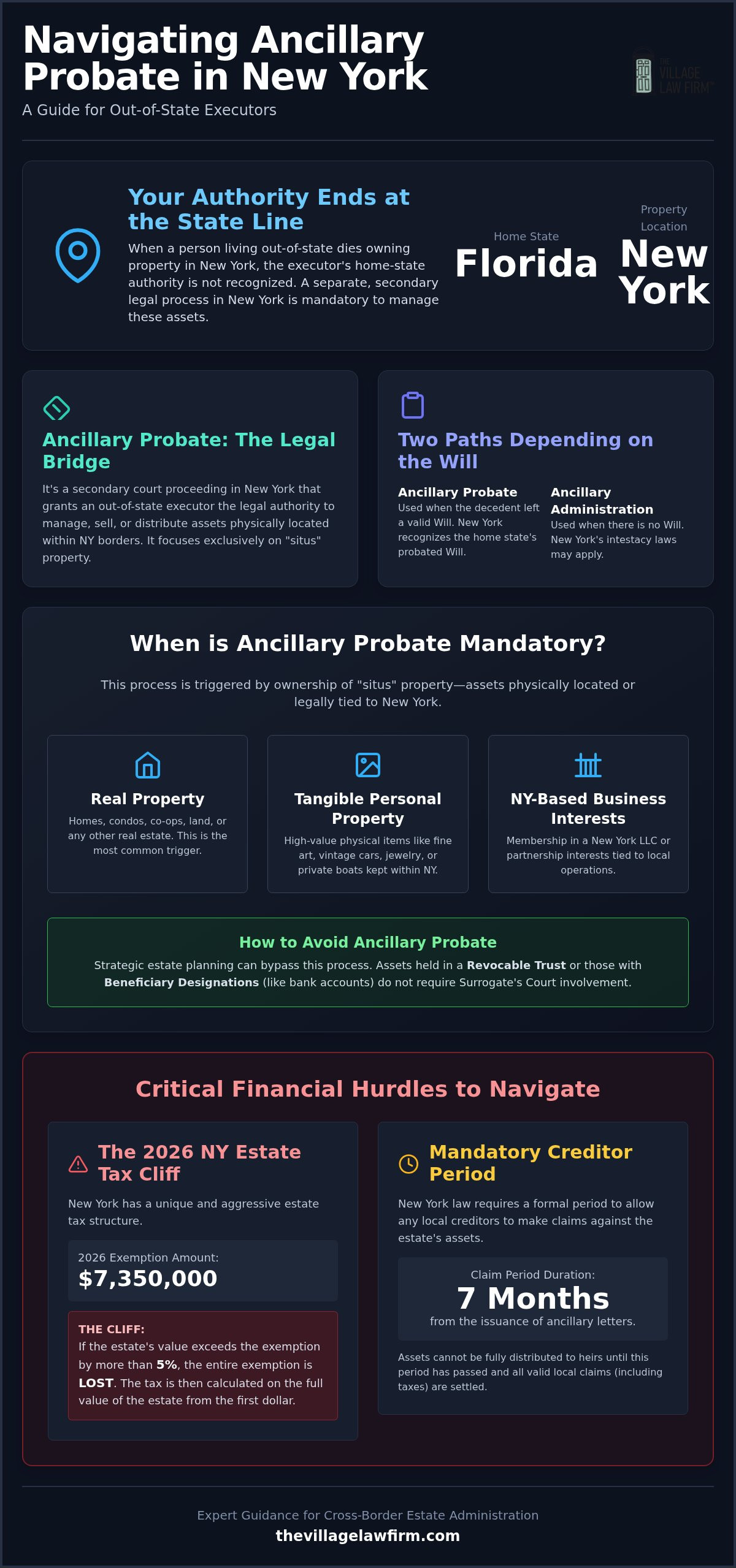
Your authority as an executor is typically bound by the borders of the state where the decedent lived. If your loved one resided in Florida but owned a Manhattan condo or a vineyard in the North Fork, your home-state court orders don’t carry weight in the Empire State. This legal gap is filled by ancillary probate New York, a secondary proceeding designed specifically for non-domiciliary decedents. It focuses exclusively on “situs” property, which includes real estate and tangible assets physically located within New York’s jurisdiction.
Ancillary probate New York acts as the essential legal bridge, providing an out-of-state executor with the specific authority required to manage, sell, or distribute assets located within New York borders.
The Legal Necessity of New York Jurisdiction
New York law is fiercely protective of its land and its people. Out-of-state courts simply lack the sovereign power to transfer the title of New York real property. If you attempt to sell a decedent’s New York home using only out-of-state letters testamentary, the title company will halt the transaction immediately. They require a decree from a local Surrogate’s Court to ensure the transfer is valid under state law.
The Surrogate’s Court also serves as a protective shield for local interests. It ensures that any New York-based creditors or tax obligations are satisfied before assets are whisked away to another state. Without this formal process, the property’s title remains “clouded.” This creates a legal stalemate that prevents future sales, refinancing, or clear inheritance, effectively trapping the asset in a state of perpetual uncertainty.
Ancillary Probate vs. Ancillary Administration
The specific path you take in the Surrogate’s Court depends entirely on whether the decedent left a valid Will. If a Will exists and has been admitted to probate in the home state, you will file for Ancillary Probate. This process asks the New York court to recognize the existing Will and grant you the power to carry out its instructions regarding New York property. It’s a methodical transition from one jurisdiction to another that honors the decedent’s stated wishes.
If the decedent died without a Will, the process is known as Ancillary administration. In these cases, New York’s intestacy laws may influence who is eligible to serve as the local administrator. While the core objective remains the same—moving assets from chaos to order—the filing requirements are distinct. You must provide proof of your appointment as the administrator in the home state and demonstrate that you’ve met New York’s specific bonding and notice requirements to protect the interests of potential heirs.
When is New York Ancillary Probate Legally Required?
Not every estate with a New York connection requires a formal court filing. However, if a decedent lived elsewhere but held title to specific types of assets within the state, ancillary probate New York becomes a mandatory legal step. The most frequent trigger is the ownership of real property. This includes everything from a single-family home in Westchester to a luxury condo in Manhattan or a seasonal cottage in the Finger Lakes. Because these assets are fixed to New York soil, only a New York court can authorize their transfer to heirs or a potential buyer.
Beyond real estate, other “tangible” assets can necessitate a filing. If the decedent kept high-value items like fine art, private boats, or vintage car collections within state lines, you’ll likely need local authority to manage them. Similarly, business interests or LLC memberships that are tied specifically to New York operations often require a local decree to ensure the business can continue to function or be liquidated without legal interruption.
You can avoid this secondary layer of administration through strategic planning. Assets held in a revocable trust or those with valid beneficiary designations bypass the Surrogate’s Court entirely. If you’re currently managing an estate and aren’t sure which assets fall under this requirement, we can help you audit the estate’s New York footprint to determine the most efficient path forward.
The “Situs” Rule: What Counts as New York Property?
The legal concept of “situs” determines where an asset is officially located. Real estate always has a New York situs. Conversely, “intangible” property like bank accounts or brokerage funds typically follows the owner’s domicile. If the decedent lived in Connecticut, their bank account is usually handled there, even if the bank has a branch in New York City. A notable exception is the New York City co-op. While co-ops are technically shares of stock in a corporation, the Surrogate’s Court treats them as real property for probate purposes. This nuance often surprises out-of-state executors who expect a simpler transfer process.
International Assets and Cross-Border Complexity
This complexity isn’t limited to New York; other states have their own specialized procedures for property-related recoveries. If your estate administration involves a California property that has been through a foreclosure, you may visit Surplus Funds CA to learn how to claim any surplus funds that may be owed to the estate.
New York is a primary hub for global investment, which frequently leads to international estate complications. When a non-US citizen dies owning property in New York, the ancillary process becomes the primary mechanism for settling those US-based interests. These cases require a deep understanding of international estate planning to navigate the interplay between New York law and foreign jurisdictions. In these high-stakes scenarios, the goal is to create a sanctuary of order that protects the estate from unnecessary delays or international tax penalties.
The Strategic Process: Filing in the New York Surrogate’s Court
Successfully initiating ancillary probate New York requires a meticulous approach to the court’s specific order of operations. You can’t simply walk into a Manhattan or Brooklyn courthouse with a standard copy of your local probate decree and expect immediate recognition. Instead, you must follow a structured path that respects the jurisdictional sovereignty of the Empire State. This process transforms your out-of-state authority into a legally recognized power within New York, ensuring every transaction involving the decedent’s assets is beyond reproach.
The journey begins with these four essential milestones:
- Step 1: Secure exemplified (triple-sealed) copies of the probate records from your home state court.
- Step 2: File the formal Petition for Ancillary Letters in the Surrogate’s Court of the county where the New York property is physically located.
- Step 3: Satisfy New York’s strict notice requirements by issuing citations to any necessary parties, including heirs and potential local creditors.
- Step 4: Obtain the Decree and the Ancillary Letters Testamentary, which grant you the final authority to act.
Required Documentation for a Seamless Filing
The most common cause of administrative friction is providing the wrong type of documentation. New York courts require an “exemplified” copy of the home state records, not just a standard certified version. An exemplified copy, often called a triple-seal, includes signatures from both the court clerk and a judge to verify the document’s authenticity for use across state lines. Because the original Will is usually retained by your home state’s court, these verified copies are your primary currency in New York. You’ll also need to submit the Petition, the Oath and Designation, and a Citation, which are the standard forms that signal your readiness to take responsibility for the New York assets.
Timeline and Expectations for 2026
The duration of these proceedings varies significantly depending on the county. In smaller upstate counties, you might see progress in a few months. However, in busy urban hubs like Kings or New York County, the process can often stretch beyond a year. A major factor in this timeline is the mandatory seven-month creditor claim period required by New York law. This period ensures that local debts are addressed before assets are distributed. Missing heirs or complex property valuations can also trigger delays. Utilizing a white-glove legal approach streamlines the ancillary probate New York experience by ensuring every filing is precise the first time, preventing the back-and-forth corrections that often stall less meticulous applications.
Navigating Creditors, Taxes, and the 2026 Estate Tax Cliff
Managing an estate across state lines requires a vigilant eye on local obligations that differ significantly from your home jurisdiction. In ancillary probate New York, the Surrogate’s Court acts as a guardian for local interests. This means New York creditors hold a legal priority over your out-of-state beneficiaries. You must observe a mandatory seven-month window where creditors can file claims against the estate’s New York assets. Distributing property too early can lead to personal liability for the executor, making this waiting period a non-negotiable phase of your administration journey.
Tax compliance adds another layer of complexity. If the decedent was a non-resident but owned New York property, you must file Form ET-706 within nine months of the date of death. This filing is essential even if the estate’s value seems modest because New York’s tax authorities are particularly diligent about “situs” assets. In some cases, previous Medicaid planning strategies implemented during the decedent’s life may also come under review, requiring a sophisticated defense of the estate’s asset protection structures.
The 2026 New York Estate Tax Exemption Update
For deaths occurring in 2026, the basic exclusion amount is set at $7,350,000. While this sounds generous, New York’s “tax cliff” creates a precarious situation for families. If the total value of the estate exceeds 105% of that exemption amount, the entire estate is taxed from the very first dollar. This isn’t a progressive tax where only the excess is hit; it’s a total loss of the exemption. You can find a deeper analysis of these mechanics in our guide to the New York Estate Tax Exemption 2026. Calculating the “New York portion” of a non-resident estate requires technical precision to avoid triggering this aggressive tax trap.
Managing Out-of-State Executor Risks
You don’t have to live in New York to serve as an ancillary executor, but you do have to play by their rules. The court requires you to designate a “New York agent for service of process.” This ensures the court can reach you if legal issues arise. As an out-of-state fiduciary, your duties remain the same: you are held to a standard of unwavering integrity and meticulousness. Any misstep in handling New York property can result in personal financial exposure. We invite you to partner with our cross-border specialists to ensure your fiduciary shield remains intact throughout this process.
The Village Law Firm: Order and Calm in Cross-Border Administration
Managing an estate from a distance often feels like trying to solve a complex puzzle with missing pieces. While your hometown attorney is likely an expert in their own jurisdiction, they may lack the intimate familiarity required to navigate the specific nuances of the Manhattan or Brooklyn Surrogate’s Courts. Ancillary probate New York is a specialized field. It demands more than just general legal knowledge; it requires a partner who understands the local temperament and the procedural idiosyncrasies that can either stall a filing for months or move it forward with precision.
At The Village Law Firm, we act as your steady urban guide. We replace the inherent chaos of cross-border administration with a methodical, white-glove service tailored for busy professionals. Our approach is fundamentally reassuring. We don’t just process paperwork. We provide a sanctuary of order. We ensure that every requirement is met with meticulous attention to detail, protecting your family’s legacy from the unpredictability of New York’s legal landscape. Our goal is to move you from a state of anxiety to a place of absolute security.
Our Expertise in International and Complex Estates
High-net-worth estates often involve assets that cross not just state lines, but international borders. A boutique firm offers a distinct advantage here, providing the sophisticated, personalized attention that global assets require. We specialize in International Estate Planning in New York, helping families manage properties and business interests spread across multiple countries. Our team bridges the gap between different legal systems. We ensure that your international holdings are integrated into a seamless, tax-compliant administration process without the friction of standard probate firms.
Securing Your Next Steps
The transition from stress to security begins with a single, focused conversation. During our initial consultation, we’ll audit your specific situation and define a clear roadmap for the New York portion of the estate. To make this meeting as productive as possible, please bring any existing home-state probate documents and a list of New York-based assets. We’re here to shoulder the legal weight so you can focus on your family. It’s time to move toward a finalized, secure legacy. Schedule a consultation with The Village Law Firm to begin your journey toward a streamlined and professional resolution.
Securing Your Family’s New York Legacy
Managing an estate across state lines often feels like navigating a maze without a map. You now understand that ancillary probate New York isn’t just a bureaucratic hurdle; it’s the vital legal bridge that protects your loved one’s local assets and ensures a clean title for the future. From identifying “situs” property to navigating the sharp edge of the 2026 estate tax cliff, each step requires technical precision and a steady hand. You don’t have to carry this administrative weight alone.
Our team brings sophisticated cross-border estate administration expertise to every filing, providing a calming and meticulous approach that transforms legal complexity into a sanctuary of order. We’re here to serve as your steady urban guide through the Surrogate’s Court, ensuring every detail is handled with white-glove care. Replace the stress of distance with the security of expert local partnership.
Your commitment to excellence in this final act of service is a profound gift to your family. We’re ready to help you finish this journey with total peace of mind.
Frequently Asked Questions
Do I need ancillary probate if the decedent had a revocable living trust?
You generally don’t need it if the New York property was properly titled in the name of the revocable living trust before the decedent’s death. Trust assets pass according to the trust document without court intervention. However, if any NY-based “situs” assets were left in the decedent’s individual name, you’ll likely need to file. It’s essential to audit the deed or stock certificate to confirm the exact ownership structure before proceeding.
How much does ancillary probate cost in New York in 2026?
Filing fees for ancillary probate New York are set by the Surrogate’s Court Procedure Act (SCPA) 2402 and are based on the value of the New York assets. For estates valued under $10,000, the fee is $45. This increases on a sliding scale up to a maximum of $1,250 for estates valued at $500,000 or more. These figures represent the court’s administrative fees and don’t include other professional or legal costs.
Can an out-of-state executor sell New York real estate without ancillary probate?
No, an out-of-state executor cannot legally transfer or sell New York real estate without first obtaining authority from the New York Surrogate’s Court. Title insurance companies will not clear the sale of a Manhattan condo or a Westchester home unless they see Ancillary Letters Testamentary. This process ensures that New York creditors and tax authorities are satisfied before the property changes hands or the proceeds leave the state borders.
What happens if I don’t file for ancillary probate in New York?
Failing to file creates a “clouded title,” making it impossible to sell, refinance, or legally transfer the property to heirs. The asset remains trapped in the decedent’s name indefinitely. Furthermore, the estate may face significant penalties if the New York estate tax return isn’t filed within nine months. You could also be held personally liable for unpaid local debts or taxes if you distribute other estate assets before satisfying New York obligations.
Is ancillary probate required for a New York City co-op?
Yes, ancillary probate New York is almost always required for a New York City co-op. While a co-op is technically personal property consisting of shares in a corporation, the Surrogate’s Court and co-op boards treat it as real property for probate purposes. Without a local decree, the co-op board will not allow the shares to be transferred or the proprietary lease to be assigned to a new owner or beneficiary.
How long does the New York ancillary probate process take?
The process typically takes between six months and over a year. A major factor is the mandatory seven-month creditor claim period, which prevents the final distribution of assets until local debts are addressed. While smaller upstate counties may move faster, busy urban courts like those in Brooklyn or Queens often experience administrative backlogs. A meticulous filing can prevent additional delays caused by court rejections or missing documentation from your home state.
Does the New York estate tax apply to out-of-state residents?
Yes, the New York estate tax applies to the portion of a non-resident’s estate physically located in New York. In 2026, the basic exclusion amount is $7,350,000. If the total value of the entire estate, including out-of-state assets, exceeds 105% of this limit, the New York portion is taxed without the benefit of the exemption. This “cliff” makes precise valuation and strategic tax planning critical for every out-of-state executor.
What is an exemplified copy and why do I need it for NY probate?
An exemplified copy is a “triple-sealed” document that includes certifications from both the court clerk and a judge in your home state. It’s a higher standard than a standard certified copy. New York courts require this level of authentication to ensure the home state probate records are valid and enforceable across state lines. Without this specific documentation, the New York Surrogate’s Court will not accept your petition for ancillary authority to manage the local assets.