
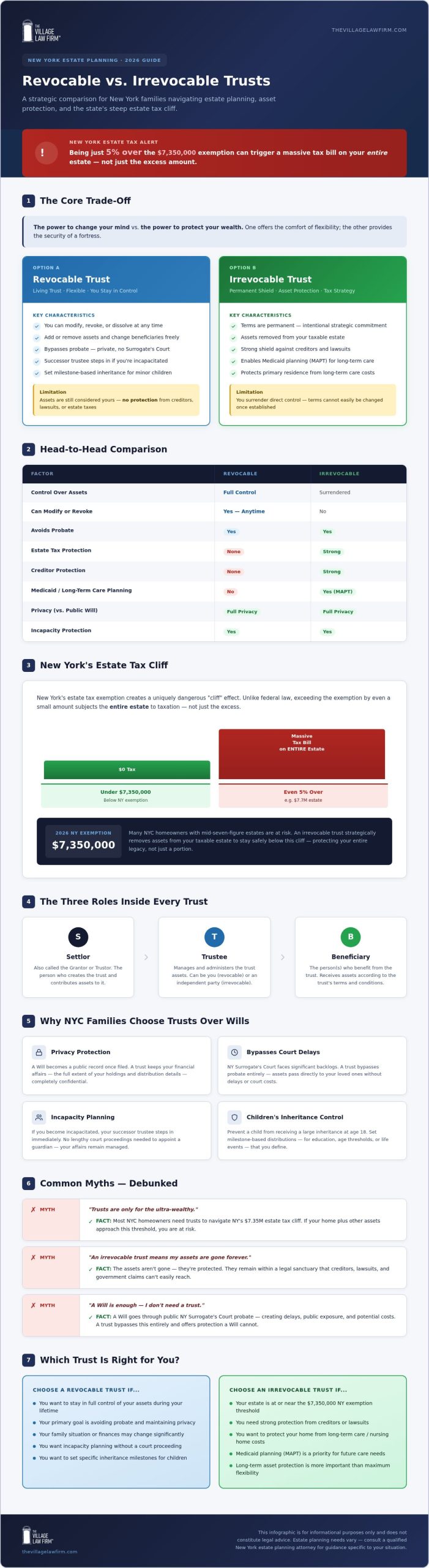
A Manhattan professional recently realized that being just five percent over the New York estate tax limit could trigger a massive tax bill on their entire seven million dollar estate. It’s a sobering reality in 2026. You’ve spent your career building a meaningful legacy, and the fear of losing control or watching your assets vanish into the complex New York probate system is a heavy burden to carry. We believe your hard work should result in a sanctuary of order, not a state of unpredictability. Understanding the nuances of an irrevocable vs revocable trust New York is the first step toward reclaiming your peace of mind.
You don’t have to leave your family’s future to chance. This guide provides a meticulous roadmap to help you choose the strategy that secures your assets while avoiding the public chaos of the courts. We’ll explain how to manage the current $7,350,000 state exemption, protect your home from long-term care creditors, and keep your private matters truly private. By the end of this article, you’ll have the clarity needed to make a sophisticated, protective choice for those who matter most.
Key Takeaways
- Identify the fundamental trade-off between retaining total control and establishing a permanent shield for your family’s long-term security.
- Learn how a revocable trust serves as a private alternative to the public New York probate process, keeping your family’s financial affairs confidential.
- Evaluate the strategic benefits of an irrevocable vs revocable trust New York to protect your assets from creditors and plan for future Medicaid needs.
- Debunk the myth that trusts are only for the ultra-wealthy and see why most NYC homeowners need these tools to navigate the state’s steep estate tax cliff.
- Establish a clear roadmap that replaces legal complexity with a meticulously crafted plan for your family’s lasting peace of mind.
The Foundation: Understanding Revocable vs. Irrevocable Trusts in New York
Think of a trust as a legal sanctuary for your assets. It is a carefully constructed vessel designed to hold your property, ensuring your legacy remains intact and your family stays protected. In a city where the Surrogate’s Court often faces significant backlogs, a trust acts as a vital bypass. It replaces the public, often chaotic probate process with a private, orderly transition. To build this sanctuary, you must understand The Foundation: Understanding Revocable vs. Irrevocable Trusts and the three roles that make them work. The Settlor creates the trust; the Trustee manages the assets; and the Beneficiary enjoys the fruits of that labor.
The decision between an irrevocable vs revocable trust New York ultimately hinges on a single trade-off: the power to change your mind versus the power to protect your wealth. One offers the comfort of flexibility, while the other provides the security of a fortress. For many New Yorkers, the choice isn’t just about money. It’s about removing complexity and ensuring that a lifetime of hard work isn’t tied up in legal red tape for years.
What is a Revocable Living Trust?
A revocable trust is a dynamic tool that lives and breathes alongside you. Because it’s “living,” it functions while you are healthy and active, allowing you to manage your assets exactly as you did before. You, as the Settlor, retain absolute authority. You can swap assets, change beneficiaries, or even revoke the entire structure if your family’s needs evolve. It’s a sophisticated will substitute that avoids probate, keeping your financial affairs out of the public record and away from the delays of the New York court system.
What is an Irrevocable Trust?
An irrevocable trust is designed for those who require a permanent shield. By choosing this path, you intentionally limit your ability to change the trust’s terms in exchange for significant legal advantages. In New York, families often utilize Medicaid Asset Protection Trusts (MAPTs) to safeguard their primary residence from the rising costs of long-term care. While the word “irrevocable” may feel restrictive, it’s actually a strategic commitment. It ensures that your assets are no longer considered yours for tax or creditor purposes. Reassuringly, this doesn’t mean the assets are gone; it means they are safe within a sanctuary that creditors, lawsuits, and the government can’t easily penetrate.
Revocable Trusts: Maximizing Flexibility and Privacy for NYC Families
In the high-stakes environment of New York City, the probate process is often a public and expensive ordeal that families want to avoid at all costs. A revocable trust serves as your private alternative to the Surrogate’s Court. When you place your assets into this structure, you ensure they pass directly to your loved ones without the delays or costs associated with proving a Will. As Forbes explains the difference between revocable and irrevocable trusts, the revocable option is often the starting point for those who prioritize retaining total authority over their wealth.
Privacy is a luxury in a city where everything feels visible. Unlike a Will, which becomes a public record once filed, a trust remains confidential. Your neighbors, creditors, and the public won’t know the extent of your holdings or the specifics of your distributions. This sanctuary of privacy extends to moments of crisis. If you become incapacitated, your successor trustee can step in immediately to manage your affairs. There’s no need for a long, humiliating court proceeding to appoint a guardian. To ensure you haven’t missed a critical step in this process, consult The 2026 Estate Planning Checklist for New Yorkers.
Control and Modification in a Fast-Paced World
New York careers and families grow at a rapid pace. You might buy a second home in the Hudson Valley or welcome a new grandchild. A revocable trust is designed to move with you. You can add or remove assets, change your beneficiaries, or replace your trustees at any time. This flexibility is vital for protecting minor children. Instead of a child receiving a large inheritance at eighteen, you can set meticulous milestones for when and how they access their legacy. When weighing an irrevocable vs revocable trust New York, the primary driver for most families is this desire to maintain a steady hand on the wheel while life remains unpredictable.
Revocable Trusts and New York Estate Taxes
It’s vital to clarify that a revocable trust doesn’t inherently reduce your estate tax liability. Because you still control the assets, the state still views them as yours. However, these trusts provide the essential framework needed for more advanced tax planning strategies. For many NYC families, avoiding the probate backlog is the primary motivation. With the 2026 New York estate tax exemption set at $7,350,000, having a structured plan in place prevents the “tax cliff” from turning an orderly transition into financial chaos. Meticulous planning ensures your family remains in a sanctuary of order. As your life circumstances shift, knowing when to update your estate plan in New York is just as critical as establishing the right trust structure from the start. If you’re ready to build that shield, our team is here to provide dedicated estate planning support.
Irrevocable Trusts: Strategic Asset Protection and Medicaid Planning
While a revocable trust offers privacy and probate avoidance, an irrevocable trust serves as a sophisticated shield. It’s designed for those who require an impenetrable barrier between their hard-earned assets and external threats like lawsuits, creditors, or the staggering costs of long-term care. By transferring ownership to the trust, you effectively remove those assets from your personal estate. This strategic move is particularly vital in the 2026 legal climate, where New York’s estate tax “cliff” remains a significant hurdle for families whose wealth exceeds the $7,350,000 exemption. When weighing an irrevocable vs revocable trust New York, the irrevocable path is the choice of those who prioritize absolute protection over future flexibility.
Establishing this type of sanctuary requires meticulous drafting to meet strict New York legal standards. One small error in the trust’s language can expose your assets to the very risks you’re trying to avoid. Our approach focuses on removing complexity and replacing it with a sense of security. If you’re ready to explore these high-level strategies, a consultation with an Irrevocable Trust Attorney NYC: Sophisticated Asset Protection for 2026 ensures your plan is built on a foundation of technical precision and white-glove service.
Medicaid Planning and the Family Home
For many New Yorkers, their home is their most significant asset. Protecting it from being “spent down” for nursing home care is a primary concern. An irrevocable trust, specifically a Medicaid Asset Protection Trust (MAPT), allows you to qualify for benefits while ensuring your home stays in the family. The 60-month look-back period for institutional Medicaid is a reality, but it’s one we manage with a calming, proactive approach. We help you start the clock early, turning a source of anxiety into a well-defined journey toward long-term security. It’s about ensuring you receive the care you need without sacrificing the legacy you’ve built.
International Assets and Cross-Border Protection
New York is a global hub, and many of our clients manage lives that span continents. Whether you own a flat in London or investment accounts in Tokyo, international assets add a layer of friction to any estate plan. Irrevocable trusts are essential tools for managing these cross-border complexities, helping to mitigate the impact of foreign taxes and conflicting legal jurisdictions. For those with holdings abroad, working with a foreign trust attorney New York professionals rely on ensures your international assets are reviewed and recalibrated as tax laws evolve. We act as your steady urban guide, providing the specialized expertise required to harmonize your international holdings with your New York roots. This level of meticulous planning ensures that no matter where your assets are located, they remain protected within a unified, sophisticated structure.
Myth-Busting: Debunking Common Misconceptions About Trusts
Misinformation often creates a barrier to the security you deserve. In the fast-paced world of New York real estate and finance, waiting to plan based on a misunderstanding can be a costly mistake. We believe that transparency is the antidote to anxiety. By clearing away the common myths surrounding an irrevocable vs revocable trust New York, you can move from a state of uncertainty to a position of strength.
- Myth 1: “Trusts are only for the ultra-wealthy.” With New York City property values at historic highs, even a modest family home can push an estate toward the 2026 tax cliff of $7,350,000. Most NYC homeowners benefit from the privacy and probate avoidance a trust provides.
- Myth 2: “If I have a Will, I don’t need a Trust.” A Will is essentially a letter to the Surrogate’s Court. It guarantees your family will enter the probate process, which is currently facing significant backlogs. A trust allows you to bypass this public and expensive ordeal entirely.
- Myth 3: “I lose all control over my house in an Irrevocable Trust.” While you relinquish the power to revoke the trust, you can often retain the legal right to live in your home for the rest of your life. You keep the “roof over your head” while the trust shields the equity from creditors.
- Myth 4: “Setting up a trust is too complicated.” Complexity only exists when you attempt to navigate the legal landscape alone. A meticulous attorney acts as your steady urban guide, removing the chaos and handling the technical precision on your behalf.
The Reality of Estate Planning Mistakes to Avoid in New York
The most dangerous path a New Yorker can take is the “DIY” route. Generic online forms rarely account for specific New York statutes, such as the presumption of irrevocability unless a document explicitly states otherwise. Even a perfectly drafted document fails if it isn’t “funded.” Funding a trust is the vital process of transferring the legal title of your assets into the name of the trust entity. Without this step, your trust is an empty vessel, and your assets will still be subject to the very probate process you sought to avoid. Understanding what happens if you die without a will in New York makes clear just how critical it is to have a properly funded trust rather than relying on the state’s rigid default inheritance rules.
Revocable vs. Irrevocable: The Decision Framework
Choosing the right path requires a balance of your current needs and future goals. We partner with you to find the steady path between these two primary options. If you’re ready to replace confusion with a clear roadmap, we invite you to schedule a sophisticated estate planning design session today.
- Revocable Trusts: Best for young parents or professionals who prioritize total control and probate avoidance. You can change the terms at any time as your career grows.
- Irrevocable Trusts: Ideal for seniors planning for Medicaid or high-net-worth individuals seeking to mitigate the New York estate tax cliff. This provides the highest level of asset protection.
Securing Your Legacy: How The Village Law Firm Guides You
The legal landscape of New York doesn’t have to be a source of constant stress. We understand that behind every financial decision lies a deeply human story of hard work, family, and the desire for lasting security. Our firm serves as your steady urban guide, providing a sanctuary of order in a city that often feels unpredictable. We provide a white-glove experience that prioritizes your time and peace of mind, ensuring that every detail of your estate is handled with meticulous precision. Choosing between an irrevocable vs revocable trust New York is a pivotal choice, but you don’t have to make it in isolation.
Our team takes on the heavy lifting of estate administration and cross-border estate administration, removing the administrative burden from your shoulders. Whether you’re managing international assets or simply trying to protect your family home, we provide the sophisticated framework required to succeed. By partnering with an Estate Planning Attorney New York: Protecting Your Legacy in 2026, you gain a partner who values transparency and directness over complex legalese.
A Calming Approach to Complex Decisions
We believe that clarity is the best antidote to anxiety. Our approach to legal counsel is rooted in emotional intelligence, ensuring you feel seen and understood throughout the planning process. For those focused on planning for families with children, we prioritize the creation of a seamless guardianship plan that avoids the chaos of the court system. We don’t talk down to our clients; we walk alongside them. Whether we are discussing Medicaid planning or the nuances of an irrevocable vs revocable trust New York, our goal is to replace your current state of uncertainty with a profound sense of security. You deserve a plan that reflects your values and protects your loved ones with unwavering integrity.
Next Steps: Your Journey Toward Order
Your journey toward a secure legacy begins with a sophisticated consultation designed to identify your unique needs. During this session, we’ll strip away the external complexity of New York law and focus on a methodical, structured solution tailored to your life. We’ll examine your assets, discuss your family goals, and determine which trust structure offers the most robust shield for your future. For high-income individuals, this often involves coordinating with a boutique virtual family office like Kotini & Kotini to consolidate tax, wealth, and lifestyle planning. It’s a transition from unpredictability to a well-defined roadmap. You’ve spent a lifetime building your legacy. We’re here to ensure it remains a source of stability and pride for generations to come. Let’s replace the weight of “what if” with the confidence of a plan that works.
Building a Sanctuary of Order for Your Family
You’ve spent a lifetime building a legacy in a city that never stops moving. Whether you prioritize the absolute flexibility of a revocable structure or the impenetrable shield of an irrevocable one, the path you choose today defines your family’s security tomorrow. Deciding between an irrevocable vs revocable trust New York is about more than just legal documents. It’s about replacing the chaos of the Surrogate’s Court with a private, meticulously crafted sanctuary of order.
Our firm specializes in the complexities that NYC professionals face, from cross-border estate administration to specialized Medicaid and family planning strategies. We provide a white-glove service level that respects your time and honors your achievements. You don’t have to navigate these intricate tax laws and look-back periods alone. Secure your family’s future with a sophisticated New York estate plan; contact The Village Law Firm today.
Take the first step toward lasting peace of mind. Your future self, and your beneficiaries, will thank you for the clarity you provide today.
Frequently Asked Questions
Is a revocable trust better than an irrevocable trust in New York?
Neither option is objectively superior. The choice between an irrevocable vs revocable trust New York depends entirely on your specific goals. If you prioritize maintaining total control and avoiding probate, a revocable trust is likely your best path. However, if your primary concern is shielding your home from Medicaid or reducing estate taxes, the permanent protection of an irrevocable trust is necessary. We help you weigh these trade-offs to find the steady path forward.
Can I be the trustee of my own irrevocable trust in NY?
While New York law technically allows this, it’s rarely advisable for those seeking asset protection. If you retain too much control over the assets, creditors or Medicaid may argue that the property is still effectively yours. To ensure your sanctuary of protection remains impenetrable, most New Yorkers appoint a trusted family member, a professional trustee, or a close friend. This separation of control is what creates the legal shield you require.
Does a revocable trust protect assets from creditors in New York?
No, a revocable trust does not offer protection from creditors or lawsuits. Because you have the power to change the trust or take the money back at any time, the law views those assets as being within your reach. Consequently, they’re also within reach of your creditors. If your goal is to safeguard wealth from potential legal threats, you must utilize an irrevocable structure that moves the assets outside of your personal estate.
How much does it cost to set up a trust in NYC?
The investment required to establish a trust varies based on the complexity of your assets and the specific protections you need. A plan involving international holdings or meticulous Medicaid planning requires more technical precision than a standard probate avoidance strategy. Rather than looking for the lowest price, focus on the value of a meticulously drafted plan. A sophisticated, white-glove approach ensures your family avoids the much higher costs of a public probate battle.
What happens to a revocable trust when the grantor dies?
At the moment of your passing, the revocable trust becomes irrevocable. Your named successor trustee steps in immediately to manage the assets without waiting for permission from the Surrogate’s Court. This seamless transition allows for the private distribution of your legacy to your beneficiaries. It effectively replaces the chaos of a public court proceeding with a methodical, pre-planned journey that keeps your family’s financial affairs completely confidential and out of the public record.
Can I change an irrevocable trust if my family situation changes?
Changing an irrevocable trust is difficult but not impossible in New York. Under EPTL section 7-1.9, a trust can be amended or revoked if the creator and all beneficiaries provide written, notarized consent. Additionally, some modern trusts include “decanting” provisions that allow a trustee to move assets into a new trust with updated terms. We provide the sophisticated counsel needed to navigate these complex modifications when life takes an unexpected turn.
How does a trust help with the New York estate tax?
Strategic trust planning is essential for navigating the 2026 New York estate tax exemption of $7,350,000. Because New York has a “tax cliff,” exceeding this limit by even a small amount can result in the entire estate being taxed. An irrevocable trust can remove assets from your taxable estate, helping you stay below that critical threshold. This meticulous planning ensures your hard-earned wealth goes to your loved ones rather than the state.
Do I still need a Will if I have a Revocable Living Trust?
Yes, you still require a specific document known as a “Pour-Over Will.” This acts as a vital safety net for any assets you may have forgotten to title in the name of your trust. If you pass away with assets held in your individual name, the Pour-Over Will ensures they are directed into your trust for distribution. It provides a final layer of security, ensuring no part of your legacy is left to chance. To fully appreciate why this safety net matters, consider what happens if you die without a will in New York and how the state’s rigid intestacy laws can override your wishes entirely.