
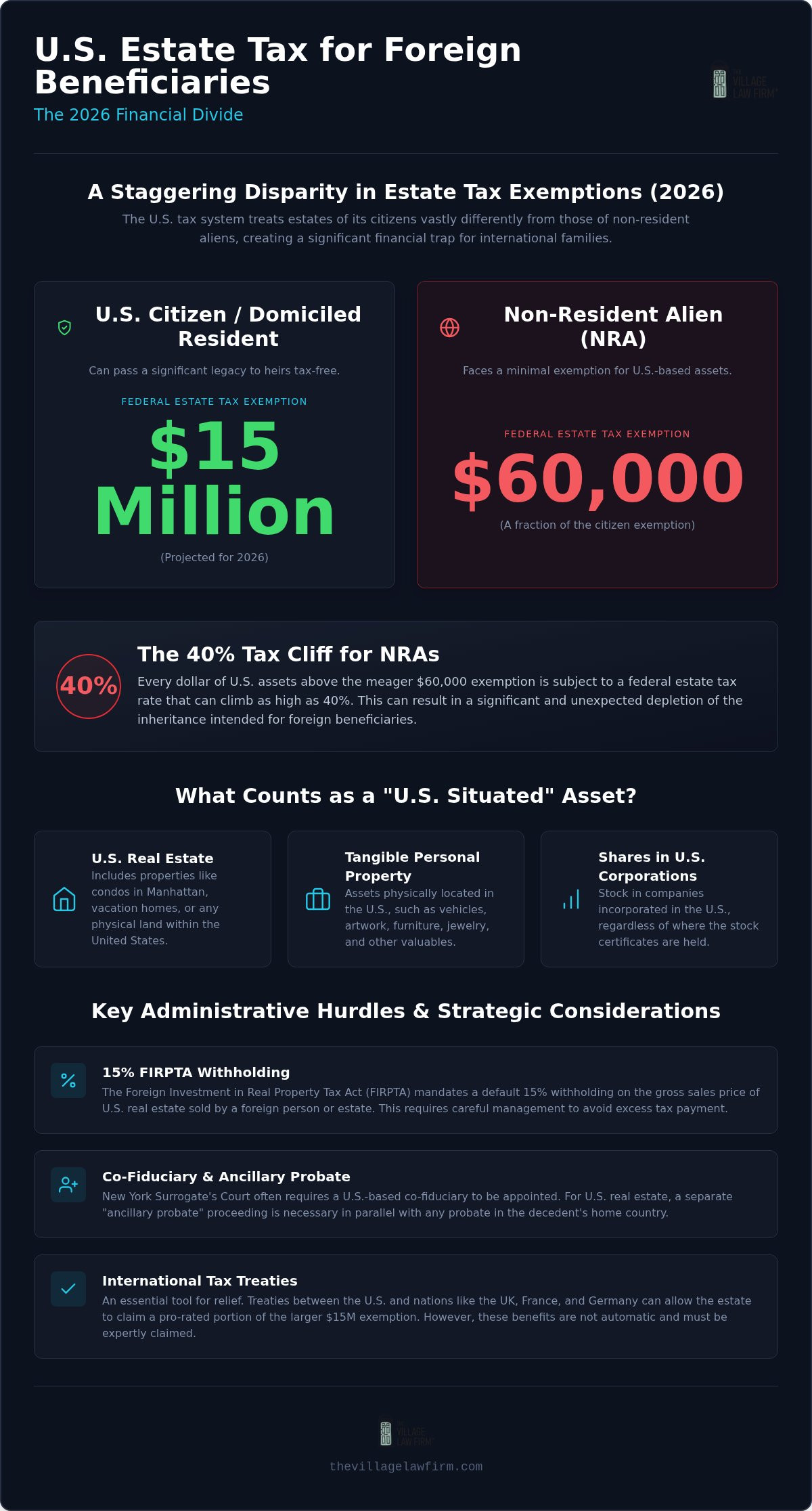
While U.S. citizens enjoy a $15 million estate tax exemption in 2026, a foreign beneficiary could see the IRS claim up to 40 percent of every dollar over just $60,000 in U.S. situated assets. It’s a staggering disparity that feels both unfair and overwhelming. You’re likely feeling the weight of managing New York Surrogate’s Court requirements while simultaneously worrying about international wire compliance and the looming threat of double taxation. We understand that administering US estate for foreign beneficiary isn’t just a legal task; it’s a mission to protect a family’s legacy from unnecessary depletion.
This guide replaces that anxiety with a sense of order and security. You’ll gain a clear roadmap of the administration process designed to minimize tax liability and bypass common IRS traps. We’ll explore the specific 2026 filing thresholds, the reality of the 15 percent FIRPTA withholding, and how to manage the multi-year wait for Federal Transfer Certificates. By the end of this article, you’ll have the confidence to move from a state of chaos to a meticulously planned distribution that honors the deceased’s wishes without compromise.
Key Takeaways
- Identify the specific “situs” rules and the rigid $60,000 federal tax exemption that applies to non-resident aliens in 2026.
- Learn why administering US estate for foreign beneficiary often requires appointing a US-based co-fiduciary to meet New York Surrogate’s Court standards.
- Understand the 15% FIRPTA withholding requirements on real estate sales and the necessary steps for heirs to obtain an ITIN.
- Explore sophisticated liquidity planning and tools like Qualified Domestic Trusts to protect a non-citizen spouse’s inheritance.
- Discover a methodical roadmap to bridge the gap between complex IRS regulations and New York legal mandates with confidence.
Understanding the Legal Landscape: US Assets and Foreign Heirs
The United States tax system operates on a rigid binary that often catches international families off guard. When you are tasked with administering US estate for foreign beneficiary, the first hurdle is defining the decedent’s legal status. In 2026, the IRS distinguishes sharply between U.S. citizens, domiciled residents, and Non-Resident Aliens (NRAs). An NRA is someone who is neither a U.S. citizen nor a resident domiciled in the U.S. at the time of their passing. This status dictates how much of the estate the government can claim. While a U.S. citizen might pass on $15 million tax free, an NRA is limited to a mere $60,000 exemption for assets located within the country.
The “Situs” rule determines which assets fall under U.S. jurisdiction. If the asset is physically or legally tied to American soil, the IRS wants its share. This includes New York real estate, tangible personal property like art or cars kept in a local residence, and shares in U.S. based corporations. If the decedent owned a condo in Manhattan, the process typically requires ancillary probate in New York. This is a specific New York Surrogate’s Court proceeding that runs parallel to any probate happening in the decedent’s home country. It is a necessary bridge to legally transfer title of New York land to a foreign heir.
Resident vs. Non-Resident: Why Domicile Matters
One of the most common points of confusion is the difference between residence and domicile. You might live in New York for several months a year and be a “resident” for income tax purposes, yet still be a “non-resident” for estate taxes. Domicile is a deeper, more permanent concept. It is the place you intend to make your home indefinitely. In 2026, the IRS evaluates this intent by looking at your driver’s license, where you are registered to vote, and where your primary social and business ties lie. If a decedent lived in London but kept a pied-à-terre in NYC, the IRS will meticulously examine their lifestyle to determine if that $15 million exemption applies or if the estate is capped at $60,000. For families navigating multiple nationalities, a comprehensive approach to dual citizen estate planning in New York can be essential to ensuring the correct domicile determination is made and the maximum available exemptions are secured.
The Role of International Tax Treaties
Treaties act as a vital shield against the chaos of double taxation. The U.S. maintains estate tax treaties with a select group of nations, including the United Kingdom, France, Germany, and Japan. These agreements can provide significant relief; they often allow a foreign estate to claim a pro-rated portion of the $15 million exemption based on the percentage of assets held in the U.S. versus globally. However, these benefits are not granted by default. They must be claimed through complex filings. For real estate specifically, the Foreign Investment in Real Property Tax Act (FIRPTA) governs how proceeds are handled at the time of sale. Without a treaty, or if the beneficiary resides in a non-treaty jurisdiction, the tax exposure remains high and the margin for error is slim.
The 2026 Tax Trap: Navigating Estate and Income Liabilities
The financial reality of 2026 presents a sharp cliff for international families. While the “One Big Beautiful Bill Act” solidified a generous $15 million exemption for U.S. citizens and domiciled residents, it left non-resident aliens (NRAs) in a precarious position. When you are administering US estate for foreign beneficiary, you must confront the fact that the IRS only grants a $60,000 exemption for U.S.-situated assets. Every dollar above this threshold is subject to a federal estate tax rate that climbs as high as 40 percent. This isn’t just a minor administrative hurdle; it’s a significant wealth transfer to the government that requires meticulous planning to mitigate.
One of the most painful traps involves the marital deduction. In domestic estates, assets passing to a surviving spouse are generally tax-deferred. However, this protection vanishes if the surviving spouse is not a U.S. citizen. Without specific structures like a Qualified Domestic Trust, the estate could face a massive tax bill immediately upon the first spouse’s death. Understanding these IRS rules on estate tax for nonresidents is the first step in shielding your family’s legacy. If you’re feeling overwhelmed by these numbers, partnering with an expert in cross-border estate administration can provide the clarity you need to move forward.
Filing Form 706-NA: Requirements and Deadlines
The IRS requires the filing of Form 706-NA if the fair market value of U.S.-situated assets exceeds the $60,000 threshold at the date of death. Crucially, this amount is not indexed for inflation, meaning more estates fall into this trap every year. You have exactly nine months from the date of death to file this return and pay any tax due. Missing this window often results in heavy penalties. Preparation is intensive; you’ll need certified death certificates, formal appraisals for real estate or business interests, and professional translations for any foreign-language documents.
Income Tax Withholding for Foreign Beneficiaries
Beyond the estate tax, the IRS also monitors the income generated by estate assets before they are distributed. Standard U.S.-source income, such as rental income from a New York apartment or dividends from U.S. stocks, is generally subject to a flat 30 percent withholding tax. This is reported on Form 1042-S. A key concept here is “Distributable Net Income” (DNI). DNI is the portion of estate income that can be taxed to the beneficiary rather than the estate. By distributing income to heirs in lower-tax jurisdictions, a savvy administrator can sometimes reduce the overall tax burden, provided they navigate the complex flow-through rules correctly.
How to Navigate New York Probate for Cross-Border Estates
While the IRS focuses on the numbers, the New York Surrogate’s Court focuses on the process. Administering US estate for foreign beneficiary in the Empire State requires a delicate dance between local mandates and international logistics. New York law is notoriously protective. If a decedent owned property in Manhattan or Brooklyn but lived abroad, the court must grant someone the legal authority to manage those assets. This authority comes in the form of Letters Testamentary or Letters of Administration. For estates exceeding $500,000, the filing fee in 2026 is approximately $1,250. It’s a small price for the legal certainty it provides, but the procedural hurdles can be significant.
One of the most common roadblocks is the residency of the executor. New York law generally requires executors to be U.S. residents. If the named executor is a foreign national living abroad, the court may require the appointment of a U.S. based co-fiduciary. This partner serves as a local point of contact and a safeguard for the court. Additionally, non-resident executors are almost always required to post a “bond.” This is essentially an insurance policy that protects the beneficiaries from potential mismanagement. You must also adhere to the “Notice to Foreign Consulates” protocol. If a foreign national dies leaving property in New York, the local consulate of their home country must be formally notified of the proceeding.
Step 1: Petitioning for Letters Testamentary
The journey begins with establishing ancillary jurisdiction. If the primary probate is happening in another country, you must file a petition for ancillary probate in New York in the specific county where the assets are located. This process requires a “decree” from the foreign court and a copy of the will. Every document not in English must have a certified professional translation. The court will not accept informal summaries. Accuracy here is vital to avoid delays that can stretch for months. Fortunately, many New York Surrogate’s Courts now accommodate remote proceedings, allowing you to manage these steps without constant international travel.
Step 2: Managing the New York Estate Account
Opening a U.S. estate bank account is often the most frustrating part of the process. Even with court papers in hand, many major New York banks refuse to open accounts for fiduciaries who lack a U.S. social security number or a local address. This is where having an Estate Planning Attorney New York: Protecting Your Legacy in 2026 becomes a practical necessity. We help bridge the gap with financial institutions that understand cross-border complexities. To move forward, beneficiaries will likely need an Individual Taxpayer Identification Number (ITIN) to comply with tax reporting. The application process for an ITIN typically takes seven to eleven weeks. Starting this early ensures that once the court grants authority, the financial infrastructure is ready to support the distribution of assets.
Practical Hurdles: FIRPTA, ITINs, and Global Transfers
Once the Surrogate’s Court grants authority, the focus shifts to the logistical “pipes” through which the inheritance must flow. This phase is often where the most significant delays occur. When you are administering US estate for foreign beneficiary, you aren’t just dealing with New York law; you’re dealing with federal anti-money laundering (AML) and “Know Your Customer” (KYC) protocols. Banks are increasingly cautious about international transfers. They require meticulous documentation to prove the source of funds and the identity of the recipient. Even a minor discrepancy in a middle name or a residential address can freeze an estate account for weeks, creating unnecessary stress during an already difficult time.
The most immediate financial hurdle for estates involving New York property is the Foreign Investment in Real Property Tax Act (FIRPTA). This law requires the buyer of a property from a foreign person to withhold 15 percent of the gross sales price. It’s vital to remember that FIRPTA is a withholding, not the final tax liability. It serves as a deposit to ensure the IRS gets its share of capital gains. However, losing 15 percent of a property’s gross value at the closing table can cripple an estate’s liquidity, making it difficult to pay final debts or administrative fees. Securing the right guidance for cross-border estate administration ensures these withholdings are managed with precision.
Selling New York Real Estate as a Foreign Heir
To avoid the full 15 percent hit, we often help clients apply for an IRS Withholding Certificate. This document allows the IRS to reduce the withholding to the actual amount of tax expected to be owed. You must file this application before the closing date. If you’ve already overpaid, the only way to recover those funds is by filing a U.S. tax return the following year. This creates a significant lag in the distribution of funds. We coordinate closely with your real estate broker and the title company to ensure the FIRPTA requirements are met without jeopardizing the sale or the estate’s cash flow.
The Mechanics of International Fund Distribution
The final stage is the physical transfer of wealth across borders. This involves more than just a wire transfer. You must manage currency exchange risks; a sudden shift in the Euro or Pound can erode the value of an inheritance in days. Additionally, we must ensure the distribution complies with the tax laws of the beneficiary’s home country to avoid “exit taxes” or double inheritance duties. In some cases, we utilize structures discussed by an Irrevocable Trust Attorney NYC: Sophisticated Asset Protection for 2026 to shield assets before they ever leave U.S. jurisdiction. Every beneficiary will need an Individual Taxpayer Identification Number (ITIN) to receive these funds legally. A valid foreign passport is the only standalone document the IRS accepts to prove identity and status, and the application process typically takes 7 to 11 weeks. Start this early to ensure a seamless conclusion to the administration process.
Strategic Solutions: Protecting the Legacy with The Village Law Firm
The complexities we’ve explored, from the rigid $60,000 exemption to the multi-month ITIN wait times, can make the process of administering US estate for foreign beneficiary feel like a series of insurmountable barriers. It’s easy to feel overwhelmed by the technicalities of the New York Surrogate’s Court and the looming presence of the IRS. However, these challenges aren’t dead ends. They’re simply the landscape in which we build your family’s protection. By shifting from a reactive stance to a proactive, strategic partnership, we can transform a chaotic legal requirement into a methodical preservation of wealth.
Our approach is fundamentally “white-glove.” We act as your steady urban guide, navigating the fast-paced and often unpredictable nature of cross-border law with unwavering integrity. We don’t just file forms; we provide a sanctuary of order. Whether it’s coordinating with international banks or managing the meticulous details of ancillary probate, our goal is to shield you from future uncertainty. This level of care is essential for busy professionals who value efficiency and require a partner who understands the emotional weight of a global legacy. We replace anxiety with a sense of security through transparency and directness.
The QDOT: A Shield for Non-Citizen Spouses
One of the most effective tools in our arsenal is the Qualified Domestic Trust (QDOT). As we noted earlier, the standard marital deduction is unavailable when the surviving spouse is not a U.S. citizen. This often leads to a massive, immediate tax bill that can force the sale of beloved family assets. A QDOT allows a non-citizen spouse to benefit from the marital deduction that is otherwise denied. By placing assets into this trust, the estate tax is deferred until the surviving spouse’s death, providing lifelong financial security and stability. To qualify, the trust must have at least one U.S. trustee, a role in which The Village Law Firm can provide expert guidance and oversight.
Partnering with a New York Cross-Border Expert
Generalized legal firms often miss the nuanced international filing requirements that lead to IRS penalties or double taxation. They might understand New York probate but lack the specific experience required to manage the flow of assets across continents. We bridge this gap. Our methodical, calming approach ensures that every detail, from life insurance liquidity planning to the use of irrevocable trusts to remove assets from the U.S. taxable estate, is handled with precision. Families who hold citizenship in multiple countries face an additional layer of complexity, and proactive dual citizen estate planning in New York can prevent costly gaps between jurisdictions before an estate ever enters administration. If you’re ready to replace confusion with a clear roadmap, schedule a consultation for cross-border estate administration today. Let us help you navigate administering US estate for foreign beneficiary with the clarity and confidence your legacy deserves.
Secure Your Family’s Global Legacy
The path to distributing a cross-border estate is often paved with unforeseen tax liabilities and rigid procedural requirements. From navigating the $60,000 non-resident alien exemption to managing the specific protocols of the New York Surrogates’ Court, the margin for error is slim. You’ve learned how tools like QDOTs and methodical ITIN planning can shield assets from the 40 percent federal tax trap. These aren’t just legal maneuvers; they’re the essential steps to ensuring a loved one’s wishes are respected without the interference of administrative chaos.
At The Village Law Firm, we specialize in administering US estate for foreign beneficiary by providing a boutique, white-glove service that prioritizes your peace of mind. Our NYC-based team combines deep technical expertise in IRS compliance with a compassionate partnership mindset. We act as your steady guide through the complexities of international estate planning and Medicaid protection. Secure your family’s global legacy with a New York international planning expert. You don’t have to face these complexities alone. We’re here to help you move forward with clarity and absolute confidence.
Frequently Asked Questions
Do non-US citizens pay estate taxes on US-based assets?
Yes, non-U.S. citizens who are classified as non-resident aliens must pay federal estate taxes on assets situated within the United States. This includes real estate, tangible property, and stock in U.S. corporations. Unlike U.S. citizens, these individuals don’t receive a multi-million dollar exemption, often resulting in a significant tax liability that must be settled before assets are distributed to heirs.
What is the federal estate tax exemption for a non-resident alien in 2026?
The federal estate tax exemption for a non-resident alien is fixed at $60,000 in 2026. This amount isn’t indexed for inflation, creating a stark contrast to the $15 million exemption available to U.S. citizens. When you are administering US estate for foreign beneficiary, any U.S. situated assets valued above this $60,000 threshold are subject to tax rates as high as 40 percent.
How long does the New York probate process take for a foreign beneficiary?
The New York probate process for a foreign beneficiary typically takes between nine and eighteen months, though complex cross-border cases can last longer. Delays often stem from the need for certified translations of foreign documents and the time required to obtain IRS Federal Transfer Certificates. We work to streamline this timeline by coordinating directly with the Surrogate’s Court and managing banking compliance requirements early.
What is Form 706-NA and when is it required?
Form 706-NA is the federal estate tax return for non-resident aliens and must be filed if U.S. situated assets exceed the $60,000 threshold. It’s required to calculate the estate tax due and to obtain the necessary clearance for financial institutions to release assets. You must file this form within nine months of the decedent’s death to avoid substantial late-filing penalties and interest charges.
Can a foreign person be the executor of a New York estate?
Yes, a foreign person can serve as an executor, but New York law generally requires them to serve alongside a U.S. resident co-fiduciary. The Surrogate’s Court also typically mandates that non-resident executors post a bond to protect the estate’s assets. This ensures there’s a locally accountable person to manage the legal and financial obligations within the state’s jurisdiction during the administration process.
How does FIRPTA affect the sale of an inherited New York apartment?
FIRPTA requires the buyer to withhold 15 percent of the gross sales price when a foreign person sells U.S. real property. This withholding acts as a prepayment of capital gains tax rather than a final tax bill. Heirs must file a U.S. tax return to calculate their actual liability and claim a refund for any excess funds held by the IRS during the real estate closing.
Is there an inheritance tax in New York for foreign heirs?
New York doesn’t have an inheritance tax, but it does impose an estate tax on the total value of the decedent’s property. For 2026, the state tax applies to estates exceeding a specific threshold, regardless of the beneficiary’s nationality. It’s vital to distinguish between the federal $60,000 exemption and New York’s own estate tax rules to ensure full compliance and avoid double taxation of the assets.
What is an ITIN and why does a foreign beneficiary need one?
An Individual Taxpayer Identification Number (ITIN) is a tax processing number issued by the IRS to individuals who aren’t eligible for a Social Security number. When administering US estate for foreign beneficiary, an ITIN is necessary for the heir to receive distributions, report income, or claim treaty benefits. The application process requires a valid foreign passport and usually takes between seven and eleven weeks to complete.