
If you haven’t drafted a will, the State of New York has already written one for you. It’s a rigid, one-size-fits-all document that ignores your family’s unique needs and your personal values. Understanding exactly what happens if you die without a will New York is the only way to replace this clinical legal default with a plan that actually protects the people you love. You might worry that the state will simply seize your assets or that your children’s guardianship will be left to a crowded courtroom. These fears are valid, but they don’t have to be your reality.
We understand that the complexity of the Surrogate’s Court can feel like a labyrinth, especially when you’re balancing a demanding career and a busy family life. This 2026 guide provides the clarity you need to move from anxiety to a sense of absolute security. We’ll walk through the specific hierarchy of New York inheritance laws, explain the timeline of estate administration, and show you how to shield your legacy from unnecessary legal interference. By the end of this article, you’ll know exactly how to transform potential chaos into a structured, lasting sanctuary for your heirs.
Key Takeaways
- Discover exactly what happens if you die without a will New York, including how the state’s rigid $50,000 plus 50% rule dictates the split between your spouse and children.
- Understand why the absence of a will forces the Surrogate’s Court to appoint strangers to oversee your minor children’s futures and how you can reclaim that control.
- Learn the methodical steps of the administration process, from filing the initial petition to navigating the complexities of notifying all legal distributees.
- Explore how modern tools like Trusts can bypass the public and often lengthy court system to provide your family with immediate, private access to funds.
- Gain clarity on protecting complex assets, including international holdings, through a sophisticated 2026 planning approach that prioritizes stability over chaos.
The Concept of Intestacy: When New York State Writes Your Will
Silence in estate planning isn’t a neutral act. When you don’t leave behind a valid legal document, you don’t leave a void; instead, you trigger a pre-written, rigid set of rules. The Concept of Intestacy defines this specific legal state where the government dictates the distribution of your legacy. To truly grasp what happens if you die without a will New York, you must see the state’s Estates, Powers and Trusts Law (EPTL) 4-1.1 as a default contract you never signed. It’s a clinical roadmap that ignores your nuances, your blended family dynamics, and your charitable intentions.
There’s a common myth that the state simply “takes” your money if you die without a will. This is rarely the case. The reality is often more bureaucratic than predatory. The state doesn’t want your assets; it wants an orderly, predictable way to close your books. However, this order comes at the cost of your autonomy. Without your specific instructions, your personal wishes carry zero legal weight. The law prioritizes bloodline over bond, and structure over sentiment. Your legacy becomes a matter of math rather than a reflection of your life.
Probate vs. Administration in New York
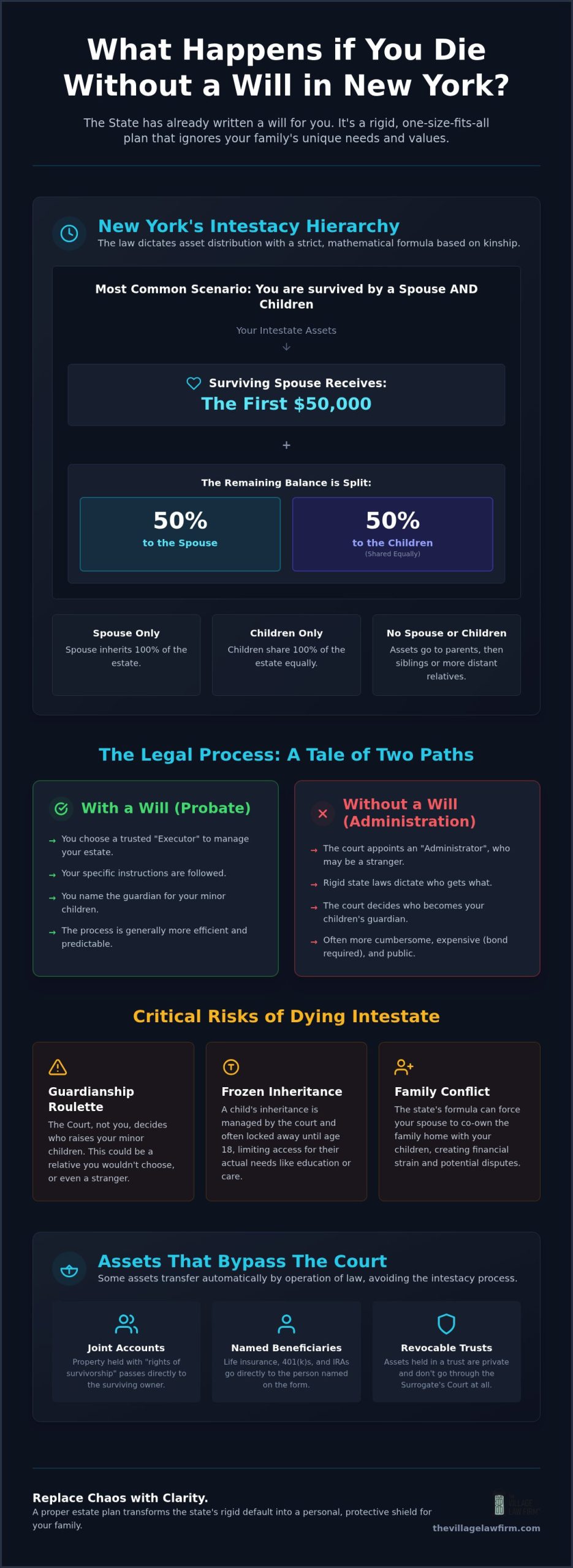
When a will exists, the court goes through “probate” to confirm your chosen Executor. Without a will, the process shifts to “administration.” This distinction is far more than a semantic one. Instead of an Executor you trust, the court appoints an “Administrator.” Obtaining “Letters of Administration” is frequently more cumbersome than receiving “Letters Testamentary.” The court often requires the Administrator to post a bond, which is essentially an insurance policy that protects the estate from mismanagement. This adds a layer of expense and scrutiny that a well-drafted will easily bypasses.
Assets That Bypass the Will Entirely
Not every asset is subject to the rigid rules of intestacy. Certain properties transfer automatically by operation of law, providing a small sanctuary of predictability amidst the court’s involvement. These include:
- Joint Accounts: Bank accounts or real estate held with “rights of survivorship” pass directly to the surviving owner.
- Named Beneficiaries: Life insurance policies and retirement accounts, such as 401(k)s or IRAs, go straight to the person you named on the original designation forms.
- Revocable Trusts: Assets held within a trust are private. They don’t pass through the Surrogate’s Court at all, allowing for a seamless transition of control.
While these tools offer immediate access to funds, they don’t solve every problem. They can’t appoint a guardian for your children or manage assets that were accidentally left in your individual name. True security requires a comprehensive strategy that connects these moving parts into a single, protective shield.
The New York Intestacy Hierarchy: Who Inherits Your Assets?
New York law operates on a rigid hierarchy of kinship that prioritizes biological and legal ties above all else. It doesn’t account for the strength of your friendships or the longevity of a partnership. The law is blind to your intentions. Understanding exactly what happens if you die without a will New York requires a clear look at the math found in the Estates, Powers and Trusts Law (EPTL). If you’re survived by a spouse and children, the distribution isn’t a simple choice. Your spouse receives the first $50,000 of your intestate assets. The remaining balance is then split: 50% to your spouse and the other 50% divided among your children.
This formula often creates unintended financial strain. A surviving spouse might suddenly find themselves co-owning the family home with their children, including minors who cannot legally manage their own share. The reality of what happens if you die without a will New York is that the court’s priority is closure, not your family’s specific comfort. If you’re survived only by a spouse, they receive everything. If only children, they share the estate equally. The law continues down the family tree to parents and then siblings, but it stops abruptly for those outside these categories. Domestic partners and “common law” spouses, regardless of how long they’ve lived as a family, are often left with nothing under these default rules. If you’re weighing your options, our trust vs. will New York 2026 comparison guide breaks down which approach best protects your specific family structure.
The Impact on Blended Families
Modern families often don’t fit into the neat boxes drawn by state legislators in the past. Under New York’s default law, step-children have no inherent right to inherit from a step-parent. This can lead to heartbreaking scenarios where a second spouse inherits a significant portion of an estate, only for those assets to eventually pass to that spouse’s biological children, completely bypassing the original owner’s children from a first marriage. EPTL 4-1.1 fails to recognize “modern” family structures, leaving non-traditional bonds unprotected by the law. If you want to ensure your step-children are cared for, you must act decisively rather than relying on the state’s generic plan.
When There Are No Close Relatives
When someone dies without immediate family, the process becomes significantly more complex. The court initiates a search for “distributees,” which can lead to lengthy and expensive kinship hearings. In many NYC estates, the Public Administrator becomes involved to manage the assets while the court attempts to locate heirs. This can result in the “Laughing Heir” phenomenon, where distant relatives who never met the deceased receive a windfall. While many fear their money will go to the state, “escheatment” is actually a rare final resort. However, the path to avoiding it is often paved with high legal fees and administrative delays. Partnering with an expert in estate administration can help your family navigate these hurdles with much-needed precision and calm.
The Hidden Complications: Minor Children and International Assets
The most unsettling aspect of what happens if you die without a will New York isn’t the distribution of money. It’s the power vacuum left regarding the care of your children. When a parent passes away without naming a guardian, the decision shifts from your family dinner table to a judge’s chambers. The court’s primary duty is the “best interests of the child,” but they’re making that determination based on legal filings rather than personal history. This often involves the appointment of a “Guardian Ad Litem.” This is a court-appointed attorney, essentially a stranger, who is paid from your estate to investigate your family and report back to the judge. It’s a process that can feel invasive during a time of profound grief.
Protecting Your Children’s Inheritance
In New York, minor children cannot directly inherit more than $10,000. If your estate is distributed under intestacy and a child is entitled to a larger share, the Surrogate’s Court will typically require those funds to be held in a court-supervised account until the child turns 18. This means your spouse or a family member must petition the court every time the child needs money for tuition, medical bills, or summer camp. For a deeper look at creating a more flexible framework, see our NYC Estate Planning: 2026 Parent’s Guide to Legal Security. Without a document that creates a trust, you’re essentially handing an 18-year-old a significant windfall without any guardrails or guidance.
Global Assets and the NYC Resident
Many New Yorkers maintain deep ties to their home countries or invest in property abroad. This adds a layer of extreme complexity to an intestate estate. New York law generally governs your “movable” assets like bank accounts and stocks, regardless of where they’re located. However, real estate is governed by the laws of the country where the land sits. This often necessitates “ancillary administration,” a secondary legal proceeding in a foreign jurisdiction. In 2026, the risk of double taxation and conflicting inheritance laws is higher than ever for multinational families. You can explore these nuances in our 2026 Guide: International Estate Planning in New York. Without a clear plan, your family may face multiple court systems, each with its own set of rules, languages, and delays.
The intersection of international law and local probate can quickly drain an estate’s value. When you own property in different countries, the “default” will provided by New York may clash with the forced heirship laws of another nation. This creates a legal knot that can take years to untangle. Our role is to act as your steady urban guide, ensuring that your global footprint doesn’t become a burden for those you leave behind. By addressing these hidden complications now, you replace potential chaos with a meticulously crafted sanctuary of order.
The Legal Journey: Navigating New York Surrogate’s Court Administration
The journey through the Surrogate’s Court is a methodical transition from the chaos of loss to a structured sanctuary of order. When there is no will, the process is called “Administration,” and it follows a strict legal path. Understanding exactly what happens if you die without a will New York requires looking at the five primary milestones of this court-supervised journey:
- Step 1: Filing the Petition. Your family must file a Petition for Administration in the specific county where you resided. Whether it’s the high-volume courts of Manhattan and Brooklyn or the more localized offices in Queens or the Bronx, the venue is non-negotiable.
- Step 2: Notifying Distributees. The court requires that every legal heir, known as a “distributee,” be formally notified. This includes relatives who might not even inherit under the hierarchy rules but have a right to contest the appointment of an administrator.
- Step 3: Obtaining the Bond. To protect the estate’s assets, the Surrogate often requires the administrator to post a bond. This acts as an insurance policy against potential mismanagement or errors during the process.
- Step 4: Letters of Administration. Once the court is satisfied, it issues “Letters of Administration.” This document is the administrator’s “golden ticket,” granting them the legal authority to talk to banks, sell real estate, and collect assets.
- Step 5: Settling the Estate. The administrator must pay valid debts, funeral expenses, and taxes. In 2026, this includes navigating the New York Estate Tax “cliff.” If the estate exceeds the $7,350,000 exemption by more than 5%, the state taxes the entire value from the very first dollar.
Why Administration Takes Longer than Probate
Administration is frequently a more patient process than probate. The court requires absolute certainty regarding the family tree, which often means finding distant relatives to sign waivers or conducting genealogical research to “clear” the heirs. In 2026, NYC Surrogate’s Courts are still managing significant backlogs, making the timeline even more unpredictable for grieving families. Partnering with a dedicated Estate Planning Attorney New York: Protecting Your Legacy in 2026 can help you anticipate these hurdles and move through the court system with professional grace.
The Administrator’s Personal Liability
Serving as an administrator is a role of profound responsibility and significant personal risk. You are a fiduciary, which means you can be held personally liable for financial mistakes, such as paying a low-priority creditor before a high-priority tax bill. You must maintain meticulous records and provide a formal accounting to all heirs before any final distribution occurs. This transparency is your primary shield against future litigation. If you have been tasked with managing a loved one’s estate, our firm provides the meticulous estate administration support you need to protect yourself and the family legacy.
Moving from Chaos to Clarity: Securing Your Family’s Future in 2026
Control is a choice. While the Surrogate’s Court provides a necessary framework for those caught in the web of intestacy, a sophisticated estate plan acts as a private bridge. It spans the gap between your assets and your heirs without the need for public intervention. Now that you understand exactly what happens if you die without a will New York, you can see the state’s default rules for what they are: a rigid, clinical fallback. You have the power to replace that clinical formula with a bespoke legal shield. This shield doesn’t just protect your money. It protects your family’s peace of mind during their most vulnerable moments.
A white-glove approach to planning ensures that the burden of administration never falls on your grieving loved ones. By utilizing tools like Revocable Living Trusts, you can provide your family with immediate access to funds. They won’t have to wait for the Surrogate’s Court to issue Letters of Administration. They won’t have to navigate the 2026 tax cliff alone. Instead, your legacy remains a private matter, handled with the same meticulous attention to detail that you applied to building your life’s work.
The Power of a Comprehensive Estate Plan
Modern estate planning in 2026 goes far beyond a simple two-page document. It’s a holistic strategy that ensures family harmony while addressing complex tax landscapes and long-term care needs. A well-crafted plan manages the intersection of Medicaid eligibility and asset preservation. It also clarifies your wishes for international property, preventing the nightmare of foreign ancillary proceedings. To begin organizing your thoughts, we recommend reviewing The 2026 Estate Planning Checklist for New Yorkers. Understanding the nuances between an Irrevocable vs. Revocable Trust in New York is often the first step toward creating a sanctuary of order for your heirs. If you’re still weighing the foundational question of do I need a trust or a will in New York, our dedicated comparison guide walks you through the strategic benefits of each path in light of the 2026 tax landscape.
Starting Your Journey with The Village Law Firm
Our firm operates on a philosophy where authoritative legal expertise meets deep emotional intelligence. We don’t see ourselves as just your attorneys; we are your steady urban guides. We understand the fast-paced nature of NYC life and the unpredictability that comes with it. Our role is to handle the complexity of the law so you can focus on the significance of your legacy. We replace the potential chaos of the court system with a partnership mindset that prioritizes transparency and security. Your journey toward clarity begins with a strategy session. This is where we define your goals, identify potential risks, and build a protective framework that stands the test of time. Let’s ensure that what happens if you die without a will New York never becomes your family’s story.
Reclaiming Your Legacy from Legal Defaults
Leaving your family’s future to the state’s clinical hierarchy is an unnecessary risk. The reality of what happens if you die without a will New York involves a rigid distribution formula, potential guardianship crises, and the public complexities of the Surrogate’s Court. You don’t have to let a court-appointed administrator or a stranger acting as a Guardian Ad Litem dictate your family’s story. Instead, you can choose a path of meticulous order and private protection, much like the specialized advocacy Leon Legal Group provides for those navigating personal injury, employment law, or wrongful death cases. This choice ensures your legacy reflects your specific values rather than a generic statute.
At The Village Law Firm, we serve as your steady urban guide through these complex decisions. Our specialized expertise in NYC Surrogate’s Court and our status as cross-border estate administration specialists allow us to handle the heaviest burdens for busy professionals. We provide a reassuring, white-glove service that transforms legal uncertainty into a lasting sanctuary. Schedule a Strategic Consultation with The Village Law Firm today to secure your legacy with technical precision and a deeply human touch. Your family deserves the peace of mind that only a bespoke plan can provide.
Frequently Asked Questions
Does my spouse automatically get everything if I die without a will in New York?
No, your spouse only inherits the entire estate if you have no living children or descendants. If you are survived by both a spouse and children, New York law dictates a specific split. Your spouse receives the first $50,000 of the assets plus one half of the remaining balance. The other half is divided equally among your children, which can create significant financial complexity if those children are still minors.
How long does the New York administration process take in 2026?
The administration process typically takes between 9 and 18 months to conclude in 2026. This timeline depends heavily on which county’s Surrogate’s Court is handling the file, as Manhattan and Brooklyn often face longer backlogs than smaller jurisdictions. Delays frequently occur during the initial search for heirs or when the court requires a kinship hearing to prove the family tree before appointing an administrator.
Who is responsible for my debts if I die intestate in NY?
Your estate assets are responsible for settling your valid debts before any heirs receive their inheritance. The court-appointed administrator must use the estate’s funds to pay funeral expenses, taxes, and creditor claims in a specific order of priority. Heirs are not personally liable for your debts, but their inheritance will be reduced by the amount needed to satisfy those obligations. This is why a formal accounting is essential for protection.
Can a domestic partner inherit my estate if we weren’t married?
No, New York intestacy laws do not recognize domestic partners or “common law” spouses as legal heirs. Regardless of how many years you lived together or the depth of your commitment, a non-married partner has no inherent right to your assets under the default state rules. To provide for a partner, you must proactively use a will or a trust to grant them legal standing and financial security.
What happens to my house if I die without a will in NYC?
Your house becomes part of the intestate estate unless it is held in “joint tenancy with rights of survivorship” or a similar protective structure. If you owned the property in your name alone, it will be distributed according to the state’s hierarchy, which might result in your spouse and children co-owning the home. This often leads to forced sales or family disputes that could have been avoided with a clear, documented plan.
Is a will from another state valid in New York if I die here?
Yes, New York generally recognizes a will from another state if it was validly executed according to the laws of that state at the time it was signed. However, the document must still be probated in the New York Surrogate’s Court if you were a resident here at the time of death. While the will remains valid, it may not address specific New York issues like the 2026 estate tax cliff or local real estate requirements.
How much does it cost to settle an estate without a will in NY?
The cost includes statutory court filing fees, which can reach $1,250 for estates valued over $500,000 in 2026. Beyond court fees, the estate must often pay for a fiduciary bond, which acts as insurance for the administrator’s performance. Legal fees for administration are also a factor, as the process is often more labor-intensive than probating a clear will. These expenses are paid directly from the estate’s assets before final distribution.
Can I appoint a guardian for my children without a formal will?
No, you cannot legally appoint a permanent guardian for your minor children through an informal letter or a verbal wish. To ensure your choice of guardian is respected, you must use a formal will or a stand-by guardianship document executed according to New York law. This is a critical part of understanding what happens if you die without a will New York, as the court will otherwise choose a guardian based on its own assessment.