

The Medicaid look-back period is not a legal trap designed to catch you off guard; it is a predictable window that we can manage with meticulous planning. You’ve spent decades building a legacy. The thought of nursing home costs reaching $20,000 a month in New York City can feel like a direct threat to everything you’ve earned. It’s natural to feel anxious that a simple gift to your children might trigger a years-long penalty under the Medicaid look-back period New York. We understand that your home is more than an asset; it is the foundation of your family’s story.
This guide provides a strategic framework to protect your future, replacing confusion with a clear, sophisticated approach to asset protection. We’ll explore the current enforcement of the 60-month rule, the status of community care regulations in 2026, and the specific trusts that act as a shield for your property. By the end, you’ll have the clarity needed to maintain control over your estate and the calm that comes from a professional partnership.
Key Takeaways
- Understand the mechanics of the 60-month window to see how the state evaluates asset transfers before approving coverage.
- Learn to calculate potential penalty periods using regional rates so you aren’t blindsided by gaps in eligibility.
- Identify the critical differences between nursing home and home care rules, including the current enforcement status of the Medicaid look-back period New York.
- Discover how sophisticated tools like Medicaid Asset Protection Trusts shield your home while starting the five-year clock for security.
- Shift from anxiety to control by building a meticulous planning framework that preserves your legacy against rising institutional costs.
Understanding the Medicaid Look-Back Period in New York
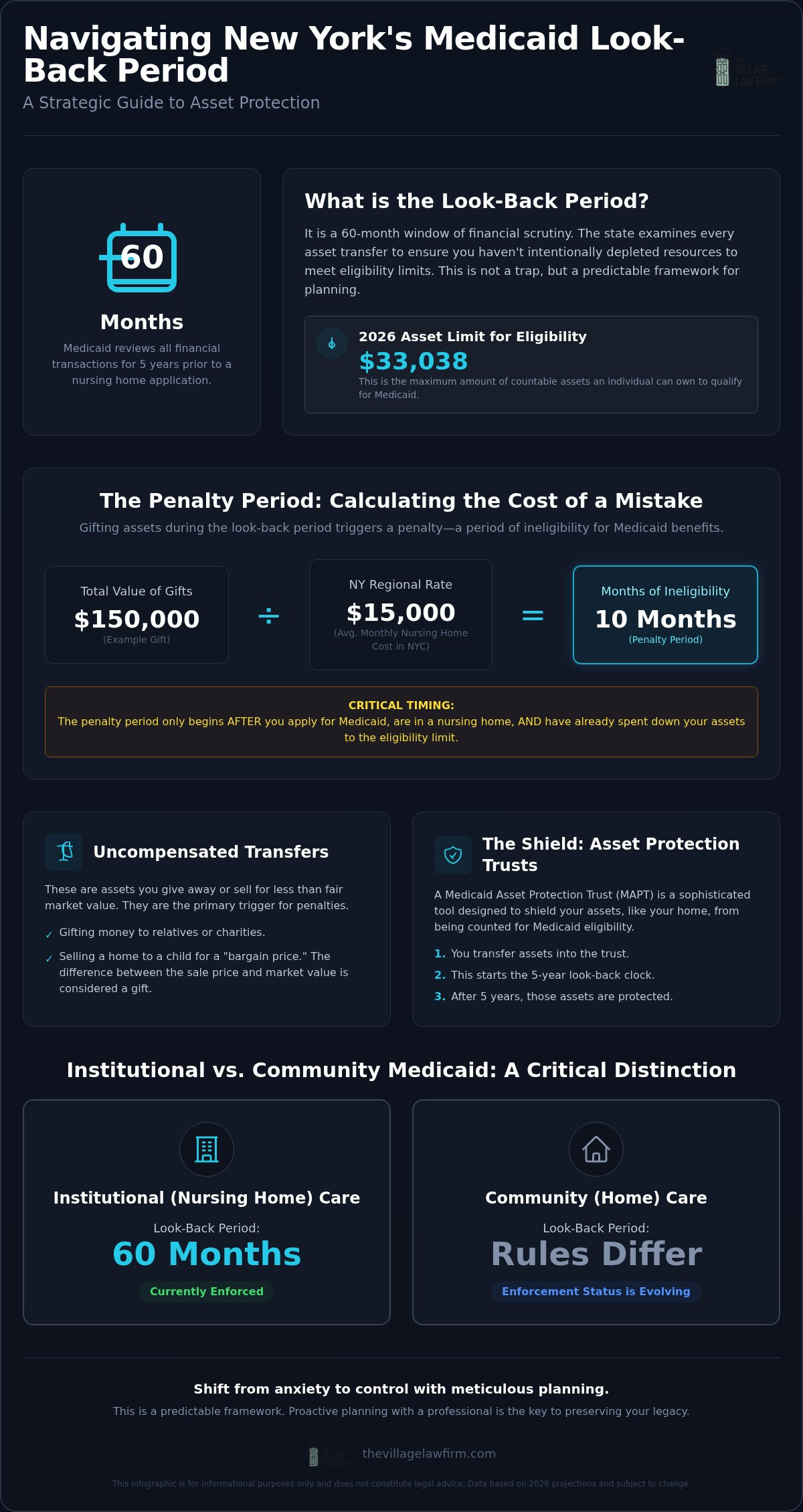
The Medicaid look-back period New York is a 60-month window of financial scrutiny that begins the moment you submit an application for nursing home coverage. During this five-year period, the Department of Social Services examines every bank statement, property transfer, and significant gift to ensure you haven’t intentionally depleted your resources to qualify for state aid. While Understanding the Medicaid Look-Back Period is often framed as a hurdle, it’s actually a predictable framework. The state’s objective is to prevent individuals from giving away wealth simply to meet the asset limit of $33,038 for 2026. Proactive shielding of your assets isn’t about evasion; it’s about using the law’s own timeline to create a sanctuary for your family’s future.
What Counts as an ‘Uncompensated Transfer’?
An uncompensated transfer occurs whenever you part with an asset without receiving something of equal value in return. Most people recognize that writing a check to a relative or a charity triggers this rule. However, more subtle transactions can be just as problematic. Selling your family home to a child for a bargain price is a common mistake that leads to severe penalties. In the context of a New York Medicaid audit, fair market value is defined as the price a property would command on the open market between a willing buyer and a willing seller at the time of the transaction. If the sale price falls short of this objective standard, the difference is treated as a gift, potentially delaying your eligibility for months or years.
The Role of the 60-Month Clock
Timing is the most powerful tool in your arsenal. The 60-month clock is a countdown toward total asset protection. Once five years have passed since a transfer into a trust, those assets are generally beyond the reach of Medicaid’s look-back. This is why consulting a Medicaid planning attorney New York is so vital before a crisis occurs. Starting the clock early provides a profound psychological benefit, replacing the fear of uncertainty with the peace of mind that your legacy is secure. Your best defense during this window is meticulous record-keeping. Organizing five years of financial history today ensures that when the time comes to apply, you can present a narrative of order rather than a chaotic scramble for old receipts.
The Penalty Period: Calculating the Cost of ‘Waiting Too Long’
Violating the Medicaid look-back period New York doesn’t result in a permanent disqualification from benefits. Instead, it triggers a “penalty period,” which is a specific duration during which the state will not pay for your nursing home care. The length of this delay is determined by a precise mathematical formula: the total value of all uncompensated transfers made during the look-back window divided by the applicable New York Regional Rate. This calculation is where a Medicaid planning lawyer NYC provides the most value, ensuring that every dollar is accounted for and that the penalty is not a day longer than necessary.
A critical and often misunderstood detail is when this penalty actually begins. The clock doesn’t start ticking the moment you give a gift. It only begins when you have applied for Medicaid, are residing in a nursing home, and are “otherwise eligible.” This means you must have already spent down your assets to the 2026 limit of $33,038 before the penalty period even starts. Without a strategic plan, you could find yourself in a position where you have no money left to pay for care but are still ineligible for state assistance.
New York Regional Rates Explained
Regional rates are the state’s determination of the average monthly cost of nursing home care in specific counties. These rates are updated annually to reflect the rising costs of healthcare. For 2026, the regional rate for the New York City area is projected to be between $14,000 and $15,000 per month. Because NYC rates are significantly higher than those in upstate counties, a gift of the same size will result in a shorter penalty period for a city resident than for someone living in a lower cost region. Accuracy here is vital; using outdated figures can lead to a liquidity crisis during your transition to care.
The ‘Incurred Medical Expenses’ Strategy
When a penalty period is unavoidable, we focus on a strategy of order rather than chaos. Managing the transition requires a liquidity plan to cover nursing home costs during the gap. This might involve setting aside specific funds or using exempt transfers to ensure care remains uninterrupted. We view our role as the bridge between your current financial state and a secure future, helping you find the most efficient path through the penalty. If you are concerned about how a past gift might impact your eligibility, consulting with a professional partner can help you map out these numbers with precision and confidence.
Institutional vs. Community Medicaid: The Critical NY Distinction
While the 60-month Medicaid look-back period New York is a fixed reality for nursing home care, the rules for home-based services offer a significant, albeit temporary, reprieve. Chronic Care Medicaid covers long-term institutional stays, while Community Medicaid provides for home health aides, adult day care, and physician services in your own residence. For many, this distinction represents the difference between a clinical setting and the sanctuary of their own living room. It’s a cornerstone of estate planning for seniors because it allows you to access professional care without immediately triggering the five-year asset scrutiny required by nursing facilities. As of late 2026, the eligibility process for home care remains markedly more flexible than the institutional path.
Home Care (Community Medicaid) Benefits
Choosing home care isn’t just about comfort; it’s a strategic financial decision. Community Medicaid allows you to qualify for services without navigating the strict five-year look-back that governs institutional care. This means you can often transfer assets and qualify for home care benefits much faster. Additionally, “Community Spousal Budgeting” allows the healthy spouse to keep a significant portion of income and resources, ensuring their standard of living remains intact. It’s a partnership between your health needs and your financial legacy. Aging in place provides an emotional stability that clinical environments simply cannot replicate.
The 2.5-Year Look-Back Rumor vs. Reality
There’s been significant confusion regarding a proposed 30-month look-back for New York home care services. While this law was enacted in 2020, the state has repeatedly postponed its enforcement. As of September 2026, New York still processes Community Medicaid applications without a transfer look-back. This creates a critical planning window that could close at any time. We advise our clients that while the door is currently open, the most sophisticated approach is to plan as if the 30-month rule will eventually be enforced. Waiting for the state to announce a deadline is a reactive gamble. Securing your plan now ensures you aren’t caught in a sudden shift of regulatory tides. The current flexibility is a gift, but it isn’t a guarantee.
Sophisticated Strategies to Protect Assets within the Window
Navigating the Medicaid look-back period New York requires a shift from reactive fear to proactive architecture. Certain “exempt transfers” allow you to move assets without triggering a penalty period regardless of when they occur. Transfers to a spouse or a blind or disabled child are fully protected. These sophisticated maneuvers are the primary defense against the Medicaid look-back period New York and its potential to drain a family’s wealth. For those facing a more immediate need for care, the “Promissory Note” or “Gift and Loan” strategy serves as a high-stakes emergency tool. It involves gifting a portion of assets while using the remainder to fund a private loan that pays for care during the resulting penalty period. These methods require technical precision to withstand a state audit.
The Medicaid Asset Protection Trust (MAPT)
The Irrevocable Trust NYC remains the gold standard for long-term security. A MAPT functions as a legal shield, removing assets from your individual ownership while allowing you to receive income from the trust. To satisfy Medicaid auditors, you must appoint an independent trustee rather than serving in that role yourself. This separation of control is what validates the trust in the eyes of the state. For families focused on NYC estate planning, this tool ensures that a lifetime of investments isn’t consumed by nursing home costs in a matter of months.
Protecting the Family Home
Your home is often your most significant asset and your most cherished legacy. The “Caregiver Child” exception allows you to transfer your home to a son or daughter who has lived with you for at least two years prior to your institutionalization and provided care that delayed your entry into a facility. This transfer is exempt from the look-back penalty. While the “Intent to Return Home” rule may protect the house during your lifetime, it doesn’t prevent the state from seeking estate recovery after you pass away. A Life Estate deed is a common alternative to trusts that allows you to retain use of the property for life while automatically passing ownership to your heirs upon your death. If you want to explore which shield best fits your family’s needs, schedule a consultation with our team to begin building your protective framework.
Why Meticulous Medicaid Planning is a Partnership
Medicaid regulations are a moving target that requires constant vigilance and a proactive mindset. In 2026, the legal landscape continues to shift, making the Medicaid look-back period New York one of the most complex challenges a family can face. We don’t view our work as a series of isolated transactions. Instead, we act as your steady guide through an unpredictable environment, replacing the chaos of uncertainty with a meticulously structured plan. Our white-glove service is specifically designed to shoulder the burden of the heavy documentation Medicaid demands. We handle the technical precision of your application so you can focus on your family’s well-being.
Early action is the most effective way to ensure the five-year clock becomes your ally rather than your enemy. By starting the process before a medical crisis occurs, you gain the luxury of time to move assets into protective structures without the pressure of immediate eligibility needs. This partnership ensures that every decision is made with deliberation and foresight. We walk alongside you, offering the clarity needed to navigate New York’s specific regional rates and probate nuances with total confidence. Taking control now prevents the Medicaid look-back period New York from dictating your family’s financial future.
The Village Law Firm Approach
We believe in transparency and direct, compassionate counsel. Our approach is fundamentally different because we treat your legacy with the same meticulous care you’ve used to build it. For global families, we specialize in integrating these protections with international estate planning. Managing assets across borders adds layers of complexity to Medicaid eligibility, but our expertise in cross-border matters ensures that your domestic and international interests are harmonized. You aren’t just hiring a lawyer; you’re gaining a partner dedicated to shielding your future from the rising costs of long-term care.
Taking the First Step Toward Security
There is a profound sense of relief that comes from having a definitive legal roadmap. You no longer have to wonder if a past gift will trigger a penalty or if your home is truly safe from estate recovery. A consultation today is the most protective gift you can give your children. It removes the financial and emotional weight of care decisions from their shoulders and provides a clear path forward. We invite you to schedule a calming, comprehensive consultation with our team. Let us help you turn the complexities of the law into a managed window of opportunity that secures your family’s story for generations to come.
Securing Your Family’s Sanctuary in 2026
The Medicaid look-back period New York doesn’t have to be a source of constant anxiety. By understanding the 60-month window and the current flexibility of community care, you’ve already taken the first step toward long-term stability. We’ve explored how sophisticated tools like Medicaid Asset Protection Trusts and exempt transfers can shield your home from the rising costs of institutional care. You don’t have to navigate these shifting regulations alone.
The Village Law Firm offers the specialized NYC expertise and white-glove service needed to handle the meticulous documentation of your application. We provide strategic asset protection that treats your legacy with the respect it deserves. Our partnership mindset ensures that your family’s future is anchored in order rather than chaos. Secure your legacy with a sophisticated Medicaid plan; contact The Village Law Firm today. You’ve worked hard to build your life’s work. Now, let’s ensure it stays exactly where it belongs, protected for the people you love most.
Frequently Asked Questions
Does the Medicaid look-back period apply to home care in New York in 2026?
No, the look-back period is not currently enforced for Community Medicaid in New York. While a 30-month look-back was enacted in 2020, its implementation has been repeatedly delayed. As of late 2026, applications for home care are processed without transfer penalties. This creates a closing window of opportunity for families to protect assets while accessing care. We recommend planning now, as the state could begin enforcement with very little notice.
Can I give my house to my children to avoid the Medicaid look-back?
Gifting a home directly usually triggers a penalty unless a specific exception applies. If you transfer the deed within the 60-month window, Medicaid views this as an uncompensated transfer. You might qualify for the Caregiver Child exception if a child lived with you for two years and provided care that delayed your institutionalization. Otherwise, a Medicaid Asset Protection Trust is a more secure way to protect the property while starting the clock.
What happens if I need a nursing home before the 5-year look-back is over?
You will likely face a penalty period of ineligibility. Medicaid calculates this by dividing the value of transferred assets by the regional rate for your New York county. During this time, you must pay for care privately. We often use a “gift and loan” strategy to preserve a significant portion of the assets while using the remainder to fund care during the penalty months. This approach replaces financial chaos with a predictable roadmap.
Are there any assets that are exempt from the New York Medicaid look-back?
Yes, several transfers do not trigger penalties. Transfers to a spouse, a blind or disabled child, or a trust for a disabled person under age 65 are exempt. Additionally, the “Caretaker Child” and “Sibling with Equity” exceptions can protect the family home. Understanding these nuances is vital to ensuring your legacy remains intact while you receive high-quality care. These exemptions provide a legal sanctuary for families navigating the Medicaid look-back period New York.
How does New York calculate the Medicaid penalty period?
The state uses a formula based on the total value of gifts divided by the regional rate. For the Medicaid look-back period New York, the regional rate represents the average monthly cost of nursing home care in your area. Because NYC rates are higher than upstate, the resulting penalty period may be shorter for city residents. This calculation only begins once you are in a nursing home and have spent down to the $33,038 asset limit.
Is it too late to start Medicaid planning if a loved one is already ill?
It is rarely too late to protect at least a portion of the estate. Even if a crisis has already begun, emergency strategies like the “Promissory Note” can shield significant assets. While early planning is ideal to satisfy the 60-month rule, we can implement “crisis planning” to mitigate the financial impact of nursing home costs. A structured partnership with an expert replaces panic with a clear, calm path forward for your family.
Does the look-back period apply to my spouse’s assets?
Yes, Medicaid considers the assets of both spouses when one applies for nursing home care. However, spousal impoverishment rules allow the non-applicant spouse to keep a resource allowance of up to $162,660 in 2026. Transfers between spouses are exempt from the look-back penalty, allowing for strategic re-titling of assets. This ensures the healthy spouse maintains their standard of living and financial security while their partner receives necessary medical support.
What is the difference between a gift and a spend-down for Medicaid?
A gift is an uncompensated transfer that triggers a penalty period. A spend-down involves using assets to pay for fair-market-value goods or services, which does not trigger a penalty. Examples include paying off a mortgage, making home repairs, or purchasing a pre-paid funeral. Meticulous documentation is required to prove to auditors that these funds were used for legitimate expenses. This distinction is a cornerstone of a sophisticated and successful asset protection strategy.