
What if the most sophisticated way to settle a loved one’s affairs isn’t through a grueling probate battle, but through a streamlined path that many overlook? In the fast-paced environment of New York, the complexity of the Surrogate’s Court can feel like a labyrinth designed to overwhelm. You’re likely feeling the pressure of distinguishing which assets count toward the $50,000 limit and fearing that a single administrative error could lead to personal liability for decedent debts. It’s a heavy burden to carry while you’re trying to honor a legacy.
This 2026 guide is your strategic roadmap to master small estate administration NY, designed to transform legal chaos into a sanctuary of order. We’ll show you how to utilize New York’s specific exemptions, such as the $25,000 cash allowance for surviving spouses, to simplify the process and protect your family’s future. You will learn the exact steps to file an Affidavit of Voluntary Administration, avoid common real estate traps, and handle the court’s requirements with the meticulous confidence of a seasoned professional.
Key Takeaways
- Identify which assets qualify for the $50,000 threshold and which high-value items, like life insurance, are legally excluded from the calculation.
- Navigate the “NYC Real Estate Trap” to determine if a family home or condo requires a transition from voluntary administration to formal probate.
- Master the 2026 filing requirements for small estate administration NY to avoid common Surrogate’s Court delays and administrative errors.
- Protect yourself from personal liability for decedent debts by establishing a methodical, professional framework for asset distribution.
- Learn how to leverage statutory exemptions to simplify your role as an executor and preserve your loved one’s legacy with meticulous care.
What is Small Estate Administration in New York?
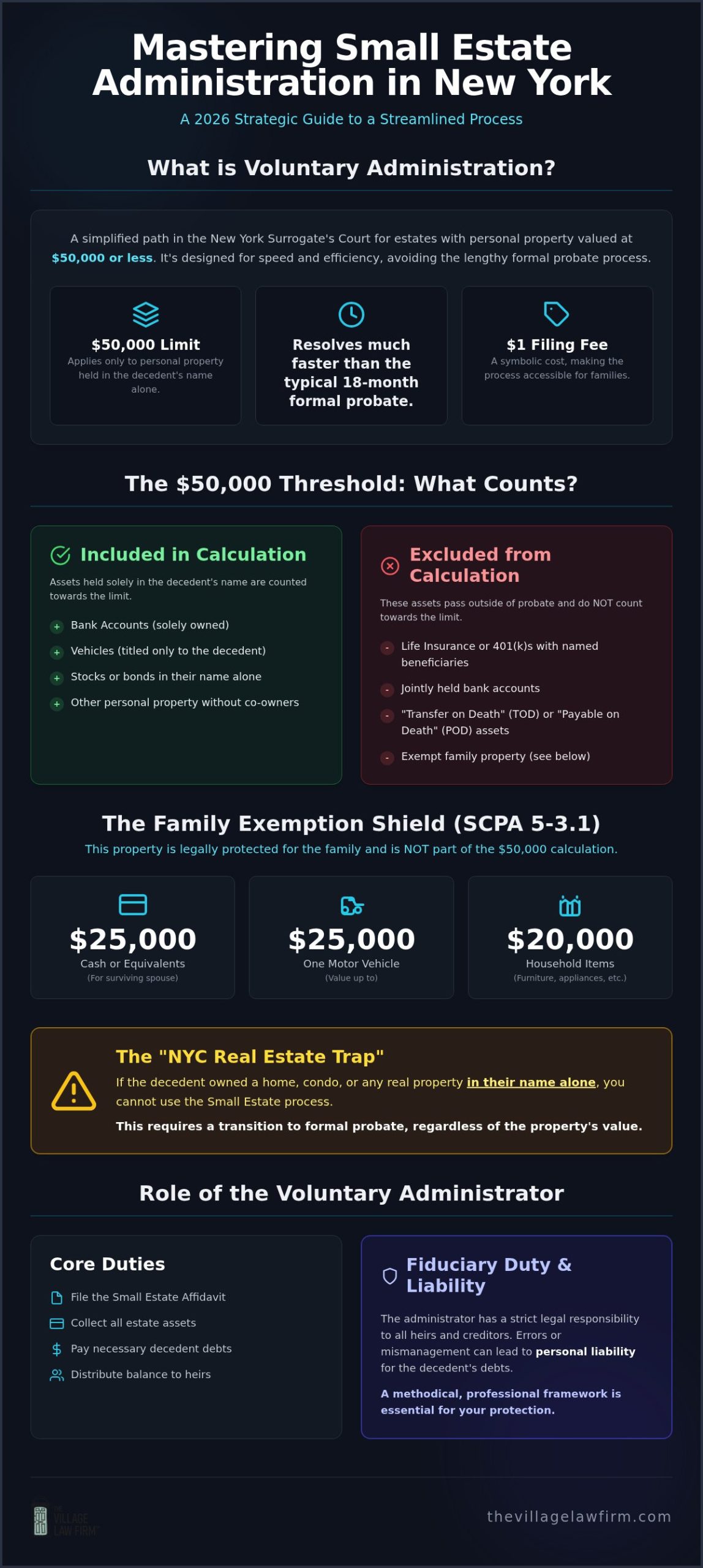
Voluntary administration, commonly referred to under Article 13 of the Surrogate’s Court Procedure Act, is a streamlined legal path designed for efficiency. It serves families when a loved one passes away leaving personal property valued at $50,000 or less. This process occurs within the New York Surrogate’s Court, providing a simplified alternative to the more rigorous formal probate or administration proceedings. While standard probate can stretch across eighteen months, small estate administration NY is built for speed, often resolving in a fraction of that time. Small estate administration is a bridge to legacy for estates with limited personal assets.
The primary distinction lies in the use of a “Small Estate Affidavit” rather than a full petition for probate. This document allows you to collect assets, pay necessary debts, and distribute the remaining balance to the rightful heirs without the exhaustive notice requirements of a full-scale court case. It’s a specialized tool for specific circumstances. It specifically excludes estates that include real property owned solely by the decedent. If the assets are strictly personal, such as bank accounts or vehicles, this path offers a sanctuary of order during an otherwise unpredictable time. The filing fee is a symbolic one dollar, reflecting the state’s intent to keep this process accessible for families.
The Role of the Voluntary Administrator
The court appoints a voluntary administrator to act as the estate’s steady guide. Usually, this role is filled by the executor named in a will, a surviving spouse, or a child. Don’t let the terminology mislead you. While the choice to initiate the filing is voluntary, the duties you assume are strictly mandatory. You carry a heavy fiduciary duty to every heir and creditor involved. You’re legally responsible for every dollar. Accuracy isn’t just a goal; it’s a requirement to protect yourself from personal liability. Professional oversight ensures that your actions align with New York law, preventing the “DIY” errors that often lead to future litigation.
Emotional Intelligence in Legal Processes
Settling a final affair is rarely just about the logistics. It’s a deeply personal transition that carries significant emotional weight. The pressure of getting the paperwork right can feel overwhelming when you’re still in the early stages of grief. We believe a structured process replaces chaos with a sense of security. By following a methodical roadmap, you move away from the friction of administrative hurdles and toward a place of calm. This clarity protects your peace of mind. It ensures that your focus remains on honoring your loved one’s memory rather than battling the complexities of the legal system.
Eligibility: What Counts Toward the $50,000 Limit?
Many families assume the $50,000 threshold is a hard cap on the decedent’s entire net worth. This is a common misconception. In reality, the limit applies only to “probate assets” held in the individual’s name alone. The distinction between a full probate and a small estate proceeding hinges on what the law considers a countable asset. If a loved one had a $200,000 life insurance policy or a $400,000 401(k) with named beneficiaries, those funds pass directly to the recipients. They don’t count toward the limit. They exist outside the court’s jurisdiction for this specific filing.
Jointly held bank accounts and “Transfer on Death” (TOD) designations also bypass the calculation. These assets transfer by operation of law the moment someone passes away. Because they never enter the estate, they don’t threaten your eligibility for small estate administration NY. Understanding these nuances is the first step toward replacing anxiety with a sense of security. Partnering with an expert in estate administration ensures you maximize these legal protections while maintaining meticulous compliance with Surrogate’s Court rules.
The Family Exemption (SCPA 5-3.1) Explained
New York law provides a powerful shield for surviving family members through SCPA 5-3.1. This statute identifies specific property that is “exempt” for the benefit of a spouse or children under twenty-one. These items aren’t considered part of the estate for the $50,000 calculation. A surviving spouse can claim up to $25,000 in cash or cash equivalents. One motor vehicle valued at up to $25,000 is also exempt. Additionally, household furniture, appliances, and electronics up to $20,000 are protected. These exemptions serve as a sanctuary of order. They prioritize family stability over creditor claims, effectively allowing an estate to hold significant value while still qualifying for the simplified voluntary administration process.
The 2026 Asset Inventory Checklist
Precision is your greatest ally during the inventory phase. You must value every asset as of the exact date of death to ensure accuracy. Start with a thorough search for uncashed checks, utility deposits, and forgotten tax refunds. These small amounts can accumulate quickly. Follow this methodical roadmap to identify countable property:
- Individual bank accounts without a “Pay on Death” beneficiary
- Stocks or bonds held in the decedent’s name alone
- Refunds from insurance premiums or medical providers
- Personal belongings not covered by the family exemption
- Valuables like jewelry or collectibles without a co-owner
Every dollar must be accounted for with transparency. This level of detail prevents the personal liability that arises from “DIY” errors. By documenting the estate’s value with professional precision, you protect the legacy you were entrusted to manage.
Small Estate vs. Formal Probate: The NYC Real Estate Trap
The simplicity of a small estate affidavit often vanishes the moment real property enters the equation. In high-stakes markets like Manhattan and Brooklyn, a single piece of real estate changes the entire legal landscape. You might have an estate with very little cash, but if the decedent owned a condo or brownstone in their name alone, you cannot use small estate administration NY to settle the affairs. This is the “Sole Ownership” rule. It forces families into formal probate or administration regardless of the liquid asset value. It’s a sudden shift from a one-page affidavit to a complex court proceeding that requires meticulous attention to detail and a higher level of scrutiny.
When “Small” Becomes “Formal”
Imagine a scenario where your loved one left behind a $10,000 bank account but also held the deed to a small family home. Even though the cash is well under the $50,000 threshold, the presence of real property acts as a legal gatekeeper. The Surrogate’s Court requires a formal petition to ensure the title transfers correctly to the heirs or is sold with proper authority. Interestingly, NYC co-ops are often treated differently. Because they represent shares in a corporation rather than direct ownership of real property, they are technically personal property. However, the complexity of proprietary leases usually means you’ll still need the guidance of an Estate Planning Attorney New York: Protecting Your Legacy in 2026 to navigate the board’s requirements and ensure the transfer is recognized.
Strategic Planning to Avoid Probate
The most effective way to protect your family from this trap is to move beyond reactive administration and into proactive planning. A revocable trust acts as a shield. It keeps your assets out of the court system entirely, allowing for a seamless transition of ownership without the public and often expensive probate process. For those seeking even more robust security, an Irrevocable Trust Attorney NYC: Sophisticated Asset Protection for 2026 can help design a structure that protects the family home from future uncertainty. The cost-benefit analysis is clear. Court administration is transactional and public. Professional planning is a partnership that offers long-term security. It replaces the potential chaos of court dates and legal fees with a legacy of stability and calm. Choosing the right path today ensures your family isn’t caught in a legal labyrinth during their time of grief.
The 2026 Step-by-Step Small Estate Filing Process
Precision transforms a daunting legal obligation into a manageable path toward closure. Moving through small estate administration NY requires a methodical mindset and a commitment to meticulous detail. You aren’t just filing forms; you’re fulfilling a final promise. The process begins with securing the right documentation. Obtain at least five to ten certified copies of the death certificate. Financial institutions and the court will each require their own original. You don’t want to be caught waiting for more copies while trying to secure a frozen account.
Next, identify all distributees, or heirs-at-law, according to their legal priority. This includes gathering their current addresses and verifying their relationship to the decedent. Once you’ve gathered this data, you’ll complete the Affidavit of Voluntary Administration. This central document lists every asset and distributee with total transparency. File this affidavit with the Surrogate’s Court in the county where the decedent lived. Finally, you must notify creditors and prioritize the payment of funeral expenses from the estate funds. This sequence ensures you remain a shield against future liability, protecting both the estate and your own personal assets from administrative errors.
Surrogate’s Court Specifics: Manhattan to Queens
Navigating the halls of the court in Manhattan, Brooklyn, or Queens reveals that each borough has its own procedural rhythm. While the filing fee for a small estate is a standard $1.00, the local requirements for supporting documents can vary slightly. If an Original Will exists, it must be filed with the court, even in a voluntary administration. This document dictates who serves as the administrator and how the assets are eventually distributed. It’s the definitive voice of the decedent. Missing this step or failing to provide the original document can stall the process for months, replacing your sense of security with unnecessary friction.
Managing International Assets and Ancillary Probate
Complexity scales quickly when a decedent owned property in another country. A small estate filing in New York only grants authority over assets within the state. If there are bank accounts in London or a small plot of land in the Caribbean, you may need to coordinate cross-border administration with foreign legal counsel. This often involves Ancillary Probate in New York: A 2026 Guide to Managing Out-of-State Assets. Managing these moving parts requires a high-end, white-glove approach to ensure no detail is overlooked. If you’re feeling overwhelmed by these cross-border requirements, our team provides the expert estate administration you need to move forward with confidence and calm.
The Path Forward: Why Professional Oversight Simplifies Settlement
While the forms for small estate administration NY appear straightforward, the legal reality is rarely simple. Grieving families often feel pressured to distribute funds quickly to heirs. However, doing so without first identifying potential Medicaid recovery claims can be a costly mistake. If the decedent received certain long-term care benefits, the state may have a right to reimbursement from the estate assets. Distributing those funds before settling these claims can leave you, as the voluntary administrator, personally liable for the debt. This is where professional guidance becomes a shield. By partnering with a Medicaid Planning Attorney New York: Protecting Your Assets & Legacy in 2026, you can identify these risks early. We ensure that your loved one’s legacy is protected and your personal financial security remains intact.
Professional oversight transforms the settlement process from a source of friction into a sanctuary of order. Technical precision is required to avoid the “DIY” errors that frequently lead to court rejections or future litigation. Whether it’s calculating the exact value of exempt property or coordinating with financial institutions, having an authoritative partner ensures the process moves at a steady, deliberate pace. This white-glove approach provides the transparency and directness needed to replace anxiety with a sense of security. You deserve the peace of mind that comes from knowing every detail is handled with meticulous care.
Reducing Executor Anxiety
The role of an executor is often a lonely one, filled with the fear of making a public mistake in a complex system. We act as your steady urban guide through the NYC legal landscape. The Village Law Firm handles the administrative chaos, allowing you to focus on your family’s emotional needs. We ensure every legal “i” is dotted and every “t” is crossed. Our service isn’t just about the paperwork. It’s about providing a professional partnership. We replace the stress of Surrogate’s Court deadlines with a clear, methodical roadmap. You don’t have to navigate this labyrinth alone.
Next Steps for Your Family
Moving forward requires a single, intentional step. Before your initial consultation, gather the death certificate, any existing will, and a preliminary list of known assets. During a strategy session with The Village Law Firm, we’ll review your specific situation and determine the most efficient path for settlement. We’ll identify the specific exemptions available to you and address any cross-border or real estate complications. It’s time to replace uncertainty with a sense of momentum. Schedule a strategy session for NYC estate administration today to begin the process of honoring your loved one’s legacy with excellence.
Protecting Your Family’s Legacy with Clarity
Navigating the final affairs of a loved one is a profound responsibility that demands both technical precision and emotional intelligence. You now understand that small estate administration NY offers a streamlined path, provided you respect the $50,000 threshold and the specific nuances of Article 13. By identifying exempt property and avoiding the common real estate traps that often force formal probate, you can replace administrative chaos with a sanctuary of order. This process isn’t just about forms; it’s about honoring a life with meticulous care.
At The Village Law Firm, we provide the white-glove expertise necessary to manage complex Surrogate’s Court procedures and sophisticated international asset distributions. We understand the unique pressures busy New York professionals face during times of loss. Our team acts as your steady guide, shielding you from personal liability while ensuring every legal requirement is met with unwavering integrity. You don’t have to carry this burden alone. It’s time to move forward with a partner who values your family’s security as much as you do.
Secure your family’s future with a NYC estate administration expert. You’ve taken the first step toward clarity; let us help you complete the journey with confidence and peace of mind.
Frequently Asked Questions
What is the maximum value for a small estate in New York in 2026?
The maximum value for a small estate in New York is $50,000 in personal property as of 2026. This threshold specifically excludes assets with named beneficiaries, joint accounts, and family exempt property defined under SCPA 5-3.1. If the liquid assets exceed this cap, you must file for formal probate or administration. Precision in valuing these assets is vital to maintain eligibility for the simplified voluntary administration process.
Does New York small estate administration include real estate?
Small estate administration cannot be used to transfer or sell real property owned solely by the deceased person. If the decedent owned a home, condo, or land in their name alone, you must initiate a formal probate or administration proceeding regardless of the home’s value. This “Real Estate Trap” is a common hurdle in NYC. However, certain joint ownership structures or trusts may allow real property to bypass this requirement entirely.
How long does it take to get a Small Estate Affidavit in NYC?
While a standard probate process in New York often takes nine to eighteen months, a Small Estate Affidavit is significantly faster. Once you file the necessary paperwork with the Surrogate’s Court, you can typically receive the certificates within a few weeks. The exact timeline depends on the current caseload of the specific borough’s court. Having your documents organized and your distributees identified beforehand ensures a steady and deliberate pace toward resolution.
Can I file a small estate affidavit if there is a Will?
Yes, you can utilize the small estate process even if the decedent left a Will. In this scenario, the executor named in the document has the first priority to serve as the voluntary administrator. You must file the original Will with the Surrogate’s Court along with your affidavit. This ensures the decedent’s specific wishes regarding asset distribution are honored while still benefiting from the simplified and cost-effective Article 13 procedure.
Am I personally responsible for the deceased person’s debts in NY?
Generally, you aren’t personally responsible for a decedent’s debts simply by acting as a voluntary administrator. However, you carry a fiduciary duty to pay valid creditors from the estate’s assets before distributing funds to heirs. If you distribute money prematurely and ignore a valid claim, such as a Medicaid recovery notice, you could face personal liability. Professional oversight acts as a shield, protecting your personal finances from these administrative errors.
What is the filing fee for a small estate in New York Surrogate’s Court?
The filing fee for small estate administration NY is exactly $1.00 as of 2026. This nominal fee is designed to keep the simplified process accessible for families managing estates with limited personal assets. While the court fee is minimal, you should also account for the costs of obtaining multiple certified copies of the death certificate. These documents are necessary for collecting assets from banks, insurance companies, and other financial institutions.
What property is exempt from creditors in a New York small estate?
Under SCPA 5-3.1, certain assets are set aside for a surviving spouse or children under twenty-one and are exempt from most creditor claims. This includes up to $25,000 in cash, one motor vehicle valued at $25,000 or less, and $20,000 in household items. These exemptions are a sanctuary of order, ensuring that essential family assets are protected during the settlement process and aren’t counted toward the $50,000 small estate limit.
Do I need a lawyer for a small estate proceeding in New York?
While New York law doesn’t strictly require you to hire a lawyer for a small estate proceeding, professional guidance is highly recommended to avoid personal liability. A lawyer ensures that you correctly identify distributees, handle complex tax requirements, and address potential Medicaid recovery risks. For estates involving international assets or NYC-specific co-op rules, a professional partner provides the white-glove service needed to replace overwhelming complexity with a sense of security and calm.