

The quickest way to update your estate plan might actually be the exact move that puts your legacy at risk. When life changes, whether you are welcoming a child or updating an executor, executing a codicil to will New York assets might seem like an effortless shortcut. It makes complete sense to seek simplicity. You want to protect what you have built without inviting unnecessary friction, stressful delays, or bitter disputes for your surviving family.
Under New York law, however, modifying an existing testamentary document demands the exact same rigorous statutory formalities as creating an original one. In this guide, you will discover how state law governs codicils, the strict execution steps required by statute, and whether an amendment or a clean, modern will best protects your family legacy. We will walk through the essential legal standards so you can decide your next steps with confidence and keep your estate secure in Surrogate’s Court.
Key Takeaways
- Drafting a codicil to will New York assets requires the exact same formal execution ceremony as the original document, rendering informal notes and handwritten margin edits legally unenforceable.
- Submitting a codicil alongside an existing will exposes prior revisions in Surrogate’s Court, potentially granting displaced beneficiaries legal standing to challenge your estate.
- Learn clear, practical criteria to evaluate whether a minor administrative adjustment justifies a codicil or if a clean restatement offers superior protection.
- Discover the specific statutory signing protocols that eliminate probate friction, reduce court delays, and preserve long-term harmony for your family.
Understanding a Codicil to a Will Under New York Law (EPTL Rules)
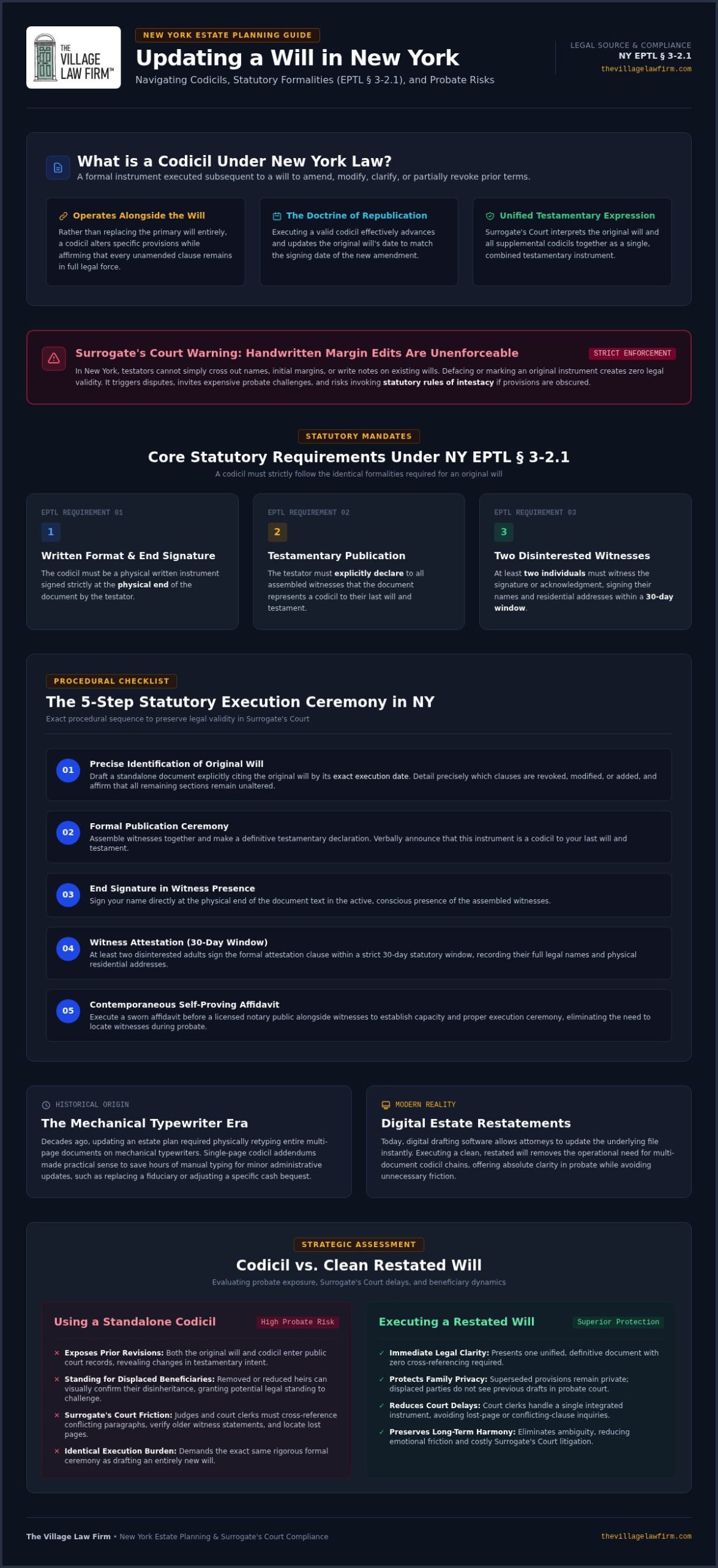
Under New York law, a codicil is a formal legal instrument executed subsequent to a will that amends, modifies, clarifies, or partially revokes the provisions of the original document. Rather than replacing the primary will entirely, it operates alongside it. Rooted in traditional common law, a codicil alters specific terms while affirming that every unamended clause remains in full effect. When you draft an amendment to your estate plan, New York courts view both instruments as a unified testamentary expression.
This integration rests on the legal doctrine of republication. Executing a valid codicil effectively updates your original will to the signing date of the amendment. While republication can resolve certain technical conflicts, drafting an effective codicil to will New York property requires total alignment with state statutes. A failure in language or execution can jeopardize both documents.
Statutory Requirements Under NY EPTL § 3-2.1
New York Estates, Powers and Trusts Law (EPTL § 3-2.1) leaves no room for informal adjustments. To establish validity, your codicil must strictly meet these core mandates:
- Written format: The document must be written and signed at the physical end by the testator.
- Testamentary publication: You must explicitly declare to the witnesses that the document represents a codicil to your last will and testament.
- Disinterested witnesses: At least two individuals must witness your signature or acknowledgment, signing their own names and addresses within a 30-day window.
The Evolution of Codicils in Modern Estate Planning
Codicils once served an indispensable purpose. Decades ago, creating a new testamentary document required an attorney to physically retype an entire multi-page will on a mechanical typewriter. In that era, drafting a single-page addendum saved hours of manual labor. It made practical sense for modest adjustments, such as replacing a nominated fiduciary or adjusting a specific cash bequest.
Modern legal technology has reshaped this landscape. Today, attorneys can swiftly update the underlying digital file and execute a clean, restated will. Choosing a standalone codicil to will New York assets often introduces unnecessary friction. Submitting multiple papers to the Surrogate’s Court forces judges and court clerks to cross-reference conflicting paragraphs, verify older witness statements, and locate lost pages. A streamlined, single-document approach creates immediate legal clarity and spares your family unnecessary emotional strain.
How to Legally Execute a Codicil in New York: Step-by-Step
Many testators assume they can cross out a name, write in a new beneficiary, or initial the margins of an existing estate document. In New York, the Surrogate’s Court strictly rejects these informal alterations. Defacing or marking an original instrument does not create a valid modification. Instead, it invites expensive challenges or risks triggering statutory rules of intestacy if the underlying provisions become obscured or deemed revoked.
Executing a codicil to will New York property requires the identical formal ceremony demanded of any full testamentary document. Adhering to a meticulous five-step protocol preserves your intent and ensures your updates withstand court scrutiny.
Step 1 to 3: Drafting, Referencing, and the Publication Ceremony
Precision begins with clear identification. To establish legal force, follow these initial steps:
- Step 1: Precise identification. Draft a standalone document that cites the original will by its exact execution date. Clearly state which clauses are revoked, modified, or added, and confirm that all remaining sections remain unaltered.
- Step 2: Formal publication. Assemble your witnesses and make a definitive testamentary declaration. You must verbally state that this document is a codicil to your last will and testament.
- Step 3: End signature. Sign the document at the physical end of the text in the active presence of your witnesses.
Step 4 & 5: Attestation, Self-Proving Affidavits, and Secure Storage
The closing stages transform your drafted intent into an enforceable legal instrument:
- Step 4: Witness attestation. Have at least two disinterested adults sign the attestation clause within a 30-day window. They must record their legal names and physical residential addresses.
- Step 5: Execute a self-proving affidavit. Sign a contemporaneous affidavit before a licensed notary public alongside your witnesses. This sworn statement confirms testamentary capacity and proper ceremony, eliminating the need to track down witnesses years later during probate.
Once signed, place the amendment directly alongside your original will without physically stapling or unstapling the documents. Tampering with existing staples raises immediate red flags for court clerks. If coordinating these formal steps feels daunting, partnering with an experienced attorney for tailored estate planning ensures your legacy remains secure from the start.
Codicil vs. Writing a New Will in New York: The Hidden Probate Risks
Submitting an amendment alongside a primary will often invites the exact friction testators hope to avoid. While drafting an addendum feels like an efficient shortcut, every codicil to will New York assets must be admitted to probate in Surrogate’s Court alongside the original document. This dual submission exposes your entire testamentary history to public view. Instead of offering a quiet resolution, it creates an evidentiary trail that disgruntled parties can exploit.
Modern estate planning favors executing an entirely new will. A freshly drafted will revokes all prior instruments cleanly. It leaves a single, unified text for the court to review, eliminating competing interpretations and shielding your family from avoidable litigation.
Increased Surrogate’s Court Scrutiny and Will Contests
Transparency cuts both ways in Surrogate’s Court. Under New York law, any beneficiary whose financial share is diminished or eliminated by a codicil must receive a formal citation during probate. This legal notice gives that displaced heir standing to demand pre-objection depositions under SCPA 1404.
They can examine your attorney and the attesting witnesses under oath, probing your mental capacity and investigating potential undue influence. Had you executed a new, comprehensive will instead, that former beneficiary would have no automatic standing to challenge the new document unless they were an intestate distributee or named in an immediately preceding will. A codicil practically hands an aggrieved heir the evidence and procedural standing they need to contest your estate.
Cost and Complexity: Comparing Both Approaches
Many clients believe a codicil costs a fraction of a new will. The reality is quite different. Because a codicil requires the same statutory drafting precision, formal execution ceremony, and witness presence, the initial legal investment remains remarkably similar.
The downstream expenses, however, can diverge wildly:
- Higher court filing fees: Under SCPA 2402, Surrogate’s Court filing fees are tied to gross estate value. Complex, multi-document estates require additional administrative processing, often increasing overall probate costs.
- Longer timelines: Straightforward New York probates generally take between 9 and 18 months, especially with the mandatory seven-month creditor period. Adding a codicil that triggers SCPA 1404 discovery can extend this timeline to two years or longer.
- Escalating attorney hours: Retaining counsel to harmonize contradictory language or respond to citations drains estate assets that should pass directly to your beneficiaries.
Working alongside a skilled estate planning attorney New York ensures your documents present a cohesive plan, minimizing court exposure and keeping administrative costs under control.
When to Use a Codicil vs. Restating Your Estate Plan
Deciding between an addendum and a full document restatement comes down to scope. An isolated administrative tweak can sometimes be handled cleanly by an amendment. Layering multiple adjustments over an evolving life, however, invites procedural chaos. For modern New Yorkers managing dynamic careers, real estate, and growing families, drafting a codicil to will New York property should be a targeted exception rather than the default solution.
Narrow Scenarios Where a Codicil May Suffice
A codicil remains appropriate when you need to make an isolated change to an otherwise modern, properly structured will. Practical applications include:
- Replacing a fiduciary: Naming a successor executor after your primary choice passes away or steps down, provided your distribution terms stay untouched.
- Modifying a modest bequest: Adding a specific charitable gift or allocating a specific family heirloom without disturbing the residuary estate.
- Reflecting legal name changes: Updating an individual beneficiary’s name following marriage or legal petition while leaving their financial share identical.
Major Milestones Demanding a Comprehensive New Will
Substantive shifts require tearing down the old framework and drafting a fresh document. Executing a new will is vital during key life transitions:
- Growing your family: Welcoming a child involves nominating legal guardians and establishing protective minor trusts. Consult our NYC estate planning parent’s guide to structure these critical safeguards.
- Marital changes: Entering a marriage, finalizing a divorce, or shielding children from a previous relationship requires recalibrating spousal elective shares and trust provisions.
- Expanding property and multi-jurisdictional assets: Purchasing real estate outside New York, acquiring cross-border assets, or planning around New York’s estate tax cliff ($7,350,000 exemption in 2026) demands an integrated, sophisticated will.
To eliminate ambiguity and shield your family from courtroom disputes, schedule an estate planning consultation to ensure your testamentary documents reflect your exact current wishes.
Securing Your Legacy with The Village Law Firm
Preserving a lifetime of achievement requires more than good intentions. It demands technical precision. Leaving your family with an outdated or patched-together estate plan introduces friction, court delays, and emotional fatigue. While attempting an informal codicil to will New York assets might seem practical on the surface, true peace of mind comes from knowing your documents are clear, current, and fully enforceable.
The Risks of DIY Codicils and Online Legal Templates
The temptation to download a digital template or draft an addendum at your desk is understandable. Yet generic boilerplate forms frequently fail the exacting standards enforced by New York courts. A missing attestation clause, an incomplete notary acknowledgment, or vague phrasing can lead the Surrogate’s Court to reject the entire document.
When an amendment collapses under judicial review, your authentic voice is lost. That failure leaves your estate vulnerable to protracted disputes or unintentional intestacy. Meticulous legal drafting eliminates these vulnerabilities, ensuring your instructions remain unassailable.
A Thoughtful, Streamlined Process for New York Families
Updating your estate plan should bring relief, not stress. At our boutique Manhattan practice, we cut through legal noise to provide an orderly sanctuary for busy professionals and families. We carefully audit your existing documents, examine how changes in your life intersect with current laws, and provide clear recommendations tailored to your goals.
Our white-glove approach blends rigorous asset protection with deep emotional intelligence. We guide you through every choice with warmth and clarity:
- Holistic reviews: We assess your existing wills, trusts, and beneficiary designations to uncover hidden conflicts before they reach probate.
- Customized structures: We craft cohesive strategies designed to preserve wealth, protect young children, and maintain family harmony across generations.
- Seamless execution: Every signing ceremony is conducted under strict statutory oversight, closing procedural loopholes that invite litigation.
Whether you need to reflect a major family milestone or refresh an aging will, you don’t have to carry the legal burden alone. Partner with The Village Law Firm to transform uncertainty into lasting order. Connect with our Manhattan legal team today to schedule a collaborative consultation and secure your family legacy.
Protect Your Family’s Future with Confident Legal Planning
A thoughtful estate plan should evolve alongside your life, not complicate it. While executing a codicil to will New York assets might appear to be a quick fix, maintaining fragmented testamentary instruments often prolongs probate and leaves your true intentions exposed in Surrogate’s Court. In most modern situations, restating your wishes through a unified, attorney-drafted will delivers superior protection, closing the door on avoidable disputes before they ever reach your loved ones.
You don’t have to navigate these complex statutory choices on your own. At The Village Law Firm, our boutique private legal practice based in New York City provides white-glove legal guidance that replaces anxiety with complete clarity. We tailor estate planning and administration to your family’s unique dynamics, giving you an orderly foundation that stands the test of time. Take control of your tomorrow today. Schedule a consultation with The Village Law Firm to secure your legacy with confidence.
Frequently Asked Questions
Can I write my own handwritten codicil to a will in New York?
No, handwritten codicils are generally invalid in New York. Under EPTL § 3-2.2, handwritten or holographic testamentary instruments are recognized only in exceptional circumstances, specifically for active-duty military personnel during armed conflict or mariners at sea. For all other residents, writing changes by hand or annotating the margins of an existing document holds zero legal force. The Surrogate’s Court will simply disregard informal handwritten notes.
What are the legal witness requirements for a codicil in New York?
New York law requires at least two competent, disinterested witnesses to observe the signing of a codicil. Under EPTL § 3-2.1, you must explicitly declare to both witnesses that the document amends your existing will. Both individuals must sign their names and record their physical residential addresses within 30 days of each other. Using named beneficiaries as witnesses can forfeit their inheritances.
Does a codicil need to be notarized under New York law?
A codicil does not strictly require notarization to be valid, but executing a contemporaneous self-proving affidavit before a notary is standard legal practice. Without this sworn affidavit, your witnesses must be located years later to give sworn testimony during probate. Notarizing the witness attestation at signing prevents substantial probate delays, particularly if witnesses move out of state or pass away.
Why do New York estate attorneys frequently recommend a new will instead of a codicil?
Attorneys usually advise executing a new will because an addendum introduces distinct litigation risks. When executing a codicil to will New York assets, anyone whose inheritance is reduced or eliminated receives formal notice and standing to object in Surrogate’s Court. Drafting a new, comprehensive will revokes earlier documents cleanly, keeping historical changes private and shielding your family from avoidable will contests.
What happens if an executor loses the physical codicil before probate in New York?
If a known codicil cannot be located after death, New York courts apply a strong presumption that the testator intentionally revoked and destroyed it. Admitting a lost codicil to probate under SCPA 1407 requires exhaustive legal proof, including testimony from witnesses who can confirm its precise language. This legal hurdle often leads to expensive delays, highlighting the inherent fragility of multiple physical documents.
Can a codicil change an executor or legal guardian in New York?
Yes, a valid codicil can replace an executor or nominate a new legal guardian. While modifying an executor is a relatively common use for an amendment, changing legal guardians for young children deserves extra caution. Layering separate guardianship instructions across multiple documents risks creating procedural confusion in court. A cohesive, newly restated will ensures your parental protective directives remain completely transparent.
How many codicils can be legally attached to an existing New York will?
New York law does not place a statutory limit on how many codicils you can execute. In practice, however, attaching multiple amendments to a codicil to will New York arrangement creates administrative confusion. Interpreting several sequential instruments forces the court to cross-reference conflicting terms, raising the odds of misinterpretation. If you need more than one minor adjustment, executing a fresh will is far safer.