
What if the brownstone you’ve maintained for decades became a source of recovery for Medicaid instead of a gift for your grandchildren? For many high-net-worth New Yorkers, the upcoming 2026 shifts in estate tax exemptions and the state’s harsh “tax cliff” make this a valid concern. Implementing an asset protection trust NYC is the most effective way to transform that anxiety into a concrete strategy for stability. You’ve spent a lifetime building your success in this city. Your legacy shouldn’t be left to the whims of changing legislation or unpredictable long-term care costs.
It’s natural to feel protective of what you’ve built, and even more natural to feel confused by the dense layers of New York legal requirements. You deserve a partner who replaces that confusion with a sense of order and meticulous care. In this guide, we’ll demystify how sophisticated trust structures shield your wealth from creditors and ensure Medicaid eligibility without requiring you to spend down your life’s work. We will walk through the 2026 tax landscape and the specific mechanics of Medicaid planning so you can move forward with absolute confidence in your family’s inheritance.
Key Takeaways
- Understand why high litigation rates in New York make a dedicated trust essential for protecting your home and professional success beyond standard insurance coverage.
- Learn the mechanics of an asset protection trust NYC and how creating a legal separation between you and your wealth ensures long-term security.
- Compare Medicaid Asset Protection Trusts with domestic and international strategies to determine which structure best fits your specific financial portfolio.
- Discover why an “empty trust” is a common failure and how meticulous funding is required to satisfy the five-year look-back period.
- See how a partnership with a sophisticated urban guide can replace the complexity of New York trust law with a clear, orderly plan for your family’s inheritance.
Beyond Insurance: Why New Yorkers Need a Dedicated Asset Protection Trust
Living in New York City offers unmatched opportunity, but it also carries unique financial risks. High-net-worth individuals often rely on umbrella insurance policies, thinking they are fully shielded. However, insurance has limits and exclusions that can leave your most valuable holdings exposed. To truly secure your legacy, you need an asset protection trust NYC. What is an Asset Protection Trust? At its core, it is an irrevocable legal structure designed to hold your assets, effectively removing them from your personal ownership while keeping them within the family’s reach. This creates a formidable barrier against external threats.
For doctors, architects, and business owners in Manhattan and the surrounding boroughs, the litigation climate is particularly aggressive. A single professional malpractice claim or a business dispute can quickly exceed your policy limits. If your business operations extend to the South Florida region, consulting with a specialist like Matthew Fornaro, P.A. can ensure your commercial interests are legally sound. While insurance acts as a first line of defense, a trust is a permanent fortress that replaces the chaos of potential lawsuits with a structured, orderly sanctuary for your wealth.
The 2026 Tax Cliff and Your Wealth
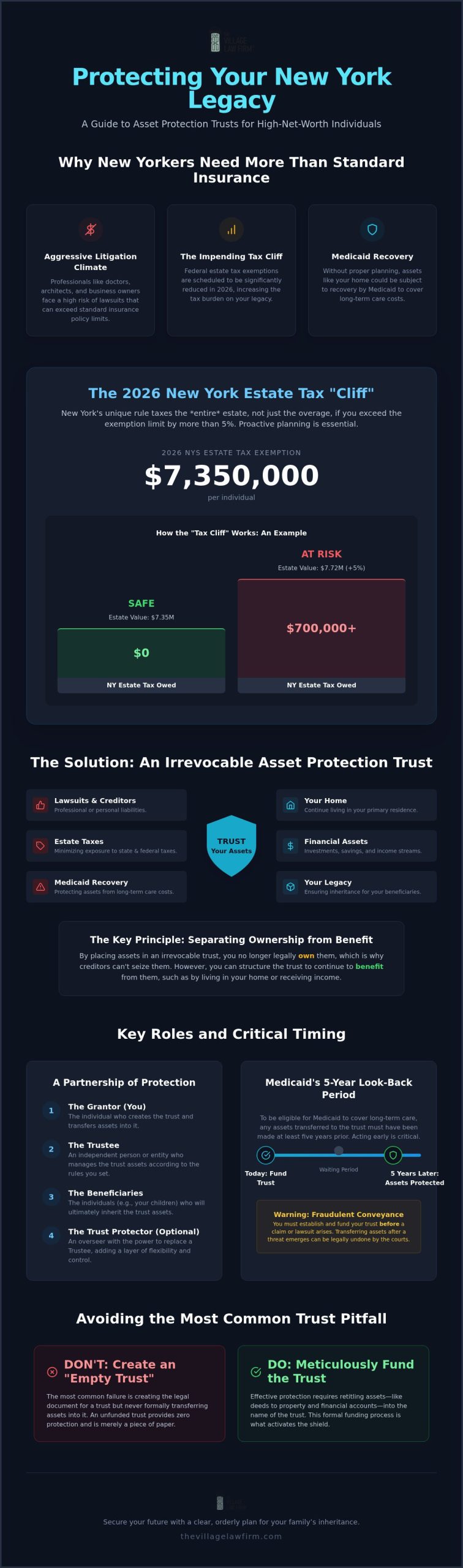
The year 2026 represents a pivotal moment for your financial future. Many current federal tax exemptions are scheduled to sunset, which will likely lead to a significant reduction in the amount you can pass on to your heirs tax-free. By establishing a trust now, you can “lock in” current, higher exemptions before they decrease. In New York, this is especially critical because of the state’s “estate tax cliff.” If your estate exceeds the exemption by just five percent, New York taxes the entire value rather than just the overage. For 2026, the New York State estate tax exemption is $7,350,000, making proactive asset transfers essential for those whose wealth approaches this threshold.
Protection Against Creditors and Lawsuits
NYC professionals often find themselves targeted in high-claim litigation. A dedicated asset protection trust NYC utilizes spendthrift provisions, which legally prevent creditors from reaching the assets held within the trust. This mechanism ensures that your family’s inheritance remains untouched by professional liabilities or personal judgments. Timing is everything. You must act before a threat emerges. Transferring assets after a lawsuit is filed can trigger fraudulent conveyance laws, which allow courts to undo the transfer. Establishing your shield today ensures your peace of mind remains intact tomorrow.
The Irrevocable Shield: How NY Asset Protection Trusts Function
The word “irrevocable” often triggers a sense of loss or restriction. It shouldn’t. In the context of an asset protection trust NYC, irrevocability is actually your greatest ally. If you don’t have the power to pull assets back into your name at will, a judge cannot compel you to do so to satisfy a creditor’s judgment. This legal finality creates the shield. You are essentially trading a degree of direct ownership for a high degree of permanent security. Looking back at the history of asset protection trusts, the goal has always been to create a clear boundary between the individual and their wealth.
You might wonder if you’ll lose the ability to enjoy your home or your income. The answer is usually no. Most New York residents structure an asset protection trust NYC so they can continue living in their primary residence or receive income from invested assets. The key is that while you benefit from the assets, you no longer own them in the eyes of the law. This separation is maintained by an independent Trustee. Their role is to ensure the trust operates according to the rules you set, which preserves the integrity of the shield under New York’s rigorous legal standards.
Grantor vs. Trustee: A Partnership of Protection
Establishing a trust involves three primary roles: the Grantor (you), the Trustee (the manager), and the Beneficiaries (those who receive the assets). Selecting a Trustee who understands NYC’s pace and complexity is vital. We often recommend including a Trust Protector. This person acts as a safeguard, holding the power to replace a Trustee or adjust the trust if laws change. It adds a layer of flexibility to an otherwise permanent structure. If you’re unsure who to appoint, our team can help you evaluate the best Medicaid planning and trustee selection strategy for your specific family dynamics.
The Legal Mechanics of Asset Transfer
A trust is merely a stack of papers until it is funded. This involves retitling your assets from your personal name into the name of the trust. Whether it’s a Manhattan condo deed or a brokerage account, this step must be executed with technical precision. Most asset protection trusts are designed as “Grantor Trusts” for tax purposes. This means the transfer is tax-neutral. You don’t need a separate tax return for the trust, and you continue to report income on your personal return. This removes complexity while maintaining a robust legal defense.
Choosing Your Strategy: MAPTs vs. Domestic vs. International Trusts
Not all shields are forged for the same battle. When establishing an asset protection trust NYC, you must first identify your primary vulnerability. Are you protecting your home from the staggering costs of long-term care, or are you shielding a global business empire from aggressive litigation? The structure you choose dictates the strength of your defense. While Domestic Asset Protection Trusts (DAPTs) are popular in states like South Dakota or Delaware, New York doesn’t have its own DAPT statute. This means NYC residents often look toward specialized Medicaid structures or international options to achieve true security.
The decision depends on the complexity of your holdings and your specific goals for the 2026 tax year. For many, the goal is to qualify for government benefits without depleting the family’s inheritance. For others, the priority is creating a jurisdictional barrier that makes lawsuits prohibitively expensive for creditors. Your strategy should feel like a custom-tailored suit. It must fit your current lifestyle while providing room for your legacy to grow.
The New York Medicaid Asset Protection Trust (MAPT)
A Medicaid Asset Protection Trusts (MAPT) is specifically engineered to safeguard your primary residence and other life savings from being “spent down” on nursing home costs. In New York, the current look-back period for nursing home care is 60 months. This means any assets transferred into the trust must happen five years before you apply for benefits. There is also a 30-month look-back period for community home care that has been approved but is not yet implemented as of mid-2026. Working with a Medicaid Planning Attorney New York allows you to start this clock early, ensuring your family home remains a gift for your children rather than a source of state recovery.
Cross-Border Asset Protection for Global Families
For families with property in London or business interests in Paris, a standard domestic trust often falls short. International or “offshore” trusts provide the highest level of protection because they aren’t subject to U.S. court orders. This forces creditors to re-litigate their claims in foreign jurisdictions, which is a massive deterrent. Beyond litigation defense, International Estate Planning in New York is essential for preventing chaotic probate processes across multiple countries. It ensures that your global portfolio remains orderly and that your heirs don’t face a bureaucratic nightmare after you’re gone. This level of planning requires technical precision and a partner who understands the nuances of international law.
Avoiding the Pitfalls: Funding, Trustees, and the 5-Year Look-Back
Signing your legal documents is only the beginning. A trust without assets is merely an expensive stack of paper. To ensure your asset protection trust NYC actually functions as a shield, you must fund it correctly. This means physically and legally transferring ownership of your property, bank accounts, and business interests into the trust’s name. If you leave your Manhattan co-op or your investment portfolio in your personal name, you haven’t built a fortress; you’ve only drafted a blueprint for one. Creditors and Medicaid will look right past the document to the title of the assets themselves. Technical precision here is the difference between a legacy preserved and a legacy lost.
In New York, the law is particularly strict regarding “self-settled” trusts. If you create a trust for your own benefit and retain too much control, the shield becomes transparent to creditors. This is why the role of the independent Trustee is so vital. You need a structure that balances your needs with the rigid requirements of NY law to ensure the protection is ironclad. If the trust isn’t managed with meticulous adherence to these rules, a court can pierce the veil and allow creditors to seize what you worked so hard to save.
The Art of Proper Trust Funding
Retitling real estate requires a new deed recorded with the city. Moving brokerage accounts involves specific transfer forms and coordination with your financial advisor. Business interests, such as shares in an LLC or corporation, must be formally assigned to the trust. It’s also vital to recognize that qualified retirement accounts like IRAs usually cannot be transferred into an irrevocable trust without triggering massive tax penalties. These require separate, specialized strategies to protect. Meticulous record-keeping for every transfer is the only way to prove the trust was funded before a crisis arose. We provide the steady guidance needed to navigate these administrative hurdles without the stress.
Timing Your Plan: The Look-Back Reality
Time is your most valuable asset. For New York nursing home Medicaid, the 60-month look-back period is an absolute boundary. Any transfer made within five years of an application is scrutinized and can lead to a penalty period where you must pay for care out of pocket. With the implementation of the 30-month look-back for home care looming, proactive planning in 2026 is the most compassionate gift you can give your family. If you haven’t hit the five-year mark yet, there are still sophisticated strategies that can provide partial protection. Don’t wait for a medical emergency to begin the process. Contact The Village Law Firm to start your five-year clock today and secure your family’s future.
Securing Your Future: The Village Law Firm’s White-Glove Approach
The complexity of New York law shouldn’t be a barrier to your peace of mind. While the technical requirements of an asset protection trust NYC are rigorous, you don’t have to carry that burden alone. We see ourselves as your steady urban guide; a partner who understands the high stakes of Manhattan life but offers a sanctuary of calm and order. Our approach is fundamentally different from a transactional document service. We offer a white-glove experience designed for busy professionals who value efficiency and meticulous attention to detail.
The Village Process begins with a calm, thorough assessment of your unique asset profile. We look at the whole picture, from your local real estate to your global business interests. Once we’ve defined the strategy, we move into meticulous execution. This includes the technical precision of drafting and the critical step of trust funding. We replace the chaos of uncertainty with a well-defined journey toward security. Our goal is to ensure that every asset is positioned correctly to withstand future challenges.
A Partnership Mindset for NYC Professionals
For NYC professionals, time is the most constrained resource. You’ve built a life of significance, and you deserve a legal partner that respects your schedule while protecting your achievements. Our firm specializes in managing complex, multi-national portfolios that require a high degree of cross-border expertise. We also provide dedicated Estate Planning for Families with Children NYC, ensuring the next generation is shielded from the risks of a litigious city. We handle the heavy lifting of compliance and administrative oversight so you can stay focused on your family and your career.
Take the First Step Toward Order
Taking the first step toward order is often the most difficult part of the process. We invite you to book a consultation to discuss how an asset protection trust NYC can fit into your specific financial life. Our commitment to transparency and directness means you’ll always know exactly where you stand. You’ll find that our relationship is built on unwavering integrity rather than a one-time transaction. A well-crafted legacy is more than just a tax strategy; it’s the ultimate expression of your care for those you love. Let’s work together to ensure that legacy remains exactly as you intended.
Shield Your Future and Secure Your Family’s Inheritance
The 2026 shift in estate tax law and the evolving landscape of Medicaid eligibility don’t have to be sources of anxiety. By establishing a sophisticated asset protection trust NYC, you move from a state of reactive concern to proactive control. You’ve seen how the right trust structure shields your home from nursing home costs and protects your professional success from high-claim litigation. Most importantly, you now understand that a trust is only as strong as its technical precision and proper funding. Timing is your most valuable asset; starting the five-year clock now ensures your shield is ready when you need it most.
Transitioning your legacy from chaos to order requires a partner who understands the unique rhythm of this city. We provide the specialized international expertise and expert Medicaid planning necessary for complex, high-value portfolios. Our white-glove NYC service ensures that every detail of your plan is executed with meticulous care. Don’t leave your family’s future to chance. Secure your legacy today with a sophisticated asset protection strategy. Book your consultation with The Village Law Firm. Your hard work deserves the permanent sanctuary of a well-crafted plan.
Frequently Asked Questions
What is the primary difference between a revocable and an irrevocable asset protection trust in NYC?
A revocable trust offers flexibility but provides zero creditor protection because you retain full control over the assets. In contrast, an irrevocable asset protection trust NYC transfers legal ownership to the trust itself. This creates a robust barrier that shields your wealth from lawsuits and Medicaid recovery. While you give up the power to unilaterally dissolve the trust, you gain the permanent security necessary to ensure your family’s inheritance remains untouched by future liabilities.
Can I still live in my home if I move it into a Medicaid Asset Protection Trust?
You can absolutely continue to live in your primary residence after transferring it to a Medicaid Asset Protection Trust. Most New York residents structure these trusts to include a legal “life estate,” which guarantees your right to occupy the property for the rest of your life. This arrangement allows you to maintain your lifestyle and property tax exemptions while starting the critical five-year look-back clock. It ensures the home passes to your heirs instead of being liquidated for care.
How much does it cost to set up an asset protection trust in New York?
The investment required to establish a trust depends entirely on the complexity of your asset portfolio and the specific protections you need. A basic structure for a single family home differs significantly from a multi-national plan involving international business interests and various jurisdictions. We focus on providing a premium, white-glove service that prioritizes technical precision. Rather than looking for the lowest price, savvy professionals prioritize the value of a shield that actually holds up during a legal crisis or Medicaid application.
Is an offshore trust better than a New York trust for asset protection?
Choosing between an offshore and a New York trust depends on your specific risk profile. Offshore trusts offer the highest level of protection because foreign courts don’t recognize U.S. judgments, forcing creditors to re-litigate abroad. However, they involve higher administrative complexity. For many New Yorkers focused primarily on Medicaid eligibility and local lawsuits, a domestic asset protection trust NYC provides a robust, efficient solution that aligns perfectly with state-specific legal requirements and the mandatory five-year look-back period.
What happens to the assets in my trust when the 2026 tax exemption changes occur?
Assets successfully transferred into an irrevocable trust before the 2026 deadline are generally removed from your taxable estate. This allows you to “lock in” current, higher exemption levels before the federal sunset occurs and the New York “tax cliff” becomes a greater threat. By moving assets now, you ensure they aren’t subject to the reduced exemption limits that’ll likely impact many high-net-worth families. It’s a proactive move to replace tax uncertainty with long-term order and stability.
Can a creditor ever “break” an irrevocable trust in New York?
It’s very difficult for a creditor to “break” a properly drafted and funded irrevocable trust in New York. The most common vulnerability is a “fraudulent conveyance,” which occurs if you move assets after a lawsuit has already been threatened or filed. Additionally, if the trust is managed poorly or you retain too much personal control, a court might pierce the veil. Technical precision in the drafting phase is the only way to ensure the shield remains impenetrable against aggressive litigation.
Do I need an asset protection trust if I already have high-limit umbrella insurance?
Umbrella insurance is a vital first line of defense, but it’s not a complete solution. Insurance policies have maximum coverage limits and numerous exclusions that can leave your wealth exposed in a high-claim lawsuit. A trust acts as the ultimate safety net for assets that exceed your policy limits or for claims that fall outside your coverage. While insurance pays out for specific accidents, a trust provides a permanent legal barrier that protects your legacy from nearly any financial threat.