
A valid will in one country does not guarantee the orderly transfer of property in another. When assets span multiple jurisdictions, relying on piecemeal court filings inevitably triggers administrative gridlock, conflicting succession laws, and unexpected tax burdens. Truly effective cross-border estate administration requires deliberate, synchronized coordination across legal borders rather than isolated local petitions.
If you are trying to manage multinational property while carrying the weight of personal grief, the maze of foreign inheritance rules, document apostilles, and strict tax authorities can feel paralyzing. You don’t have to navigate this complexity alone. This guide provides total clarity on administering multinational estates, coordinating foreign courts with domestic proceedings, and shielding global assets from double taxation. We examine the essential mechanics of primary versus ancillary probate, demystify IRS foreign reporting requirements, and provide a clear framework to transfer your family’s multinational wealth smoothly and compliantly.
Key Takeaways
- Mastering cross-border estate administration requires synchronized legal coordination across borders rather than isolated probate filings.
- Differentiating between primary and ancillary probate proceedings ensures foreign assets are claimed lawfully without triggering administrative delays.
- Strategic utilization of international tax treaties and foreign death tax credits protects multinational wealth from double taxation.
- Addressing document legalization, apostilles, and translation standards early prevents procedural stalls in foreign civil and common law courts.
- Coordinating New York Surrogate’s Court procedures directly with trusted foreign legal counsel provides a seamless bridge between complex jurisdictions.
Cross-Border Estate Administration and Why It Is Complex
Fundamentally, cross-border estate administration is the formal legal process of collecting, managing, and distributing a decedent’s wealth across two or more sovereign legal systems. Global mobility has fundamentally transformed modern asset ownership. Today, a family may reside in New York, hold financial brokerage accounts in London, and own real property in Paris or Florence. Domestic probate focuses entirely on local statutes and regional registries. By contrast, managing multinational holdings forces executors to balance irreconcilable statutory frameworks, currency restrictions, and multilingual court requirements, all while navigating personal grief during a period of acute loss.
When an individual passes away without a coordinated multijurisdictional strategy, the standard rules of intestacy can splinter an estate among foreign courts, exposing assets to conflicting local mandates. What should be an orderly distribution frequently dissolves into administrative paralysis.
Common Law Probate vs. Civil Law Forced Heirship Regimes
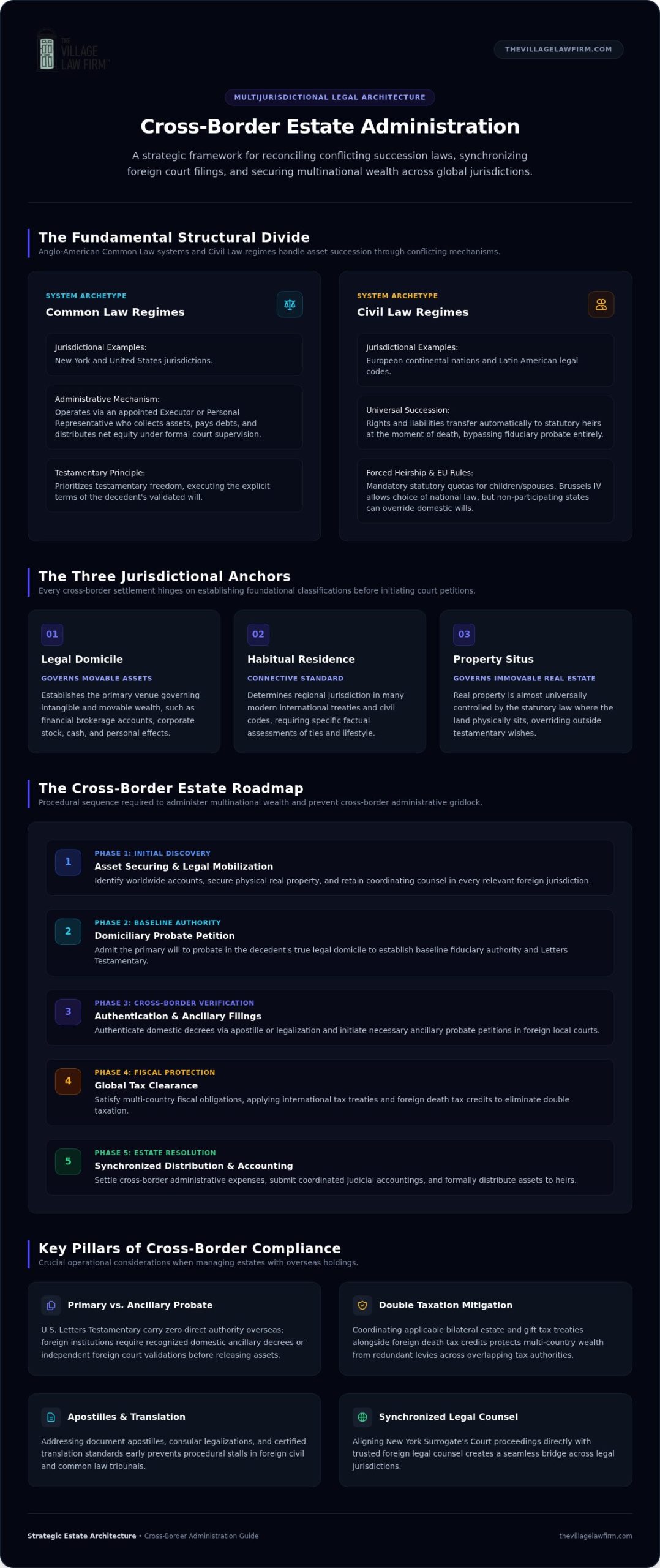
The deepest structural divide in cross-border estate administration exists between Anglo-American common law and civil law systems. Common law jurisdictions, including New York and the broader United States, rely on an executor or personal representative who gathers assets, liquidates debts, and distributes net equity under court supervision. Civil law nations operate on “universal succession.” In these countries, the decedent’s rights and liabilities pass automatically to legal heirs at the moment of death, bypassing fiduciary probate entirely.
This conflict directly challenges testamentary freedom. European and Latin American codes enforce strict forced heirship provisions that guarantee mandatory portions of an estate to surviving children or spouses, regardless of what a New York will declares. While the EU Succession Regulation (Brussels IV) allows individuals to choose the law of their nationality to govern succession, non-participating nations and strict real estate rules can still override an executor’s domestic authority.
Determining Legal Domicile, Habitual Residence, and Asset Situs
Every cross-border settlement hinges on three jurisdictional anchors: domicile, habitual residence, and property situs. Domicile establishes the primary legal venue controlling personal movable property, such as cash, corporate stock, and personal belongings. Conversely, immovable real estate is almost universally governed by the law where the land physically sits (the situs).
Determining true domicile is rarely straightforward for global executives or dual citizens who maintain ties across borders. Because each nation applies different tests to establish residency, proactive international estate planning remains the most effective defense against jurisdictional gridlock. Establishing these foundational classifications early protects fiduciaries from costly missteps before formal court petitions begin.
The Cross-Border Estate Administration Process: A Step-by-Step Roadmap
Executing an international estate demands absolute procedural discipline. Contrary to what many personal representatives assume, U.S. Letters Testamentary hold zero direct authority overseas; a foreign bank will not release funds simply because a New York judge signed an order. A structured roadmap brings clarity to an otherwise fragmented journey:
- Phase 1: Immediate Asset Securing and Legal Mobilization. Identify worldwide accounts, secure tangible property, and retain coordinating legal counsel in every relevant jurisdiction.
- Phase 2: Domiciliary Probate Petition. Admit the primary will to probate in the decedent’s true legal domicile to establish baseline fiduciary authority.
- Phase 3: International Authentication and Ancillary Filings. Authenticate domestic court decrees for foreign use and initiate necessary local court proceedings abroad.
- Phase 4: Global Tax Clearance. Satisfy multi-country fiscal obligations, leveraging applicable U.S. estate and gift tax treaties to mitigate redundant exposure.
- Phase 5: Synchronized Distribution and Accounting. Settle outstanding administrative expenses, complete cross-border accountings, and transfer remaining assets to designated heirs.
Fiduciaries owe a strict duty of asset transparency across borders. Failing to disclose foreign holdings to domestic courts, or concealing domestic rulings from foreign registries, exposes executors to personal surcharge and severe regulatory penalties.
Marshalling Foreign Assets: Authentications, Apostilles, and Certified Translations
Foreign institutions demand flawless evidentiary verification before surrendering control of local property. Under the Hague Apostille Convention, court orders, death certificates, and letters of appointment require formal state apostilles to prove their legal authenticity. When handling assets in non-signatory countries, documents must instead endure multi-step consular legalization through foreign embassies. Additionally, testamentary instruments drafted in English require sworn, certified legal translations executed by licensed court translators to ensure accurate interpretation abroad.
Coordinating Primary New York Probate with Foreign Ancillary Proceedings
When a decedent lived in New York, the executor must first qualify before the Surrogate’s Court to establish primary administration. Once appointed, that representative must petition foreign probate courts to commence ancillary administration over offshore assets. Navigating ancillary probate in New York or overseas requires delicate synchronization; an error in the primary proceeding can instantly freeze ancillary actions worldwide. Aligning these moving parts becomes much simpler when you consult a trusted firm like The Village Law Firm to steer multi-jurisdictional filings smoothly.
Final Distribution, Beneficiary Releases, and Multi-Jurisdictional Accounting
Closing a multi-jurisdictional estate requires harmonizing distinct accounting expectations. Civil and common law jurisdictions often enforce competing rules regarding fiduciary compensation, creditor notice periods, and statutory reserve funds. To insulate executors against future personal exposure, legal counsel must draft customized cross-border receipts, releases, and indemnification agreements. These formal releases prevent disgruntled beneficiaries from taking a second bite at the apple in foreign jurisdictions once local distributions conclude.
International Tax Compliance and Mitigating Double Taxation in 2026
The Internal Revenue Service imposes federal estate tax on the worldwide assets of deceased United States citizens and permanent residents, regardless of where those assets sit or where the decedent lived at death. This sweeping citizenship-based tax regime often collides violently with foreign death duties. While the U.S. federal estate tax exemption sits at $15 million per individual for 2026 (with a top statutory rate of 40%), non-resident aliens face a minuscule $60,000 exemption threshold on U.S.-situs assets. Without synchronized planning, the exact same account or parcel of real estate risks immediate, confiscatory double taxation.
| Jurisdiction | Exemption / Threshold (2026) | Top Marginal Death / Inheritance Tax Rate | Basis of Imposition |
|---|---|---|---|
| U.S. Federal (Citizen/Resident) | $15 million ($30M married couples) | 40% | Worldwide citizenship or domicile |
| U.S. Federal (Non-Resident Alien) | $60,000 | 40% | U.S.-situs property only |
| New York State | Subject to statutory threshold | 16% | New York domicile or in-state situs real estate |
| France | Varies by kinship lineage | Up to 45% (lineal) / 60% (unrelated) | Beneficiary or decedent residency, or French situs |
| United Kingdom | Varies by statutory allowance | 40% | Residence (10 of prior 20 years) or UK situs |
Fiduciaries must meet strict IRS compliance deadlines, typically within nine months of death on Form 706, to shield executors from personal financial liability and civil penalties.
Leveraging Bilateral Estate Tax Treaties and Foreign Death Tax Credits
Bilateral treaties provide vital residency tiebreaker rules that determine which nation claims primary taxing sovereignty over worldwide holdings. When treaties are absent or silent, Internal Revenue Code Section 2014 permits a foreign death tax credit against U.S. federal estate tax for duties paid overseas on foreign property. However, calculating this credit is intricate; it does not eliminate state-level exposure. Non-residents owning physical New York assets must remain mindful of the distinct New York estate tax exemption cliff, which rapidly phases out legal credits if the taxable estate exceeds statutory thresholds by even a small percentage.
Critical IRS International Informational Filings: FBAR, Form 8938, and Form 3520
Cross-border estate administration requires navigating aggressive informational disclosure rules beyond baseline estate returns. An executor steps directly into the decedent’s shoes and must submit FinCEN Form 114 (FBAR) and Form 8938 to report foreign accounts exceeding aggregate monetary limits. When an estate receives distributions from foreign trusts or substantial gifts and bequests from foreign entities, Form 3520 is legally mandatory. Non-resident non-citizens owning U.S. property, meanwhile, must file Form 706-NA to release local statutory tax liens before properties or securities can be legally distributed.
Navigating Common Pitfalls and Legal Conflicts in Cross-Border Estates
Administering an international estate without seasoned oversight often invites protracted disputes and unexpected liabilities. Cross-border estate administration can easily stall for 12 to 24 months due to preventable missteps. Personal representatives frequently act overseas without realizing that foreign jurisdictions do not automatically recognize their domestic legal status. Stepping into an overseas jurisdiction to collect assets without local qualification or a foreign grant of probate can trigger banking freezes, regulatory inquiries, or personal civil exposure for the fiduciary.
Miscalculating cross-border tax calendars creates severe financial risks. While U.S. federal estate filings are generally due nine months from date of death, many civil law regimes require inheritance tax declarations and settlements within six months. Missing these non-negotiable foreign deadlines results in statutory penalties, compounding interest, and personal surcharges against the executor. Bridging these distinct deadlines requires clear, early alignment among fiduciaries and beneficiaries across legal cultures.
Unintended Revocation Across Multiple Wills and Conflicting Clauses
One of the most destructive administrative pitfalls stems from standard legal boilerplate. When a New York attorney executes a will stating that the testator “hereby revokes all prior wills and codicils,” that generic clause can inadvertently revoke an existing foreign situs will executed in France, Italy, or the UK. Instead of an orderly transition, the foreign property gets thrown into intestacy or forced heirship disputes. To coexist seamlessly, situs wills must feature express geographic limitations, precise governing law selections, and coordinated administrative terms that leave foreign estate plans intact.
Foreign Exchange Controls, Banking Freezes, and Cross-Border Transfers
Securing and repatriating overseas liquidity is rarely as simple as ordering a wire transfer. Foreign financial institutions maintain aggressive anti-money laundering and Know Your Customer protocols. These requirements can freeze decedent accounts until local judicial clearances and tax releases are produced. In nations with strict foreign exchange controls, fiduciaries must petition central banks or national revenue bodies before moving capital abroad.
Currency volatility also poses an ongoing threat. Significant foreign exchange rate swings during an extended settlement can quietly erode an estate’s net distributive value. Diligent fiduciaries actively manage these currency exposures through structured hedging or phased repatriations rather than leaving funds vulnerable to international market shifts.
If you face conflicting international wills or complex overseas banking requirements, schedule a consultation with The Village Law Firm to protect your family’s global legacy.
Partnering with Specialized Counsel: The Village Law Firm Approach
Settling an international estate should never force a grieving family into bureaucratic quicksand. When assets span continents, grief often clashes with competing court decrees, foreign registries, and demanding tax deadlines. The Village Law Firm serves as a reassuring, empathetic legal sanctuary for families navigating cross-border estate administration. Our practice pairs white-glove personal attention with rigorous technical execution, transforming multi-jurisdictional chaos into systematic order.
Local New York probate requires meticulous adherence to court rules, yet foreign wealth transmission demands simultaneous international synchronization. Rather than expecting executors to bridge this divide alone, we assume direct project management responsibility. We provide the structural calm you need so you can focus on healing and honoring your loved one’s legacy.
White-Glove Legal Project Management for Global Estates in New York
Our dedicated international practice coordinates every phase of global settlement. We serve as the central command hub, directly managing overseas lawyers, civil law notaries, foreign apostille authorities, and international accountants. By harmonizing procedures across all five New York Surrogate’s Courts with foreign probate regimes, we ensure consistent filings that protect family harmony and prevent conflicting legal orders.
This coordinated oversight safeguards assets across borders while shielding fiduciaries from personal liability. For families looking toward the future, this seamless administration also connects naturally into comprehensive generational protection guided by an experienced New York estate planning attorney.
Your Path to Resolving a Complex Cross-Border Estate with Confidence
Clarity begins with a comprehensive diagnostic assessment of the decedent’s global holdings. During this initial legal evaluation, we analyze citizenship records, establish domicile, examine situs-specific testamentary instruments, and identify potential exposure to foreign death taxes or mandatory heirship rules. Gathering a few foundational documents allows us to build your roadmap quickly:
- Original death certificates and certified court records
- All domestic and international wills, codicils, and trust agreements
- Statements for domestic and overseas bank, brokerage, and investment accounts
- Real property deeds and foreign land registry extracts
- Corporate certificates for family businesses or holding entities abroad
You don’t have to carry the burden of multinational probate alone. Schedule a consultation with The Village Law Firm to restore order to your family’s global estate.
Transforming Multinational Complexity into Lasting Peace of Mind
Settling multinational assets doesn’t have to mean enduring years of jurisdictional conflict or administrative paralysis. Achieving an orderly settlement in cross-border estate administration rests on proactive synchronization: aligning New York Surrogate’s Court proceedings with foreign legal systems, authenticating vital documents early, and claiming every available treaty credit to prevent confiscatory double taxation. Harmonizing these moving pieces protects both your family’s financial legacy and your peace of mind.
As a boutique New York practice dedicated to complex multi-jurisdictional administration, The Village Law Firm pairs technical precision with compassionate, white-glove service. We coordinate directly with trusted foreign counsel across civil and common law systems, lifting heavy administrative burdens so you don’t have to face foreign bureaucracies alone. Ready to move forward with complete clarity and reassurance? Schedule a Cross-Border Estate Administration Consultation with our team today, and let us bring order, stability, and enduring protection to your family’s global estate.
Frequently Asked Questions
Can a New York executor administer assets located in a foreign country directly?
No, a New York executor cannot directly collect or sell foreign property using domestic Letters Testamentary alone. Foreign financial institutions and land registries lack legal authority to honor state court orders issued in the United States. To collect offshore assets lawfully, the executor must petition the foreign court for an ancillary grant of probate or retain local foreign counsel to complete recognition proceedings under that country’s specific probate rules.
What happens if a decedent had separate wills in two different countries?
When properly drafted, multiple wills operate side by side to govern assets in their respective jurisdictions. Each document acts as a situs will limited strictly to property situated in that nation. Problems arise if either instrument contains standard revocation boilerplate that accidentally voids foreign testaments. Harmonizing concurrent wills requires skilled cross-border estate administration to ensure both documents proceed through probate without contradictory terms or cross-border challenges.
Is an estate subject to both U.S. federal estate tax and foreign inheritance taxes?
Yes, multinational estates frequently face dual tax claims on identical property. Because the United States taxes the worldwide wealth of its citizens and domiciled residents, foreign assets are automatically included in the federal gross estate. However, executors can often eliminate or lower double taxation by applying bilateral estate tax treaty provisions or by claiming statutory foreign death tax credits under Internal Revenue Code Section 2014 against U.S. obligations.
How long does cross-border estate administration typically take compared to domestic probate?
While domestic New York probate often concludes within nine to fifteen months, international administration typically takes between 12 and 24 months. Coordinating two or more court systems naturally introduces procedural intervals. Processing foreign apostilles, completing certified legal translations, obtaining mandatory tax clearances from foreign revenue authorities, and lifting overseas banking restrictions require substantial lead time before fiduciaries can legally release distributions to beneficiaries.
What is an apostille and why is it necessary for cross-border probate proceedings?
An apostille is a specialized government certification that authenticates the origin of a public document under the Hague Apostille Convention. Foreign probate judges and overseas banks require apostilles on New York death certificates, letters of appointment, and probated wills to confirm their legal validity. Without an apostille, or consular legalization in non-member countries, overseas registries will reject foreign filings, freezing the estate settlement completely.
Can a non-U.S. citizen serve as the executor of an estate with New York property?
A non-U.S. citizen can serve as executor in New York, but specific statutory restrictions apply. Under New York Surrogate’s Court Procedure Act Section 707, a non-domiciliary alien is ineligible to serve as sole fiduciary unless they serve alongside a co-fiduciary who is a New York resident. If no local co-fiduciary is named, the Surrogate’s Court may require a formal fiduciary bond or appoint an alternative local administrator.
What happens if a foreign country has forced heirship laws that conflict with a U.S. will?
Forced heirship rules in civil law countries mandate that a specific statutory portion of an estate must pass directly to surviving children or spouses, regardless of contrary terms in a U.S. will. While real estate is almost universally bound by the forced heirship laws of the land’s location, the EU Succession Regulation permits non-residents to elect the law of their citizenship in their will, providing a legal mechanism to protect testamentary freedom.