
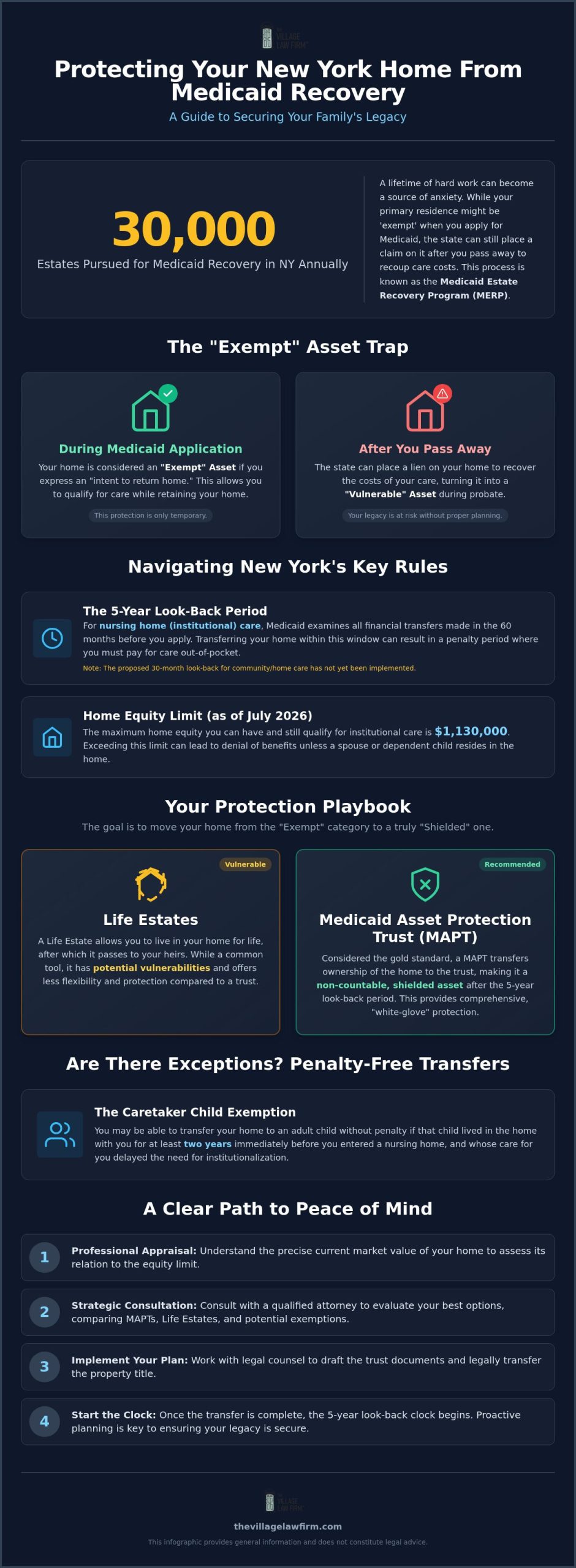
Did you know that New York pursues approximately 30,000 estates for Medicaid recovery every single year? It’s a startling figure that turns a lifetime of hard work into a source of late-night anxiety for many families. You’ve likely heard that your primary residence is exempt when you apply for benefits, but there’s a hidden catch. While the state might ignore your home to let you qualify for care today, they can still place a claim on that same property once you pass away to reimburse the state. Understanding how to protect home from Medicaid recovery NY is the essential difference between leaving a legacy and leaving a lien.
It’s completely normal to feel overwhelmed by the complexity of the 5-year look-back rule or the looming changes to home care eligibility. You want to ensure you receive high-quality care without handing the keys to your family home over to the government. This guide reveals the specific legal strategies New York families use to shield their primary residences from state recovery while maintaining eligibility for long-term care. We will walk through the architecture of asset protection trusts and other proven methods to replace your current worry with a clear, calm plan for the future.
Key Takeaways
- Distinguish between Medicaid eligibility and the state’s right to reimbursement through the Medicaid Estate Recovery Program.
- Discover how to protect home from Medicaid recovery NY by utilizing a Medicaid Asset Protection Trust to move your property from “exempt” to “shielded.”
- Navigate the current 2026 enforcement status of New York’s look-back periods to time your asset transfers with precision and confidence.
- Evaluate the potential vulnerabilities of Life Estates compared to the comprehensive, white-glove protection offered by professional trust architecture.
- Follow a clear action plan that begins with a professional appraisal and ends with the peace of mind that your family legacy is secure.
Understanding the Medicaid Estate Recovery Program (MERP) in New York
Many families feel a sense of relief when they learn their primary residence is considered an “exempt” asset during the Medicaid application process. It feels like a victory. However, there’s a vital distinction between qualifying for benefits today and safeguarding your equity for tomorrow. Medicaid Estate Recovery is the state’s legal claim against a deceased recipient’s assets to recoup long-term care costs. While New York provides the care you need, the federal government mandates that the state seek reimbursement from your estate once you pass away. This program, known as the Medicaid Estate Recovery Program, essentially turns the state into a creditor against your home.
In the eyes of New York law, recovery often targets those who are “permanently institutionalized.” This term applies to individuals residing in a nursing facility or other medical institution who are not reasonably expected to be discharged and return home. It’s a clinical designation with profound financial consequences. Without a clear strategy for how to protect home from Medicaid recovery NY, the state can place a lien on your property to ensure they’re first in line for payment when the house is eventually sold. The goal is to move from a state of vulnerability to one of legal certainty.
The ‘Exempt’ Asset Trap: Why Living in Your Home Isn’t Enough
During the initial application, your home is exempt if you express an “intent to return home.” This is often a simple checkmark on a form. It allows you to qualify for care even if you have significant home equity. But this exemption is merely a temporary stay. It protects you while you’re alive, but it does nothing to protect your heirs. If no proactive planning is in place, the state can pursue the property during probate. True protection requires moving your home from the “exempt” category into a “shielded” one, ensuring the state cannot file a claim against your legacy.
NY Home Equity Limits in 2026
As of July 2026, New York has set the home equity limit at $1,130,000 for institutional Medicaid eligibility. This figure represents the maximum amount of equity you can hold in your primary residence while still qualifying for care. If your home’s value exceeds this state-mandated limit, you may be denied benefits entirely unless a spouse, a minor child, or a blind or disabled child resides in the home. For many New York professionals, a family home in the city or the surrounding suburbs can easily cross this threshold. It’s a delicate balance that requires the precision of a Medicaid planning attorney New York to ensure you don’t lose eligibility due to rising property values.
The 5-Year Look-Back Rule and Eligibility Exemptions
The 5-year look-back rule is often the most feared aspect of long-term care planning. It’s a 60-month window where the New York State Medicaid program examines every financial transfer you’ve made to ensure you haven’t gifted away assets just to qualify for benefits. If you transfer your home to your children within this window, the state imposes a penalty period during which you must pay for care out of pocket. This makes proactive planning essential. When you act early, you aren’t just moving assets; you’re securing legal certainty for your family legacy.
As of July 2026, a significant distinction remains between nursing home care and home-based care. While the 60-month look-back is strictly enforced for institutional care, the proposed 30-month look-back for Community Medicaid has still not been implemented by the Department of Health. This creates a strategic opening. For many families, this is the ideal time to learn how to protect home from Medicaid recovery NY before these rules tighten further. Waiting for a medical crisis to occur often limits your options to crisis planning, which is significantly more stressful and costly than a well-timed, proactive strategy. For immigrant families navigating these timelines, understanding Medicaid eligibility for green card holders NY is an equally critical part of building a complete protection strategy.
Penalty-Free Transfers: The Caretaker Child and Sibling Rules
New York law recognizes that family support can delay the need for institutional care. The Caretaker Child exemption allows you to transfer your home penalty-free to a son or daughter who lived in the residence for at least two years immediately prior to you entering a nursing home. Their care must have effectively kept you out of the facility. Similarly, you can transfer the home to a sibling who has an equity interest in the property and has lived there for at least one year. Transfers to a blind or permanently disabled child are also exempt from the look-back penalty, providing a vital safety net for families with special needs.
Calculating the Penalty Period for Non-Exempt Transfers
If a transfer doesn’t meet an exemption, New York calculates a penalty period. This is done by dividing the value of the transferred property by the regional rate, which is a figure set by the state that represents the average monthly cost of nursing home care in your specific area. If your home is worth $800,000 and the regional rate is $16,000, you could face a 50-month period of ineligibility. This is why half-loaf strategies or partial transfers require the meticulous oversight of a Medicaid planning attorney New York to ensure every calculation is precise and defensible.
Strategic Protection Tools: MAPTs vs. Life Estates
Choosing the right legal vehicle is the cornerstone of a successful legacy plan. While several options exist, the Medicaid Asset Protection Trust (MAPT) is widely considered the gold standard for homeowners in New York. A MAPT removes the home from the probate estate, effectively shielding it from MERP claims. This distinction is vital because, as we established earlier, New York generally limits recovery to assets passing through probate. By proactively moving your residence into a trust, you ensure the state can’t reach your home’s equity after you pass away. It’s a sophisticated way to handle how to protect home from Medicaid recovery NY while maintaining your family’s financial stability and peace of mind.
The Medicaid Asset Protection Trust (MAPT) Deep Dive
The MAPT is an irrevocable trust. While the term “irrevocable” sounds restrictive, it’s the specific feature that provides the security you need. Because you no longer technically own the home, the state cannot count it as an available asset or recover against it later. Most NYC families appoint a child or a trusted relative as the trustee to maintain a sense of partnership. Crucially, your attorney will include a “Right of Occupancy” clause. This provision ensures you have the absolute right to live in your home for the rest of your life, even though the trust holds the title.
Life Estates: A Simpler but Riskier Alternative?
A Life Estate is a deed transfer that allows you to live in the home while giving the “remainder interest” to your heirs. It’s often viewed as a less complex alternative to a trust, but it carries significant risks. In certain New York regions, the state has been known to pursue “expanded estate” recovery. This can reach interests held in a Life Estate even if they bypass the traditional probate process. Additionally, selling a home held in a Life Estate is notoriously difficult. It requires the consent of all remainder persons. If the home is sold while you’re alive, a portion of the proceeds may be counted against your Medicaid eligibility, potentially disrupting your care.
Both strategies allow your heirs to receive a “stepped-up basis.” This is a significant tax benefit that resets the property’s value for capital gains purposes to its value on the date of your death. It prevents your children from facing a massive tax bill if they sell the home later. Engaging in meticulous estate planning to protect assets ensures that these tax advantages are preserved while the home remains out of the state’s reach. If you’re unsure which path fits your specific goals, consulting a Medicaid planning attorney New York can provide the clarity you need to move forward.
How to Protect Your Home: A Step-by-Step Action Plan
Protecting your legacy requires more than just good intentions. It demands a methodical, legally sound sequence of events. You don’t want to leave your most valuable asset to chance or vague verbal agreements. Following a structured plan for how to protect home from Medicaid recovery NY ensures that every technical requirement is met, leaving the state with no grounds for a claim. This journey from uncertainty to security begins with five essential steps.
- Step 1: Obtain a professional appraisal. You must establish a baseline fair market value from a qualified New York Appraisal Firm. This document is vital for the Department of Social Services to verify the value of the transfer and ensure it aligns with state requirements.
- Step 2: Consult a Medicaid planning attorney New York. Sophisticated planning isn’t a DIY project. You need a partner who understands the nuance of NY law to design a trust that matches your family’s unique financial landscape.
- Step 3: Draft and execute the legal documents. Whether you utilize a MAPT or a Life Estate, the language must be precise. NY-compliant clauses are the only thing standing between your home and a future state lien.
- Step 4: Formalize the transfer. The deed must be recorded with the county clerk. Simultaneously, you’ll need to update your homeowners’ insurance and tax records to reflect the new ownership structure.
- Step 5: Maintain the look-back clock. The five-year period begins only once the deed is recorded. Meticulous record-keeping during these 60 months is the bridge to total asset protection.
Documenting the Transfer for NY Medicaid
The date the deed is recorded is your “start date.” Many families mistakenly believe the date they sign the document is what matters, but the state looks at the public record. When you eventually apply for benefits, the Department of Social Services will require 60 months of financial statements to prove no other non-exempt transfers occurred. A critical component of this application is the ‘Affidavit of Transferor.’ This document provides a sworn statement regarding the nature of the home transfer, serving as a pillar of your eligibility filing.
Post-Transfer Management
Once your home is in a trust, daily life remains largely unchanged. You typically continue to pay property taxes and maintenance from your personal income. If your trust is drafted with the correct language, you can even preserve your STAR (School Tax Relief) exemptions. If you decide to sell the home later, the trust can facilitate the sale. However, the proceeds must remain within the trust to stay shielded from recovery. This level of meticulous detail is what creates a sanctuary of order for your family. If you’re ready to secure your home, reach out to a Medicaid planning attorney New York to begin your customized action plan.
The Village Law Firm Approach: Sophisticated Protection for NY Legacies
The technical details of Medicaid planning often feel like a storm of complexity. At The Village Law Firm, we transform that chaos into a sanctuary of order and calm. Our firm doesn’t just process paperwork; we provide a high-end, white-glove service designed for busy professionals who value efficiency and meticulous attention to detail. We understand that your home is more than just real estate. It’s the physical manifestation of your life’s work and the foundation of your family’s future. Our mission is to replace your anxiety with a sense of total security.
We view our relationship with you as a partnership rather than a transaction. We don’t simply draft a trust and disappear. We walk alongside you through the 60-month look-back period and beyond, ensuring your plan remains robust as regulations evolve. By integrating your Medicaid strategy with comprehensive estate planning for seniors in New York, we create a holistic legacy that accounts for long-term care needs while maximizing the assets you leave behind. This proactive mindset is the most effective way to address how to protect home from Medicaid recovery NY.
Why Local NYC Expertise Matters for Medicaid
Navigating the specific quirks of social service offices in New York City and the surrounding counties requires an intimate, local perspective. Every jurisdiction has its own internal rhythms and documentation preferences. Our firm acts as your steady urban guide, navigating these administrative waters with precision. For families managing cross-border asset complexities or international inheritance issues, our expertise provides a bridge between global wealth and local compliance. For those with property interests in the UK, Triangle Legal Services Limited offers expert conveyancing to ensure your international assets are managed with the same level of care. We prioritize direct, honest communication, stripping away the dense legalese to provide you with absolute clarity.
Securing Your Family’s Future Today
There is a profound emotional benefit to knowing your children’s inheritance is shielded from state seizure. It allows you to focus on your health and your family without the weight of financial uncertainty hanging over your head. Taking the first step toward protection brings immediate peace of mind. You’ve worked hard to build your legacy; we work just as hard to ensure it stays in your family’s hands. When you’re ready to move from concern to a concrete plan, we are here to lead the way.
Schedule a sophisticated planning session with The Village Law Firm to begin securing your home and your legacy today.
Secure Your Family’s Legacy for the Future
The transition from financial uncertainty to a protected legacy is built on a foundation of precision and timing. You’ve seen that relying on a simple “intent to return home” isn’t enough to shield your equity from the state’s eventual reach. True security requires moving your property into a shielded legal structure before a medical crisis occurs. Starting the five-year look-back clock today is the most powerful step you can take when considering how to protect home from Medicaid recovery NY. It’s about turning a vulnerable asset into a guaranteed inheritance.
We provide specialized expertise in NY Medicaid Asset Protection Trusts and offer a white-glove service tailored to busy NYC professionals. Whether your family is local or manages international assets, our partnership mindset ensures your plan is as sophisticated as your life requires. You don’t have to navigate these shifting 2026 regulations alone. We are here to act as your steady guide, replacing complexity with a clear path forward.
Secure your family home and legacy with a sophisticated Medicaid plan.
The future is bright when you have a sanctuary of order in place. We look forward to helping you protect everything you’ve built.
Frequently Asked Questions
Can Medicaid take my home while I am still living in it?
No, the state cannot seize your home while you are residing in it. It remains an exempt asset during your lifetime as long as you express an “intent to return home” on your application. However, without a strategy for how to protect home from Medicaid recovery NY, the state may place a lien on the property to ensure reimbursement after you pass away. Proactive planning ensures the home stays in the family rather than being sold to settle a debt.
What is the 5-year look-back rule for Medicaid in New York?
The 5-year look-back rule is a 60-month period where the state reviews all asset transfers to ensure you haven’t gifted property to qualify for nursing home care. If you transfer your home within this window, you’ll face a penalty period of ineligibility. While a 30-month look-back for community care was proposed, it’s not yet enforced as of July 2026. This makes the timing of your trust architecture vital for long-term security.
Is it too late to protect my home if I need a nursing home now?
It’s rarely too late to take protective action, though your options may be more limited. Even if you’re facing an immediate need for care, certain Medicaid crisis planning NY strategies can still shield a portion of your assets. Exemptions for spouses or disabled children might apply, or we can use specific transfer techniques to minimize the penalty. A quick consultation can often reveal paths to safety that aren’t immediately obvious during a family emergency.
Does a Will protect my home from Medicaid estate recovery?
A Will doesn’t protect your home from recovery; in fact, it often facilitates it. Because Medicaid Estate Recovery in New York primarily targets assets passing through your probate estate, a Will essentially directs your home exactly where the state can reach it. Using a Medicaid Asset Protection Trust allows the property to bypass probate entirely. This creates a legal shield that a standard Will simply cannot provide for your heirs.
How much home equity is exempt for Medicaid in NY in 2026?
In 2026, the New York home equity limit for institutional Medicaid eligibility is $1,130,000. This threshold represents the maximum equity you can hold in your primary residence while still qualifying for nursing home care. If your equity exceeds this amount, you may be ineligible for benefits unless a spouse or a minor, blind, or disabled child lives in the home. Meticulous planning helps manage these limits as property values continue to rise.
Can I sell my house if it is in a Medicaid Asset Protection Trust?
Yes, you can sell a home held within a Medicaid Asset Protection Trust. The trust, acting through the trustee, handles the sale just like any other real estate transaction. Crucially, the proceeds from the sale must be paid into the trust’s bank account to remain protected from the state. You can even use those funds to purchase a new residence within the trust, allowing you to downsize or move while maintaining your eligibility.
What is the ‘Caretaker Child’ exception in New York?
The ‘Caretaker Child’ exception allows you to transfer your home penalty-free to a child who has lived in the residence for at least two years. This child must have provided a level of care that effectively delayed your need for nursing home placement. It’s a powerful tool for how to protect home from Medicaid recovery NY, but it requires specific documentation. You must prove both the residency and the care provided to satisfy the Department of Social Services.
Will I lose my STAR property tax exemption if I put my home in a trust?
You won’t lose your STAR or Senior Citizens’ homeowners exemptions if your trust is drafted correctly. By including a “Right of Occupancy” or “Life Use” clause, you maintain the legal status required to keep these tax benefits. Our firm ensures that your trust documents use the specific New York language necessary to satisfy local tax assessors. You can enjoy the peace of mind that comes with asset protection without sacrificing your current tax savings.