
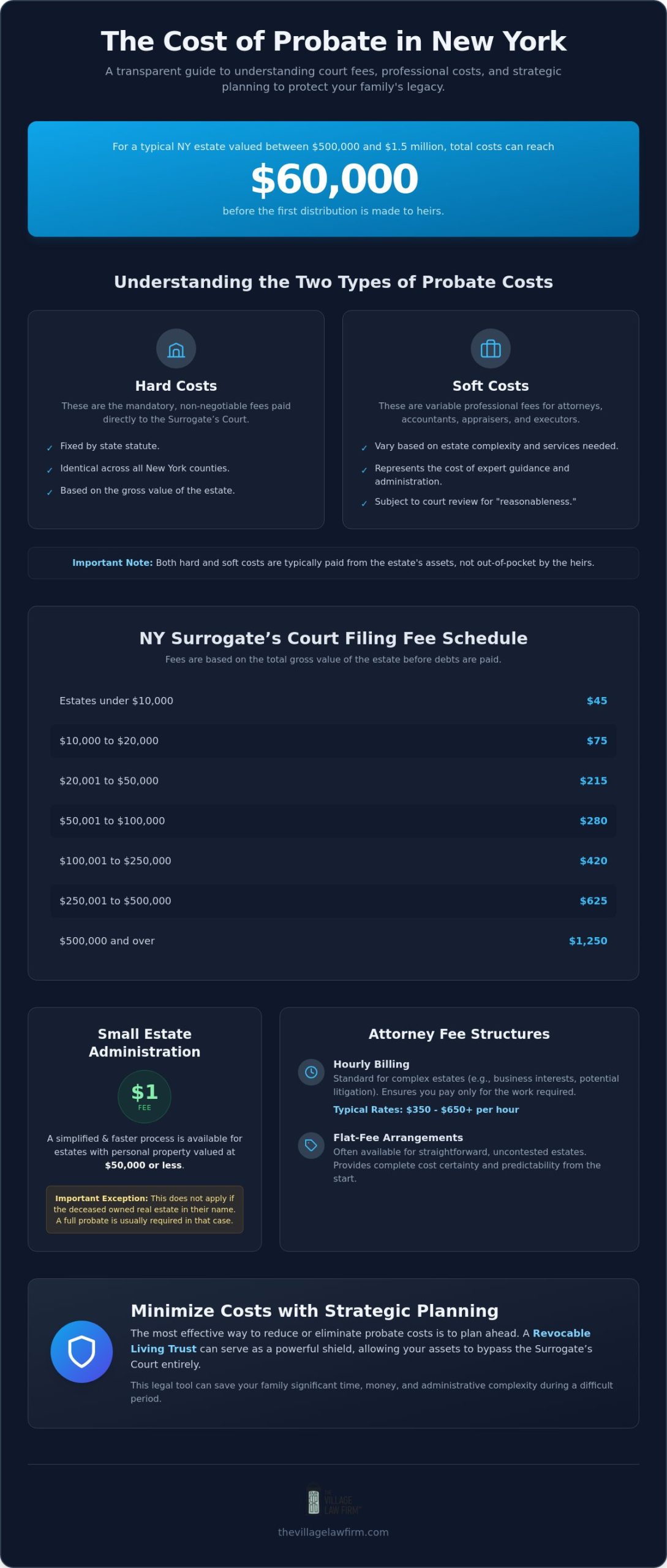
For a typical estate valued between $500,000 and $1.5 million, the total cost of probate in New York can reach $60,000 before the first distribution is ever made. This figure often catches families off guard, turning a period of mourning into a source of unnecessary financial friction. It’s natural to feel a sense of weight when facing the Surrogate’s Court, especially when you’re worried about hidden legal fees or the opaque nature of statutory commissions. You deserve a process that feels like a sanctuary of order rather than a descent into administrative chaos.
This guide will provide the transparency and meticulous detail you need to move forward with absolute confidence. We’ll outline a predictable budget for your estate administration by breaking down the mandatory court filing fees and the specific math behind executor commissions. By understanding which costs are fixed by law and which are within your control, you can protect your family’s legacy and choose a legal partner who values precision as much as you do.
Key Takeaways
- Learn to distinguish between mandatory court “hard costs” and professional “soft costs” to build a realistic and predictable estate budget.
- Understand how the cost of probate in New York is influenced by current 2026 billing structures, including the transparency benefits of flat-fee legal partnerships.
- Master the statutory math of SCPA § 2307 to accurately calculate executor commissions and ensure the person managing the estate is fairly compensated.
- Identify the financial implications of “Ancillary Probate” and international assets to prevent unexpected delays in complex cross-border administrations.
- Discover how strategic planning tools like Revocable Living Trusts can serve as a shield, allowing your assets to bypass the Surrogate’s Court entirely.
Understanding the New York Probate Fee Landscape
Losing a loved one brings a heavy emotional burden, and the sudden requirement to manage their legal affairs often adds a layer of unwanted complexity. In New York, the legal mechanism for this transition is probate. This is the court-supervised process where a will is validated, debts are settled, and assets are eventually distributed to the rightful heirs. Understanding the New York Probate Fee Landscape is the first step toward regaining a sense of security and order during a turbulent time.
When calculating the total cost of probate in New York, it’s helpful to categorize expenses into “hard costs” and “soft costs.” Hard costs are the mandatory filing fees paid directly to the Surrogate’s Court. These are fixed by statute and remain consistent regardless of which firm you hire. Soft costs represent the professional fees for attorneys, accountants, and appraisers. While these vary based on the estate’s needs, they are essential investments in ensuring the administration is handled with meticulous precision. One reassuring fact for many families is that these expenses are typically paid directly from the estate’s assets. Heirs generally don’t have to pay out-of-pocket to begin the protective process of estate administration.
The Surrogate’s Court Filing Fee Schedule
The filing fee is determined by the gross value of the probate estate. This means the court looks at the total value of assets passing through the will before any debts or taxes are deducted. Understanding this structure is essential to predicting the total cost of probate in New York for any given estate. These fees are non-negotiable and identical across all counties. As of 2026, the fee schedule follows these specific tiers:
- Estates under $10,000: $45
- $10,000 to $20,000: $75
- $20,001 to $50,000: $215
- $50,001 to $100,000: $280
- $100,001 to $250,000: $420
- $250,001 to $500,000: $625
- $500,000 and over: $1,250
Small Estate Administration (Voluntary Administration)
New York offers a simplified path for smaller estates known as Voluntary Administration. If the total value of the personal property is $50,000 or less, the estate qualifies as a “Small Estate” under SCPA § 1301. This process is significantly faster and involves a nominal flat filing fee of only $1.00. However, this path is only available for personal property like bank accounts or vehicles. If the deceased owned real estate in their individual name, a full probate proceeding is almost always required, even if the property’s value is modest. This distinction is a common point of confusion that a sophisticated legal partner can help you clarify early in the journey.
Attorney Fees: Hourly Rates vs. Flat Fees in New York
While court filing fees are set by statute, attorney fees represent the most variable component of the total cost of probate in New York. This is where the distinction between a transactional service and a sophisticated legal partnership becomes most apparent. Choosing a legal partner is not merely about finding the lowest price point; it is about securing a shield against future uncertainty. Selecting “budget” counsel often results in “chaos costs,” where procedural errors or missed deadlines lead to extended court timelines and higher overall expenses for the estate.
Transparency is the cornerstone of a professional relationship. In the sophisticated landscape of 2026, New York firms typically utilize one of two primary billing structures. Regardless of the method, beneficiaries have the right to challenge legal fees, which are ultimately subject to the Surrogate’s Court’s review for “reasonableness.” This oversight ensures that the fees remain proportional to the estate’s size and the complexity of the work performed. High-end firms prioritize Minimizing Probate Costs: Strategic Planning for New Yorkers by providing clear, up-front expectations that replace anxiety with a sense of security. To gain a broader perspective on how specialized firms handle these complex financial and personal matters, you can explore Legal representation and consultation fees for bankruptcy, family, and estate law options to see how transparency is maintained across various practice areas.
Hourly Billing for Complex Estates
For estates involving international assets, business interests, or potential litigation, hourly billing remains the industry standard. This model ensures that the estate pays precisely for the level of meticulous attention required. In 2026, hourly rates for experienced probate attorneys in metropolitan New York typically range from $350 to $650 or more per hour. Meticulous record-keeping is essential here. A professional partner provides detailed billing statements that document every action taken, from court filings to asset valuations, ensuring total accountability to the heirs.
Flat Fee Arrangements for Predictability
Flat fee arrangements are often available for straightforward, uncontested probate proceedings. This structure offers a predictable budget, covering the standard steps of filing the petition, notifying interested parties, and coordinating the initial asset transfers. It is a “white-glove” approach to simplicity. However, you must be aware of “scope creep.” If a family dispute arises or unexpected creditors emerge, the matter may transition to hourly billing to cover the additional complexity. A sophisticated partner ensures every detail is captured from the start, often saving the estate from the hidden costs of administrative delays. Our approach to estate administration prioritizes this level of transparency and protection.
Executor Commissions: The Cost of Administration
Managing a loved one’s final affairs is a significant undertaking that requires time, emotional resilience, and an eye for detail. New York recognizes this effort through Surrogate’s Court Procedure Act (SCPA) § 2307. This statute establishes the legal right for an executor to receive a commission for their service. While this payment is a right, it isn’t a requirement. Many family members choose to waive their commission to maximize the inheritance for all beneficiaries. It’s a personal decision that directly impacts the total cost of probate in New York, as commissions are often one of the largest line items in a final accounting.
There’s a vital tax distinction to understand before accepting a commission. These payments are considered taxable income to the executor and must be reported on their personal tax returns. However, for the estate, the commission is a deductible administrative expense. For high-net-worth individuals or those with complex international holdings, appointing a professional executor can be a strategic choice. This ensures that a sophisticated partner handles the meticulous requirements of cross-border estate administration without the emotional strain often felt by family members. You gain a shield against administrative errors while ensuring your legacy is handled with the highest level of integrity. Working with a dedicated executor of estate attorney in New York can help you navigate these fiduciary responsibilities while protecting yourself from personal liability.
The 2026 Statutory Commission Scale
The commission isn’t a flat percentage. It follows a sliding scale based on the value of the assets the executor “receives and pays out.” In 2026, the rates are set by statute:
- 5% on the first $100,000
- 4% on the next $200,000
- 3% on the next $700,000
- 2.5% on the next $4,000,000
- 2% on any amount exceeding $5,000,000
Specific assets, such as real estate that isn’t sold by the executor or specific bequests of personal property, are typically excluded from this calculation. This nuance is why a clear breakdown of the estate’s gross value is essential for a predictable budget.
Multiple Executors and Commission Caps
Appointing more than one executor provides a system of checks and balances, but it also increases the financial drain on the estate. For estates valued over $300,000, New York law allows for up to two full commissions to be paid if two executors are serving. This means each executor receives a full commission, effectively doubling that portion of the cost of probate in New York. If three or more are named, they must share three full commissions among themselves. To maintain the estate’s value and ensure efficiency, we often recommend naming a single, steady guide as the primary executor, supported by a professional legal partner to manage the technical complexities.
The Cost of Complexity: International Assets and Disputes
For many global New Yorkers, the financial reach of an estate often extends far beyond the five boroughs. When assets are held in other states or foreign countries, the cost of probate in New York is compounded by a secondary process known as Ancillary Probate. This requirement forces the estate to open additional court proceedings in every jurisdiction where real property is located. Each new location brings its own set of filing fees, local legal requirements, and administrative hurdles. It’s a layer of complexity that demands a steady guide to prevent the process from stalling.
International estates introduce unique “soft costs” that many families fail to anticipate. You may need to hire foreign legal counsel to navigate local inheritance laws or pay for certified translations of the will and court decrees. These expenses are necessary to maintain order across different legal systems. If a beneficiary challenges the validity of the will, the estate faces what we call a “litigation tax.” Will contests can easily double or triple the final bill as legal hours accumulate and distributions are frozen for months or even years. This unpredictability is exactly what a high-end legal partner works to minimize through meticulous preparation. An experienced executor of estate attorney in New York is essential for managing these cross-border complexities and keeping the administration on track.
International Estate Administration Costs
Managing a global legacy requires a specialized shield. The Village Law Firm provides the expertise needed to streamline cross-border estate administration, ensuring that “Letters Testamentary” are properly coordinated for use in foreign jurisdictions. This proactive approach prevents expensive foreign tax penalties and avoids the administrative friction that often stalls international asset transfers. We focus on efficiency and meticulous attention to detail so that a family’s international wealth doesn’t get swallowed by avoidable penalties.
Appraisals, Bonds, and Accounting Fees
High-value assets like NYC real estate or private art collections require professional appraisals to satisfy both the court and tax authorities. These valuations provide the meticulous detail necessary for a formal fiduciary accounting. In many cases, the Surrogate’s Court may also require a “Surety Bond.” This is essentially an insurance premium paid by the estate to protect beneficiaries against potential executor errors. While these fees add to the initial budget, they serve as a sanctuary of order. They prevent much costlier disputes in the future by ensuring every asset is documented with unwavering integrity.
Minimizing Probate Costs: Strategic Planning for New Yorkers
You don’t have to be a passive spectator in the erosion of your estate’s value. While the cost of probate in New York is structured by rigid statutes and court schedules, the extent to which these fees apply to your legacy is largely a matter of choice. Proactive planning is the ultimate cost-saving measure. It transforms a potentially chaotic court proceeding into a private, streamlined transition. By shifting your focus from reactive administration to strategic protection, you replace probate anxiety with a deep sense of legacy security.
The most effective way to shield your family from the Surrogate’s Court is to ensure assets never enter its jurisdiction. This is achieved through meticulous asset titling and the use of beneficiary designations. Financial accounts, life insurance policies, and retirement funds with clearly named beneficiaries pass directly to your heirs outside of the probate process. This simple act of organization removes these assets from the calculation of court filing fees and executor commissions, immediately lowering the financial burden on your loved ones.
Trusts vs. Probate: A Financial Comparison
When evaluating your options, it’s helpful to view estate planning through a financial lens. A Revocable Living Trust requires a higher upfront investment in legal design and asset funding compared to a simple will. However, this initial cost is often a fraction of the eventual cost of probate in New York. While a standard probate proceeding can trap an estate in a 9 to 15 month timeline, a trust provides your family with immediate liquidity. They gain access to funds for taxes, maintenance, and personal support without waiting for court approval. For many, the question isn’t just about the dollar amount saved, but the months of stress avoided. You can explore this further in our analysis: Do I Need a Trust or a Will in New York?
Partnering with The Village Law Firm
The Village Law Firm offers a white-glove approach to estate administration that prioritizes the needs of busy professionals and families with complex assets. We act as a protective shield, handling the meticulous technical requirements so you can focus on what truly matters. Our firm specializes in removing complexity from the equation, whether you’re navigating a cross-border estate or seeking to minimize future administrative drain through a sophisticated trust. We invite you to Schedule a consultation to secure your family’s future. Let us help you build a sanctuary of order and ensure your legacy remains exactly where you intended: with your family.
Transforming Complexity into Clarity
The journey through the New York Surrogate’s Court doesn’t have to be a path of uncertainty. We’ve explored how the cost of probate in New York is composed of both fixed statutory mandates and variable professional choices. By distinguishing between mandatory filing fees and the strategic value of expert counsel, you can build a predictable budget that honors your loved one’s legacy. Meticulous preparation is your greatest shield against administrative chaos. Whether you’re managing complex international assets or simply seeking a sanctuary of order during a difficult time, clarity is within your reach.
Our firm provides the white-glove service busy professionals expect, specializing in international and cross-border estate administration along with dedicated planning for families with children. It’s time to replace the weight of the unknown with the stability of a dedicated partner. You’ve taken the first step by seeking clarity; now, take the next step toward permanent security. Secure Your Legacy with The Village Law Firm today and ensure your family’s future is defined by order and peace of mind. Your legacy deserves the protection of unwavering integrity and technical precision.
Frequently Asked Questions
How much does a probate lawyer cost in NYC in 2026?
Legal fees vary based on the complexity of the estate and the billing structure of the firm. In 2026, hourly rates for experienced probate attorneys in New York City typically range from $350 to over $650 per hour. While some firms offer flat-fee arrangements for uncontested matters to provide financial predictability, complex estates with international assets or litigation requirements are almost always billed hourly to ensure meticulous attention to every detail.
Is the executor fee mandatory in New York?
No, the executor commission is a legal right provided by statute, but it isn’t a requirement. Many family members choose to waive their commission to maximize the inheritance for all beneficiaries. However, if an executor decides to accept payment, they are entitled to the full statutory rate defined in SCPA § 2307. It’s also important to remember that these commissions are considered taxable income for the recipient.
What are the court filing fees for probate in New York?
Court filing fees are mandatory “hard costs” determined by the gross value of the probate estate. These fees follow a sliding scale set by New York’s Surrogate’s Court Procedure Act. For example, estates valued under $10,000 pay a $45 fee, while estates valued at $500,000 or more reach the maximum filing fee of $1,250. These rates are non-negotiable and consistent across all New York counties.
Can I avoid probate costs by having a small estate?
Yes, New York provides a simplified process for estates with $50,000 or less in personal property. This is known as “Voluntary Administration” and it significantly reduces the cost of probate in New York. The filing fee for a small estate is a nominal flat rate of only $1.00. This path offers a sanctuary of order for families dealing with modest assets without the need for a full probate proceeding.
Who pays for the probate costs—the executor or the estate?
The estate’s assets typically cover all administrative expenses, meaning the executor doesn’t pay out-of-pocket. This includes the court filing fees, attorney fees, and any necessary appraisal or accounting costs. These expenses are paid before the final distribution to heirs. Heirs and executors are generally protected from personal liability for these costs unless there is evidence of gross negligence or a breach of fiduciary duty.
How long does probate take in New York, and does that increase the cost?
A typical uncontested probate takes between 9 and 15 months, though complex estates can extend to 36 months or longer. Time is a direct driver of the cost of probate in New York because extended timelines often require more legal hours and ongoing administrative oversight. Maintaining a steady, efficient pace with a sophisticated legal partner is the best way to prevent the budget from swelling due to court delays.
Are international probate costs higher for New Yorkers with foreign assets?
International estates generally incur higher costs due to the need for “Ancillary Probate” and specialized cross-border expertise. You must account for additional expenses like foreign legal counsel, certified translations of documents, and specialized tax filings. While these “complexity costs” are higher upfront, they serve as a shield against foreign tax penalties and administrative friction that can stall the distribution of global assets for years.
Does a will help reduce the cost of probate in New York?
A well-drafted will reduces costs by providing clear instructions that prevent expensive family disputes and litigation. While a will doesn’t bypass the Surrogate’s Court or the mandatory filing fees, it creates a structured roadmap that speeds up the administration process. To truly eliminate the costs associated with the court system, many New Yorkers choose to utilize a Revocable Living Trust, which allows assets to pass directly to heirs.