
Most New Yorkers believe that qualifying for long-term care requires a total surrender of their hard-earned savings. This misconception often leads to unnecessary financial loss. You’ve likely felt the rising tide of anxiety as you consider the cost of a nursing home or the new 30-month look-back rule for community care. It’s a heavy burden to wonder if the family home you’ve maintained for decades will be claimed by the state. You want to ensure your spouse is cared for and your children receive their rightful inheritance.
You don’t have to choose between quality care and your family’s future. This guide provides the clarity you need to master Medicaid spend down strategies New York while meticulously shielding your property and wealth. We’ll walk through the 2026 legal frameworks, from Irrevocable Trusts to pooled income accounts, that turn complex regulations into a sanctuary of order. By the end of this article, you’ll understand how to navigate the 2026 asset limits and look-back periods with the confidence of a well-prepared partner.
Key Takeaways
- Learn how New York’s unique “Medically Needy” pathway provides a flexible route to eligibility for those who initially exceed standard income thresholds.
- Master effective Medicaid spend down strategies New York families use to convert vulnerable assets into protected legacies without sacrificing the family home.
- Explore the “Spousal Refusal” strategy, a robust legal mechanism unique to New York that safeguards the financial security of a non-applicant spouse.
- Clarify the 2026 look-back regulations, including the 30-month rule for home care, to proactively protect your wealth from state recovery.
- Build a meticulous “Paperwork Shield” using our step-by-step template to organize documentation and ensure a seamless application process.
Understanding the 2026 New York Medicaid Landscape
For many families, the term “spend down” sounds like a mandatory depletion of everything they’ve built. In reality, the New York Medicaid Spend Down program is a legal mechanism that allows individuals with “excess income” to qualify for benefits by applying that surplus toward medical costs. New York is uniquely generous in this regard. Unlike many other states, our “Medically Needy” pathway provides a flexible bridge for those who earn more than the standard limits but face high care costs. Understanding the New York Medicaid Landscape is the first step in moving from uncertainty to a structured plan.
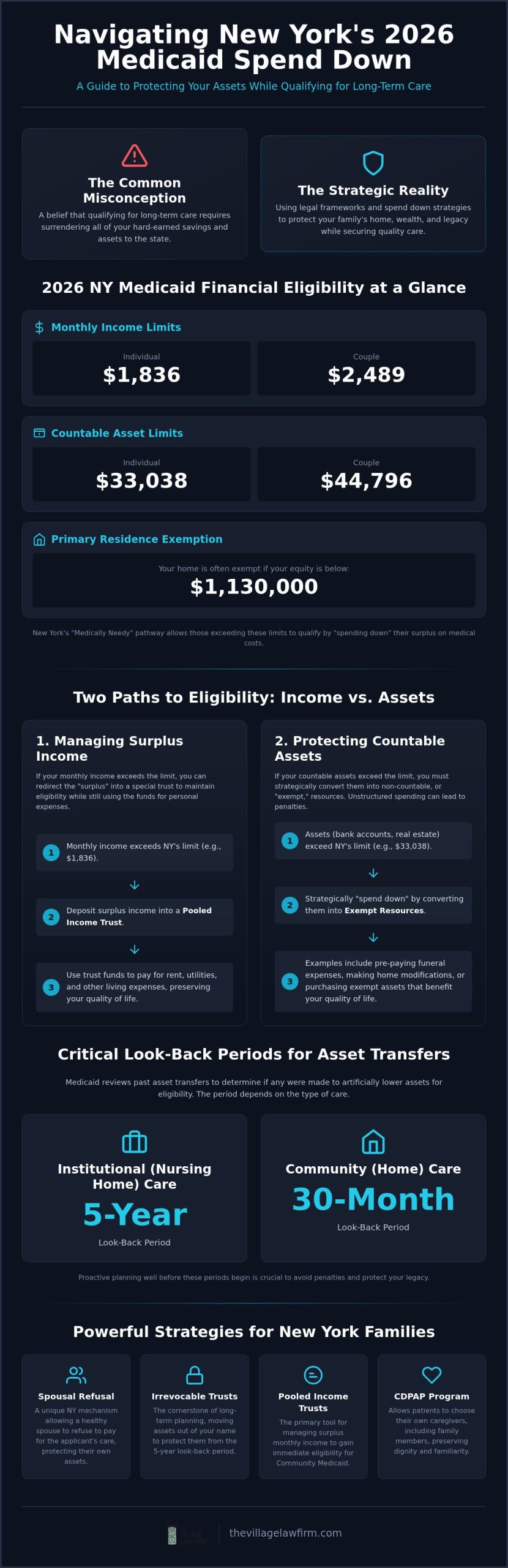
As of August 2026, the financial thresholds have shifted. For an individual in the Disabled, Aged, and Blind (DAB) category, the monthly income limit is $1,836. For a couple, it’s $2,489. If your income exceeds these figures, you aren’t automatically disqualified; you simply enter the spend down phase. This is where sophisticated Medicaid spend down strategies New York residents rely on become essential. We distinguish between Community Medicaid, which covers home care and allows you to stay in your own neighborhood, and Institutional Medicaid, which covers nursing home care and involves a much stricter five-year look-back period. The distinction is vital because the rules for protecting your home and savings vary significantly between the two.
NY Medicaid Eligibility Limits for 2026
The asset ceilings for 2026 are equally critical. An individual can keep up to $33,038 in countable resources, while a couple can retain $44,796. It’s vital to know that your primary residence is often exempt if your equity interest is below $1,130,000. Other exempt assets include personal belongings and certain retirement accounts in payout status. For those seeking home care, the Consumer Directed Personal Assistance Program (CDPAP) continues to be a vital resource in 2026, allowing patients to choose their own caregivers, including family members, which maintains a sense of dignity and familiarity during a vulnerable time.
The Emotional Reality of Medicaid Planning
The transition from feeling “too rich for Medicaid” to “legally protected” is a profound psychological shift. Many professionals we work with feel a sense of failure or panic when they first see the eligibility numbers. We replace that bureaucratic anxiety with a sense of security. Waiting until a medical crisis occurs limits your strategic options and can lead to the loss of assets that could have been shielded. By acting early, you transform a chaotic situation into a meticulous legacy plan. This proactive approach ensures that your life’s work isn’t consumed by care costs but is instead preserved for the next generation.
Asset Spend Down vs. Income Spend Down in New York
Understanding the difference between your monthly cash flow and your accumulated wealth is the foundation of any successful plan. New York law separates these two categories, requiring distinct legal tools for each. When you apply for benefits, the state examines your Asset Spend Down vs. Income Spend Down in New York to determine if you meet the 2026 eligibility criteria. Income is what you receive monthly, such as Social Security or a pension. Assets are what you own, like bank accounts or real estate.
Unstructured spending is a common trap. Many people believe they should simply buy luxury items to lower their bank balance. This is a mistake. Medicaid officials scrutinize where the money goes. If you give money away or buy non-exempt items, you may trigger a penalty period. Effective Medicaid spend down strategies New York residents utilize focus on “exempt” transfers that benefit your quality of life without violating state rules. It’s about being meticulous with your resources rather than being reckless.
Managing Surplus Income with Pooled Income Trusts
If your monthly income exceeds the $1,836 limit for an individual, you have what the state calls “surplus income.” Instead of handing this money over to the department of social services, you can direct it into a Pooled Income Trust. These trusts are managed by specialized non-profit organizations throughout NYC and the surrounding counties. A Pooled Income Trust is the primary legal instrument used in New York to preserve excess monthly income for Community Medicaid recipients while maintaining eligibility. Once the money is in the trust, it can be used to pay your rent, utilities, or other personal expenses, effectively allowing you to live on your full income.
Converting Countable Assets into Exempt Resources
Reducing your assets to the $33,038 individual limit requires a methodical approach. You can legally “spend down” by investing in your own future and comfort. This includes pre-paying for a funeral through an irrevocable trust or making necessary home improvements. Updating your roof or installing a walk-in tub adds value to your property while lowering your countable cash. These are considered exempt transfers because you’re receiving fair market value in return for the expenditure.
Your primary residence is often your most significant asset. Under New York’s homestead rules, this property is generally exempt if your equity is below $1,130,000. However, the state may still attempt to recover costs from your estate after you pass away. Learning how to protect home from Medicaid recovery NY is a vital step in ensuring your house remains in the family. If you feel overwhelmed by these numbers, our team can help you design a personalized asset protection plan that restores your peace of mind.
Sophisticated Spend Down Strategies for New York Families
Medicaid planning for New York families shouldn’t be viewed as a frantic attempt to shed assets. Instead, consider it a sophisticated form of wealth management. By using the right legal frameworks, you can transform vulnerable savings into protected family legacies. These Medicaid spend down strategies New York residents employ are designed to provide a sanctuary of calm amidst the storm of rising long-term care costs. Whether you’re planning years in advance or facing an immediate health crisis, there are precise tools available to shield your life’s work.
One of the most powerful, state-specific tools is the “Spousal Refusal” strategy. In New York, a spouse has the legal right to refuse to contribute their income or assets toward the care of the applicant spouse. This allows the ill spouse to qualify for Medicaid while the healthy spouse retains their own resources for their own financial security. Additionally, Medicaid-compliant annuities can turn a countable lump sum of cash into a protected stream of income for the non-applicant spouse. For those receiving care at home, formal Caregiver Agreements allow you to legally compensate family members for their support, ensuring your money stays within the family while meeting spend down requirements.
The Medicaid Asset Protection Trust (MAPT)
An Irrevocable Trust remains the gold standard for asset protection in the Empire State. By transferring your home or investments into a MAPT, you effectively remove them from your “countable” estate while still enjoying the use of the property. Success with this strategy requires navigating the five-year look-back period for institutional nursing home care. Because the rules are rigid, partnering with a sophisticated irrevocable trust attorney NYC is essential to ensure the trust is structured to withstand state scrutiny and protect your property from future recovery efforts.
The ‘Gift and Note’ Strategy for Crisis Planning
Even if you’re already in a nursing home, it’s not too late to protect your wealth. The “Gift and Note” strategy, often called a “half-loaf” plan, allows families to save approximately half of their remaining assets during a crisis. This involves gifting a portion of the assets while using the remaining portion to purchase a Medicaid-compliant promissory note. The income from that note then pays for care during the penalty period triggered by the gift. This technique requires mathematical precision and the guidance of a Medicaid planning attorney New York families trust to execute correctly. It’s a meticulous process that replaces the chaos of a medical emergency with a structured, protective solution.
Your Medicaid Spend Down Planning Template
Applying for benefits in New York requires more than just meeting financial limits. It requires a meticulously organized history of your financial life. This template serves as your “Paperwork Shield,” protecting your assets by proving your eligibility with undeniable clarity. When executing Medicaid spend down strategies New York officials will examine every transaction over a 60-month period for institutional care. Without a structured framework, the process quickly descends into a chaotic search for missing statements and forgotten receipts. We replace that chaos with a steady, methodical journey toward approval.
The first step is identifying your “Strategic Spend” list. These are high-value, exempt categories where you can legally reduce your countable cash while improving your quality of life. This includes paying off existing debts, updating your primary residence, or purchasing a new vehicle. By focusing on these exempt areas, you ensure that every dollar spent serves your family rather than being lost to the state. Organization is the antidote to the anxiety of the application process.
The 2026 Medicaid Document Checklist
Gathering your documentation early is the most effective way to avoid delays. You’ll need to provide a transparent view of your finances from the last five years. Prepare the following items:
- Financial History: 60 months of consecutive bank statements for every account held, even those that have been closed.
- Tax Records: Federal and state tax returns from the last five years.
- Proof of Exempt Assets: Current property deeds, vehicle titles, and documentation of home equity (ensuring it’s below the $1,130,000 limit).
- Legal Instruments: Copies of your Irrevocable Trust documents, Pooled Income Trust joinder agreements, and updated beneficiary designations.
- Income Verification: Social Security award letters, pension statements, and proof of any other monthly revenue.
Executing the Spend Down: A Monthly Timeline
The timeline for your application is as critical as the financial figures. Proactive planning allows you to navigate the look-back periods without incurring penalties. We suggest following this structured approach:
- Months 1-3: Conduct a comprehensive asset inventory. This is the time for a deep legal consultation to identify which assets are countable and which are exempt.
- Months 4-6: Establish your legal shields. This includes setting up a Medicaid Asset Protection Trust (MAPT) and initiating asset transfers.
- Ongoing: Manage your monthly income surplus through a Pooled Income Trust. This ensures you remain eligible for Community Medicaid while keeping your income for personal expenses.
Success in this process depends on precision and timing. If you’re ready to secure your family’s future with a professional plan, you can schedule a strategic Medicaid consultation with our team today.
Navigating the 5-Year Look-Back and Protecting Your Legacy
The look-back period is often the source of the greatest anxiety for families exploring Medicaid spend down strategies New York offers. For institutional nursing home care, the state reviews every financial transaction from the 60 months preceding your application. In 2026, a significant shift has arrived with the implementation of a 30-month look-back period for community-based long-term care services. This means your financial history is under a microscope, and any uncompensated transfers can trigger a “transfer penalty.” This penalty is a period during which you’re ineligible for benefits, leaving you to cover the staggering costs of care out of pocket.
The state calculates this penalty by dividing the total value of transferred assets by the regional nursing home rate. For example, in Central New York, the 2026 rate is $14,146 per month, while in the Rochester area, it’s $15,675. If you gifted $150,000 to a family member in Rochester, you could face nearly ten months of disqualification. Understanding these numbers is the difference between a secure future and a financial crisis. We work to ensure that your previous generosity doesn’t become a barrier to your current needs.
Mitigating Transfer Penalties
There are specific, legal exceptions to the transfer rules that many families overlook. You can transfer your primary residence to a “caretaker child” who lived in the home for at least two years and provided care that delayed your entry into a nursing home. Similarly, transfers to a sibling with an equity interest in the home who has lived there for at least one year are often exempt. If a transfer was made in error, you can “cure” the gift by having the funds returned, which can eliminate the penalty period entirely. The look-back period is a hurdle, not a wall, for those with professional guidance.
Securing the Future with The Village Law Firm
Moving from information to action requires a partner who understands the high stakes of legacy protection. We provide a white-glove service that handles the meticulous details of your application, replacing bureaucratic chaos with a structured path forward. Our goal is to protect your children’s inheritance while ensuring you receive the premium care you deserve. By implementing sophisticated Medicaid planning for seniors New York families can rely on, we act as your steady urban guide through the complexities of the 2026 landscape. Your life’s work is a legacy of order and stability. We’re here to ensure it stays that way.
Secure Your Legacy and Peace of Mind in 2026
Medicaid planning isn’t just about qualifying for benefits; it’s about protecting the life you’ve built. We’ve explored how New York’s unique rules allow for sophisticated reallocation of assets and the use of trusts to shield your primary residence. By mastering Medicaid spend down strategies New York families can ensure their loved ones remain the beneficiaries of their hard work rather than the state. Success requires a meticulous approach to the 2026 look-back periods and a deep understanding of exempt resources. This journey from uncertainty to order is possible when you have the right framework in place.
The Village Law Firm offers specialized expertise in New York Medicaid law, providing a premium, white-glove service specifically for NYC families. Our strategic focus remains on protecting the family home and replacing bureaucratic anxiety with a sense of security. We act as your steady urban guide, walking alongside you with compassion and technical precision. You deserve a partner who values your legacy as much as you do.
Schedule a Calm and Reassuring Consultation with Our Medicaid Planning Experts
You don’t have to face this complexity alone. We’re ready to help you build a lasting shield for the next generation.
Frequently Asked Questions
What is the Medicaid spend down amount in New York for 2026?
The spend down amount is the specific portion of your monthly income that exceeds the 2026 New York limit of $1,836 for an individual or $2,489 for a couple. If you earn $3,000 a month, your “excess income” or spend down is $1,164. You must apply this surplus toward medical expenses or utilize a trust to maintain your eligibility for the program.
Can I keep my house and still qualify for Medicaid in NY?
Yes, your primary residence is generally an exempt asset if your equity interest does not exceed $1,130,000. It’s also considered exempt regardless of value if a spouse, minor child, or disabled child lives in the home. While the house is exempt for eligibility, we focus on protecting it from future estate recovery to ensure it stays in your family.
How does a Pooled Income Trust help with Medicaid eligibility?
A Pooled Income Trust allows you to deposit your monthly surplus income into a managed account so it isn’t counted toward the state’s income limits. These funds can then be used to pay for your recurring personal bills, such as rent, utilities, or groceries. This is one of the most effective Medicaid spend down strategies New York residents use to qualify for home care while maintaining their standard of living.
Is there a look-back period for Community Medicaid in New York in 2026?
Yes, a 30-month look-back period for community-based long-term care services is being implemented in 2026. This represents a major policy shift from previous years when home care had no look-back requirement. Any asset transfers made within this 30-month window will now be scrutinized and could result in a penalty period of ineligibility for home care services.
Can I give money to my children as part of a Medicaid spend down?
Giving money directly to your children usually triggers a transfer penalty if it happens during the 60-month look-back for nursing homes or the 30-month look-back for home care. These gifts are seen as uncompensated transfers that can delay your benefits. We help families use legal alternatives, like caregiver agreements or specific trust structures, to provide for children without jeopardizing their own care.
What happens if I apply for Medicaid and I’m over the asset limit?
If your countable resources exceed the 2026 limit of $33,038 for an individual, your application will likely be denied. You aren’t required to simply spend that money until it’s gone. We guide you through a strategic reallocation process, turning countable cash into exempt resources or protected trusts that meet the state’s requirements while preserving your family’s wealth.
How long does the Medicaid application process take in NYC?
The application process in NYC typically takes three to six months from the initial filing to a final determination. This timeline can fluctuate based on the volume of applications and the completeness of your financial documentation. Using a methodical “Paperwork Shield” to organize your 60-month history is the best way to ensure your application moves through the system without unnecessary delays.
What are ‘exempt assets’ in the eyes of New York Medicaid?
Exempt assets are resources that New York does not count toward your $33,038 eligibility ceiling. These include your primary home (within equity limits), one automobile, personal effects, and irrevocable pre-paid funeral contracts. Correctly identifying these items allows you to utilize Medicaid spend down strategies New York officials recognize, ensuring you qualify for care without sacrificing your most essential personal property.