
What if Medicaid wasn’t a safety net for the impoverished, but a sophisticated legal architecture designed to shield your life’s work? Many families in Manhattan and beyond believe that qualifying for long-term care means sacrificing the family home or depleting a hard-earned inheritance. You’ve likely spent years building a legacy, and the thought of the five-year look-back rule or the complexities of New York’s eligibility requirements feels like an impending storm. It’s natural to feel overwhelmed by a system that seems to prioritize bureaucracy over the people it serves.
We believe that Medicaid planning for seniors New York should provide a sanctuary of order amidst the chaos of aging. This guide offers a clear, sophisticated roadmap to navigating the 2026 landscape, ensuring you can preserve your assets while securing the high-quality care you deserve. We’ll walk through the current income limits, explain the nuances of the look-back periods, and show you how a partnership with an expert guide can replace your anxiety with absolute peace of mind.
Key Takeaways
- Learn how Medicaid planning for seniors New York transforms a complex bureaucratic process into a sophisticated legal architecture that shields your family’s future.
- Master the 2026 eligibility landscape by understanding the exact income and asset limits required to qualify for care without depleting your savings.
- Demystify the 5-year look-back period and discover proactive strategies to protect your primary residence from state recovery.
- Explore the Medicaid Asset Protection Trust (MAPT), the gold standard for New Yorkers looking to preserve their legacy while ensuring high-quality care.
- Transition from uncertainty to order by adopting a partnership mindset that replaces legal chaos with a clear, methodical roadmap.
Understanding Medicaid Planning in New York for 2026
Medicaid planning for seniors New York is often misunderstood as a desperate measure for the impoverished. In reality, it’s a sophisticated legal architecture designed to protect the legacy you’ve spent a lifetime building. It’s a proactive framework that allows you to access essential care without surrendering your home or depleting your children’s inheritance. By establishing this structure early, you transform a period of potential vulnerability into a demonstration of foresight and care for the next generation.
The year 2026 represents a pivotal moment for New York families. Regulatory updates and shifting asset limits have created a complex environment where traditional "spend-down" methods are no longer sufficient. We’re seeing a transition toward stricter oversight, making this the critical year to solidify your strategy. While the state continues to adjust its requirements, having a methodical plan in place ensures you aren’t left reacting to sudden policy shifts.
In addition to legal strategies, securing your immediate medical coverage is a vital part of this transition. The Modern Medicare Agency provides guidance needed to navigate 2026 Medicare options, ensuring your primary care remains stable while you build a long-term Medicaid strategy.
Most families fall into the trap of "crisis planning." They wait for a hospital discharge or a sudden diagnosis before seeking legal counsel. This approach is defined by chaos, high stress, and limited options. We provide an alternative. Our strategy replaces that panic with a sense of security, acting as a steady urban guide through the fast-paced New York legal landscape. In a city where your home is your sanctuary, protecting that space requires precision and a partnership mindset.
The Role of Medicaid in Long-Term Care
It’s vital to distinguish between standard health insurance and long-term care coverage. Medicare and private policies are designed for acute medical needs, not the ongoing, custodial care required as we age. Understanding Medicaid is the first step in realizing it’s the primary payer for long-term services in the United States. In New York City, the financial stakes are particularly high. With nursing home costs often exceeding $120,000 per year, even a substantial retirement fund can vanish in a matter of months. Medicaid acts as a necessary safety net, allowing professional families to maintain their quality of life while receiving high-level care.
Why Proactive Planning Trumps Reactive Crisis
The emotional benefits of a proactive plan are immeasurable. When you choose to act before a health crisis occurs, you retain control over the narrative. You aren’t just filling out forms; you’re making deliberate choices about your future and your family’s stability. Methodical legal drafting removes the complexity that often paralyzes families during difficult times. By working with a Medicaid Planning Attorney New York: Protecting Your Assets & Legacy in 2026, you ensure that every document is a bridge between current uncertainty and long-term security. It’s about replacing the "what ifs" with a clear, documented path forward.
New York Medicaid Eligibility: 2026 Income and Asset Limits
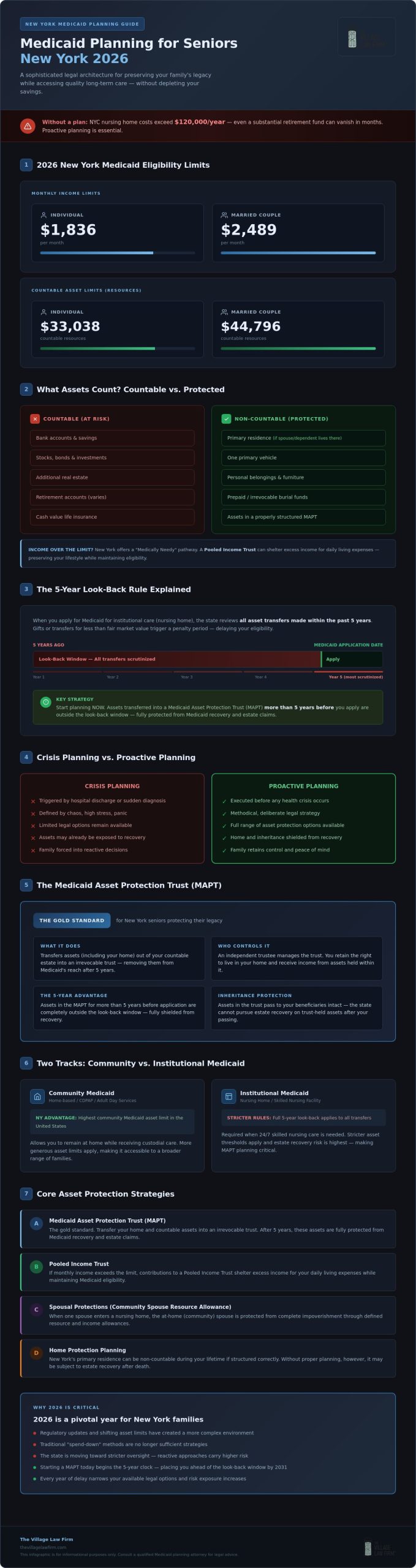
Understanding the financial thresholds is the first step toward long-term security. For many, these numbers feel like rigid barriers, but they actually serve as the parameters for a professional legal strategy. In 2026, the individual income limit for Medicaid in New York is $1,836 per month. For a married couple where both spouses are applying, the monthly limit is $2,489. Asset limits are equally specific. An individual can retain $33,038 in countable resources, and a couple can hold $44,796. These figures might seem modest, but they represent only one part of a much larger, more sophisticated picture.
It’s essential to distinguish between what the state considers "countable" and "non-countable" assets. Your primary residence, for instance, is often non-countable if a spouse or certain dependents reside there. However, without proper Medicaid planning for seniors New York, that same home could be vulnerable to estate recovery later. Personal belongings, one vehicle, and specific burial funds typically fall into the protected category. If your income exceeds these limits, New York offers a "Medically Needy" pathway. Rather than a mandatory spend-down that depletes your lifestyle, we often utilize Pooled Income Trusts to protect that excess income for your daily living expenses, effectively removing the complexity of the eligibility process.
Community Medicaid vs. Institutional Medicaid
The eligibility rules shift depending on the level of care you require. Community Medicaid provides for home-based care, allowing you to remain in the comfort of your own residence. Currently, New York has the highest community Medicaid asset limit in the United States, offering a unique advantage for those seeking to age in place. Specialized clinical support, such as the home infusion services from Vital Care of Syracuse, can be integrated into these home-based care plans to manage complex medical needs. Institutional Medicaid is the entitlement for certified nursing home care. While it covers the high costs of facility care, it also triggers a 60-month look-back period. Balancing these two paths requires a clear understanding of your current health trajectory and your family’s long-term legacy goals.
The 2026 Asset Landscape for Couples
Protecting a spouse who remains at home is a priority in our practice. The Community Spouse Resource Allowance (CSRA) is designed to prevent the "well spouse" from falling into financial hardship while their partner receives care. In 2026, the non-applicant spouse can generally retain the greater of $74,820 or half of the couple’s assets, up to a maximum of $162,660. Additionally, the Community Spouse Monthly Income Allowance (CSMIA) permits the non-applicant spouse to keep up to $4,066.50 in monthly income. This high-end approach ensures that one spouse’s need for care doesn’t compromise the other’s independence. If you’re feeling uncertain about how these figures apply to your specific portfolio, speaking with a dedicated partner can provide the clarity you need to move forward with confidence.
Navigating the Look-Back Period and Spend-Down Myths
The five-year look-back period is often portrayed as a looming wall, a barrier designed to trap the unwary. This narrative of fear serves no one. In the context of Medicaid planning for seniors New York, the look-back is simply a technical window that requires a methodical approach. For nursing home care, the state reviews financial records from the 60 months prior to your application to ensure assets weren’t gifted away solely to meet eligibility requirements. While a 30-month look-back for community-based care has been approved, as of July 2026, it has not yet been implemented. This means the window for proactive protection remains open, but it demands precise timing and a partnership mindset.
Perhaps the most damaging myth is the belief that you must spend down every cent on medical bills before the state will step in. This is fundamentally untrue. Eligibility isn’t about poverty. It’s about how your assets are structured. By moving from a state of financial chaos to one of legal order, you can qualify for care while keeping your legacy intact. We view the look-back not as an obstacle, but as a timeline we navigate together with transparency and foresight. It’s a manageable technicality when you have a steady guide to light the way.
The Mechanics of Asset Transfers
A transfer occurs whenever an asset is moved for less than its fair market value. If you gift a vacation home to a child or transfer significant funds without receiving something of equal value in return, the state may impose a penalty period. The penalty period is a duration of ineligibility based on the uncompensated value of transferred assets. However, New York law provides vital exceptions that many overlook. Transfers made to a spouse, a blind or disabled child, or certain qualifying trusts are often exempt from these penalties. Understanding these nuances allows us to protect your wealth without triggering unnecessary delays in care.
Strategic Spend-Downs That Build Legacies
When people hear the term spend-down, they often imagine writing checks to a nursing home until their bank account is empty. A more sophisticated strategy involves an exempt spend-down. This means using your resources in ways that the state allows while simultaneously benefiting your family and your quality of life. You might pay off an existing mortgage, renovate your primary residence to make it safer for aging in place, or purchase a pre-paid funeral contract. These actions reduce your countable assets while increasing the value of your estate or securing your future comfort. We act as the bridge between these technical mechanics and the emotional peace that comes from knowing your family is protected.
Asset Protection Strategies: Trusts and the Family Home
For most New York families, the home is more than just real estate. It’s a repository of memories and the cornerstone of a hard-earned legacy. Protecting this sanctuary from the rising costs of long-term care is the primary objective of a sophisticated legal strategy. Without proactive Medicaid planning for seniors New York, the state may place a lien on your property or seek recovery from your estate after you pass away. This doesn’t have to be your story. By implementing methodical protections today, you ensure that your home remains where it belongs: with your children. Understanding how to protect your home from Medicaid recovery in NY is the essential difference between leaving a legacy for your heirs and leaving a lien for the state to collect.
While this guide focuses on New York properties, families with diverse holdings in states like Texas can explore Massingill Attorneys & Counselors at Law for probate and estate planning to ensure their entire legacy is protected.
One of the most powerful tools in our arsenal is the "Caregiver Child" exception. This rule allows a senior to transfer their primary residence to a child who has lived in the home for at least two years and provided care that delayed the senior’s need for institutionalization. It’s a deeply human provision that rewards the dedication of family members while preserving the family’s most significant asset. However, relying on exceptions alone is risky. A truly secure plan utilizes robust legal structures to remove uncertainty entirely, providing a sanctuary of order for families with children.
The Medicaid Asset Protection Trust (MAPT)
The Medicaid Asset Protection Trust is the gold standard for asset preservation in New York. Unlike a revocable trust, which the state views as an available resource for care costs, the MAPT is an irrevocable structure. Once your assets are placed within this trust and the five-year look-back period concludes, they’re shielded from Medicaid’s reach. Crucially, a MAPT allows you to retain the right to live in your home for the rest of your life. You keep your tax exemptions, and your children receive a stepped-up basis for capital gains purposes. It’s a meticulous way to bridge the gap between current independence and future security. To see how this fits into your broader goals, consult an Estate Planning Attorney New York: Protecting Your Legacy in 2026.
Protecting the Primary Residence
In 2026, New York continues to offer a home equity exemption for primary residences, but the limits are strict and the risks of "estate recovery" are real. If the home is in your name at the time of your death, the state can sue your estate to recoup the costs of the care they provided. This often forces the sale of the family home, leaving heirs with nothing. New York pursues approximately 30,000 estates for Medicaid recovery every year, making it critical to implement a proactive strategy to protect your home from Medicaid estate recovery in NY well before a care need arises. While a Life Estate is a common alternative that gives you the right to occupy the property while transferring the remainder interest to your children, it lacks the comprehensive protection of a trust. A Life Estate can still be subject to liens during your lifetime. We focus on creating a shield that addresses both your immediate needs and your long-term desire to provide for your family. If you’re ready to secure your family’s future, schedule a consultation with our expert team to build your custom protection strategy.
The Village Law Firm: A White-Glove Approach to Medicaid
Medicaid planning for seniors New York is not a task to be handled with a transactional mindset. It’s a life-altering process that requires a delicate touch and a sharp legal mind. We understand that our clients aren’t just looking for forms; they’re looking for a shield against uncertainty. Our firm is dedicated to replacing the inherent chaos of state regulations with a methodical, calm, and highly professional order. We act as your steady urban guide, navigating the fast-paced and often cold legal environment to ensure your family remains protected.
The success of a Medicaid strategy often hinges on the smallest details. A single misreported asset or a misunderstood transfer can trigger a penalty period that lasts for months. We provide the meticulous attention to detail required to ensure your application is seamless. By focusing on the removal of complexity, we allow you to step away from the bureaucracy and focus on what truly matters: your family’s well-being. This is how we bridge the gap between current instability and a future defined by order.
A Partnership, Not a Transaction
Busy New York professionals value efficiency, but they also value empathy. When you’re planning for an aging parent’s future, the emotional weight can feel staggering. We don’t just provide legal mechanics; we provide a partnership. Our high-end service model is designed to respect your time while honoring the significance of your legacy. We remove complexity through transparent, direct communication, ensuring you always know where you stand. By walking alongside you, we transform a stressful obligation into a shared commitment to excellence. You aren’t just a case number; you’re a family seeking a sanctuary of calm.
Securing Your Family’s Future
The journey from anxiety to security begins with a single, decisive step. We’ve seen how Medicaid planning for seniors New York can transform a family’s outlook, replacing fear of the unknown with a state of protected security. Our focus remains steadfast on protecting legacies for the next generation, ensuring that what you’ve built isn’t lost to the system. Experience a sanctuary of order in your legal planning and replace your fears with a clear, documented roadmap. Schedule a consultation to secure your legacy today and let us build the bridge to your family’s long-term peace of mind.
Securing Your Legacy in an Unpredictable Landscape
You’ve spent a lifetime building your legacy in the city. Protecting that life’s work requires more than just reactive measures; it demands a sophisticated, proactive vision. By mastering the 2026 eligibility thresholds and utilizing strategic tools like the Medicaid Asset Protection Trust, you transform potential financial vulnerability into a position of absolute strength. Medicaid planning for seniors New York is the vital bridge between the unpredictability of long-term care and the sanctuary of a shielded family home.
As a boutique NYC firm specializing in high-stakes asset protection, we offer a white-glove service specifically tailored for busy professionals who value precision and empathy. Our deep expertise in complex local and international estate law ensures that every detail of your family’s future is handled with meticulous care. You don’t have to face these decisions alone. Begin your journey toward a secure legacy with a private consultation. Your future deserves the clarity and peace of mind that only a steady, expert guide can provide. Let’s ensure your legacy remains exactly where it belongs.
Frequently Asked Questions
What is the Medicaid look-back period in New York for 2026?
The look-back period for institutional nursing home care remains 60 months. During this five-year window, the state reviews all financial transfers to ensure assets weren’t gifted to meet eligibility. While a 30-month look-back for Community Medicaid was approved, it hasn’t been implemented as of July 2026. This means home care applications currently proceed without a look-back period, though this could change with little notice.
Can I keep my home and still qualify for Medicaid in NY?
You can generally keep your primary residence as an exempt asset if your equity is below the state’s 2026 limit or if a spouse resides there. However, simply keeping the home doesn’t protect it from Medicaid estate recovery after you pass away. We utilize sophisticated Medicaid planning for seniors New York to shield the property’s value, ensuring your home remains a legacy for your children rather than a source of state reimbursement.
What is a Medicaid Asset Protection Trust (MAPT)?
A Medicaid Asset Protection Trust is an irrevocable legal structure designed to hold your assets and start the five-year look-back clock. Once assets are inside the trust for the required duration, they’re no longer counted toward your eligibility limits. You retain the right to live in your home and receive trust income while protecting the principal for your heirs. It’s the gold standard for methodical, long-term asset preservation.
How much income can a senior have and still get Medicaid in New York?
In 2026, the individual monthly income limit for Medicaid is $1,836. If your income exceeds this amount, you don’t necessarily lose eligibility. New York allows the use of Pooled Income Trusts, where you deposit your "surplus" income to pay for personal living expenses. This sophisticated mechanism allows you to meet the state’s strict requirements while maintaining your quality of life in your own community.
Does Medicaid pay for assisted living in New York?
Medicaid does not typically pay for the room and board costs of standard assisted living facilities. However, it may cover the medical and personal care services provided through the New York Assisted Living Program (ALP) for those who qualify. Because these slots are limited, we help families navigate the specific eligibility requirements to ensure their loved ones receive high-quality care in the most appropriate setting.
What happens if I need a nursing home but haven’t planned 5 years in advance?
If an immediate need arises, we implement "crisis planning" strategies to protect a significant portion of your estate. Even without the five-year lead time, techniques like the gift and promissory note strategy can often preserve roughly half of your assets. While proactive planning is ideal, our firm acts as a steady guide during these high-stress moments to find an orderly solution that prevents total financial depletion. Families facing urgent placement can find a detailed breakdown of these techniques in our Medicaid crisis planning NY checklist for protecting assets in 2026.
Is my IRA or 401(k) counted as an asset for New York Medicaid?
In New York, a retirement account is generally considered a non-countable resource if it’s in "payout status," meaning you’re taking regular, periodic distributions. While the principal balance is shielded, the monthly distributions you receive will count toward your income limit. This is a unique advantage in New York Medicaid planning for seniors New York that requires precise documentation to ensure the state correctly categorizes your retirement savings. For those managing complex portfolios, wealth management firms like Timothy Roberts & Associates, LLC can provide the necessary oversight to align your retirement planning with these specific legal requirements.
How does the "Spousal Refusal" rule work in New York?
Spousal refusal is a legal procedure where a "well spouse" formally refuses to contribute their income or assets toward the care of the applicant spouse. Under New York law, the state must then evaluate the applicant’s eligibility based only on their own resources. While this allows the applicant to receive immediate care, the state retains the right to seek reimbursement from the refusing spouse later. It’s a complex, high-stakes strategy that requires expert legal oversight.