
You might believe that an immediate need for nursing home care means your family’s life savings are already lost to the state. In reality, the eleventh hour is often the most critical time for strategic legal architecture. When a loved one faces urgent placement, the pressure is immense. You’re likely feeling the weight of NYC’s $15,282 monthly regional rates and the fear that the five-year look-back period has already closed the door on protection. We understand that this feels like a descent into chaos. Effective Medicaid crisis planning NY isn’t about finding a loophole; it’s about using established legal protections to ensure your family isn’t left behind by a complex system.
It’s natural to feel overwhelmed by the 2026 implementation of the 30-month community look-back and the rising costs of care. You want to provide the best for your parents without sacrificing the inheritance they worked decades to build. This article provides a clear, reassuring roadmap to qualify for benefits immediately while preserving a significant portion of your assets. We’ll walk through the 2026 checklist, including the “gift and note” strategy and the power of spousal refusal, to restore order to your family’s future.
Key Takeaways
- It’s never too late to act. Even with immediate nursing home placement, specific legal architectures can safeguard your life savings from being entirely consumed by care costs.
- Start with the essentials. Effective Medicaid crisis planning NY requires an immediate inventory of all assets and a Power of Attorney that explicitly grants gifting authority.
- Use the “Rule of Halves.” This strategy leverages promissory notes to bridge the gap during penalty periods, allowing you to preserve a legacy for your heirs.
- Navigate the audit with confidence. We explain how New York’s regional rates and the 60-month look-back window impact your qualification timeline.
- Focus on the transition. Moving from medical chaos to financial security is possible when you have a steady guide to manage the complex NYC Medicaid application process.
Defining a Medicaid Crisis in New York: Is It Truly Too Late?
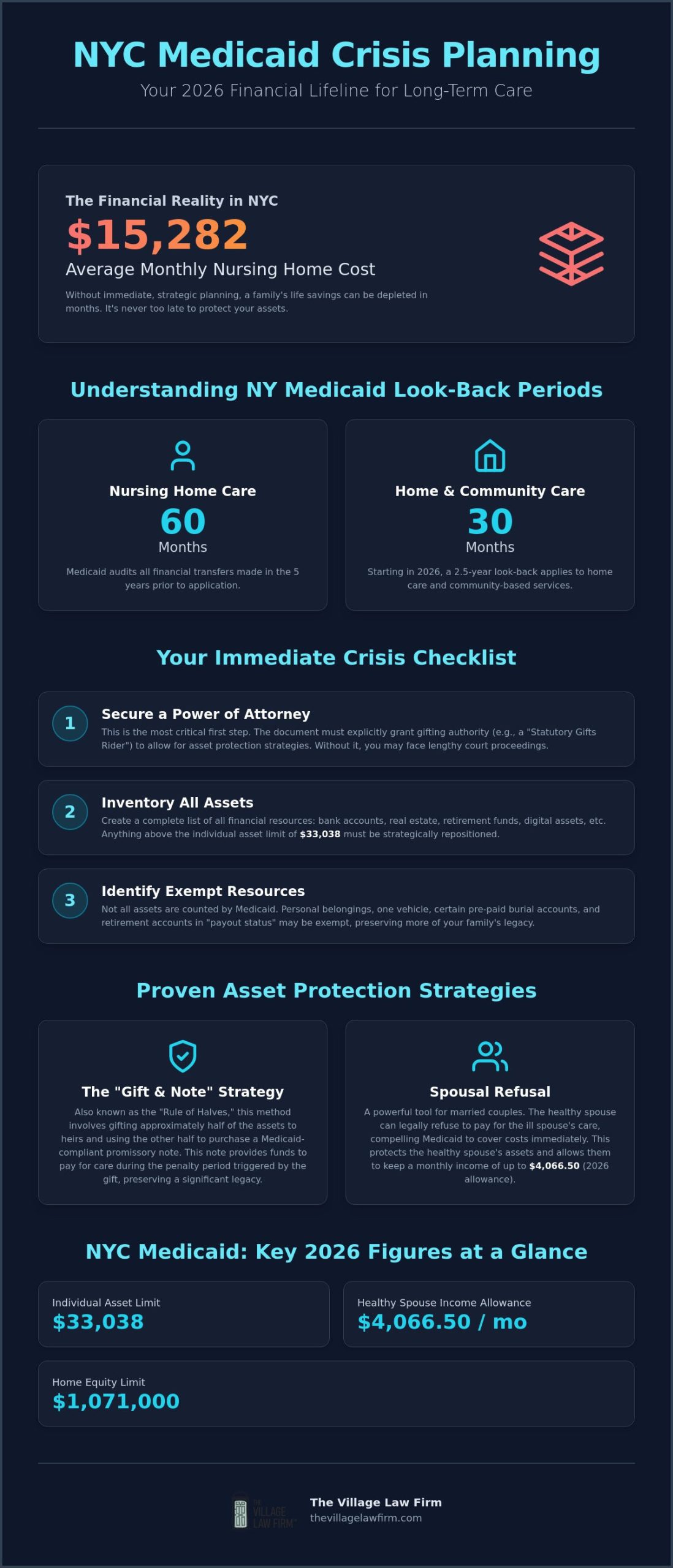
You’ve just received the call. A parent needs a nursing home now. This is the definition of a Medicaid crisis, a moment where the need for professional care outpaces your financial preparation. In New York City, the stakes are exceptionally high. Average nursing home costs have climbed to $15,282 per month in 2026. Without a plan, a family’s entire legacy can vanish in a matter of months. While understanding the federal Medicaid program is a good starting point, the specific rules in New York offer unique opportunities for those who feel they’ve run out of time.
The belief that you must “spend down” every penny before qualifying is a common misconception. New York law allows for sophisticated strategies like the “Rule of Halves,” even at the hospital bedside. We can often reposition assets to protect nearly half of a family’s savings, even if no prior planning was done. Medicaid crisis planning NY is the process of replacing that initial panic with a meticulous, structured defense of your home and bank accounts. It turns a medical emergency into a manageable legal transition.
The Difference Between Chronic and Crisis Planning
Chronic planning is the proactive path. It involves setting up trusts five years before care is needed to satisfy the 60-month look-back period. Crisis planning is the reactive path. It happens after a stroke, a fall, or a sudden decline in health. NYC families face unique pressure because local real estate values often sit right at the 2026 home equity limit of $1,071,000. This makes the family home a primary target for Medicaid recovery if it isn’t shielded correctly during the crisis window.
Identifying Your Specific Crisis Scenario
Every crisis follows a different trajectory based on family structure. For a single applicant, the focus is on the “Gift and Note” strategy to trigger a shortened penalty period while preserving assets for heirs. For married couples, the strategy is often more robust. New York allows for “Spousal Refusal,” where a healthy spouse can legally decline to pay for the ill spouse’s care, forcing Medicaid to step in immediately. This protects the healthy spouse’s income, which can be as high as the $4,066.50 monthly allowance in 2026.
The “Home Care” crisis is also changing. In 2026, New York has implemented a 30-month look-back period for community-based Medicaid. This means that even if your loved one is staying at home with a health aide, the state will now audit past transfers. Whether you’re facing a nursing home or home care, the goal remains the same: move from the chaos of the medical event into the sanctuary of a well-ordered legal plan.
The 2026 NYC Medicaid Crisis Checklist: Immediate Steps
When a medical event forces an immediate transition to long-term care, the clock starts ticking against your family’s savings. You don’t have years to prepare; you have days or weeks. This is where Medicaid crisis planning NY becomes your primary defense. To replace panic with a sense of order, we follow a prioritized checklist designed to stop the financial bleed of private-pay nursing home rates, which now average over $15,000 monthly in the city.
- Step 1: Secure a Comprehensive Power of Attorney. This is the most critical document in your arsenal. It must include robust gifting authority. Without a specific “Statutory Gifts Rider” or equivalent language, your representatives cannot legally move assets to protect them. If your current document is outdated, we must address it immediately to avoid a lengthy guardianship proceeding.
- Step 2: Inventory All Assets. We need a clear picture of everything. This includes NYC real estate, digital assets, and retirement accounts. In 2026, the individual asset limit is $33,038. Anything above this must be strategically repositioned according to official New York State Medicaid guidelines.
- Step 3: Identify Exempt Resources. Not every asset counts toward the limit. Personal belongings, one vehicle, and certain pre-paid burial accounts are typically exempt. Crucially, retirement accounts in “payout status” may be treated as income rather than countable assets, though this requires meticulous documentation.
- Step 4: Engage Professional Counsel. To halt the drain of your life savings, you should consult a Medicaid planning attorney New York. A professional guide ensures that every transfer is compliant and every deadline is met, preventing the common errors that lead to application denials.
- Step 5: Prepare the Application. For NYC residents, this means organizing a package for the Human Resources Administration (HRA). The goal is to prove eligibility from day one of care.
Document Gathering for the NYC HRA
The HRA requires a forensic level of detail. You’ll need five years of financial statements for every account owned, even those that are closed. NYC caseworkers look for “uncompensated transfers”—any gift or large withdrawal that could trigger a penalty. You must also provide proof of NYC residency, citizenship or legal status, and detailed health insurance premium records. For immigrant families navigating these requirements, understanding Medicaid eligibility for green card holders in NY is an essential part of building a complete and accurate submission. If you’re feeling overwhelmed by the paperwork, our team can help you organize this administrative labyrinth into a clear, submission-ready file.
Protecting the Primary Residence in NYC
Your home is likely your most significant asset. In 2026, the home equity limit is $1,071,000. If your equity exceeds this, or if you want to ensure the state doesn’t place a lien on the property later, you must act. We often utilize the “Intent to Return Home” declaration or the Caregiver Child exemption. This specific exemption allows a parent to transfer the home to a child who lived there for at least two years and provided care that delayed nursing home placement. You can learn more about these strategies in our guide on how to protect your home from Medicaid recovery in NY.
Advanced Crisis Strategies: The ‘Gift and Note’ Method
When you’re facing a monthly nursing home bill of $15,282 in NYC, the standard advice to “just spend it down” feels like a surrender. It shouldn’t. Advanced Medicaid crisis planning NY allows us to pivot from financial loss to asset preservation using the “Gift and Note” method. This strategy, often called the “Rule of Halves,” is designed for families who need care immediately but still hold significant assets. It’s a sophisticated legal architecture that balances a gift to heirs with a private loan to cover care during the resulting penalty period.
The logic is meticulous. We gift a portion of the assets to a trust or family member, which intentionally triggers a Medicaid penalty period. Simultaneously, the remaining assets are used to purchase a Medicaid-compliant promissory note or a Medicaid-Compliant Annuity (MCA). This note or annuity provides a monthly income stream specifically calculated to pay the nursing home until the penalty period expires. Because these tools convert a “countable asset” into an “income stream,” they allow the applicant to meet the $33,038 asset limit while still controlling the funds needed for their care. This requires “white-glove” precision. A single error in the note’s interest rate or the timing of the gift can lead to an immediate HRA rejection, leaving the family to pay the full private rate indefinitely.
The Gift and Note Strategy Explained
The success of this strategy depends on the 2026 NYC regional rate of $15,282. This figure is the “divisor” used by the state to determine how many months of care a gift represents. For example, if a family gifts $152,820, they face a 10-month penalty. By running these numbers against the total asset pool, we typically help NYC families save between 40% and 60% of their life savings. Timing is everything. The gift must occur in the same month as the Medicaid application to ensure the penalty period begins to run immediately, rather than sitting in a state of limbo.
Spousal Refusal: The New York Advantage
New York remains one of the few states that offers “Spousal Refusal,” a powerful tool for married couples. Under New York Social Services Law, a well spouse has the right to refuse to contribute their assets or income toward the ill spouse’s nursing home costs. This allows the ill spouse to qualify for Medicaid immediately based on their own limited resources. While this protects the healthy spouse’s lifestyle and the $162,660 Community Spouse Resource Allowance, it isn’t without risk. The NYC HRA maintains the right to seek reimbursement from the refusing spouse later. We treat this as a calculated step in a broader plan, ensuring the family has the stability to handle future negotiations from a position of strength.
Navigating the Look-Back Period and Penalty Calculations
The 60-month look-back often feels like a looming threat, but it’s actually a defined forensic process. NYC Human Resources Administration (HRA) caseworkers examine five years of financial history to identify uncompensated transfers. These are gifts or sales below market value that the state believes were made to artificially qualify for benefits. Every transaction over a certain threshold is scrutinized. If your bank records show large, unexplained withdrawals, the state assumes they were gifts unless you can prove otherwise.
If the audit reveals such transfers, a penalty period is triggered. We calculate this by taking the total value of the gifts and dividing it by the 2026 NYC regional rate of $15,282. For example, a $60,000 gift results in nearly four months of Medicaid ineligibility. During this time, the applicant must pay for their own care. It’s a common fear that a past gift is a permanent disqualification, but New York allows for a “cure.” If the gifted funds are returned to the applicant, the penalty can be reset or eliminated entirely. This requires careful coordination to ensure the funds are handled correctly before the application is filed.
Strategic spending is often better than gifting. Before triggering a penalty, we recommend spending excess assets on exempt items to reach the $33,038 limit. You can pay off an existing mortgage, renovate the family home for accessibility, or prepay for funeral services. These actions preserve the value of the estate for the family while satisfying Medicaid’s strict financial requirements. For a comprehensive overview of how to legally reduce countable assets, our guide on Medicaid spend down strategies New York walks through the full range of 2026 legal frameworks available to protect your property and wealth. Contact us to review your financial records and identify the most effective spend-down strategy for your specific situation.
Exempt Transfers You Might Not Know About
Certain transfers are never penalized, even within the five-year window. You can transfer any amount of assets to a spouse or a blind or disabled child without consequence. The “Caregiver Child” exception is a powerful tool for protecting NYC real estate. If an adult child lived in the home for at least two years and provided care that kept the parent out of a facility, the home can be transferred to that child penalty-free. Transfers made exclusively for a purpose other than to qualify for Medicaid, such as a regular pattern of charitable giving, may also be exempt if documented properly.
Managing the Application Timeline in NYC
Navigating the HRA requires meticulous timing. In 2026, application processing often stretches over several months. However, Medicaid can provide “Retroactive Eligibility” for the three months prior to the application month if the individual was financially eligible during that time. This is vital for covering nursing home bills that accumulated while the legal plan was being finalized. To avoid immediate denials, every page of every bank statement must be included. Even a single missing page from a closed account can derail the entire process, making the role of a steady guide essential.
Partnering for Protection: Why Sophisticated Planning Matters
Attempting to navigate the NYC Human Resources Administration alone is like walking through a labyrinth without a map. The stakes are too high for guesswork. When a medical emergency strikes, the administrative friction of the application process often compounds the emotional weight of the situation. Our approach at The Village Law Firm is designed to replace this complexity with a sanctuary of meticulous order. We act as your steady urban guide, shielding you from the unpredictability of the system so you can focus on the well-being of your loved one.
The financial cost of “Do-it-Yourself” crisis planning is often staggering. A single error in a promissory note or a mischaracterized bank transfer doesn’t just lead to a paperwork delay. It results in a Medicaid denial that leaves the family responsible for the full $15,282 monthly nursing home rate. Professional Medicaid crisis planning NY pays for itself by securing immediate qualification and preserving nearly half of the assets that would otherwise be lost to a spend-down. We don’t just file forms; we build a legal architecture that protects your family’s hard-earned legacy from being entirely consumed by a few months of care.
A Personalized Sanctuary of Order
Our strategies are particularly vital for families with children. We recognize that your priority isn’t just the current crisis but the long-term stability of the next generation. By utilizing sophisticated asset repositioning, we ensure that your children’s inheritance remains intact. Our commitment to transparency means you’ll always have a direct line to the status of your case. We believe in removing the “black box” of legal mechanics and replacing it with clear, honest communication. For more details on our approach to long-term security, explore our guide on Medicaid planning for seniors in New York.
Your Path Forward
Moving from a state of medical chaos to a secured future begins with a single, structured conversation. During your initial Medicaid crisis consultation, we’ll perform a forensic review of your assets and identify the specific exemptions available to you. You won’t have to manage the nursing home’s billing department or the local social workers alone. We coordinate directly with facility administrators on your behalf, ensuring that the transition from private-pay to Medicaid-covered care is seamless. Don’t let the pressure of an immediate placement force you into losing your life savings. Secure your family’s future today by partnering with a firm that treats your legacy with the meticulous attention it deserves.
Restoring Order to Your Family’s Future
A medical crisis is an invitation to protect what matters most, not a signal to give up. Even with the pressures of immediate nursing home placement, you can still shield a significant portion of your assets. By leveraging strategies like the “gift and note” method or spousal refusal, we move your family away from the chaos of private-pay rates and toward the stability of a structured plan. The 2026 regional rates and asset limits create a complex administrative landscape, yet these hurdles remain manageable with the right legal architecture.
Effective Medicaid crisis planning NY is about more than just paperwork; it’s about preserving the life you’ve built for the people you love. You don’t have to navigate the HRA or the look-back audit alone. Our firm provides the specialized NYC expertise and white-glove service necessary to replace anxiety with a secured legacy. We’re dedicated to acting as your steady guide through every step of this journey, ensuring your family receives the protection it deserves.
Schedule a Calming Consultation with Our NYC Medicaid Planning Team
You’ve worked hard for your family’s future, and it’s still possible to protect it.
Frequently Asked Questions
What is the 2026 asset limit for Medicaid in New York?
The 2026 asset limit for an individual applying for Medicaid in New York is $33,038. For a married couple where both are applying, the limit increases to $44,796. Staying under these thresholds is a strict requirement for eligibility, but you shouldn’t confuse this with having to lose everything. Strategic planning allows you to reposition excess funds to meet these limits while still protecting your family’s financial security.
Can Medicaid take my home if I enter a nursing home in NYC?
Medicaid generally won’t take your home while you’re alive if your equity is below $1,071,000 or if a spouse still lives there. However, without proper planning, the state may file a claim against your estate after your death to recover care costs. Using exemptions like the “Caregiver Child” rule or transferring the home to a spouse can effectively prevent this recovery process and keep the property in the family.
How does ‘Spousal Refusal’ work in a New York Medicaid crisis?
Spousal refusal is a legal strategy where a healthy spouse formally declines to contribute their income or assets toward their partner’s nursing home care. This forces Medicaid to assess only the applicant spouse’s resources, allowing for immediate qualification. It’s a powerful tool in Medicaid crisis planning NY, though the city may later seek reimbursement from the refusing spouse’s resources through a separate legal proceeding.
What is the ‘Rule of Halves’ in Medicaid planning?
The “Rule of Halves” involves gifting roughly 50% of your assets to heirs and using the remaining 50% to pay for care during the resulting penalty period. This is typically achieved through a Medicaid-compliant promissory note that provides a monthly income stream to bridge the gap. It’s a sophisticated way to save a significant portion of an estate even when nursing home placement is happening tomorrow.
Does New York have a look-back period for home care (Community Medicaid) in 2026?
Yes, New York has implemented a 30-month look-back period for community-based Medicaid services in 2026. This is a major shift from previous years when home care had no look-back audit at all. If you’re seeking home health aides or managed long-term care, the state will now forensicly audit your financial transfers from the past two and a half years to check for uncompensated gifts.
How can a Power of Attorney help with last-minute Medicaid planning?
A Power of Attorney is the most vital tool in a crisis because it allows your representative to move assets when you’re no longer able to do so. For this to work, the document must include specific gifting authority or a Statutory Gifts Rider. Without these precise legal powers, your family might be forced into a costly and slow guardianship proceeding just to qualify you for the benefits you need.
What happens to my retirement accounts (IRA/401k) when applying for Medicaid?
In New York, retirement accounts like IRAs and 401ks are generally exempt from being counted as assets if they’re in “payout status.” This means you must be receiving regular, periodic distributions from the account, such as required minimum distributions. While the principal is protected from the spend-down, the monthly distributions will be counted as part of your income, which may go toward your care costs.
How long does it take for a Medicaid application to be approved in NYC?
The NYC Human Resources Administration is legally required to process a Medicaid application within 45 to 90 days. In practice, the complexity of the 2026 rules and administrative backlogs often lead to longer wait times. Fortunately, Medicaid can provide retroactive coverage for the three months prior to your application date, ensuring that initial nursing home bills are eventually covered once approval is granted. For non-citizen residents wondering about their eligibility, our detailed overview of Medicaid eligibility for green card holders in NY explains how New York’s specific protections can work in your favor during this process.