
Imagine receiving a call in London or Tokyo about a Manhattan penthouse and a local investment account, only to realize that the laws of two different nations are now pulling your family’s legacy in opposite directions. It’s an overwhelming realization. You’re grieving a loss while simultaneously staring down a mountain of Surrogate’s Court filings, complex IRS reporting, and the looming 105% New York estate tax cliff. Managing these logistics from thousands of miles away often feels like a nightmare of conflicting rules and endless paperwork.
We understand that you need more than just a legal filing; you need a partner who acts as a shield against this uncertainty. By engaging a specialized international probate attorney NYC, you can transform this chaotic process into a structured journey. This guide provides a sophisticated roadmap for settling cross-border estates with precision and calm. We’ll examine the 2026 tax landscape, the nuances of ancillary probate, and our white-glove approach to ensuring a predictable timeline for asset distribution. You don’t have to manage the chaos alone. Let’s find a methodical path forward together.
Key Takeaways
- Understand the unique procedural requirements of the NYC Surrogate’s Court and how they impact families managing estates from abroad.
- Learn how foreign wills are treated under New York’s EPTL and the vital role of the Hague Apostille Convention in validating international documents.
- Determine whether your situation requires original or ancillary probate to efficiently secure and transfer New York-based assets.
- Partnering with an international probate attorney NYC ensures you avoid the “estate tax cliff” and remain compliant with 2026 IRS reporting for foreign inheritances.
- Replace logistical chaos with a methodical, white-glove path forward that provides a predictable timeline for asset distribution and legacy protection.
Understanding International Probate in the NYC Surrogate’s Court
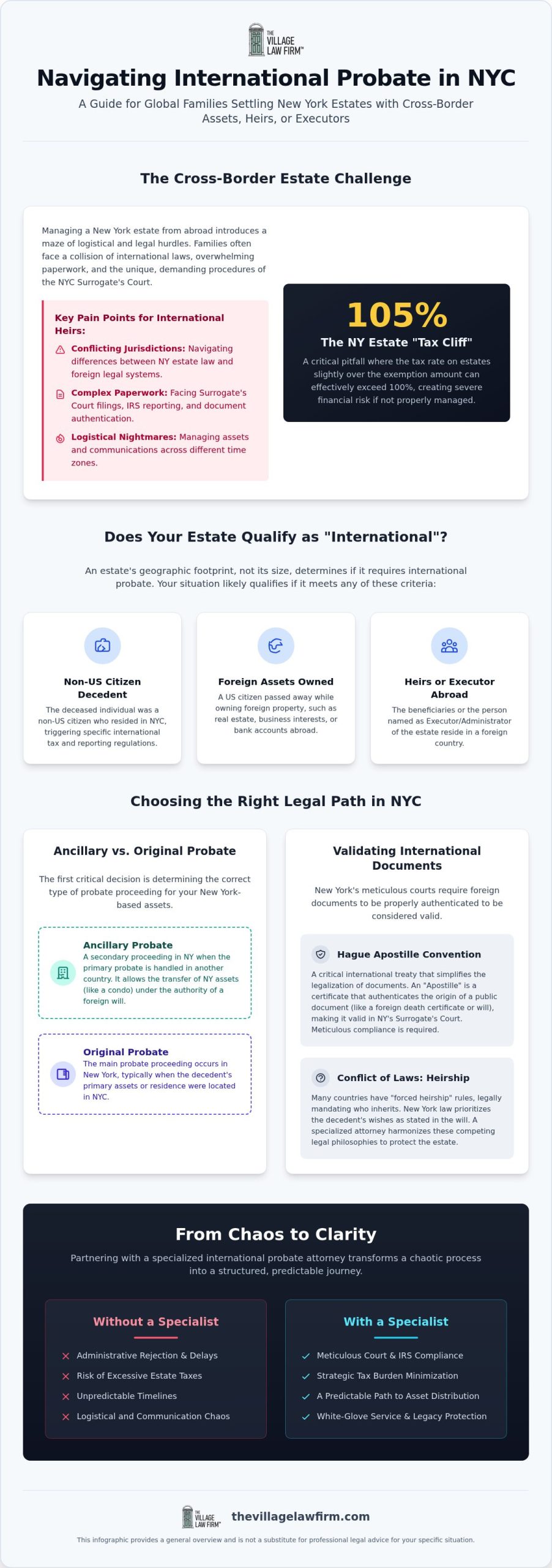
International probate is the legal process of settling a New York estate when the decedent’s life crossed national borders. This isn’t a standard administration. It involves assets, heirs, or executors located in different countries, creating a collision between New York law and foreign legal systems. In the fast-paced environment of Manhattan, Brooklyn, and Queens, the Surrogate’s Courts operate with a high level of scrutiny. Partnering with a seasoned international probate attorney NYC is often the first step in transforming a fragmented global situation into a clear, legal resolution.
Managing a legacy across borders carries a unique emotional weight. You aren’t just dealing with legal forms; you’re managing family expectations across time zones and navigating financial institutions that may not understand New York’s requirements. Our firm serves as the bridge between this international chaos and the orderly distribution of assets. We replace the stress of the unknown with a methodical, protective path forward.
When Does an Estate Qualify as “International” in New York?
An estate is generally classified as international if it meets one of several criteria. It’s not always about the size of the estate, but rather its geographic footprint. You are likely facing an international probate matter if:
- The decedent was a non-US citizen residing in NYC: Even if they lived in a Manhattan apartment for decades, their citizenship status triggers specific tax and reporting rules.
- A US citizen died with foreign property: Owning a villa in Italy or a bank account in Zurich requires New York executors to coordinate with foreign jurisdictions.
- Heirs or the named Executor live abroad: When the person responsible for the estate is located in London or Hong Kong, the physical distance complicates court filings and asset collection.
The Role of the New York Surrogate’s Court
The Surrogate’s Court has exclusive jurisdiction over real property located within its specific borough. If a decedent owned a brownstone in Brooklyn or a condo in Queens, the court in that borough must oversee the transfer of that title. This often involves Ancillary administration, a process that allows the court to recognize foreign probate proceedings so New York assets can be legally released.
Court clerks in New York City are famously meticulous. They require exact documentation, often demanding certified translations and specific authentications that go beyond what a standard domestic probate requires. Working with an international probate attorney NYC allows you to delegate this logistical burden. Our firm provides a white-glove approach to these inquiries, ensuring every document is polished and precise before it reaches a clerk’s desk. Meticulous preparation is the only way to avoid years of delays and ensure the court moves at a predictable pace.
The Complex Interplay of Global Assets and New York Law
When a family’s footprint spans multiple continents, legal systems often collide. New York Estates, Powers and Trusts Law (EPTL) provides the framework for how the NYC Surrogate’s Court recognizes foreign wills. For a will executed in Paris or Tel Aviv to be valid in Manhattan, it must satisfy specific execution requirements. This is where the technical precision of an international probate attorney NYC becomes indispensable. We ensure your documents meet the rigorous standards of the Hague Apostille Convention, a critical verification process for international estates in 2026. This convention simplifies document legalization, yet the court still requires meticulous attention to detail to prevent administrative rejection.
A frequent point of friction is the conflict between New York law and “forced heirship” rules found in many civil law jurisdictions. In countries like France or Japan, a portion of the estate is legally mandated to go to specific heirs. New York, however, traditionally prioritizes the testator’s intent for assets located within the state. Harmonizing these two philosophies requires more than just legal knowledge; it requires a sophisticated strategy that respects international relationships while shielding the estate from unnecessary litigation. We act as your guide, creating a sanctuary of order amidst the potential chaos of competing legal mandates.
Situs Assets: Real Estate, Business Interests, and Bank Accounts
The physical location of an asset, known as its “situs,” serves as the anchor for New York jurisdiction. If your loved one owned a condo in the Financial District or a co-op on the Upper East Side, the New York court must oversee its transfer. NYC co-ops present a unique challenge. They are technically personal property held as shares in a corporation, yet the Surrogate’s Court treats them with the same gravity as real estate. Managing these “situs assets” requires a methodical approach to ensure titles are cleared and bank accounts are unfrozen without triggering avoidable delays. Situs is the defining factor that determines which court holds the power over your family’s New York legacy.
Treaty Protections and International Agreements
The 2026 tax landscape introduces new complexities for non-resident aliens and global families. U.S. tax treaties often provide a vital shield, preventing the same dollar from being taxed by two different governments. However, these protections aren’t automatic. They require proactive reporting and transparency with the IRS, particularly regarding Form 3520 for foreign gifts and inheritances. If you’re feeling uncertain about how these global agreements apply to your specific situation, consulting with a specialist in cross-border estate administration can provide the clarity you need. We prioritize minimal tax liability and full compliance to ensure your inheritance remains protected for the next generation.
Ancillary vs. Original Probate: Choosing the Right Path
Choosing between original and ancillary probate is the most critical decision an executor will make. Original probate is the primary proceeding. It’s used when the decedent lived in New York or when NYC holds the majority of the estate’s value. Conversely, Ancillary Probate New York is a secondary action. It’s designed for situations where a foreign court has already validated the will, and you simply need the New York Surrogate’s Court to grant authority over local assets like a bank account or real estate. An experienced international probate attorney NYC helps you determine which path offers the least resistance.
Original probate involves the full scrutiny of the court, including notifying every heir across the globe. This process can be lengthy, often stretching from 9 to 18 months depending on the specific NYC borough. Ancillary probate is typically more efficient. Because the New York court relies on the findings of the foreign “home” court, the procedural hurdles are lower. Costs are generally more predictable in ancillary proceedings because the legal work focuses on asset transfer rather than proving the will’s validity from scratch. We use a methodical framework to analyze your assets and family structure, identifying the route that secures your legacy with the greatest speed and precision.
The Ancillary Probate Process in NYC
The ancillary process follows a specific, three-step rhythm to ensure the New York court recognizes foreign authority. First, we manage the authentication of the foreign court’s decree. This requires a “triple-sealed” or apostilled copy of the probate record from the home country. Second, we file the petition in the appropriate NYC borough. Whether the assets are in Manhattan or Queens, the paperwork must be flawless to pass the clerk’s review. Finally, the court appoints the NYC ancillary fiduciary. New York law often requires a local resident or a qualified co-fiduciary to ensure the estate remains compliant with local tax and distribution rules.
Managing the Process Remotely
In 2026, managing a New York estate doesn’t require a flight to JFK. Modern legal technology has transformed the Surrogate’s Court experience. We utilize secure digital platforms for remote signatures and virtual appearances, allowing you to fulfill your duties from your home office in London, Paris, or Dubai. Our firm provides white-glove coordination with your foreign counsel, ensuring that both legal teams are in perfect sync. For families also dealing with residential property in the UK, Eagle Haus Conveyancing Consultants can facilitate any necessary sales or transfers in England and Wales. This approach protects your time and energy. It reduces the need for international travel during a time of mourning, allowing you to focus on your family while your international probate attorney NYC handles the administrative burden in New York.
The administrative burden of a cross-border estate often brings unexpected financial risks. One of the most significant hurdles for international families is the requirement for a fiduciary bond. If the court appoints an executor who doesn’t reside in the United States, they may demand a bond to protect the estate’s assets. This can be difficult and expensive to obtain for non-residents. Without meticulous planning, you risk facing frozen bank accounts and administrative gridlock. An international probate attorney NYC provides the technical precision needed to navigate these requirements, often proposing co-executors or alternative structures to keep the process moving.
IRS compliance is another area where silence is not an option. In 2026, reporting requirements for foreign gifts and inheritances via Form 3520 remain a high priority for federal authorities. Failing to file this form can result in staggering penalties, even if no tax is actually owed. Transparency is your best protection. We help you maintain a clear record of asset transfers to ensure the IRS has no reason to disrupt your family’s sanctuary of order. Our firm acts as a shield, ensuring that your global legacy isn’t eroded by avoidable administrative fines.
Navigating the New York Estate Tax in 2026
New York’s tax laws are uniquely aggressive toward estates that hover near the exemption limit. For 2026, the New York Estate Tax Exemption 2026 is set at $7,350,000. It’s vital to understand that non-residents are generally only taxed on NYC-situs property, such as real estate or tangible goods located within the five boroughs. However, the “cliff” remains a dangerous trap. If your New York estate exceeds the exemption by a mere 5%, you lose the entire exemption and owe tax on every dollar from the very first cent. We work to identify these risks early, using strategic valuations and meticulous documentation to protect your inheritance from this punitive tax structure.
Timeline Management: What to Expect
International probate is a marathon, not a sprint. Delays are often caused by the slow retrieval of foreign documents or backlogs in the NYC Surrogate’s Court. In 2026, processing times can vary significantly between boroughs, making proactive communication essential. We don’t just wait for the court to respond. We maintain a steady rhythm of follow-ups to keep your petition moving through the system. Setting realistic expectations is part of our partnership mindset. We provide a clear, predictable timeline so foreign beneficiaries know exactly when to expect their distribution. If you are ready to replace legal chaos with a methodical path forward, contact our cross-border estate administration team today to begin your journey with confidence.
Why a Specialized International Probate Attorney in NYC is Essential
A general probate lawyer might understand the mechanics of the NYC Surrogate’s Court, but they often lack the global perspective required for cross-border families. Managing international assets involves navigating a complex web of treaties, translation requirements, and foreign legal coordination. An international probate attorney NYC acts as more than just a legal representative; they are a strategic partner who understands how a decision in Manhattan affects a family’s standing in London, Paris, or Hong Kong. When an estate involves Australian interests, collaborating with Aquarius Lawyers ensures that every facet of the global legacy is addressed. We don’t view probate as a series of isolated filings. Instead, we see it as a comprehensive effort to honor a life that spanned continents with dignity and precision.
Our firm prioritizes a peaceful, efficient settlement over the aggressive, litigation-heavy approach often found in the New York market. Families navigating a loss don’t need a “fight”; they need a resolution. We focus on removing the friction between different legal systems to ensure that assets are transferred without unnecessary conflict. This is especially vital when protecting the interests of children or minor heirs. We coordinate cross-border guardianship and trust provisions with meticulous care, ensuring the next generation’s security remains uncompromised regardless of where they reside.
Our philosophy centers on “sophisticated protection.” This means looking beyond the immediate court requirements to ensure your NYC settlement aligns perfectly with your overall global legacy. Our approach to international estate planning and administration is designed to create a calm sanctuary of order. We replace the unpredictability of the legal process with a methodical path forward. By acting as a shield against administrative chaos, we allow you to focus on your family while we handle the technical complexities of New York law. You deserve a partnership that values long-term security over transactional speed.
Taking the Next Step Toward Resolution
Transitioning from the weight of anxiety to the relief of security begins with a single, clear conversation. You can initiate a consultation with an international probate attorney NYC from anywhere in the world, utilizing our secure digital platforms for virtual meetings. To make our initial assessment as productive as possible, we recommend having a few key documents ready for review:
- A copy of the decedent’s will and any existing foreign probate decrees.
- A preliminary list of New York-based assets, such as real estate deeds or bank statements.
- The names and current residency status of all executors and primary heirs.
Replacing complexity with clarity is our ultimate goal. We invite you to step away from the logistical nightmare of managing court filings from overseas and enter a partnership defined by integrity and compassion. Your family’s global legacy deserves the meticulous care of a specialist who understands both the technicalities of the law and the human weight of your journey. Let’s begin the process of securing your inheritance with the precision it requires.
Securing Your Family’s Global Legacy in New York
Managing an estate that spans continents doesn’t have to be a source of persistent anxiety. We’ve explored the critical distinctions between original and ancillary probate, the technical precision required for Hague Apostille compliance, and the strategic importance of navigating the 2026 New York estate tax cliff. By understanding these nuances, you can replace logistical chaos with a methodical, predictable journey. A specialized international probate attorney NYC serves as your authoritative guide, ensuring that every Surrogate’s Court filing and IRS report is handled with meticulous attention to detail.
The Village Law Firm provides the white-glove service that global professionals require. We act as a protective shield against the unpredictability of cross-border administration, allowing you to honor your loved one’s memory without being overwhelmed by administrative complexity. You deserve a partner who values transparency and long-term security. Schedule a sophisticated consultation with The Village Law Firm to secure your international legacy. We’re here to walk alongside you, transforming a complex legal process into a calm sanctuary of order. Your legacy is in safe hands.
Frequently Asked Questions
Do I need to travel to New York to handle the probate process?
You don’t need to travel to New York to manage the probate process. In 2026, the Surrogate’s Court allows for remote filings and virtual appearances. We utilize secure digital platforms for signatures and coordination, meaning you can fulfill your fiduciary duties from London, Paris, or anywhere else. Our firm handles the local logistics and court interactions, providing a white-glove experience that respects your time and eliminates the need for international flights.
What is the difference between ancillary probate and original probate in NYC?
Original probate is the primary legal proceeding used when the decedent lived in New York or the bulk of the estate is located here. Ancillary probate is a secondary process for assets like a Manhattan condo when a foreign court has already validated the will. Choosing the right path is a decision your international probate attorney NYC will help you make to ensure the most efficient transfer of property while minimizing procedural delays.
How long does international probate typically take in the New York Surrogate’s Court?
International probate in the New York Surrogate’s Court typically takes between 9 and 18 months to reach completion. This timeline depends on the specific borough and the complexity of your global assets. Backlogs in 2026 can be significant, but proactive communication and flawless documentation help maintain momentum. We focus on providing a predictable schedule for asset distribution so beneficiaries understand exactly when they will receive their inheritance without unexpected interruptions.
Will the IRS tax my inheritance if I am a non-US citizen living abroad?
The IRS generally taxes non-US citizens only on “U.S.-situs” property, such as New York real estate or tangible personal property located in the city. While you may not owe federal estate tax on foreign accounts, you must still comply with reporting requirements like Form 3520 for foreign gifts and inheritances. Failing to file these disclosures can lead to substantial penalties. We prioritize transparency and full compliance to shield your inheritance from avoidable federal scrutiny.
Can a foreign citizen serve as the Executor of a New York estate?
A foreign citizen can serve as an Executor in New York, but the court often imposes additional requirements. You may be required to appoint a New York resident as a co-executor or post a fiduciary bond to protect the estate’s assets. These hurdles can be complex for non-residents to manage alone. Our firm helps you navigate these specific Surrogate Court rules, ensuring your appointment is secured without compromising the estate’s administrative stability.
What happens to NYC real estate if the owner died without a will in another country?
If a person dies without a will, New York’s laws of intestacy govern any real estate located in the city, regardless of the owner’s home country. The property will be distributed to legal heirs according to a strict hierarchy defined by the Estates, Powers and Trusts Law (EPTL). This often creates a conflict of laws with foreign rules. Working with an international probate attorney NYC is essential to resolve these disputes and clear the title.
How are international legal documents verified for use in New York courts?
International legal documents must be verified through the Hague Apostille Convention to be accepted by New York courts. This process involves obtaining a specific certification from the issuing country that authenticates the document’s origin. Additionally, the Surrogate’s Court requires certified English translations for any paperwork not originally in English. We manage this meticulous verification process on your behalf, ensuring every document meets the court’s high standards before it reaches a clerk.
What are the costs associated with international probate in NYC?
Costs include NYC Surrogate’s Court filing fees, which range from $45 to $1,250 based on the estate’s value under SCPA 2402. You must also account for executor commissions, which follow a sliding scale starting at 5% on the first $100,000. Total probate costs for an uncontested estate typically range between 3% and 7% of the estate’s total value. We provide a clear breakdown of these expenses to ensure full financial transparency throughout the process.