
Imagine you’ve spent a lifetime building a legacy across continents, only to realize that a single signature in London, Paris, or Tokyo might not carry the weight you intended in a Manhattan courtroom. It’s a heavy thought to carry. You’ve worked tirelessly to secure your family’s future, and the fear that your New York property could be frozen or your wishes ignored due to conflicting international laws is a valid source of stress. Dealing with the complexities of the Surrogate’s Court from thousands of miles away can feel overwhelming, but the legal system is more welcoming than you might expect.
This guide clarifies the validity of foreign will in New York and provides the exact steps required to ensure your international assets transition seamlessly to your heirs. You’ll discover how the “safe harbor” provisions of New York law protect your documents and how to navigate the 2026 probate landscape with absolute confidence. We’ll move from the anxiety of the unknown toward a meticulous, calming roadmap that replaces legal complexity with the sanctuary of order and long-term security for your loved ones.
Key Takeaways
- Learn why New York’s global status makes its courts remarkably accommodating to international estates and foreign documents.
- Understand how EPTL § 3-5.1 establishes the validity of foreign will in New York through three distinct legal “safe harbors.”
- Identify why a document that is legally valid in your home country might still face unexpected administrative hurdles at the New York Surrogate’s Court.
- Gain a clear, step-by-step roadmap for admitting an international will to probate, whether the process has already begun abroad or not.
- Discover how a specialized cross-border partner can act as a shield, protecting your global legacy from the stress of conflicting jurisdictions.
Does New York Recognize a Will Executed in Another Country?
New York is the heartbeat of international commerce and culture. Because of this global status, the New York Surrogate’s Court is uniquely equipped to handle estates that cross borders, often dealing with documents drafted in dozens of different languages and legal systems. If you are wondering about the validity of foreign will in New York, the short answer is a reassuring yes. The state’s legal system recognizes that life isn’t confined to a single jurisdiction and provides clear paths for international documents to be honored.
Recognition isn’t a simple rubber stamp. It requires a meticulous adherence to specific statutory “Safe Harbor” rules designed to bridge the gap between different legal traditions. Under EPTL 3-5.1, a will is considered formally valid if it’s in writing, signed by the testator, and follows the laws of the place where it was signed or where the person lived. The court’s primary objective is to honor the genuine intent expressed in your last will and testament while ensuring that local New York creditors are protected. It’s a delicate balance of stability and respect for your international legacy.
Defining the “Foreign Will” in the NY Surrogate’s Court
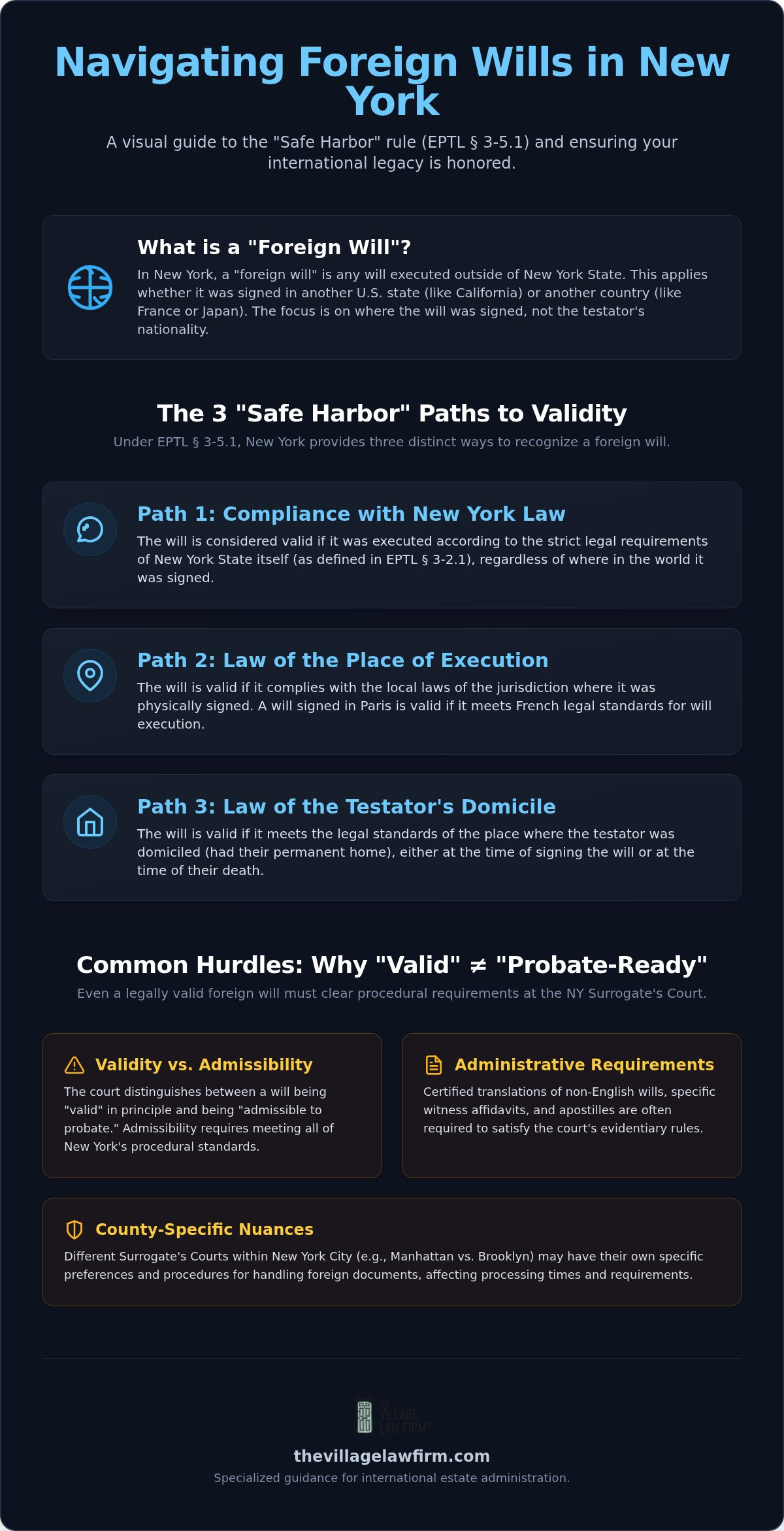
In the eyes of the New York Estates, Powers and Trusts Law (EPTL), a “foreign will” isn’t just a document from another country. It also includes wills executed in other U.S. states like California or Florida. The court focuses less on the nationality of the person who wrote the will and more on where the document was actually signed. This means a French citizen signing a will in London is subject to different initial scrutiny than if they had signed it in Paris. Under New York EPTL 3-5.1, a foreign will is any will executed outside the state of New York, regardless of whether it was signed in another U.S. state or a different country entirely.
The Role of the New York Surrogate’s Court
The Surrogate’s Court acts as a gatekeeper for your family’s future. Judges here view international documents as evidence of your final wishes, but they distinguish between a will that is “valid” and one that is “admissible to probate.” A document might be validly signed under the laws of Italy or Brazil, yet it still needs to meet New York’s procedural standards to be officially processed. The court’s evaluation of the validity of foreign will in New York often centers on whether the document provides clear, verifiable evidence of the testator’s capacity.
- Manhattan vs. Brooklyn: Even within the city, different counties have specific preferences for how they review foreign language translations or witness affidavits. What works in one court might require additional steps in another.
- Intent vs. Admissibility: The court wants to follow your instructions, but it won’t bypass the formal requirements that prevent fraud or coercion.
This methodical approach ensures that your assets are distributed exactly as you intended, protecting your heirs from unnecessary delays or legal challenges. By treating the court as a partner in your legacy rather than an obstacle, you can ensure your global property passes to the right hands without the stress of conflicting jurisdictions.
The Three Paths to Validity: Understanding EPTL § 3-5.1
Determining the validity of foreign will in New York doesn’t have to be a source of anxiety. New York law is designed with a “Safe Harbor” provision to ensure that international legacies aren’t lost to the rigid rules of intestacy. This flexibility allows the court to look beyond local formalities to honor your wishes. By offering three distinct paths to recognition, the state provides a shield against the chaos of conflicting global regulations. Strategic selection of which path to follow can save an estate from being declared invalid, turning a potentially stressful probate into a methodical journey toward security.
The core of this protection is found in New York EPTL § 3-5.1. This statute acts as a bridge between New York’s requirements and the legal traditions of other nations. It ensures that if a document was created with honest intent and followed a recognized legal standard, the New York Surrogate’s Court has the authority to accept it.
Path 1: Compliance with New York Law
The first path involves meeting the strict execution requirements of EPTL 3-2.1. This usually means the document must be signed at the very end and witnessed by at least two people who saw the testator sign it. While this is the most direct route, many foreign wills fail this test. In many civil law jurisdictions, for example, a will is often executed before a notary without the need for additional witnesses. If your document lacks these specific New York formalities, don’t worry. The law provides two alternative routes to ensure your legacy remains protected.
Path 2: Law of the Place of Execution
If your will was legal in the country where you signed it, New York will generally respect that validity. For instance, a will signed in France that follows every French legal formality is considered valid for transferring New York real estate. This path requires a meticulous approach, as you must prove the specifics of that “foreign law” to a New York judge. This often involves providing an affidavit from a legal expert in that country—for example, through Barristers Direct if the document was executed in Ireland—to confirm the document met all local standards at the time of signing.
Similarly, for estates involving Israeli law, משרד עו”ד רות גבריאל provides the specialized legal opinions and documentation required to satisfy the Surrogate’s Court regarding the validity of an international will.
The final path looks at the laws of the country where the decedent lived, either at the time they signed the will or at the time of their death. It’s important to understand that “Domicile” is more than just residency. It’s the place you consider your true, permanent home. For global citizens who move between cities like London, Hong Kong, and New York, this path offers a strategic advantage. It allows the court to apply the laws of the jurisdiction where you were most deeply rooted. If you’re unsure which path fits your specific document, a partner in cross-border estate administration can help you choose the most secure route, replacing uncertainty with a clear plan for your heirs.
Common Pitfalls: Why “Valid Abroad” Doesn’t Always Mean “Probate-Ready”
A document can be legally binding in one country but practically unusable in another. While we’ve discussed how the validity of foreign will in New York is established through specific legal paths, “validity” is only the first step. The Surrogate’s Court requires a document that is “probate-ready,” meaning it must meet procedural standards that many international documents overlook. Without this readiness, your heirs could face years of expensive litigation and frozen assets, turning a transition meant for peace into a source of deep family stress.
The Problem with Oral and Handwritten Wills
Many jurisdictions abroad recognize “nuncupative” (oral) or “holographic” (handwritten) wills. New York, however, maintains an extremely narrow window for these formats. Under EPTL 3-2.2, such wills are generally only valid if made by members of the armed forces during a period of armed conflict or by persons at sea. Relying on a handwritten document for your New York real estate creates a significant risk of the Surrogate’s Court rejecting the will entirely, as these documents rarely meet the state’s narrow military exceptions. If your international legacy relies on a simple handwritten note, the court may view your New York property as if you had no will at all, regardless of its status in your home country.
Foreign Languages and Translation Requirements
The New York Surrogate’s Court operates exclusively in English. If your document was executed in another language, the court won’t simply accept a casual translation from a family member. You must provide a formal English translation accompanied by an “Affidavit of Accuracy” from a certified translator. At The Village Law Firm, we manage this “white-glove” coordination for you, ensuring that every word is translated with the technical precision required by the court. This meticulous attention to detail removes the burden from your shoulders and ensures the judge sees a clear, indisputable record of your intent.
Revocation Issues: The “Accidental” Cancellation
One of the most dangerous pitfalls is the “accidental” revocation. Imagine you have a carefully drafted New York will for your Manhattan condo, but later sign a general will in London that says, “I hereby revoke all prior wills.” That single sentence could unintentionally void your New York plan, leaving your U.S. assets in legal limbo. We often recommend “situs wills,” which are separate documents tailored to the laws of specific countries. By coordinating your international estate planning, we act as a shield against these conflicting documents, ensuring your global strategy remains a cohesive sanctuary for your family’s future. This methodical approach replaces the chaos of conflicting laws with a clear, protected path for your heirs.
The Path to Probate: Steps for Admitting a Foreign Will in New York
Once you establish the validity of foreign will in New York, the focus shifts from legal theory to the methodical reality of probate. This is where we move from the weight of uncertainty into the sanctuary of tangible action. The path to admitting an international document requires a specific sequence of filings, each demanding meticulous attention to detail. A single missed step or an improperly authenticated signature can lead to months of unnecessary court delays, adding stress to an already complex time. By following a structured roadmap, we replace the chaos of international bureaucracy with a clear, predictable journey toward securing your heirs’ future.
Step 1: Determining Probate Type (Ancillary vs. Original)
The first strategic decision involves choosing between original or ancillary proceedings. You typically use ancillary probate New York if the will has already been admitted to probate in the decedent’s home country. This process is generally more efficient because the New York court relies on the foreign court’s prior determination of validity. However, if New York is the only jurisdiction where assets like real estate are held, or if the home country doesn’t have a comparable probate system, we pursue Original Probate. Each path has distinct advantages, and selecting the right one depends entirely on your family’s specific international footprint and the nature of the assets involved.
Step 2: Document Authentication and the Hague Convention
International documents require a level of authentication that local wills do not. For countries that are members of the Hague Convention, this involves obtaining an Apostille. This certificate verifies the authority of the official who notarized the document, making it legally recognizable in New York. For non-Hague countries, the chain of legalization is more complex, often requiring multiple stamps from foreign ministries and U.S. embassies. We handle this technical burden entirely, acting as your steady guide through the maze of international document authentication to ensure your filings are accepted the first time they reach the judge’s desk.
Step 3: Notifying Heirs and Creditors
The Surrogate’s Court cannot move forward until it has “Jurisdiction” over every interested party. This means heirs and creditors living in London, Tokyo, or anywhere else must be legally notified of the proceeding. Serving process across borders is notoriously difficult. It requires navigating international treaties and hiring specialized process servers who understand local laws in foreign jurisdictions. Our white-glove service includes managing these global logistics, ensuring every notification is served correctly and transparently. If you’re ready to protect your international legacy from the unpredictability of the court system, partner with our cross-border experts to streamline your New York probate journey.
Expert Strategy for International Estate Administration
Managing a cross-border estate is a high-stakes endeavor that requires more than just a local lawyer who handles standard probate. It demands a dedicated partner who understands the intricate nuances of international estate planning. While we’ve explored the legal requirements for the validity of foreign will in New York, the true challenge often lies in the execution. At The Village Law Firm, we act as a protective shield against the unpredictability of international probate, ensuring that your global footprint doesn’t lead to local complications. We replace the stress of conflicting jurisdictions with a meticulous, white-glove service tailored to your unique needs. You’ve worked hard to build a life across borders; your legal team should work just as hard to protect it.
Coordinating Assets Across Borders
Efficiency in cross-border administration depends on the seamless flow of information between New York and foreign jurisdictions. We don’t just work in a vacuum. Our team adopts a partnership mindset, coordinating directly with your foreign counsel to ensure every document and asset is accounted for. This collaborative approach prevents the chaos of double-taxation, asset freezing, or administrative gridlock. For parents, we often utilize strategic trusts to bypass the probate process entirely in the future, creating a direct path for your assets to reach the next generation. This is a vital component of estate planning for families with children NYC, providing a sanctuary of order for your heirs regardless of where they reside. By aligning your New York property with your international goals, we ensure your legacy remains a source of strength, not a burden.
A Calming Approach to Complex Probate
Complex legal hurdles often trigger a sense of vulnerability and deep stress. We counter this anxiety with unwavering transparency and direct, honest communication. You’ll never be left wondering about the status of your New York property or the validity of foreign will in New York in the eyes of the Surrogate’s Court. Our goal is to provide a sense of security that allows you to focus on your family rather than the technical mechanics of the law. We replace legal noise with steady, authoritative guidance. Your legacy deserves a bridge between the complexity of international life and the stability of New York law. We’re here to walk alongside you with compassion and a commitment to excellence. If you’re ready to secure your family’s future, schedule a consultation to secure your international legacy today.
Protecting Your Global Legacy in a New York Courtroom
The journey through international probate doesn’t have to be defined by chaos or confusion. New York offers clear legal “safe harbors” that respect your intent and provide a bridge between different legal systems. By understanding the validity of foreign will in New York, you’ve already taken the first step toward replacing anxiety with a sense of order. You now know that whether through the law of the place of execution or the law of domicile, your wishes have a recognized place in the Empire State.
Success requires more than just a valid signature. It demands specialized expertise in cross-border estate administration and a white-glove service that prioritizes your peace of mind. We bring meticulous attention to New York Surrogate’s Court nuances, ensuring your international documents are not just valid, but probate-ready. Our partnership mindset ensures that every technical hurdle is cleared with precision and transparency.
Secure your global legacy with a sophisticated New York estate plan. Your family’s future is too important to leave to chance or conflicting jurisdictions. Let’s work together to build a sanctuary of security that transcends borders and stands the test of time. You’ve built a world-class life; we are here to ensure it is protected with world-class care.
Frequently Asked Questions
Is a will written in a foreign language valid in New York?
Yes, a will written in a foreign language is valid in New York, provided it’s accompanied by a certified English translation. The Surrogate’s Court requires a formal translation along with an Affidavit of Accuracy from the translator. This ensures the judge can clearly interpret your intent without ambiguity. We handle these technical requirements with meticulous care, ensuring your international documents meet the high standards of the New York legal system.
What is the difference between ancillary probate and original probate for a foreign will?
The primary difference lies in where the probate process begins. Ancillary probate is used when a foreign court has already admitted the will, and you now need to manage New York assets. Original probate occurs when the New York Surrogate’s Court is the first to review the document. Choosing the correct path is vital for the validity of foreign will in New York and helps avoid unnecessary administrative delays for your heirs.
Does New York recognize holographic (handwritten) wills from other countries?
New York generally doesn’t recognize holographic or handwritten wills from other countries unless they fall under very specific exceptions. These exceptions are typically limited to members of the armed forces during a period of conflict or persons at sea. If your foreign will is handwritten and doesn’t meet these criteria, it may be rejected for New York assets. It’s safer to ensure your documents are formally executed to protect your legacy.
What happens if a foreign will does not have two witnesses as required by NY law?
Your will may still be valid even if it lacks two witnesses, provided it complied with the laws of the country where it was signed. New York’s Safe Harbor provisions under EPTL 3-5.1 allow the court to look beyond local witness requirements. If the document was legally executed according to the standards of the home jurisdiction or the testator’s domicile, the court will typically honor its provisions and protect your international assets.
Do I need to pay New York estate taxes on foreign assets?
You only pay New York estate taxes on foreign assets if you’re considered a New York resident at the time of your death. If you’re a New York resident, the state may tax your worldwide assets. For non-residents, New York generally only taxes tangible property located within the state, such as real estate. For 2026, the New York State estate tax exclusion amount is $7,350,000. We coordinate with tax experts to ensure precision.
How long does it take to probate a foreign will in New York Surrogate’s Court?
Probating a foreign will typically takes between six and twelve months, though international complexities can extend this timeline. Factors such as document translation, international process service, and the authentication of foreign signatures often add several months to the process. Our firm focuses on streamlining these steps to move from administrative chaos to a sanctuary of order as efficiently as possible, keeping you informed at every stage of the journey.
Can a foreign executor manage property in New York?
A foreign executor can manage New York property, but they must be officially appointed by the Surrogate’s Court. In some cases, the court may require a non-U.S. executor to post a bond or appoint a New York resident as a co-fiduciary to ensure local interests are protected. We guide international executors through these procedural nuances, acting as a steady urban partner to simplify their responsibilities and protect the integrity of the family legacy.
What is an Apostille and why is it required for my foreign will?
An Apostille is an international authentication certificate that verifies the signatures on your legal documents for use in a New York court. It’s required for the validity of foreign will in New York when the document originates from a country that’s part of the Hague Convention. This stamp confirms that the foreign official had the authority to sign the document. We manage this technical burden entirely to ensure your paperwork is authenticated correctly.