
In the eyes of New York law, a biological bond doesn’t automatically guarantee a seat at the table during probate. You might assume that being a father’s child is enough to secure a legacy, but the reality is often more complex. Understanding the inheritance rights of a child born out of wedlock in New York requires moving past assumptions and into the specific, sometimes rigid, requirements of the Surrogate’s Court. It’s a journey that demands both emotional resilience and technical precision.
It’s natural to feel overwhelmed by clinical terminology like “non-marital” or the daunting task of proving a relationship that was always clear to you in private. You deserve a path that replaces this anxiety with a sense of security. This guide provides the clarity you need to protect a child’s financial future and handle these sensitive matters with confidence. We’ll explore the specific requirements of EPTL 4-1.2, the four legal avenues for establishing paternity, and the proactive steps you can take to avoid a painful, contested estate battle.
Key Takeaways
- Understand why the legal system has shifted toward the term “non-marital child” and how this modern framework impacts standing in the Surrogate’s Court.
- Discover the four mandatory criteria under EPTL §4-1.2 that secure the inheritance rights of a child born out of wedlock in New York.
- Learn why DNA evidence is often secondary to “open and notorious” acknowledgment and what specific proof courts require to establish a father’s public recognition of his child.
- Identify the risks of relying on state default laws and how a bespoke Will serves as a definitive shield for your child’s financial security.
- Explore how international estate planning can protect families with assets or beneficiaries located across different global jurisdictions.
Understanding the Legal Status of Non-Marital Children in New York
When a person dies without a valid Will, they die “intestate.” In these cases, New York’s default laws of intestate succession dictate who inherits the estate. For many families, this is where the path diverges. Clarifying the inheritance rights of a child born out of wedlock in New York often begins with a shift in vocabulary and an understanding that the law treats maternal and paternal bonds with different levels of scrutiny. The state aims for order; it wants to avoid the chaos of contested claims while ensuring that legitimate heirs aren’t left behind.
The Automatic Right to Inherit from the Mother
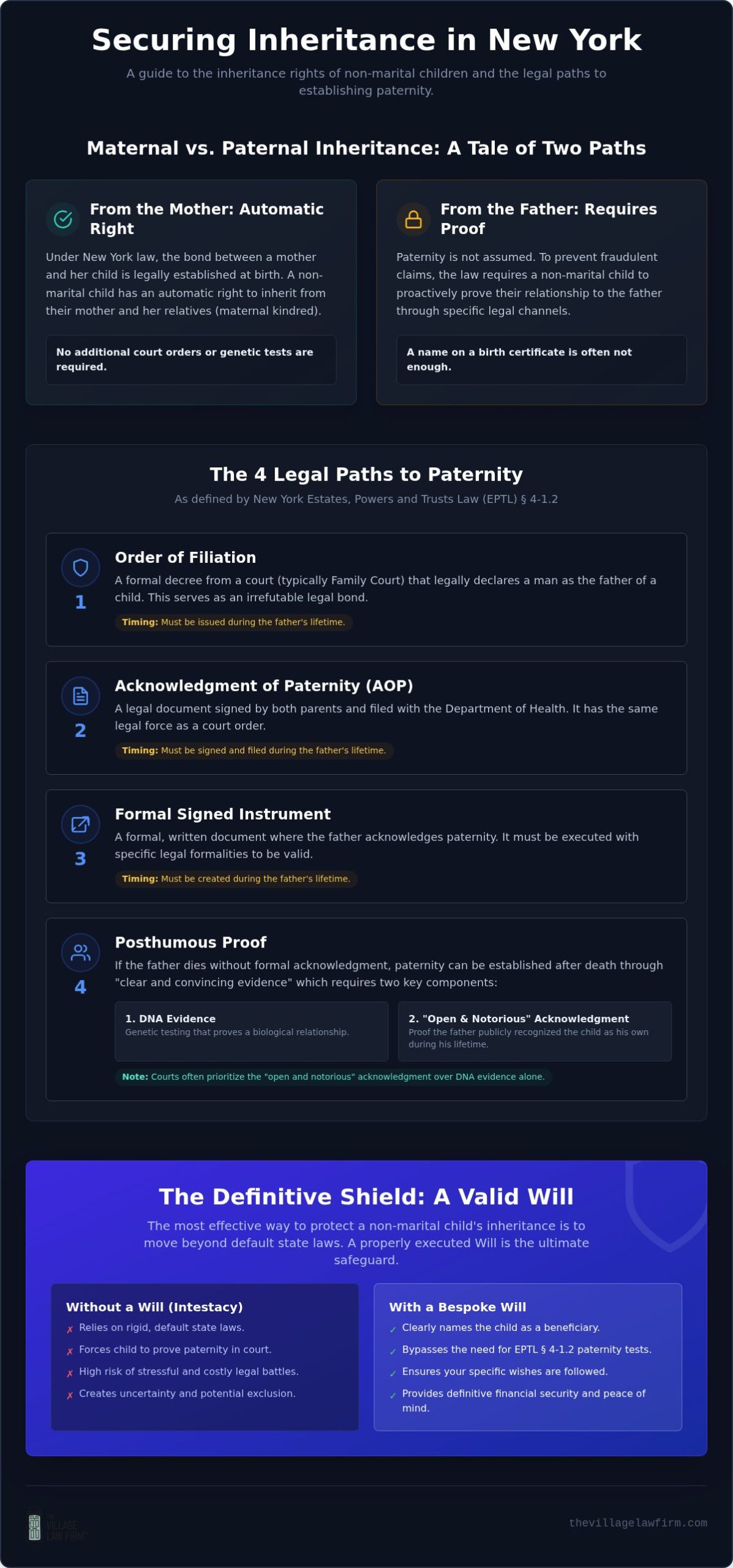
Under New York law, the bond between a mother and her child is considered legally established at birth. A non-marital child is viewed as the legitimate heir of their mother without the need for additional court orders or genetic testing. This automatic right extends beyond the mother’s immediate assets. It includes the right to inherit from “maternal kindred,” such as grandparents, aunts, or uncles, should they die without a Will. Historically, the concept of Legitimacy (family law) created significant barriers for children, but modern New York statutes have removed these hurdles for maternal inheritance. The child stands in the same legal position as any child born within a marriage.
Why the Father’s Estate Requires Additional Legal Steps
The rules change when we look at the paternal side. Paternity is not a given in the eyes of the Surrogate’s Court. While the law has evolved, securing the inheritance rights of a child born out of wedlock in New York from a father’s estate still requires meeting specific evidentiary standards. This isn’t meant to be exclusionary, but rather to prevent “probate chaos” where distant or fraudulent claimants might appear after a death.
The court acts as a protective shield for the estate’s integrity. Because a father’s name on a birth certificate isn’t always enough to satisfy New York’s high bar for inheritance, additional steps are mandatory. Without a Will, a non-marital child must proactively prove their relationship to the father through specific legal channels. This process replaces uncertainty with the stability of a court-recognized bond, ensuring the child’s financial security is grounded in legal fact rather than mere biological reality.
Establishing Paternity Under EPTL §4-1.2: The Four Paths
The New York Estates, Powers and Trusts Law § 4-1.2 is the definitive gatekeeper for non-marital inheritance. To protect the inheritance rights of a child born out of wedlock in New York, the law requires that paternity be established through one of four specific, mandatory paths. It’s a rigid framework designed to prevent fraudulent claims, but for legitimate heirs, it can feel like a series of legal hurdles. Timing is critical. Several of these paths require action while the father is still alive. If you wait until after a parent passes, your options narrow significantly.
A common misconception is that a father’s name on a birth certificate is a silver bullet. While helpful, New York courts often require more formal proof in contested estates. Relying on default assumptions can lead to exclusion from a legacy. Without a clear legal strategy, the transition of wealth can quickly descend into a stressful court battle.
Orders of Filiation and Formal Acknowledgments
The most secure paths involve formal documentation. An Order of Filiation is a decree from a court, typically Family Court, issued during the father’s lifetime. It serves as an irrefutable legal bond. Alternatively, an Acknowledgment of Paternity (AOP) can be signed by both parents and filed with the Department of Health. This document has the same legal effect as a court order. A third path involves a “signed instrument,” which is a formal writing by the father acknowledging paternity, provided it meets specific legal formalities. These methods replace doubt with legal certainty, ensuring the child’s status is never in question during probate.
Clear and Convincing Evidence: The Modern Standard
If no formal documents exist, the law turns to the “clear and convincing” standard. This is a high evidentiary bar. In 2026, genetic marker tests (DNA) provide the biological foundation for many probate proceedings. However, New York requires a two-pronged approach. You must provide biological proof and demonstrate that the father “openly and notoriously” acknowledged the child. This means he didn’t keep the relationship a secret. He told friends, family, or the community that the child was his. Proving this social reality requires gathering specific, everyday evidence to build a persuasive narrative for the Surrogate’s Court.
If you are currently navigating a sensitive family situation, our firm can help you structure an estate plan that provides a shield against this legal uncertainty and ensures your legacy is protected.
Proving “Open and Notorious” Acknowledgment in NYC Courts
Biology tells one story, but the law often demands another. While a DNA test provides scientific certainty, New York’s legal standard for the inheritance rights of a child born out of wedlock in New York frequently hinges on the “open and notorious” acknowledgment of paternity. This means the father must’ve publicly recognized the child as his own during his lifetime. Secrecy is a significant hurdle in probate. If a relationship was kept hidden from the father’s social or professional circles, scientific proof alone might not be enough to satisfy the court.
In 2026, the definition of “public” has expanded. NYC courts now look beyond physical interactions to digital footprints. We see social media posts, private message threads, and digital photo albums serving as vital evidence of a father’s public acknowledgment. This modern lens allows us to build a more comprehensive narrative of the relationship, bridging the gap between biological facts and legal recognition. It’s about showing the court a lived reality, not just a lab report.
Documentary Evidence: From Tax Returns to Birthday Cards
Building a persuasive case requires a meticulous curation of the father’s life records. The court looks for a pattern of behavior rather than a single event. Our firm provides a white-glove approach to gathering these sensitive documents, ensuring no detail is overlooked. Key evidence includes:
- Tax Returns: Listing the child as a dependent is powerful evidence of legal and financial recognition.
- Insurance Enrollments: Adding a child to health or life insurance policies demonstrates a commitment to their long-term security.
- School and Medical Records: Documents where the father is listed as a parent or emergency contact.
- Personal Correspondence: Birthday cards, letters, or emails where he identifies himself as “Dad.”
While the father’s name on a birth certificate is a strong starting point, it isn’t always definitive in a contested estate. It must be supported by these broader life records to create an unshakeable foundation for the child’s claim. We help families organize these intimate records into a clear, professional presentation for the court.
The Role of Disinterested Witnesses and Affidavits
Personal records are only one side of the coin. The court also relies heavily on the testimony of people who knew the father. However, not all voices carry the same weight. Judges are naturally skeptical of testimony from family members who stand to gain financially from the estate’s distribution. This is why we focus on identifying and interviewing disinterested witnesses.
A disinterested witness is a person with no financial stake in the estate outcome. This might include a neighbor who saw the father and child together every weekend, a teacher who spoke with the father at parent-teacher conferences, or a long-time colleague. Their affidavits provide the objective, external validation the court needs to confirm that the father’s acknowledgment was indeed open and notorious. Identifying these individuals requires a patient, methodical approach to ensure the child’s legacy is protected from future uncertainty.
Protecting Your Child’s Legacy: Moving Beyond Default Laws
Relying on New York’s default rules for intestate succession is a high-risk strategy for modern families. When you leave a legacy to the whims of the state, you’re essentially inviting the court to define the boundaries of your family. For non-marital children, this often results in the stressful, public, and expensive evidentiary battles we explored in previous sections. You don’t have to leave a child’s financial security to chance. Proactive estate planning for families with children NYC replaces these default laws with your own specific, legally binding instructions. It moves your family from a state of reactive defense to one of proactive security.
The inheritance rights of a child born out of wedlock in New York are most vulnerable when there is no plan in place. Without a Will, the burden of proof falls entirely on the child or their guardian. This process can take months, or even years, leaving the child’s needs unmet while assets are frozen in probate. We believe in building a bridge between current complexity and future order, ensuring that your intentions are the only ones that matter when it counts most.
The Power of a Bespoke New York Will
A bespoke New York Will serves as the ultimate shield for your child’s inheritance. It allows a father to name any child as a beneficiary, regardless of their marital status or whether paternity was formally established during his lifetime. In the eyes of the Surrogate’s Court, a specific bequest in a valid Will is a direct command. It bypasses the need for the “clear and convincing” evidence required in intestate cases. By working with a skilled estate planning attorney New York, you can ensure your Will is drafted with the meticulous attention to detail necessary to survive potential challenges from other relatives. This document replaces legal ambiguity with absolute clarity.
Using Trusts to Minimize Conflict and Maximize Privacy
While a Will is a powerful tool, it remains a public document once it enters probate. If you value privacy and wish to shield your family dynamics from the public record, a Trust may be a more sophisticated solution. We often guide families through the benefits of Revocable versus Irrevocable Trusts to provide long-term financial security. A trust functions as a private contract, allowing assets to pass directly to a child without the delay, cost, or scrutiny of the Surrogate’s Court. This approach embodies a “partnership” mindset, where assets are managed by a trusted trustee for the child’s benefit. It creates a sanctuary of order and calm, protecting your child from the chaos of a contested estate. If you’re ready to secure your family’s future, our team is here to help you design a plan that acts as a definitive shield against future uncertainty.
Sophisticated Planning for Modern and International Families
New York City is a global crossroads. For many families here, life isn’t contained within the five boroughs. You might have a bank account in London, a second home in the Caribbean, or children living across different continents. This international footprint is a mark of success, but it introduces significant legal friction. When you’re managing the inheritance rights of a child born out of wedlock in New York, these complexities multiply as soon as a border is crossed. Relying on local default laws is no longer enough when your legacy spans jurisdictions.
Foreign legal systems often have vastly different views on family structure and heirship. What works in a Manhattan Surrogate’s Court might not hold up in a European or South American court. Our firm specializes in international estate planning, helping you bridge the gap between conflicting laws. We move you from a state of reactive anxiety to a position of meticulous order. This ensures your child’s future remains secure regardless of where your assets are located. It’s about building a sanctuary of stability in a fast-paced, unpredictable world.
Cross-Border Challenges for Non-Marital Children
New York’s EPTL 4-1.2 provides a clear framework within the state, but it doesn’t have global reach. Many countries still adhere to restrictive or traditional definitions of family that could exclude a non-marital child from inheriting real estate or accounts located there. If you own property outside of New York, your heirs might eventually face ancillary probate in New York or similar secondary proceedings abroad. We provide a white-glove service that coordinates with foreign counsel to manage these global asset distributions. Our goal is to act as a shield against international legal chaos, ensuring that your intentions are honored everywhere.
Medicaid and Long-Term Security for Your Children
True security means looking at the entire lifecycle of your wealth. It isn’t just about who receives the money; it’s about making sure the assets are still there when the time comes. Long-term care costs in NYC are notoriously high and can quickly erode a child’s inheritance if you haven’t planned ahead. By working with a Medicaid planning attorney New York, you can protect your legacy from being consumed by nursing home fees. This partnership-based approach ensures that the wealth you’ve built stays within your family. We combine technical precision with a deeply human touch to provide long-term financial security for your children. You’ve worked hard to build a legacy. Don’t let legal complexity dismantle it. Let’s walk alongside you to create a plan that reflects your values and protects those you love most.
Securing Your Legacy Through Meticulous Planning
Protecting a child’s future shouldn’t be left to the rigid defaults of state law. Biological reality doesn’t automatically equate to legal entitlement in the Surrogate’s Court. To fully secure the inheritance rights of a child born out of wedlock in New York, you must move beyond the uncertainty of intestacy. Whether it’s gathering clear and convincing evidence for a probate proceeding or drafting a bespoke Will that leaves no room for doubt, proactive steps are your strongest shield. You have the power to define your family’s future on your own terms.
Our firm brings a calming, high-end approach to these sensitive family matters. We offer specialized expertise in complex international and cross-border estate administration, ensuring your legacy is protected across every jurisdiction. Modern families require a partner who values both technical precision and deep emotional intelligence. By establishing a clear, legally sound framework today, you replace potential chaos with a sanctuary of order and stability. Secure your family’s future with a sophisticated New York estate plan; contact The Village Law Firm today.
Frequently Asked Questions
Can a child born out of wedlock inherit if there is no Will in New York?
Yes, non-marital children have a legal right to inherit under New York’s intestacy laws, provided they meet specific evidentiary standards. Because there is no Will to dictate terms, the Surrogate’s Court relies on the criteria set forth in EPTL 4-1.2. Securing the inheritance rights of a child born out of wedlock in New York in these cases often involves proving a formal acknowledgment or a public, consistent relationship with the father.
Is a DNA test enough to prove inheritance rights in NY Surrogate’s Court?
A DNA test provides a powerful biological foundation, but it isn’t always sufficient on its own. New York courts typically require a two-pronged approach under the “clear and convincing” standard. You must provide genetic proof and demonstrate that the father openly acknowledged the child during his lifetime. This social recognition ensures the relationship was a matter of public record, effectively preventing fraudulent claims from disrupting the orderly distribution of the estate.
Does being on the birth certificate automatically give a child inheritance rights?
No, having a father’s name on a birth certificate does not grant automatic inheritance rights in New York. While it’s a significant piece of evidence, the Surrogate’s Court requires more formal proof like a signed Acknowledgment of Paternity or a court order. If these aren’t present, you’ll likely need to provide additional documentation to prove the father openly recognized the child as his own to friends, family, or the community.
What is the “open and notorious” requirement for paternity in New York?
The “open and notorious” requirement means the father publicly and consistently recognized the child as his own. He didn’t keep the relationship a secret. Courts look for evidence like the father’s name on school records, his presence at family events, or testimony from disinterested neighbors. This standard protects the inheritance rights of a child born out of wedlock in New York by establishing a social reality that mirrors the biological one.
Can a non-marital child inherit from their father’s parents (grandparents)?
Yes, a non-marital child can inherit from their paternal grandparents through representation if their father has already passed away. However, the child must first establish legal paternity from the father using the same strict standards required for the father’s own estate. Once paternity is confirmed under EPTL 4-1.2, the child stands in the father’s shoes, gaining the right to inherit from the broader paternal family line with full legal standing.
How long does a non-marital child have to claim an inheritance in NY?
Timing is critical in New York probate. While there isn’t a single claim date for every situation, a child should act as soon as an estate proceeding begins in the Surrogate’s Court. If the estate is distributed to other heirs, recovering those assets becomes significantly more difficult. In cases where paternity must be established after death, specific legal timelines apply, making it essential to seek professional guidance immediately after a parent’s passing.
What happens if the father acknowledged the child but died before a court order was issued?
If a father died before a formal court order was finalized, the child must rely on the clear and convincing evidence path. This involves presenting biological proof, such as DNA from the father or close relatives, alongside evidence of open and notorious acknowledgment. Even without a final Order of Filiation, a legacy can still be secured if you can demonstrate a consistent, public bond that existed before the father’s death through credible testimony.
How can I prevent a legal battle over my child’s inheritance?
The most effective way to prevent a contested battle is to move beyond default state laws. By creating a bespoke Will or a Revocable Living Trust, you can specifically name your child as a beneficiary. This proactive planning removes the burden of proving paternity from the child and places your intentions into a legally binding document. It replaces the unpredictability of the court system with a sanctuary of order and long-term financial security.