
Imagine standing in a quiet bank branch on Madison Avenue, death certificate in hand, only to be told you have no authority to access your father’s accounts. It’s a moment where grief meets a cold wall of bureaucracy. Without a will, your family is left in a legal limbo that feels both overwhelming and deeply personal. To move forward, you need to secure letters of administration NY, the essential court order that grants you the legal power to settle the estate. We understand that this process feels like a weight you weren’t prepared to carry.
You’re likely feeling the pressure of the NYC Surrogate’s Court backlog and the quiet worry that family tensions might flare during this transition. It’s a heavy burden to carry alone. This guide offers a sophisticated roadmap to obtaining your Decree Granting Letters of Administration with grace and precision. We’ll explore the 2026 filing fees, the order of priority for administrators, and the exact steps needed to secure everything from local accounts to complex international assets. Let’s replace the current chaos with a sense of order and long-term security.
Key Takeaways
- Identify the critical legal differences between probate and estate administration to ensure you pursue the correct path for a loved one who died without a will.
- Learn the strict order of priority for administrators to help resolve family disputes before they reach the Surrogate’s Court.
- Master the procedural requirements for obtaining letters of administration NY, including how to navigate current 2026 filing fees and documentation.
- Establish a realistic timeline for estate settlement and understand the mandatory seven-month waiting period for creditor claims.
- Understand how to manage complex or international assets using ancillary administration to protect your family’s global legacy.
What are Letters of Administration in New York?
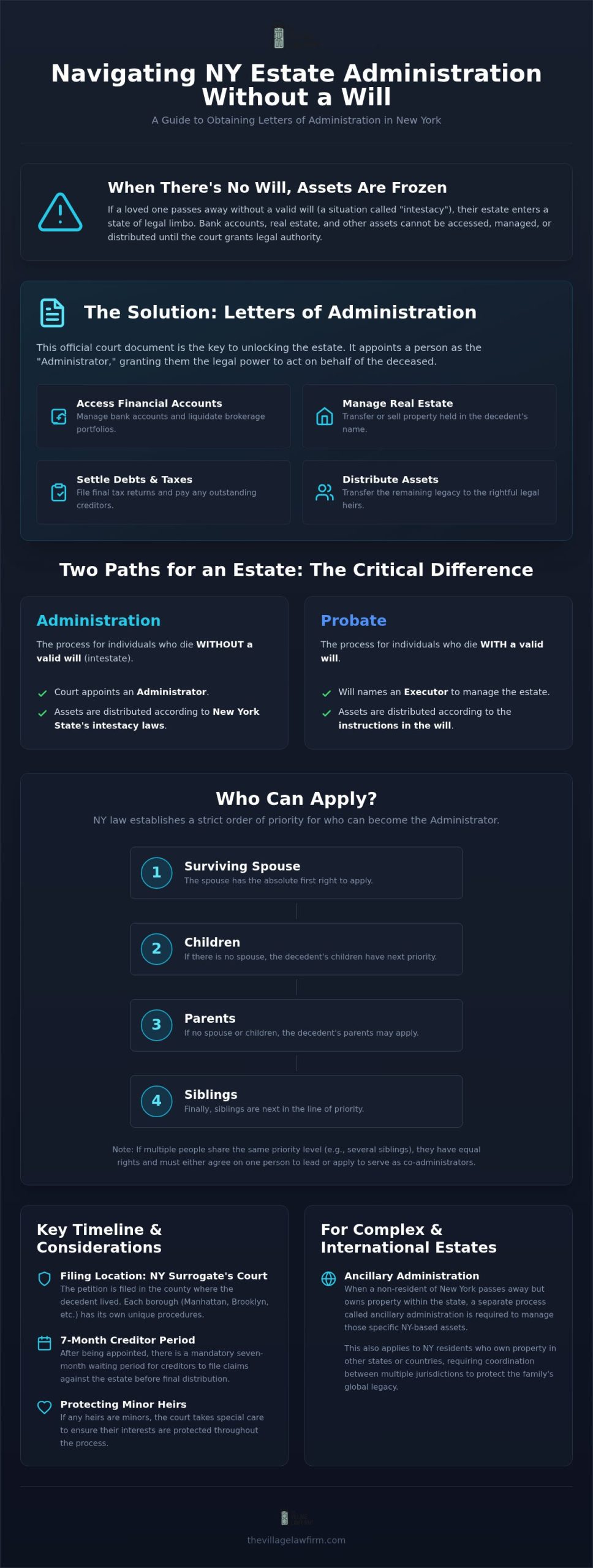
When a loved one passes away in New York without leaving a valid will, the family often enters a state of legal suspension. You can’t simply walk into a bank or list a family home for sale. To gain the power to manage these affairs, you must obtain a specific court document. In legal terms, Letters of Administration serve as your official badge of authority. This document, issued by the court, transforms an individual into an “Administrator,” granting them the legal standing to settle the estate. While the New York probate process applies when a will exists, “Administration” is the parallel path for those who died intestate.
Securing letters of administration NY is a mandatory step for several critical tasks. Without this document, the decedent’s assets remain frozen and out of reach. You’ll need this authority to:
- Access bank accounts or liquidate brokerage portfolios.
- Transfer or sell real estate held solely in the decedent’s name.
- File final tax returns and settle outstanding debts with creditors.
- Distribute the remaining legacy to the rightful legal heirs.
The Role of the New York Surrogate’s Court
The Surrogate’s Court serves as the sanctuary of order for these proceedings. Its primary duty is to protect the interests of the deceased and ensure that the rightful heirs are treated with fairness. In New York, the specific court you visit depends on where the decedent lived. Filing for letters of administration NY in Manhattan often feels different than filing in Brooklyn, Queens, or the Bronx. Each borough’s court has its own unique “filing culture” and specific procedural preferences. Our team understands these local nuances, helping you move through the system with precision rather than frustration.
When “Intestacy” Triggers the Need for Letters
Intestacy is the legal term for dying without a valid Last Will and Testament. It’s a common situation that leaves the state to decide how your assets are distributed. However, intestacy isn’t the only trigger for this process. Sometimes a will exists, but the named executor has passed away, and no successor was listed in the document. In these cases, the court must appoint an administrator to bridge the gap and complete the work. Intestate Succession is the default legal “will” the State of New York provides for those who didn’t create their own. It dictates a strict hierarchy of who receives assets, leaving no room for personal preference or unique family dynamics.
Who Can Apply? The Order of Priority in NY Intestacy
Determining who has the right to lead an estate is often the first point of friction for grieving families. New York law does not leave this to chance or family vote. Instead, the Surrogate’s Court Procedure Act (SCPA) § 1001 establishes a rigid hierarchy of who is entitled to receive letters of administration NY. These individuals are known as “distributees,” the specific group of people who stand to inherit under the laws of intestacy. Understanding your place in this line is essential before beginning the application process.
The court seeks stability and clear lines of authority. While the law is precise, the human element is often complex. For families with children, the stakes are particularly high. If a parent passes without a will, the court must ensure that the person seeking authority is not only legally entitled to do so but also capable of protecting the interests of minor heirs. Professional guidance can help clarify these roles and prevent the process from stalling due to internal family disagreements. If you are unsure of your standing, our team can help you evaluate your eligibility to serve as a fiduciary.
New York’s Legal Hierarchy of Kin
The NYC Bar on Administrator Priority highlights that the surviving spouse holds the absolute first right to apply. If there is no spouse, the priority moves down a specific ladder:
- Step 1: Surviving Spouse
- Step 2: Children (or grandchildren if the child is deceased)
- Step 3: Parents of the decedent
- Step 4: Siblings
When multiple people share the same priority level, such as three siblings, the court views them as having equal rights to serve. This often requires siblings to sign “waivers and consents” to allow one person to lead, or they may choose to serve as co-administrators. In rare cases where no eligible family members are available or willing to act, the court may appoint the Public Administrator to manage the estate’s affairs.
Eligibility and Disqualifications for Administrators
Holding a high spot in the hierarchy does not guarantee appointment. To obtain letters of administration NY, an applicant must be over 18 years old, of sound mind, and not a convicted felon. The court takes its protective role seriously. It may disqualify an individual for “unfitness” if there is evidence of substance abuse, extreme improvidence, or a history of financial dishonesty. Non-US citizens living abroad face additional hurdles; they typically cannot serve alone and must often appoint a New York resident to serve alongside them as a co-administrator to ensure the estate remains within the court’s jurisdiction.
The Step-by-Step Process for Filing in New York
The path to securing letters of administration NY is a methodical journey that transforms personal loss into legal authority. It begins with the collection of vital records. You must obtain the original death certificate; the court will not accept photocopies for this foundational requirement. Once you have this document, you’ll prepare the “Petition for Letters of Administration.” This formal filing identifies the decedent, all potential distributees, and a preliminary valuation of the estate’s assets. Accuracy here is paramount, as this data determines both the court’s filing fees and the scope of your initial authority.
The most delicate phase of the process involves managing the other distributees. To streamline the filing, you’ll ask each person with an equal or higher right to serve to sign a “Waiver and Consent” form. This document confirms they agree to your appointment and waive their right to a formal court hearing on the matter. If a family member refuses to sign, the process doesn’t stop, but it does shift. The court will then issue “Citations,” which are formal notices requiring those individuals to appear in court on a specific date to voice any objections. While this ensures everyone’s rights are protected, it often adds weeks or months to the timeline.
Required Documentation and Court Forms
Success in the Surrogate’s Court relies on meticulous attention to detail. Your filing package typically includes the original death certificate, the verified Petition, and an Affidavit of Heirship. This affidavit is particularly critical in New York when there is only one distributee or when the kin are more distant relatives. In many NYC boroughs, you’ll also need to provide an “Affidavit of Comparison.” This specific document confirms that the copies you’ve submitted are identical to the originals held in your possession. We recommend an exacting review of all asset values before submission to avoid the need for amended filings later.
Understanding Bonds and Waivers
An Administrator’s Bond acts as an insurance policy for the estate. It protects the heirs and creditors from potential financial mismanagement or errors during the administration process. While you can request a bond waiver if all distributees consent, the court retains the final discretion. They may mandate a bond if the estate carries significant debt or if the interests of minor children must be shielded. Asking family members to sign these legal waivers carries a unique emotional weight. It requires a high level of transparency and trust, making clear communication essential to maintaining family bonds while you navigate the legal system.
Timelines, Costs, and Common Roadblocks in 2026
Efficiency is a hallmark of professional service; however, the NYC Surrogate’s Court operates on its own deliberate clock. In 2026, the typical processing time for letters of administration NY ranges from 3 to 9 months for uncontested estates. This timeline assumes all documentation is flawless and every distributee is cooperative. If a family member is missing or refuses to sign a waiver, the court must schedule hearings, which can easily double the wait time. Once the decree is finally issued, your first act must be obtaining a Federal Tax ID (EIN) from the IRS to open an estate bank account.
Financial transparency starts with the court’s filing fees, which are calculated based on the estate’s gross value. For 2026, the fee schedule is as follows:
- Estates from $50,000 to under $100,000: $280
- Estates from $100,000 to under $250,000: $420
- Estates from $250,000 to under $500,000: $625
- Estates of $500,000 or more: $1,250
If you’re facing a complex family dynamic or a significant asset pool, it’s wise to schedule a consultation with our administration team to ensure your filing is structured for maximum efficiency.
Managing Creditors and Estate Debts
Your appointment as administrator carries a significant fiduciary duty to the decedent’s creditors. New York law provides a mandatory 7-month window for creditors to come forward with valid claims after letters are issued. You shouldn’t distribute assets to heirs until this period has safely passed. If you distribute funds prematurely and a legitimate debt surfaces later, you could face personal liability for that amount. It’s a risk that requires a patient, methodical approach to financial settlement.
Handling Real Estate and NYC Property
In the specific context of the New York market, your Letters are the only key that unlocks the sale of a co-op or condo. Board members and title companies won’t recognize your authority without a recent Certificate of Letters. While the court usually grants a broad “power of sale,” they may occasionally impose restrictions if they feel the estate needs extra oversight. For those looking beyond the immediate administration toward long-term security, integrating asset protection strategies can shield the family’s legacy from future uncertainty.
Sophisticated Support for Complex and International Estates
New York’s international character means many families face estates that stretch far beyond the five boroughs. When assets are scattered across borders, the standard administrative process gains layers of significant complexity. Obtaining letters of administration NY is the essential first step, but it’s often just the beginning of a larger global coordination. You may find that foreign banks require specific legal validations or that you must initiate ancillary probate to manage property located in other states or countries. This process requires a partner who understands exactly how the NYC Surrogate’s Court interacts with international legal systems.
Managing a global legacy involves more than just identifying accounts. It requires a deep understanding of how different jurisdictions treat intestate succession. Our firm specializes in cross-border estate administration, providing the meticulous attention to detail required to secure assets in multiple time zones. We act as your steady guide, ensuring that the transition of wealth is handled with the same sophistication and care that went into building it.
Cross-Border Estate Administration
International tax treaties and varying inheritance laws can create a labyrinth for the unprepared administrator. While your New York authority is powerful, foreign jurisdictions often have their own rules regarding “forced heirship” or unique local estate taxes. Global assets require a global perspective in legal counsel. We help you navigate these legal intersections, ensuring that your authority is recognized and respected from Manhattan to Madrid. Our team handles the heavy lifting of coordinating with foreign counsel and tax professionals, allowing you to focus on your family’s well-being.
The Village Law Firm: Your Partner in Legacy Protection
We provide more than just legal filings; we offer a sanctuary of order in a time of profound transition. Our white-glove approach is designed to remove the burden of legal complexity from your shoulders. We view estate settlement as a partnership focused on your family’s long-term security. By replacing anxiety with a methodical roadmap, we ensure every asset is secured and every legal requirement is met with precision. Once the current estate is settled, it’s vital to transition from reactive administration to a proactive future estate plan. We invite you to schedule a consultation today to replace uncertainty with a sense of order and lasting peace of mind.
Secure Your Family’s Legacy with Clarity and Order
The weight of managing a loved one’s estate shouldn’t rest solely on your shoulders. By understanding the legal hierarchy of kin and the methodical steps required to secure letters of administration NY, you can transform a period of uncertainty into one of structured resolution. Whether you’re navigating the nuances of NYC Surrogate’s Courts or protecting complex international assets, precision and empathy are your greatest allies. We replace the chaos of bureaucracy with a clear, calming path forward.
At The Village Law Firm, we provide a sanctuary of order amidst the complexities of estate settlement. Our white-glove approach combines deep expertise in cross-border administration with a commitment to long-term legacy protection. We don’t just file paperwork; we partner with you to ensure every asset is secured and every family interest is shielded. From strategic Medicaid planning to intricate international tax treaties, we handle the technical precision so you can focus on what truly matters. It’s about more than just legal authority; it’s about peace of mind.
Secure your family’s legacy; schedule a consultation with The Village Law Firm today. You’ve already taken the first step by seeking clarity. Let us help you walk the rest of the path with confidence and professional excellence.
Frequently Asked Questions
How long does it take to get Letters of Administration in NYC?
In 2026, obtaining letters of administration NY in NYC typically takes between 3 and 9 months for uncontested estates. This timeline depends heavily on the specific borough’s court backlog and the completeness of your initial filing. If family members are uncooperative or if there are missing distributees, the process can easily extend beyond a year. Working with a dedicated partner ensures your petition is prioritized and free of the technical errors that often cause delays.
Can a non-resident of New York be an administrator?
Yes, a non-resident can serve as an administrator, but specific conditions apply. If you live outside New York but within the United States, the court may require you to post a fiduciary bond to protect the estate’s assets. However, if you are not a US citizen and live abroad, you generally cannot serve alone. In these sophisticated cross-border cases, you must often appoint a New York resident to act as a co-administrator.
What is the difference between an Executor and an Administrator?
The primary difference lies in how the individual is chosen. An executor is specifically named in a valid Last Will and Testament to manage the estate. In contrast, an administrator is appointed by the Surrogate’s Court when someone dies without a will, a state known as intestacy. While their daily duties of settling debts and distributing assets are nearly identical, the administrator must follow a strict legal hierarchy established by New York law.
Do I need a lawyer to get Letters of Administration in NY?
While New York law doesn’t strictly require you to hire an attorney, the process is notoriously unforgiving of minor procedural mistakes. The Surrogate’s Court demands meticulous documentation, from the Affidavit of Heirship to precise asset valuations. For estates involving real property, minor children, or international assets, professional counsel is essential. We help you replace the anxiety of legal bureaucracy with a methodical, white-glove roadmap that ensures your family’s long-term security.
What happens if family members disagree on who should be the administrator?
When distributees of equal priority, such as multiple siblings, cannot agree on who should lead, the court may intervene. Initially, you’ll attempt to secure waivers and consents from all parties. If consensus is impossible, the court issues Citations to bring all parties before a judge for a hearing. In some instances, the court might appoint co-administrators or, if the conflict is too severe, designate the Public Administrator to manage the estate’s affairs impartially.
How much does the Surrogate’s Court charge for filing an administration petition?
Filing fees in New York are determined by the gross value of the estate assets. For estates valued between $100,000 and $250,000, the fee is $420. This increases to $625 for estates up to $500,000, and reaches a maximum of $1,250 for estates exceeding half a million dollars. These costs are paid directly to the court at the time of filing and are necessary to move your petition for letters of administration NY forward.
What is a “Bond” and why does the court require it?
A fiduciary bond is essentially an insurance policy that protects the estate’s heirs and creditors from potential financial mismanagement. The court often requires this bond to ensure the administrator acts with unwavering integrity. While all distributees can sign a waiver to request that the bond be excused, the Surrogate’s Court retains the final authority to mandate one. This is especially common if the estate has significant debts or involves the interests of minor children.
Can I access bank accounts before the Letters of Administration are issued?
No, you cannot legally access or transfer funds from the decedent’s individual bank accounts until the court issues your formal decree. Financial institutions are strictly regulated and will require a certified copy of your Letters before granting any authority. Attempting to manage assets prematurely can lead to personal liability or complications with the court. Once your authority is established, you’ll obtain an EIN and open a dedicated estate account to begin the settlement process.