
Could you actually qualify for Medicaid today without spending every dollar you’ve ever saved? It’s a question that keeps many New Yorkers awake at night, especially as the cost of long-term care in the city continues to climb. You’ve worked decades to build a legacy, and the thought of it disappearing into a “spend-down” requirement feels like a betrayal. A Medicaid compliant annuity New York allows you to protect your spouse and your home while bypassing the anxiety of the five-year look-back period.
You deserve the peace of mind that comes with knowing your legacy is secure. We’ll show you how to transform “countable” assets into a protected income stream, allowing you to qualify for benefits immediately under current New York law. This isn’t just about paperwork; it’s about providing a sanctuary of order in an unpredictable time. Our goal is to replace your stress with a clear, methodical path forward that treats your life’s work with the respect it deserves.
In this 2026 guide, we’ll strip away the complexity of the application process and explain exactly how this strategic tool serves as a shield for your life savings. We’ll walk through the specific regulations that allow you to secure your family’s future without the trauma of financial ruin.
Key Takeaways
- Learn how to convert excess assets into protected income to halt the “spend-down” process immediately and preserve your life savings.
- Understand why a Medicaid compliant annuity New York must be irrevocable and non-assignable to meet strict 2026 legal standards.
- Discover why an annuity is often the superior tool for crisis planning compared to irrevocable trusts when facing an immediate nursing home admission.
- Identify the critical requirements for selecting a compliant insurance carrier to ensure your application is accepted by New York state authorities.
- Transition from financial anxiety to long-term security by protecting your spouse’s quality of life and your family’s legacy.
The Medicaid Spend-Down Crisis in New York: Why an Annuity?
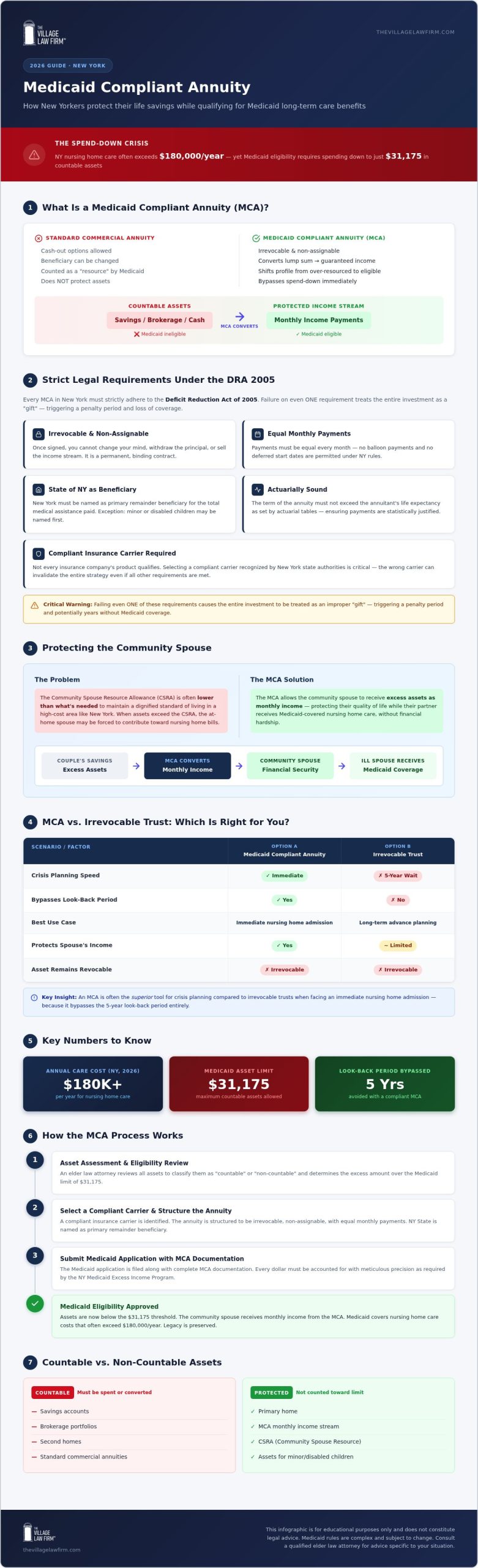
The financial reality of aging in New York is stark. By 2026, the annual cost of nursing home care in the state often exceeds $180,000. For many families, this isn’t just a number on a balance sheet; it’s a looming threat to everything they’ve built. When a loved one requires professional care, the state’s eligibility rules can feel like a trap. To qualify for the Medicaid long-term care program, an individual is typically restricted to keeping just $31,175 in countable assets. This “spend-down” requirement forces families to deplete their savings rapidly, leaving very little for the future or for a spouse who remains at home.
This is where a Medicaid compliant annuity New York becomes a vital tool. It isn’t a traditional investment meant for market growth. Instead, it’s a specialized financial instrument designed to provide a sanctuary of order. By converting a lump sum of “countable” cash into a guaranteed stream of income, you can bypass the spend-down crisis. It effectively shifts your financial profile from “over-resourced” to “eligible” in the eyes of the state, often without the standard waiting periods associated with other planning methods.
Countable vs. Non-Countable Assets in New York
New York Medicaid officials look closely at your holdings to determine eligibility. Savings accounts, brokerage portfolios, and second homes are considered “countable” assets that must be spent before benefits begin. It’s a common mistake to assume a standard commercial annuity provides protection. It doesn’t. Most commercial products allow for cash-out options or beneficiary changes that disqualify them from Medicaid’s strict rules. A true Medicaid compliant annuity New York performs a legal transformation. It turns a vulnerable lump sum into a non-countable income stream, providing immediate relief from the pressure of asset depletion.
The Protective Power of the ‘Community Spouse’ Allowance
The greatest anxiety often centers on the “community spouse,” the partner who stays in the family home. New York law provides a Community Spouse Resource Allowance (CSRA), but this limit is frequently lower than what’s needed to maintain a dignified standard of living in a high-cost area. When assets exceed the CSRA, the spouse at home is often forced to contribute toward nursing home bills. An MCA bridges this gap perfectly. It allows the community spouse to receive the excess assets as monthly income, ensuring they aren’t left in financial hardship while their partner receives the care they need. It’s a sophisticated way to protect both your partner’s quality of life and your family’s legacy.
The Strict Legal Anatomy of a Medicaid Compliant Annuity in NY
A Medicaid compliant annuity New York isn’t a standard financial product you’ll find at a local retail bank. It’s a rigid legal structure that must adhere strictly to the Deficit Reduction Act of 2005 (DRA). If the document fails to meet even one federal or state requirement, the entire investment is treated as a “gift,” triggering a penalty period that could leave you without coverage for years. To avoid this, the annuity must be irrevocable and non-assignable. This means once the contract is signed, you cannot change your mind, withdraw the principal, or sell the income stream to a third party. It’s a permanent decision designed to provide a sanctuary of financial order.
The payment structure is equally disciplined. The annuity must provide equal monthly payments with no balloon payments or deferred start dates allowed. This predictability is essential for meeting the requirements of the New York Medicaid Excess Income Program, which monitors how your resources are converted into income. Every dollar must be accounted for with meticulous precision to ensure your eligibility remains intact from the moment the first payment arrives.
The State of New York as Remainder Beneficiary
One of the most significant legal mandates is the beneficiary designation. To qualify, the State of New York must be named as the primary remainder beneficiary for the total amount of medical assistance paid on your behalf. While this feels like a high price to pay, it’s the legal bridge that allows you to protect your spouse today. There are, however, vital exceptions for families with minor or disabled children. In these specific cases, a child can be named as a priority beneficiary, ensuring the funds stay within the family. Navigating these nuances is a core part of our Medicaid planning approach, where we focus on protecting the most vulnerable members of your legacy.
Actuarial Soundness and the Social Security Life Expectancy Table
New York auditors use a specific lens to view these annuities: actuarial soundness. The annuity’s term must be shorter than your remaining life expectancy as defined by the Social Security Administration’s tables. If the term is too long, the state views the purchase as a disguised gift to your heirs rather than a legitimate income plan. Using the wrong table or miscalculating your life expectancy by even a few months can result in a catastrophic denial of benefits. Professional oversight is non-negotiable here; the technical precision required to align with state expectations is what separates a successful application from a costly financial mistake.
Strategic Comparison: MCAs vs. Irrevocable Trusts in NY
Choosing between a trust and an annuity depends entirely on your timeline. Irrevocable trusts are the gold standard for long-term protection, but they require a five-year lead time before institutional Medicaid benefits kick in. If you’re planning for the future, a trust offers more control over how assets are managed and eventually distributed to heirs. If you’re facing a medical crisis today, the trust’s five-year look-back period becomes an insurmountable wall. This is where a Medicaid compliant annuity New York serves as a vital alternative. It provides a solution for those who didn’t plan years in advance, offering a way to qualify for care without losing every asset. While you sacrifice liquidity and control over the principal, the trade-off is immediate eligibility and the preservation of your spouse’s lifestyle.
Crisis Planning: When the 5-Year Window Has Already Closed
When a family member needs immediate nursing home placement, the luxury of waiting five years is gone. In these high-stakes scenarios, an MCA is often the only viable path to eligibility. While an Irrevocable Trust Attorney NYC: Sophisticated Asset Protection for 2026 can help you build a long-term fortress, the annuity acts as the emergency exit. It allows you to convert assets that would otherwise be “spent down” into an income stream for the community spouse. We often use a “Gift and Note” strategy in tandem with these annuities to maximize what stays in the family. This ensures that even in a crisis, you aren’t left defenseless against the high costs of NYC care. The setup fees for an annuity are often a fraction of the total savings, making it a highly cost-effective intervention for families in distress.
The ‘Rule of Halves’ Strategy for NY Seniors
Even if you’ve done no prior planning, you don’t have to lose everything to the state. The “Rule of Halves” is a sophisticated mathematical approach used by a Medicaid planning attorney New York to save approximately 50% of your countable assets. This strategy relies on the 42 U.S.C. § 1396p asset transfer rules, which govern how resources are treated during the application process. By gifting a portion of the assets and using the remaining portion to purchase a Medicaid compliant annuity New York, we create a structure where the annuity payments cover the nursing home costs during the penalty period triggered by the gift. Once the penalty period ends, Medicaid begins paying for care, and the gifted portion remains safely in the hands of your family. It’s a calculated, methodical process that replaces financial chaos with a predictable path toward asset preservation. This approach requires technical precision to ensure the state accepts the filing without delay.
The Application Process: Implementing an MCA in New York
The journey toward eligibility begins with a meticulous audit of your current holdings. We calculate the exact amount of “excess” assets that jeopardize your application based on the 2026 limits. Once we determine the precise spend-down requirement, we identify a carrier that offers a true Medicaid compliant annuity New York. Many insurance companies sell products they claim are compliant, but they often lack the technical features required by state auditors. We ensure the carrier is DRA-compliant before moving to the drafting phase. This isn’t just about purchasing a contract; it’s about building a legal bridge that satisfies the local Department of Social Services (DSS) or the HRA in NYC.
Avoiding the Common Pitfalls that Lead to Denial
One small error in beneficiary ordering can trigger an immediate denial. DIY attempts often fail because the applicant forgets to name the State of New York as the primary beneficiary in the correct order. We also prepare a comprehensive paper trail to prove the source of funds, satisfying the state’s requirement that the investment didn’t come from an illicit or unverified source. If an auditor challenges the annuity during the review, we provide the legal justification needed to defend the strategy. Our Medicaid planning services ensure that every detail is scrutinized before the state sees it, removing the chaos from the application process.
Coordinating with NYC and NY State Agencies
Dealing with the Human Resources Administration (HRA) in NYC requires a specific level of persistence and technical knowledge. They will launch a “Transfer of Assets” inquiry to ensure the annuity isn’t a disguised gift. You’ll need meticulous records for the past 60 months to satisfy their look-back requirements. We guide you through this administrative maze, acting as your steady urban guide to ensure the paperwork for your Medicaid compliant annuity New York is filed correctly the first time. Meticulous record-keeping is the only way to survive a state audit. We help you organize five years of financial history into a structured, undeniable proof of eligibility, allowing you to focus on your family while we handle the bureaucracy.
Securing Your Legacy with The Village Law Firm
Financial anxiety is often the loudest voice in the room when a loved one enters long-term care. You’ve spent decades building a life of meaning, and the sudden threat of a “spend-down” can feel like watching your family’s future dissolve. At The Village Law Firm, we believe your legacy deserves better than a clinical, transactional legal service. We provide a sanctuary of order and calm, moving you away from the chaos of complex regulations and toward a state of total security. Implementing a Medicaid compliant annuity New York isn’t just about moving numbers on a ledger; it’s about restoring your peace of mind through a dedicated professional partnership.
Our “white-glove” approach is designed for those who value efficiency and meticulous attention to detail. We don’t just hand you a stack of forms and wish you luck. We act as your steady urban guide, walking alongside you through every interaction with state agencies. This partnership mindset ensures that your financial transition is handled with the highest level of sophistication and emotional intelligence. We replace the unpredictability of the Medicaid application process with a structured, transparent path forward.
Tailored Strategies for Complex NY Estates
New York’s professional class often faces unique challenges, including high-net-worth considerations and international assets that standard planning tools overlook. If your portfolio includes property abroad or complex business interests, you need a strategy that understands the global scope of your life. Our 2026 Guide: International Estate Planning in New York provides the framework for these sophisticated needs. We ensure that your Medicaid compliant annuity New York works in perfect harmony with your broader goals as established by your Estate Planning Attorney New York. This holistic view prevents one legal tool from accidentally compromising another, keeping your entire legacy protected.
A Shield Against Future Uncertainty
Your home and your family’s standard of living are our absolute priorities. We serve as a shield against the uncertainty of rising nursing home costs and the aggressive scrutiny of the DSS or HRA. By managing the technical precision of your filing and defending your strategy against state inquiries, we allow you to focus on what truly matters: your family. The first step toward clarity is a comprehensive strategy session where we map out your specific needs. Don’t wait for a crisis to dictate your terms. You can protect your assets today and secure the future your hard work has earned.
Preserving Your Legacy with Confidence
Navigating the high costs of long-term care in New York doesn’t have to mean sacrificing everything you’ve worked to build. By utilizing a Medicaid compliant annuity New York, you can transform vulnerable savings into a protected income stream for your spouse, effectively bypassing the spend-down crisis. This strategic tool offers a path to immediate eligibility, even when a medical crisis leaves no time for traditional five-year planning. Whether you are managing local holdings or complex international assets, technical precision is your greatest defense against the uncertainty of state audits.
The Village Law Firm provides the sophisticated, white-glove service necessary to handle NYC HRA and New York State Medicaid protocols with ease. We replace the stress of paperwork with a methodical, empathetic partnership that prioritizes your family’s dignity. Our expertise ensures that your application is handled with the meticulous care it deserves, protecting your home and your life’s work. Secure your legacy and qualify for Medicaid; schedule your New York strategy session with The Village Law Firm. You’ve spent a lifetime building your legacy, and we are here to help you shield it for the generations to come.
Frequently Asked Questions
Is a Medicaid compliant annuity legal in New York?
Yes, a Medicaid compliant annuity is a legally recognized tool under both federal law and New York State Department of Health regulations. These instruments are governed by the strict standards of the Deficit Reduction Act of 2005. They serve as a vital bridge for families who need to reduce their countable assets to meet eligibility limits. By following specific state protocols, you can transform a vulnerable lump sum into a protected income stream without violating asset transfer rules.
Can I use a Medicaid annuity to protect my home in NYC?
An annuity protects your home by preserving the liquid savings that would otherwise be exhausted before Medicaid begins paying for care. In New York, your primary residence is often an exempt asset if a spouse or certain relatives live there. However, without a Medicaid compliant annuity New York, you might be forced to spend every other dollar you own. This tool ensures you have the liquidity to maintain the home and support the spouse living there.
What is the difference between a regular annuity and a Medicaid compliant one?
Standard commercial annuities are built for investment growth and offer flexibility, such as the ability to withdraw principal or change beneficiaries. A Medicaid compliant version is far more rigid and technically specific. It must be irrevocable, meaning you can’t cancel it, and non-assignable, meaning you can’t sell it. It also requires the State of New York to be named as a primary remainder beneficiary to ensure the investment is treated as a legitimate income plan.
Does the 5-year look-back period apply to Medicaid compliant annuities?
The purchase of a compliant annuity is not treated as a gift, so it doesn’t trigger the typical five-year look-back penalty. Because you are exchanging a lump sum for an income stream of equal actuarial value, the state views it as a fair market transaction. This makes it a primary tool for crisis planning. It allows families to protect assets even if they haven’t planned years in advance, providing a sanctuary of order during a medical emergency.
What happens to the money in the annuity if I pass away?
If the annuitant passes away before the contract ends, the remaining funds are first used to reimburse the State of New York for the cost of medical care provided. This is a mandatory requirement for compliance. If any balance remains after the state has been paid in full, those funds are distributed to your named secondary beneficiaries. This structure allows you to protect your spouse’s lifestyle today while potentially preserving a portion of the legacy for your heirs.
Can I buy a Medicaid annuity after someone has already entered a nursing home?
You can absolutely purchase a Medicaid compliant annuity New York after a nursing home admission has occurred. This is known as crisis planning, and it’s a common strategy for New Yorkers who face sudden health declines. By implementing the annuity at the moment of need, you can immediately convert excess resources into a protected income stream. This process stops the financial drain of high private-pay rates and helps you qualify for benefits much faster.
How much does it cost to set up a Medicaid compliant annuity in NY?
The cost of establishing an annuity involves professional legal fees and the purchase price of the annuity itself. Legal fees depend on the complexity of your family’s assets and the specific strategy required for your application. Because this is a high-end, white-glove service, the investment covers the meticulous drafting and coordination with compliant carriers. Most families find the setup costs are significantly lower than paying for just a few months of private nursing home care.
Will a Medicaid annuity affect my spouse’s income limits?
Income from the annuity is typically paid to the community spouse, and it generally doesn’t jeopardize the eligibility of the spouse receiving care. New York law allows the spouse at home to keep income that is solely in their name. This is a powerful way to ensure the community spouse maintains their standard of living. It prevents them from falling into financial hardship while their partner receives necessary medical care through the state program.