
What if the home you’ve spent a lifetime building wasn’t a liability in the eyes of the state, but a protected sanctuary for the next generation? For many, the thought of long-term care brings a persistent anxiety that the state might claim their property. You’ve worked hard to build a legacy, yet the complexity of Medicaid asset protection New York rules often makes it feel as though your savings are at risk. It’s a heavy burden to carry, especially when you simply want to ensure your family is provided for.
We believe you shouldn’t have to choose between quality care and your children’s inheritance. This 2026 guide provides a clear, methodical roadmap to help you qualify for benefits while shielding your most valuable assets from rising costs. We’ll walk through the latest regulatory updates, the strategic role of trusts, and the precise steps you can take today to ensure your dignity remains intact. By the end of this article, you’ll have a professional strategy to replace uncertainty with a sense of lasting security.
Key Takeaways
- Understand the significant gap between Medicare coverage and the actual costs of custodial care in the New York City metropolitan area.
- Learn how a Medicaid Asset Protection Trust in New York functions as a protective shield for your home and savings while securing your eligibility for benefits.
- Navigate the complexities of the 60-month look-back period with a clear understanding of how the state evaluates asset transfers.
- Discover why a standard Will is insufficient to prevent Medicaid estate recovery and how to proactively secure your family home for your children.
- Explore a methodical approach to planning that balances your immediate care needs with the long-term preservation of your family legacy.
The Financial Reality of Long-Term Care in New York
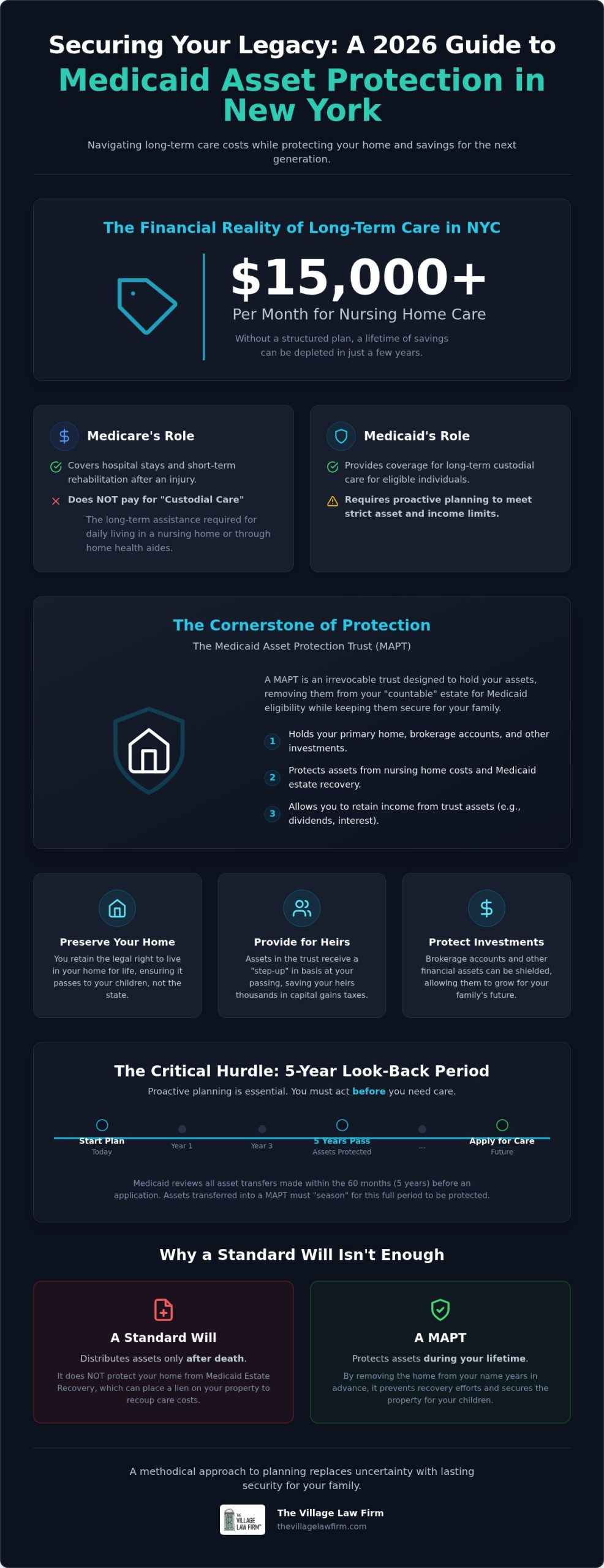
Living in New York offers an unparalleled energy, but the cost of aging in the metropolitan area is equally intense. Professional nursing home care in the city and surrounding suburbs frequently exceeds $15,000 per month. For many families, this isn’t just a number on a page; it’s a quiet crisis. Without a structured plan, a lifetime of diligent savings can vanish in a matter of years. This financial pressure creates deep anxiety for those who wish to leave a legacy for their children. Protecting your home and savings is about more than money. It’s about honoring your life’s work and ensuring your family remains on solid ground.
As we approach the 2026 legal landscape, the urgency for comprehensive planning has never been higher. Federal estate tax exemptions are scheduled to sunset, which creates a new layer of complexity for high-net-worth families. Effective Medicaid asset protection New York strategies must now be harmonized with these shifting tax thresholds. You need a plan that doesn’t just look at one piece of the puzzle, but secures your entire financial picture against the dual threats of rising care costs and changing tax laws.
The Gap Between Medicare and Long-Term Care
Medicare provides a vital safety net for hospital stays and short-term rehabilitation after an injury. It does not pay for “custodial care,” the long-term assistance required for daily living in a nursing home or through home health aides. Many New Yorkers believe they must spend every last dime to qualify for government assistance. This “spend down” approach is often unnecessary and emotionally draining. Proactive planning serves as the bridge between financial chaos and the security your family deserves. It allows you to access the care you need without sacrificing the inheritance you’ve promised to the next generation.
Defining Medicaid Asset Protection in 2026
The legal framework in New York allows for sophisticated methods to shield your assets while still meeting Medicaid eligibility requirements. This isn’t about “hiding” wealth; it’s about using established legal tools to create a sanctuary of order. We act as your authoritative urban guide, helping you balance your current lifestyle needs with the requirements of future care. A professional Medicaid asset protection New York strategy ensures you maintain your dignity and choices. By replacing unpredictability with a meticulous roadmap, you can focus on your health and family instead of worrying about the state’s next move. This partnership approach transforms a complex legal process into a manageable, reassuring journey toward long-term security.
The Medicaid Asset Protection Trust (MAPT) Explained
The Medicaid Asset Protection Trust (MAPT) is the cornerstone of sophisticated long-term care planning. It’s an irrevocable trust specifically designed to hold your assets, removing them from your “countable” estate for eligibility purposes while keeping them within the family’s reach. For those seeking Medicaid asset protection New York, this tool is the most effective way to separate your lifestyle from the threat of nursing home costs. Unlike a simple transfer or gift, which can leave you vulnerable, a MAPT offers a structured environment where your wealth is both managed and protected. A Medicaid Asset Protection Trust acts as a fortified shield for your family home, ensuring your primary residence remains a legacy for your children rather than a source of reimbursement for the state.
Meticulous drafting is essential here. A poorly constructed trust can lead to future estate litigation or, worse, a denial of benefits when you need them most. We focus on the fine details of New York law to ensure your trust is robust enough to withstand state scrutiny. This precision is what allows you to retain the income generated by trust assets while the principal remains untouchable by long-term care providers. It’s a method of creating order out of the chaos of complex regulations.
How the MAPT Preserves Your Home and Wealth
Transferring your primary residence into a trust doesn’t mean you lose your home. You retain the legal right to live there for the rest of your life, maintaining your lifestyle and familiar surroundings. This protection extends to brokerage accounts and other investments, which are managed within the trust to grow your family’s wealth. One of the most significant advantages is the “step-up” in basis. When your heirs eventually receive these assets, they are valued at the time of your passing, which can save them thousands in capital gains taxes. Coordinating these details with an estate planning attorney New York ensures your trust works in harmony with your broader legacy goals.
Maintaining Control and Choice
A common fear is that “irrevocable” means losing all control. That isn’t the case with a well-designed Medicaid asset protection New York strategy. You select a trustee, often a grown child or a trusted family partner, to manage the assets according to your wishes. Through a “limited power of appointment,” you even retain the right to change who will eventually inherit the trust assets. This flexibility ensures you stay in the driver’s seat. By replacing the anxiety of uncertainty with a clear, methodical plan, you can move forward with confidence. You aren’t just checking a legal box; you’re creating a sanctuary of security for your future.
Navigating the 5-Year Look-Back and Eligibility Rules
The 60-month look-back rule often feels like a looming shadow over estate planning. It’s the period during which the state examines your financial history to ensure assets weren’t gifted simply to qualify for benefits. If you’ve transferred property or funds within five years of applying for nursing home care, a penalty period is triggered. This isn’t a permanent disqualification. Instead, it’s a calculated delay in coverage based on the value of what was given away. Waiting until a health crisis occurs is the greatest risk to your legacy. By then, your options are limited, and the stress of a looming penalty can be overwhelming for your family.
Strategic Medicaid asset protection New York involves understanding that not all transfers are penalized. Certain “exempt” transfers allow you to protect your wealth while looking out for your loved ones. For instance, assets moved to a spouse or a child with special needs are generally protected from the look-back rules. There’s also a “caretaker child” exception for those who have lived in your home and provided care for at least two years. These nuances are why a meticulous, partnership-based approach is so vital. We act as your steady guide, ensuring every transfer is documented and every exemption is maximized to keep your family’s future secure.
Institutional vs. Community Medicaid in New York
Planning for a nursing facility (Institutional Medicaid) is distinct from planning for home-based care (Community Medicaid). As we move through 2026, the implementation of a 30-month look-back period for home care services remains a critical point of focus. While the state has historically allowed for more flexible “crisis planning” for home care, the window is narrowing. If your goal is to age in place within the comfort of your own home, your Medicaid asset protection New York strategy must account for these shifting timelines. We help you build a plan that remains resilient, whether you require care in a facility or a sanctuary of your own making.
Income and Asset Limits for 2026
To qualify for Medicaid, New Yorkers must meet specific resource and income thresholds. While these limits are adjusted annually to reflect economic changes, the “excess” income many NYC residents earn can often complicate eligibility. This is where a Pooled Income Trust becomes an essential tool. By directing surplus monthly income into a trust managed by a non-profit organization, you can maintain your eligibility while still using those funds to pay for your living expenses. It’s a sophisticated way to qualify for benefits without losing the assets you value most. This methodical approach ensures your care is funded without draining the savings you’ve spent a lifetime accumulating.
Protecting the Family Home from Estate Recovery
Your home is likely your most significant financial and emotional asset. In New York, the state has the right to seek reimbursement for long-term care costs through a process known as estate recovery. This means that even if you qualify for benefits during your lifetime, the state could place a claim against your property after you pass. Relying on a Will is a common mistake. Because a Will only governs assets that pass through probate, it leaves your home exposed to state claims. Effective Medicaid asset protection New York requires moving your residence out of your probate estate before the need for care arises. This ensures your home remains a legacy for your heirs rather than a source of repayment for the government.
Proactively securing your residence is about more than just checking a legal box; it’s about preserving the stability of your family. When you move your home into a protective structure, you’re creating a sanctuary of order that the state cannot easily penetrate. This methodical approach replaces the stress of uncertainty with a clear, documented path for your most cherished asset. It’s a way to ensure that the roof over your head remains a gift to the next generation.
Strategies to Shield Your NYC Residence
For NYC property owners, the choice often comes down to a Life Estate or an Irrevocable Trust. While a Life Estate allows you to remain in the home, it can complicate a future sale and doesn’t offer the comprehensive protection found in a trust. A Medicaid Asset Protection Trust provides a more robust shield, especially for the unique hurdles presented by New York City co-ops and condos. These properties often require board approval for transfers, making meticulous legal drafting a necessity. We focus on the fine details of these transactions to ensure your home is protected without disrupting your lifestyle or your standing within your building community.
Planning for Families with Children
Protecting your home is an act of love for the next generation. When we design a plan, we integrate guardianship and inheritance protection to ensure your children are never left in a state of financial chaos. We follow a methodical approach detailed in our NYC estate planning: 2026 parent’s guide to legal security, which harmonizes long-term care needs with your desires for your children’s future. By funding a trust now, you avoid the delays and vulnerabilities of probate entirely. This creates a clear path for your legacy to pass directly to those you love. If you’re ready to secure your primary residence, we invite you to schedule a consultation with our Medicaid planning team today.
Strategic Medicaid Planning with The Village Law Firm
Moving from the weight of legal complexity to a state of total clarity requires more than just a set of documents. It requires a methodical, reassuring partner who understands that your legacy is personal. At The Village Law Firm, we transform the high-stakes world of Medicaid asset protection New York into a sanctuary of order. We don’t just draft trusts; we design comprehensive shields that protect your family’s future against the unpredictability of long-term care costs. Our white-glove approach ensures that every detail, from the deed to your NYC home to the specifics of your brokerage accounts, is handled with meticulous precision. We believe that true security comes from knowing your plan is robust enough to withstand state scrutiny while remaining flexible enough to meet your life’s changing needs.
Our work doesn’t exist in a vacuum. We specialize in harmonizing your immediate care requirements with the long-term goals you’ve established with your estate planning attorney New York. This integrated strategy is particularly vital for the global families we serve in the city. Navigating cross-border assets adds layers of tax and eligibility risk that standard firms often overlook. By utilizing our 2026 guide: international estate planning in New York, we ensure that your global footprint is protected and that your Medicaid eligibility remains secure regardless of where your assets are located.
A Partnership Mindset for Long-Term Security
We view our clients as partners, not just transactions. This mindset defines our commitment to transparency and directness. In a field often clouded by dense legalese, we offer a steady, authoritative voice that replaces the fear of the unknown with a clear roadmap. We walk alongside you, explaining the “why” behind every strategic move. This collaborative process ensures you feel seen, understood, and entirely in control of your destiny. Our goal is to remove the emotional burden of planning, allowing you to focus on the moments that matter with your family while we manage the technical mechanics of your protection.
Your Next Steps Toward Protection
The best time to secure your legacy is before a crisis forces your hand. You can begin this conversation without the stress of immediate urgency. By scheduling a consultation today, we can review your current asset structure and identify potential vulnerabilities in your Medicaid asset protection New York strategy. This proactive step is also essential for those looking to maximize their New York estate tax exemption 2025 benefits before the upcoming federal sunsets. Don’t leave your family’s inheritance to chance. Let’s work together to build a plan that offers the stability, dignity, and peace of mind you deserve.
Securing Your Family’s Future in an Uncertain World
Your legacy is more than just a list of assets; it’s the foundation for your family’s next chapter. We’ve explored how a Medicaid Asset Protection Trust can shield your home and why understanding the 60-month look-back rule prevents financial chaos. Navigating Medicaid asset protection New York doesn’t have to be a source of stress when you have a methodical roadmap in place. By acting now, you ensure that your dignity remains intact and your children’s inheritance is preserved against the rising costs of care.
The Village Law Firm provides a white-glove legal experience tailored to the unique needs of NYC families and those with international assets. As authoritative guides in complex probate and Medicaid matters, we replace uncertainty with a sanctuary of order. Secure your legacy today with a sophisticated Medicaid planning strategy from The Village Law Firm. You’ve worked hard to build your life; let’s work together to make sure it stays protected for generations to come. You deserve the peace of mind that comes with a meticulously crafted plan.
Frequently Asked Questions
What is a Medicaid Asset Protection Trust and how does it work in NY?
A Medicaid Asset Protection Trust (MAPT) is an irrevocable legal structure designed to shield your assets from being counted toward Medicaid eligibility limits. In New York, you transfer ownership of your property or savings to the trust managed by a trustee. While you no longer own the principal, you can still receive income generated by the assets. This strategy effectively protects your legacy from being depleted by nursing home costs.
Can I still live in my house if I put it in a Medicaid trust?
You absolutely retain the right to live in your home when it’s placed inside a Medicaid Asset Protection Trust. The trust document is meticulously drafted to include a provision that grants you a life estate or the exclusive right to occupy the property. This ensures your daily life remains unchanged while the underlying value of the home is protected from state recovery efforts. You continue to pay taxes and maintenance just as before.
How long is the Medicaid look-back period in New York for 2026?
The look-back period for institutional nursing home care remains 60 months in 2026. This means the state reviews all financial transfers made within five years of your application. For Community Medicaid, which covers home care, New York has planned a 30-month look-back period. It’s essential to verify the exact implementation status for 2026 with a professional. These timelines dictate when you must begin your planning to avoid coverage penalties and protect your family’s savings.
Will I lose control of my finances with Medicaid planning?
You don’t lose total control, but your relationship with your assets does change. While the trust is irrevocable, you can still choose your trustee and retain the power to change beneficiaries through a limited power of appointment. You continue to receive any interest or dividends produced by the trust assets. We focus on creating a sanctuary of order where your financial security is prioritized without leaving you feeling powerless over your own life’s work.
What assets are exempt from Medicaid in New York?
New York allows for several exemptions, though they’re subject to strict value limits. These typically include your primary residence, up to a specific equity cap, one vehicle, and personal belongings. Certain retirement accounts, such as IRAs, may also be exempt if they’re in payout status and distributing regular income. Navigating these categories requires a partnership mindset to ensure every possible protection is utilized for your family’s unique financial structure and long-term care needs.
Is it too late to start Medicaid asset protection if I already need care?
It’s rarely too late to take action, though your options become more limited once care is immediately necessary. This is often referred to as crisis planning. While you might not be able to protect every asset due to the look-back period, specific legal strategies can still shield a significant portion of your estate. Starting late is always better than not starting at all. It still offers a path toward preserving an inheritance for your children.
How does Medicaid planning affect my 2026 estate taxes?
Medicaid planning and estate tax strategy must be harmonized, especially with the 2026 sunset of federal tax exemptions. A well-constructed Medicaid trust can help remove assets from your taxable estate while providing a step-up in basis for your heirs. This prevents them from facing heavy capital gains taxes later. We treat this as a white-glove service, ensuring your Medicaid asset protection New York strategy doesn’t create unintended tax liabilities or probate chaos for the next generation.
What is the difference between Community Medicaid and Institutional Medicaid?
Community Medicaid provides for care within your own home or an assisted living facility, focusing on helping you age in place. Institutional Medicaid covers the comprehensive costs of a skilled nursing facility. The primary differences lie in the eligibility requirements and the look-back periods. While both programs require asset protection, the strategy for home care often allows for more immediate solutions compared to the five-year window typically required for nursing home coverage in New York State.