
You’ve just lost a loved one, and now you’re facing a different kind of weight: the silence of a frozen bank account and the mounting bills of an estate in limbo. In the busy Surrogate’s Courts of Manhattan or Queens, what should be a straightforward transition often grinds to a halt. Understanding the common delays in New York probate is the first step in reclaiming your peace of mind. It’s exhausting to wait months for a simple court filing while assets remain out of reach, especially when family tensions begin to simmer under the pressure of financial uncertainty.
You deserve a path that replaces this administrative chaos with meticulous order. This 2026 guide reveals exactly why the New York probate process stalls, from the complexities of the $7,350,000 estate tax exemption to the “paperwork trap” of missing beneficiary signatures. We’ll show you how strategic legal navigation can help you obtain Letters Testamentary faster and secure your family’s inheritance with confidence. We provide a clear roadmap of the remaining steps in the Surrogate’s Court system, offering you a steady hand to minimize family friction and protect your legacy.
Key Takeaways
- Understand the current administrative landscape of NYC Surrogate’s Courts to set realistic expectations for your inheritance timeline.
- Identify the “paperwork traps,” such as missing original Wills or delayed death certificates, that cause common delays in New York probate and learn how to bypass them.
- Navigate the statutory seven-month creditor claim period safely to protect executors from personal liability while managing estate assets.
- Uncover the specific hurdles of ancillary probate when dealing with international assets and the meticulous documentation required for cross-border administration.
- Discover proactive legal tools, like Preliminary Letters Testamentary, that allow you to access accounts and maintain financial stability during the court process.
Why the New York Probate Process Faces Unique 2026 Delays
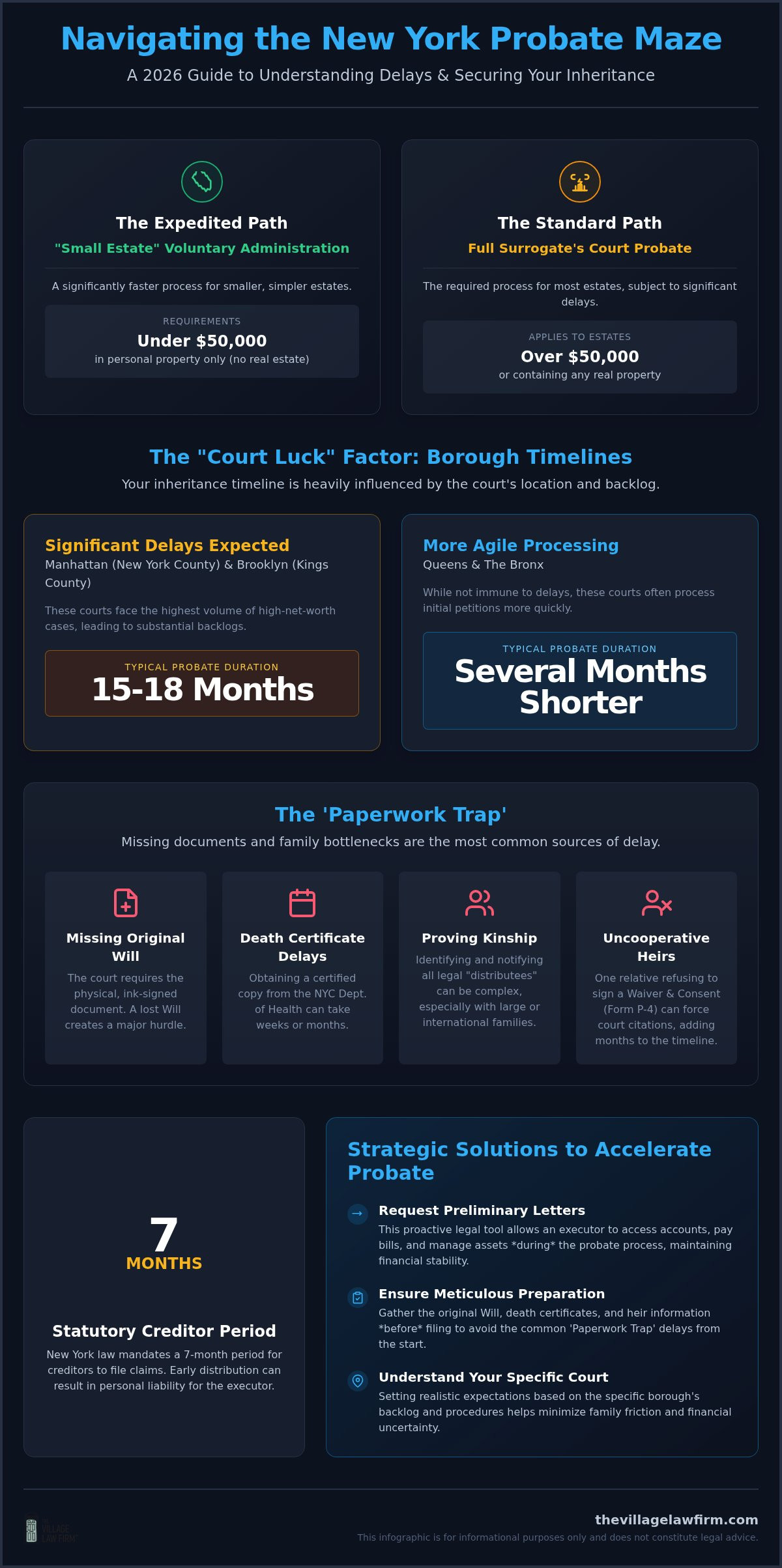
Probate is the court-supervised process of validating a Will and officially appointing an executor to manage an estate. It’s the vital bridge between a loved one’s legacy and the family’s future security. While it sounds like a straightforward administrative task, the reality in 2026 is far more complex. Families often find that common delays in New York probate stem from a system struggling to balance high-value estate filings with evolving administrative infrastructure. If the estate consists of personal property valued under $50,000, you may qualify for Voluntary Administration. This “Small Estate” path is significantly faster and requires only a $1 filing fee. However, for estates exceeding this threshold, or those involving real property, the full probate timeline is the standard reality.
The Role of the Surrogate’s Court
The New York Surrogate’s Court is the specialized judicial body that oversees the distribution of a deceased person’s assets, ensures debts are paid, and resolves any disputes regarding the validity of a Will. Even in 2026, your inheritance timeline is largely dictated by the court’s internal calendar. Staffing levels in several departments haven’t yet caught up with the surge in filings following recent tax law shifts. While the transition to digital filing was intended to streamline the process, it has created its own set of hurdles. Clerks now face a dual burden of managing legacy paper files while mastering new software. Even a “no-contest” estate, where every heir is in total agreement, can sit on a desk for months simply waiting for a signature.
Borough-Specific Wait Times
Geography is destiny in probate. Your loved one’s primary residence at the time of their passing determines your “court luck,” as each borough operates with its own unique rhythm and backlog. Manhattan (New York County) and Brooklyn (Kings County) typically present the most significant challenges due to the sheer volume of high-net-worth cases. In these courts, it’s not unusual for a standard probate to take 15 to 18 months. Identifying the common delays in New York probate requires looking at the specific court handling the file. Conversely, the Queens and Bronx Surrogate’s Courts often move with a bit more agility. While they aren’t immune to the systemic issues facing the city, their processing times for initial petitions can be several months shorter than their neighbors across the bridge. Understanding these regional discrepancies allows you to plan your family’s financial future with a clearer, more realistic lens.
The ‘Paperwork Trap’: Missing Documents and Family Bottlenecks
Locating a physical piece of paper in an era of cloud storage and digital signatures can feel like an impossible task. Yet, the Surrogate’s Court remains a traditional institution that requires the original, ink-signed Will to begin the process. If that document is lost or trapped in a frozen safe deposit box, you’re facing a significant hurdle. Similarly, obtaining a certified death certificate from the NYC Department of Health can take weeks or even months depending on current backlogs. These administrative friction points are common factors that can lengthen the probate process, often before you even step foot in a courtroom.
Proving kinship is another layer of the paperwork trap. New York law requires you to identify and notify every “distributee,” which includes the closest living blood relatives who would inherit if no Will existed. If your family tree is sprawling or international, you must provide a “Due Diligence” affidavit. This document details your exhaustive efforts to find every cousin or sibling. If you can’t prove who the heirs are, the court won’t move forward. These common delays in New York probate often arise because families underestimate the level of genealogical proof the court demands.
The Difficulty of Notarized Consents
Every heir must typically sign a Waiver and Consent form, known as Form P-4. This document confirms they don’t contest the Will and agree to the executor’s appointment. When family members are cooperative, this is a simple step. However, a single uncooperative relative can stall the entire estate. Whether they refuse to sign out of old grievances or simple confusion, their silence forces you to seek a court-issued citation. This requires formal process serving and a scheduled court appearance, adding months of waiting to your timeline. If you’re navigating these delicate family dynamics, professional support in estate administration can help mediate these bottlenecks and keep the process moving.
Finding Distant Relatives
When heirs are truly missing or unknown, the Public Administrator may become involved to protect their interests. This adds a layer of government oversight that inevitably slows the pace of administration. You must often hire professional genealogists to satisfy the court’s requirement for a complete family tree. New York’s rules on notifying distributees are strict; even if a relative is intentionally left out of the Will, they still have a legal right to be notified of the probate proceeding. Tracking down a distant relative in another country or state is a meticulous process that requires patience and precision.
The Statutory 7-Month Rule and Creditor Claims
Once the court finally issues Letters Testamentary, many families expect an immediate distribution of assets. However, New York law imposes a mandatory waiting period that often surprises first-time executors. Under EPTL § 11-1.3, creditors have seven months from the date the court issues your “letters” to file claims against the estate. This rule serves as a vital legal shield for the person in charge. If you distribute assets to beneficiaries prematurely and a valid creditor emerges within this window, you could be held personally responsible for that debt. This statutory pause is one of the most persistent and common delays in New York probate, but it’s a necessary safeguard for your own financial protection.
You shouldn’t ignore potential debts even if your loved one appeared to have none. The “unknown creditor” is a frequent source of anxiety that requires a patient approach. Medicaid recovery claims are particularly impactful in this phase. The state may seek reimbursement for long-term care costs provided during the decedent’s life. These claims can stall an estate for well over a year while the Department of Social Services reviews years of records. If you’re concerned about how prior care might impact the inheritance, consulting a Medicaid planning attorney New York can provide clarity on asset recovery risks and potential timelines.
Managing Estate Liquidity
Keeping an estate afloat during the seven-month wait requires careful planning. Urgent expenses like funeral costs, property taxes, and utility bills for a family home don’t stop just because the court is processing paperwork. New York law establishes a strict priority of claims to guide your spending. Generally, administration expenses and funeral costs are paid first, followed by taxes and then secured creditors. Understanding this hierarchy ensures you don’t inadvertently prioritize a low-level debt over a mandatory government obligation while assets are still being liquidated.
Tax Clearances and Final Returns
Tax obligations introduce their own set of deadlines that can extend the administration timeline well into the following year. Both Federal and New York State estate tax returns are generally due within nine months of the date of death. For the current year, the New York Estate Tax Exemption 2026 is set at $7,350,000. If the estate value exceeds 105% of this amount, the entire estate becomes taxable. The ultimate gatekeeper is often the IRS Closing Letter. This document confirms the tax return has been accepted, but it can take months to arrive. Without it, many executors feel a sense of unease, choosing to hold back a reserve of funds in case of a future audit or adjustment.
International Assets and Complex Cross-Border Hurdles
New York’s status as a global hub means many families hold assets spanning several continents. When a loved one passes away owning a pied-à-terre in Paris or a savings account in London, the complexity of the estate increases exponentially. International assets are among the most significant common delays in New York probate because they require a high degree of coordination between different legal systems. You aren’t just dealing with the NYC Surrogate’s Court; you’re navigating the requirements of foreign banks and government agencies that may not recognize standard New York “Letters” without additional verification.
The administrative burden often begins with the “Apostille.” This is a specialized certificate issued by a government authority that authenticates a document for use in another country. Obtaining an Apostille for a foreign death certificate or a Will can take weeks of international mail and verification. If these documents require translation, the translator must often provide a notarized affidavit of accuracy. These steps are meticulously slow. They can’t be bypassed. Treaties also impact how you distribute assets to non-US citizen heirs, as specific withholding rules and disclosure requirements must be met to satisfy federal law.
Ancillary Probate in New York
If the decedent lived abroad but owned real estate in Manhattan or Brooklyn, the family must undergo Ancillary Probate in New York. This is a secondary court proceeding used specifically to transfer title of local property. It requires your New York counsel to work in tandem with foreign attorneys to ensure the inheritance laws of both jurisdictions align. Without this synchronization, the transfer of a family home can remain stuck for years. It’s a delicate dance of cross-border cooperation that demands technical precision and constant communication.
Cross-Border Tax Complications
Taxation is perhaps the most daunting hurdle for global families. The Foreign Investment in Real Estate Tax Act (FIRPTA) can trigger mandatory withholding when a non-resident’s New York property is sold, potentially freezing a large portion of the proceeds. Additionally, dual-taxation treaties between the U.S. and other nations dictate how much the IRS takes versus the foreign government. Understanding these nuances is critical to preserving the estate’s value. Our 2026 Guide: International Estate Planning in New York offers deeper insights into how pre-planning can mitigate these risks. If you are currently managing a complex global estate, our team provides the cross-border estate administration services necessary to bridge the gap between international chaos and local order.
Strategic Solutions: How to Accelerate the NY Probate Process
The burden of an estate shouldn’t rest entirely on your shoulders while the court processes your petition. Identifying common delays in New York probate is only half the battle; the other half is deploying the specific legal mechanisms designed to bypass them. While the administrative gears of the Surrogate’s Court turn slowly, a proactive strategy can provide the sanctuary of order your family needs during a time of transition. By anticipating bottlenecks before they manifest, you can move from a state of uncertainty to one of controlled progress.
Applying for Preliminary Letters
One of the most effective tools for bypassing early court backlogs is the application for Preliminary Letters Testamentary. In the high-stakes world of New York City real estate, waiting eighteen months for full authority is often financially impossible. Preliminary letters grant you the immediate power to manage assets, pay mounting property taxes, and even sell real estate while the full probate petition is still pending. This is essential for NYC properties with high monthly carrying costs, such as co-ops or condos, where frozen accounts could lead to unnecessary debt. While this authority doesn’t allow for the final distribution of assets to heirs, it provides the vital liquidity needed to protect the estate’s value from the start.
The Importance of Meticulous Filing
The quickest way to stall an estate is to land in the “rejection pile.” Clerks in Manhattan and Brooklyn Surrogate’s Courts face immense case volumes, and even a minor clerical error or a missing signature can send your filing back to the start of the line. Avoiding common delays in New York probate requires an almost obsessive level of meticulousness. We focus on proactive due diligence, ensuring every kinship affidavit is ironclad and every “Decree” is correctly formatted before it ever reaches a clerk’s desk. A well-prepared filing can save three to four months of unnecessary back-and-forth communication with the court.
To further accelerate the timeline, we utilize professional process servers to handle heir notifications with speed and precision. This removes the reliance on slow-moving certified mail and ensures the court has immediate proof of service. Our white-glove approach is designed to lift the administrative weight from your family, replacing chaos with a structured, professional roadmap. If you’re ready to secure your family’s future without the typical wait, Contact The Village Law Firm to streamline your New York estate administration and reclaim your peace of mind.
Securing Your Family’s Inheritance with Confidence
The path through the Surrogate’s Court doesn’t have to be defined by uncertainty. While the common delays in New York probate are real, they aren’t insurmountable when you have a steady guide by your side. We’ve explored how borough-specific backlogs and the “paperwork trap” can stall your progress, but we’ve also seen the power of strategic tools like Preliminary Letters Testamentary. Meticulous attention to detail is your greatest asset in moving from administrative chaos to a sanctuary of order. Whether you’re navigating the statutory seven-month creditor period or managing complex cross-border estate administration, specialized expertise ensures your family’s legacy remains protected.
You don’t have to carry this burden alone. We are here to provide the technical precision and human touch required to bridge the gap between today’s complexity and tomorrow’s security. Schedule a compassionate consultation to streamline your New York probate process today. Your family’s peace of mind is worth the investment in excellence, and we look forward to walking this path with you.
Frequently Asked Questions
How long does the average New York probate take in 2026?
For a standard, uncontested estate in 2026, the probate process typically takes between 9 and 18 months. While some simpler estates might conclude in as little as 7 months, complex cases involving high-value assets or family disputes often extend beyond two years. These common delays in New York probate are largely driven by court volume and administrative backlogs in the busier boroughs like Manhattan and Brooklyn.
Can I access the deceased’s bank account to pay for the funeral before probate?
You generally cannot access a deceased person’s individual bank accounts until the court issues Letters Testamentary. However, many banks will allow a one-time payment directly to the funeral home upon presentation of a certified death certificate and the funeral bill. If the estate qualifies as a “Small Estate” under the $50,000 threshold, you might obtain authority faster through Voluntary Administration to manage these immediate costs.
What happens if an heir refuses to sign the Waiver and Consent form?
If an heir refuses to sign the Waiver and Consent form, the court must issue a Citation. This official document requires the uncooperative heir to appear in court on a specific date to voice their objections. Formal process servers must deliver this notice, which inevitably adds several months to your timeline. It transforms a streamlined administrative task into a court appearance, requiring meticulous preparation to keep the process moving. For those who choose to navigate these proceedings as a litigant in person, Justice Legal Practice offers the specialized support needed to handle the complexities of the courtroom with confidence.
Does the 7-month creditor period start from the date of death?
No, the seven-month creditor period begins on the day the Surrogate’s Court officially issues Letters Testamentary or Letters of Administration, not the date of death. This means the clock only starts after you’ve successfully navigated the initial filing hurdles. It is a vital safeguard that protects executors from personal liability, ensuring you don’t distribute assets before potential unknown creditors have had their legal window to file a claim.
Is probate required if there is a Revocable Living Trust in place?
Assets properly titled in a Revocable Living Trust generally bypass the probate process entirely. This allows for a much faster transition of wealth and provides the immediate liquidity that Surrogate’s Court proceedings often lack. However, if the deceased held any assets in their individual name that weren’t transferred to the trust, you may still need to file a probate or administration petition for those specific items to be legally distributed.
Why is the Manhattan Surrogate’s Court slower than other NYC boroughs?
Manhattan Surrogate’s Court faces a significantly higher volume of complex, high-net-worth estate filings than its neighbors. The sheer density of highly skilled professionals and intricate corporate assets in New York County creates a heavier administrative load for the court’s clerks and judges. These common delays in New York probate are compounded by staffing levels that haven’t yet matched the post-pandemic surge in filings and the transition to new digital systems.
Can I sell the deceased’s New York apartment while probate is still pending?
You can sell a New York apartment while probate is pending if you obtain Preliminary Letters Testamentary. This specific authority allows the executor to manage and liquidate real estate before the court grants full probate. It’s a strategic tool often used for NYC co-ops and condos to avoid mounting maintenance fees and carrying costs. Once the sale closes, the proceeds must usually remain in an estate account until full letters are issued.
What is a Kinship Hearing and why does it delay probate?
A Kinship Hearing is a formal court proceeding used to prove the family tree when the deceased’s heirs are distant or unknown. It requires a meticulous presentation of birth, marriage, and death certificates to establish a clear bloodline. This process can delay probate by a year or more, as it often involves professional genealogists and exhaustive “Due Diligence” searches to ensure no closer relatives exist who might have a legal claim.