
What if the home you’ve spent decades maintaining became a bill to be settled by the state instead of a legacy for your children? For many New Yorkers, the fear isn’t just about aging; it’s about the very real possibility that a single medical crisis could erase a lifetime of hard work. With nursing home costs in the New York metropolitan area projected to reach $20,000 per month in 2026, the stakes have never been higher. Partnering with an experienced long term care planning attorney New York is no longer just a luxury for the wealthy. It’s a necessary shield for anyone who values their independence and the stability of their family.
You likely feel that the system is designed to be confusing, especially with the 60-month look-back period and the looming implementation of new home care rules. It’s exhausting to worry about becoming a financial burden on those you love most. This article provides the clarity you need to secure your future. You’ll learn how to navigate the $33,038 asset limit, protect your primary residence from estate recovery, and utilize sophisticated legal tools to ensure your care doesn’t come at the cost of your legacy. We’ll explore the current 2026 regional rates and the specific strategies that turn legal complexity into a sanctuary of order.
Key Takeaways
- Understand that long-term care planning is a proactive shield, extending far beyond nursing home coverage to include in-home and assisted living support.
- Discover how a long term care planning attorney New York uses Medicaid Asset Protection Trusts to start the 60-month clock and safeguard your family home.
- Learn why gifting assets directly to heirs often triggers severe penalty periods and tax liabilities that can derail your Medicaid eligibility.
- Identify essential 2026 strategic updates, including how to audit international holdings and update Powers of Attorney with necessary gift riders.
- Replace the anxiety of future medical costs with a methodical, white-glove roadmap that provides a sanctuary of order for your legacy and independence.
Beyond the Nursing Home: Defining Long-Term Care Planning in New York
Long-term care planning is the bridge between the potential chaos of a medical crisis and the sanctuary of a protected legacy. It isn’t merely a set of documents; it’s a proactive legal strategy designed to manage the profound financial and personal costs that come with aging. While many associate these plans strictly with nursing homes, the reality is much broader. Defining Long-Term Care in a modern context includes everything from in-home health aides and modifications to your primary residence to placement in an assisted living facility. In New York, this planning is inextricably linked to Medicaid eligibility and meticulous asset protection. The ultimate goal is simple yet profound: ensuring you receive high-quality care without exhausting the inheritance you intended to leave for your children.
The High Cost of Care in NYC
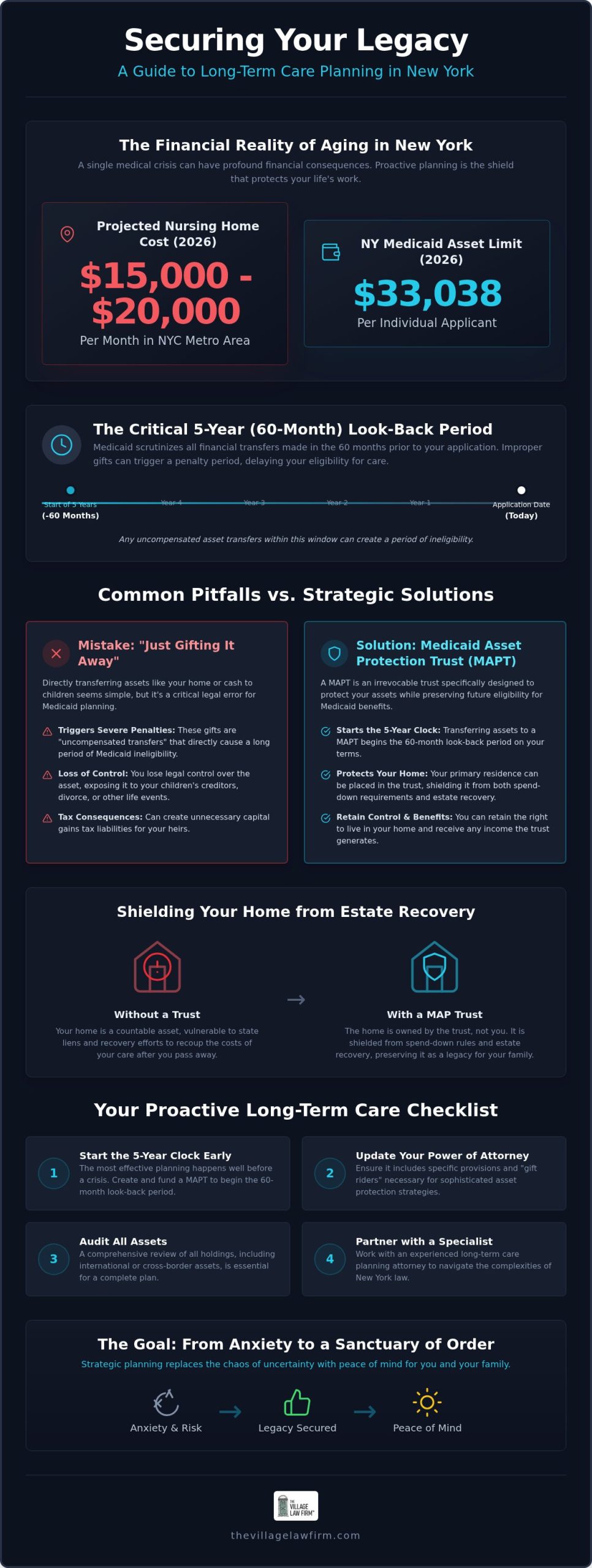
The financial reality of aging in the New York metropolitan area is stark. By 2026, the monthly cost for a skilled nursing facility in the city is projected to range between $15,000 and $20,000. Even home-based care, which many seniors prefer for the comfort and independence it provides, carries a significant price tag that can quickly deplete a lifetime of savings. For most families, relying on private pay is unsustainable over a multi-year period. This is where white-glove planning becomes essential. It’s about more than just numbers; it’s about maintaining your dignity and lifestyle through a sophisticated legal framework that anticipates these costs before they become an emergency.
The Role of a Long-Term Care Planning Attorney
A specialized long term care planning attorney New York acts as a shield against the unpredictability of future health shifts. They don’t just draft papers; they provide a roadmap through the state’s complex regulatory environment. There is a vast difference between generic elder law and the sophisticated, high-touch approach offered by The Village Law Firm. We prioritize a partnership mindset, walking alongside you to ensure your primary residence and cross-border assets remain secure. By replacing anxiety with a methodical process, an attorney ensures that your legal protections are as meticulous as the life you’ve built. You deserve a guide who understands that your legacy is more than just a balance sheet; it’s the foundation of your family’s future.
The 5-Year Look-Back Rule and Medicaid Asset Protection Trusts
New York’s Medicaid system operates on a principle of rigorous financial transparency. When you apply for institutional care, the state scrutinizes your financial history for the preceding 60 months. This is the 5-year look-back rule. Any uncompensated transfer of assets or “gifts” made during this window can trigger a penalty period, effectively delaying your eligibility for benefits when you need them most. To navigate this, many residents utilize a Medicaid Asset Protection Trust (MAPT). This legal structure is the gold standard for protecting a legacy while ensuring you can eventually access New York’s MLTC Program for your care needs.
A MAPT must be irrevocable to be effective for Medicaid purposes. While a revocable trust offers greater flexibility, Medicaid views those assets as fully accessible to you, meaning they must be spent down to the $33,038 asset limit for 2026 before you qualify. By contrast, an irrevocable MAPT removes assets from your countable estate. You retain the right to live in your home and receive any income the trust generates, but the principal is shielded from being counted toward the eligibility threshold. This allows you to start the 60-month clock early, well before a health crisis occurs.
How to Protect Your Home from Medicaid Recovery
Without a sophisticated legal shield, your primary residence is vulnerable to Medicaid estate recovery. This is a process where the state seeks to recoup the costs of your care by placing a lien on your property after your passing. Implementing specific strategies for protecting your New York home through a trust ensures that your residence passes to your heirs rather than being liquidated to settle a government bill. A Medicaid Asset Protection Trust provides a sanctuary of order where there was once financial chaos.
Navigating the 2026 Look-Back Requirements
In 2026, timing is your most valuable asset. While the 30-month look-back for community-based home care has faced implementation delays, the window for proactive planning is narrowing. Auditors from the New York State Department of Health now require meticulous documentation for every financial transaction within the look-back period. If you want to secure your future, partnering with a steady guide can help you navigate the $1,130,000 home equity limit and other complex 2026 regulations. A skilled long term care planning attorney New York ensures that every detail is addressed, replacing the stress of uncertainty with a clear, methodical roadmap to eligibility.
Common Misconceptions: Why “Just Giving it Away” is a Legal Mistake
When faced with the high costs of aging, many families believe the simplest solution is to “just give it away.” It feels intuitive. You transfer the family home to your children or gift large sums of cash to empty your accounts. However, this impulsive generosity is often a significant legal mistake. In New York, these are classified as uncompensated transfers. They trigger immediate penalty periods that can leave you without coverage when you need it most. A sophisticated asset protection strategy is the only way to move assets without inviting financial ruin.
One prevailing myth is that you must be destitute to receive help. This isn’t true. By using legal tools like trusts, you can protect your lifestyle while qualifying for Medicaid-funded home care programs. This allows you to remain in your community rather than being forced into a facility. Relying on an experienced long term care planning attorney New York ensures you don’t fall into the trap of thinking poverty is the only path to eligibility. It replaces the chaos of reactive gifting with the calm of a deliberate plan.
The Tax Trap: Step-up in Basis vs. Gift Tax
Gifting your home directly to your children might seem like a shortcut, but it often destroys the “step-up in basis.” When children inherit a home through a trust after your passing, the property’s value is reset to its current market rate. If you gift it now, they inherit your original purchase price. This can cost heirs hundreds of thousands of dollars in capital gains tax later. Additionally, the New York Estate Tax cliff makes precision essential. A single dollar over the exemption limit can trigger a tax bill on the entire estate. A trust acts as the bridge, providing Medicaid eligibility while maintaining high-end tax efficiency.
Retaining Control and Independence
Many seniors hesitate to plan because they fear losing their independence. You shouldn’t feel like you’re handing over the keys to your life. A well-drafted trust allows you to maintain the right to change trustees or beneficiaries. You aren’t losing control; you’re creating a sanctuary of order. This removes the ambiguity that often leads to family conflict. By working with a long term care planning attorney New York, you ensure that your legacy remains a source of pride rather than a source of stress. It’s about protecting your autonomy through meticulous design, ensuring that you remain the architect of your own future.
Strategic Steps for 2026: Preparing Your Estate for Future Care
Preparation is the antidote to anxiety. As we look toward the complexities of 2026, New York’s regulatory environment demands a methodical, proactive approach. You cannot afford to wait for a health crisis to dictate your terms. Instead, follow a structured path to ensure your legacy remains a sanctuary of order. By taking these steps now, you replace the stress of the unknown with the confidence of a well-designed legal shield.
First, conduct a comprehensive asset inventory. This must include everything from your primary residence and retirement accounts to international or cross-border holdings. Second, update your Power of Attorney. In New York, a standard document is often insufficient for Medicaid planning. You must include specific “gift riders” that authorize your agent to transfer assets if you become incapacitated. Third, execute a Healthcare Proxy. This document acts as your voice, ensuring your medical wishes are honored when you cannot speak for yourself. Finally, establish and fund your trust. This action starts the 5-year look-back clock immediately, shielding your principal from future scrutiny. A long term care planning attorney New York ensures these steps are executed with the precision your life’s work deserves.
Planning for Families with Children
For parents, long-term care planning is an act of love. It is not just about your personal comfort; it overlaps significantly with guardianship and family protection. You must ensure that your potential care needs do not drain the resources intended for the next generation. Clear communication is vital to prevent family conflict during a crisis. By defining these boundaries now, you protect your children from the emotional and financial burden of reactive decision-making. We walk alongside families to create a roadmap that preserves both the parent’s dignity and the children’s inheritance.
International Considerations for Global Citizens
Living a global life adds layers of complexity to your long-term security. Many New Yorkers hold foreign real estate or bank accounts, and sophisticated international estate planning is essential for Medicaid eligibility. Foreign assets are often overlooked, yet they are subject to the same scrutiny by Department of Health auditors as local holdings. Managing these cross-border complexities requires meticulous attention to detail and a deep understanding of how New York law interacts with foreign jurisdictions. If you are ready to secure your global legacy, partner with a long term care planning attorney New York to begin your comprehensive audit today.
Partnering for Peace of Mind: How The Village Law Firm Secures Your Future
The decision to secure your future is a profound act of leadership for your family. It requires more than just technical document drafting; it requires a partner who understands the emotional weight of these choices. As a premier long term care planning attorney New York, we provide a white-glove service level designed specifically for busy professionals who demand efficiency and meticulous attention to detail. We act as a shield against the unpredictability of the future, replacing the persistent hum of anxiety with the steady pulse of a completed plan. Our role is to be your steady urban guide, navigating the fast-paced and often overwhelming legal landscape of New York City so you don’t have to. You’ve spent a lifetime building your legacy, and we are here to ensure it remains intact.
Our process is designed to be fundamentally reassuring. We know that the complexities of Medicaid and estate recovery can feel like a weight on your shoulders. By implementing a methodical and transparent legal process, we remove that burden. We focus on creating a sanctuary of order that protects your primary residence and your global assets alike. This isn’t just about qualifying for benefits; it’s about maintaining your independence and dignity as you age. We provide the clarity you need to make informed decisions, ensuring that every legal mechanism we use serves your long term goals and your family’s ultimate security.
The Village Law Firm Difference
We believe that legal expertise is only half the equation. The other half is deep emotional intelligence. Our firm is built on a foundation of honesty, openness, and the radical removal of complexity. We don’t view our work as a series of transactions. Instead, we embrace a partnership mindset, walking alongside you through every phase of the planning process. This approach combines high-end technical precision with a deeply human touch. We translate dense regulations into clear, actionable strategies, ensuring you feel seen, understood, and protected at every turn. It’s about creating order where there was once only the chaos of “what if” scenarios and legal uncertainty.
Taking the First Step Toward Certainty
Transitioning from a state of worry to a state of certainty is easier than you might think when you have the right partner. We make the process seamless, handling the heavy lifting of Medicaid eligibility and asset protection so you can focus on living your life with confidence. The path toward a secure future begins with a single, intentional conversation. Don’t let another year of uncertainty pass by while the 2026 regulatory window continues to shift. You can schedule a consultation with The Village Law Firm today to begin designing your sanctuary of order. By working with a dedicated long term care planning attorney New York, you ensure that your independence and your family’s inheritance are locked behind a sophisticated legal shield.
Securing Your Legacy Through Meticulous Design
You’ve worked too hard to let the unpredictability of aging dictate the fate of your assets. True long-term care planning isn’t a reactive measure; it’s a proactive shield that ensures your primary residence and cross-border holdings remain exactly where they belong. By understanding the nuances of the 60-month look-back and the specific 2026 Medicaid limits, you move from a state of “what if” to a state of “I am prepared.” Partnering with a dedicated long term care planning attorney New York is the final step in bridging the gap between current complexity and future peace of mind.
At The Village Law Firm, we combine specialized expertise in New York Medicaid and international estate planning with a white-glove service model designed for meticulous asset protection. We believe in authoritative guidance delivered with deep emotional intelligence. It’s time to replace the persistent hum of anxiety with a sanctuary of order. Your future deserves the same level of care you’ve given your family for a lifetime. Protect your legacy and secure your future care with The Village Law Firm.
Frequently Asked Questions
What is the difference between a long-term care attorney and an elder law attorney?
Elder law is a broad practice area covering everything from guardianship to age discrimination. In contrast, a long term care planning attorney New York focuses specifically on the financial and legal mechanics of aging. We specialize in the meticulous design of asset protection strategies and Medicaid eligibility. Our work is the surgical application of law to ensure your care costs don’t erase the legacy you’ve built for your family.
Can I still protect my home if I need to go into a nursing home next month?
Yes, emergency planning is possible even if you haven’t started the 5-year clock. While you cannot use a standard trust for immediate eligibility, we can utilize sophisticated “Rule of Halves” strategies or promissory notes to shield a significant portion of your estate. This requires swift, technical precision to satisfy state auditors while ensuring your primary residence isn’t lost to immediate, high-cost private pay requirements.
Does New York have a look-back period for home care (Community Medicaid) in 2026?
Will a trust affect my ability to receive Social Security or other retirement benefits?
A properly structured Medicaid Asset Protection Trust does not interrupt your Social Security or pension payments. These are classified as income, not assets. While the trust principal is shielded for eligibility purposes, you continue to receive your monthly retirement checks directly. For those who served, ensuring that all medical documentation is accurately prepared is also vital for maintaining support, and Global Vets Consulting offers specialized guidance on disability benefits questionnaires. Our goal is to maintain your financial stability while ensuring your underlying wealth is protected from being counted toward the $33,038 asset limit for 2026.
What happens to my international assets if I apply for Medicaid in New York?
New York Medicaid requires the disclosure of all global assets, regardless of their location. If you own foreign real estate or hold international bank accounts, these are counted toward your eligibility unless they are placed in a trust or otherwise shielded. We specialize in these cross-border complexities. We ensure your global footprint doesn’t disqualify you from receiving high-quality care, providing a sanctuary of order for your entire estate.
Is long-term care insurance a better option than Medicaid planning?
These are complementary strategies rather than mutually exclusive choices. Insurance provides immediate liquidity and care options, while Medicaid planning creates a permanent shield for your legacy. Since new Partnership-qualified policies are not currently being sold in New York, a long term care planning attorney New York is essential to fill the gaps. We help you balance insurance benefits with legal protections to ensure your family’s inheritance remains secure.
How does the New York estate tax cliff affect my long-term care plan?
The New York estate tax cliff can be devastating if your care plan isn’t aligned with your tax strategy. If your estate exceeds the exemption limit by even a small margin, the state taxes the entire estate from the first dollar. We integrate Medicaid planning with tax-efficient trusts to avoid this cliff. This ensures that protecting your future care doesn’t inadvertently trigger a massive, unnecessary tax bill for your heirs.