
What if the most effective way to shield your children from a massive tax bill isn’t a complex legal loophole, but a fundamental rule already hidden within the IRS code? As we move through 2026, many New York families feel a growing sense of anxiety about the government seizing a significant portion of their hard-earned wealth. You’ve spent a lifetime building your legacy, and the thought of it being eroded by capital gains taxes is deeply unsettling. Understanding the tax step up in basis is no longer just an accounting detail. It’s the essential bridge between financial chaos and long-term security.
We’re here to help you master these complexities so you can eliminate unnecessary tax burdens and protect your family’s future. This article provides a clear, methodical look at how the step-up rule works for real estate and international assets. You’ll gain the actionable strategies needed to transform confusion into a sense of order. We’ll walk through the specific mechanisms that turn current volatility into a stable foundation for your heirs, ensuring your wealth remains exactly where it belongs.
Key Takeaways
- Understand how the tax step up in basis serves as a vital “reset button,” erasing years of capital gains tax liability to keep your wealth within the family.
- Learn to navigate the 2026 federal exemption levels and the New York estate tax “cliff” to ensure your inheritance isn’t unnecessarily diminished.
- Identify which specific assets, including New York real estate and taxable investment accounts, are eligible for these significant tax-saving mechanisms.
- Explore sophisticated strategies like the “double step-up” for married couples to secure financial stability regardless of who passes away first.
- Discover why a professional partnership in estate administration provides the meticulous attention to detail required for cross-border and complex assets.
Understanding the Tax Step-Up in Basis: The Shield for Your Legacy
Building a legacy in New York is more than a financial achievement; it’s a profound commitment to your family’s future. You’ve worked hard to acquire property and investments, but without the right strategy, a significant portion of that effort could be lost to the government. The tax step up in basis serves as a vital shield against this outcome. It’s a provision in the tax code that allows the value of an inherited asset to be adjusted to its fair market value at the time of the owner’s death. This simple adjustment can save your heirs hundreds of thousands, or even millions, of dollars.
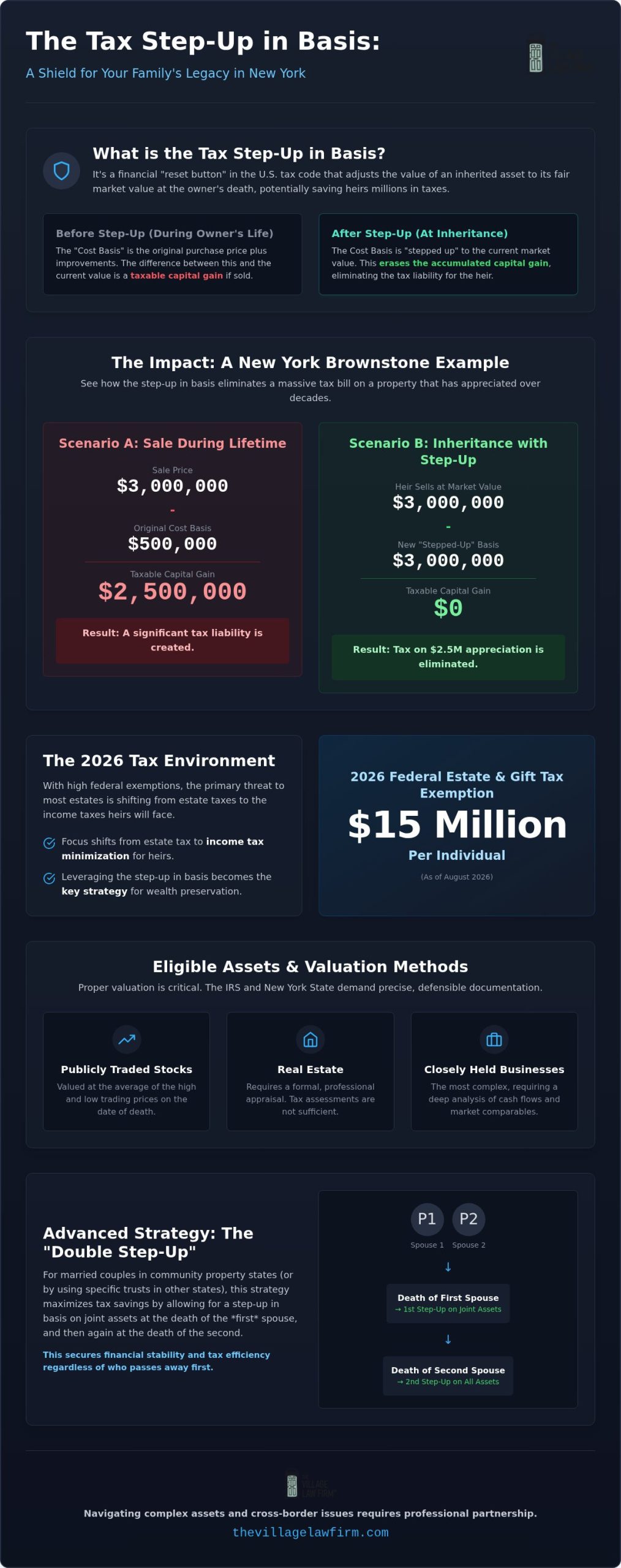
Think of this rule as a financial “reset button.” It effectively erases years of accumulated capital gains tax liability. For many New York families, 2026 is the most critical year for basis planning in a generation. With the federal estate tax exemption at $15 million per individual, the primary threat to your wealth has shifted from estate taxes to income taxes. By Understanding the Tax Step-Up in Basis, you can ensure that the emotional value of passing on a family home or a long-standing business isn’t overshadowed by a looming, preventable tax bill. It’s about creating a sanctuary of order for those you leave behind.
Basis Explained: From Purchase to Inheritance
To understand the power of a step-up, you must first understand “cost basis.” This is typically the original purchase price of an asset plus any capital improvements you’ve made over the years. If you bought a property in Manhattan thirty years ago, your cost basis is likely quite low compared to today’s market. This gap is known as appreciation. During your lifetime, that appreciation represents a hidden tax debt that only comes due when you sell. However, the law treats the moment of death as a legal pivot point. At that instant, the old cost basis vanishes, and a new, higher basis is established based on current valuations. This transition replaces uncertainty with a clean slate.
The Capital Gains Connection
The real-world impact of this rule is best seen through a simple calculation. You calculate capital gains by subtracting the basis from the final sale price. Consider a New York brownstone purchased decades ago for $500,000 that is now valued at $3 million. If you were to sell that property today, you would face taxes on a $2.5 million gain. By contrast, if your heirs receive the property through an inheritance, their new basis becomes $3 million. The tax step up in basis eliminates the capital gains tax on that $2.5 million appreciation entirely, allowing your family to retain the full wealth you’ve created.
How the Step-Up in Basis Works in the 2026 Tax Environment
The 2026 tax landscape presents a rare window of opportunity for New York families. As of August 2026, the federal estate and gift tax exemption stands at $15 million per individual. This high threshold means the vast majority of estates won’t trigger federal estate taxes. Instead, the primary focus has shifted toward minimizing future income taxes for heirs. Understanding How the Step-Up in Basis Works is the key to this strategy. By capturing the highest possible valuation at the date of death, you effectively leverage the tax step up in basis to shield your family from future capital gains.
Precision is the foundation of a successful basis adjustment. The government requires a clear, defensible snapshot of your wealth at a single moment in time. This is not the place for guesswork or estimates. Meticulous documentation ensures your family’s financial transition remains a sanctuary of order rather than a source of conflict with tax authorities.
Valuation Methods for Different Asset Classes
Different assets require different lenses. For publicly traded stocks, the IRS typically looks at the average of the high and low trading prices on the date of death. Real estate requires a more hands-on approach. For a Manhattan penthouse or a Brooklyn multi-family home, a formal, professional appraisal is non-negotiable. You cannot rely on property tax assessments; the IRS and New York State demand documented, expert opinions. Closely held businesses present the greatest challenge. Valuing a private interest requires a deep dive into cash flows and market comparables. This level of detail ensures the tax step up in basis survives any future audit.
The 2026 New York Estate Tax Context
While federal rules are generous, New York residents face a more treacherous path. The state’s basic exclusion amount for 2026 is $7,350,000. It’s vital to understand the New York Estate Tax Exemption 2026 and its notorious “cliff” provision. If an estate exceeds 105% of the exemption, the entire value becomes taxable, not just the overage. This creates a delicate balancing act. You want to maximize the basis for income tax savings, yet you must stay beneath the cliff to avoid a massive state estate tax bill. Achieving this balance requires sophisticated estate planning that looks at the total financial picture. We help you navigate these competing priorities with a steady hand, ensuring your legacy is protected from government overreach.
Assets Eligible for a Step-Up (and the Critical Exceptions)
Identifying which assets qualify for a valuation adjustment is the first step in constructing a resilient estate plan. For many New York families, the most significant “win” involves real estate. Whether it’s a primary residence on the Upper East Side or an investment property in Westchester, these assets typically qualify for a full tax step up in basis. This treatment extends to individual stocks, bonds, and mutual funds held in taxable brokerage accounts. Even your tangible legacy—items like fine art, jewelry, and family heirlooms—receives this beneficial treatment, allowing heirs to sell these pieces at their date-of-death value without a massive tax penalty.
You must be wary of the “Income in Respect of a Decedent” (IRD) trap. Certain assets are legally barred from receiving a basis adjustment. These are items that represent income the deceased person had a right to receive but hadn’t yet been taxed on. This distinction is where many families inadvertently lose wealth to the government. Checking which Assets Eligible for a Step-Up are in your portfolio is a prerequisite for any sophisticated 2026 strategy. It’s about knowing which shields are available and which are not.
The Retirement Account Exception
Retirement vehicles like 401(k)s and Traditional IRAs are the most common exceptions to the step-up rule. Because these accounts were funded with pre-tax dollars, the IRS views them as deferred income rather than capital assets. When your children inherit these accounts, they don’t get a “reset” on the value. Every dollar they withdraw is taxed as ordinary income at their current tax rate. This can be a heavy burden if they’re in their peak earning years. We often look at alternative strategies to balance your family’s total tax exposure and protect the bulk of your retirement savings from high income tax brackets.
Trusts and the Step-Up Rule
The legal structure you choose to hold your assets determines whether they qualify for a basis adjustment. Revocable Living Trusts are excellent tools for maintaining control and avoiding probate while still ensuring a step-up at death. Assets in these trusts are considered part of your estate for tax purposes, so the basis resets. The situation becomes more complex with irrevocable trusts. While these offer superior asset protection and can remove value from your taxable estate, they often require you to trade away the tax step up in basis. If you’re weighing the benefits of protection versus tax savings, consulting a specialized Irrevocable Trust Attorney NYC is essential to navigate this delicate balance before the 2026 sunset.
Sophisticated Strategies: The Double Step-Up and Global Assets
For high-net-worth families, a single basis adjustment often isn’t enough to fully shield a lifetime of growth. Sophisticated planning allows you to move beyond the basics and implement strategies that protect wealth across generations and borders. One of the most effective tools in the 2026 environment is the “Double Step-Up.” By leveraging a Qualified Terminable Interest Property (QTIP) trust, married couples can arrange for assets to receive a tax step up in basis when the first spouse passes away and again upon the death of the survivor. This ensures that the eventual heirs receive the legacy with the highest possible valuation, effectively neutralizing capital gains accumulated over two lifetimes.
You must also be mindful of the 1014(e) rule, often called the “one-year trap.” If you gift an appreciated asset to a donor who then passes away within a year and leaves that same asset back to you, the IRS denies the basis adjustment. This rule prevents families from manufactured “deathbed” transfers designed solely to wipe out taxes. Meticulous timing and honest documentation are required to ensure your strategy remains a shield rather than a liability.
International Estate Planning Nuances
New York is a global hub, and many of our clients hold assets in London, Paris, or other international jurisdictions. The United States taxes its citizens on their worldwide wealth, which can create significant anxiety for families with cross-border holdings. Fortunately, the tax step up in basis generally applies to foreign real estate and international brokerage accounts owned by US taxpayers. However, the interplay between US tax law and foreign succession rules is incredibly complex. For those managing wealth across multiple countries, our 2026 Guide: International Estate Planning in New York provides the specialized framework needed to coordinate these moving parts. Coordinated planning is the only way to replace cross-border chaos with a sense of security.
Community Property vs. Common Law States
New York is a common law state, which dictates a specific approach to marital property. Unlike community property states like California or Texas, where both halves of a marital asset receive a full step-up when one spouse dies, New York typically only grants the adjustment to the deceased spouse’s portion. This can leave the surviving spouse with a significant hidden tax debt. If you own property in a community property state or wish to capture a full adjustment on all marital assets, we can explore the use of “Community Property Trusts.” These structures allow New York residents to opt into a more favorable tax treatment, creating a sanctuary of order for the surviving partner. If your portfolio includes complex or international holdings, our expertise in international estate planning ensures every asset is positioned for maximum protection.
Securing Your Future with The Village Law Firm
Sophisticated estate planning is never a mere transaction. It’s a long-term partnership built on integrity and a deep understanding of your family’s unique dynamics. At The Village Law Firm, we provide a “white-glove” experience that respects your time and prioritizes meticulous attention to detail. We understand that the 2026 tax environment creates a sense of urgency for many New York professionals. Our role is to act as your steady urban guide, replacing the chaos of complex IRS codes with a methodical and reassuring sanctuary of order. By focusing on the tax step up in basis, we help you transform a potential tax liability into a secure financial foundation for your heirs.
The transition into the 2026 tax landscape requires more than just updated documents. It requires a strategy that anticipates change and provides a shield against future uncertainty. We work closely with you to ensure that every asset, from local real estate to complex international holdings, is positioned to benefit from the current laws. Our goal is to provide you with the peace of mind that comes from knowing your legacy is protected by a firm that values excellence as much as you do.
The Power of a Comprehensive Estate Review
A resilient plan begins with a clear-eyed assessment of where you stand today. Our comprehensive review process identifies “low basis” assets that currently lack protection. We align your existing wills and trusts with the latest 2026 updates, ensuring every mechanism is optimized for the $15 million federal exemption. Beyond the documents themselves, we provide your executors with a clear roadmap for valuation and administration. This level of preparation ensures that the tax step up in basis is captured accurately and efficiently when the time comes, preventing costly delays or disputes with tax authorities.
Partnering for Long-Term Security
Choosing a firm means choosing a protector for your legacy. We combine a deep mastery of local NYC law with the specialized knowledge required for international estate planning and cross-border administration. This dual expertise is essential for families whose lives and assets span multiple jurisdictions. We’re committed to providing authoritative guidance with a deeply human touch, walking alongside you as you make these vital decisions. Your legacy deserves more than a standard template; it requires a customized shield against future uncertainty. We invite you to Schedule a consultation with The Village Law Firm to protect your family’s legacy and ensure your plan is ready for the challenges of 2026 and beyond.
Protecting Your Legacy in an Evolving Tax Landscape
The 2026 tax window offers a rare moment of clarity for New York families who value stability and meticulousness. By mastering the tax step up in basis, you’ve seen how a low-cost property or a decades-old investment can be transformed into a tax-free inheritance. You now understand that while retirement accounts and deathbed transfers require caution, strategic tools like QTIP trusts and professional valuations provide a robust shield against government overreach. This isn’t just about numbers on a spreadsheet; it’s about the peace of mind that comes from knowing your children won’t be burdened by preventable debt.
Our firm specializes in the intersection of New York and international estate law, offering a white-glove service that handles every detail of the 2026 updates with precision. We don’t just draft documents; we build partnerships that turn legal complexity into a sanctuary of order. Your hard-earned wealth deserves a protector that understands the weight of your legacy. Take the next step to ensure your current plan is resilient enough for the challenges ahead.
Secure your family’s future with a 2026-ready estate plan from The Village Law Firm. We’re here to walk alongside you with authority and compassion.
Frequently Asked Questions
What is a step-up in basis for inherited property?
A step-up in basis occurs when the cost basis of an inherited asset is adjusted to its fair market value on the date of the original owner’s death. This process effectively erases any capital gains tax liability that accumulated while the decedent owned the asset. For heirs, this means they only pay taxes on the appreciation that occurs from the moment they inherit the property until they eventually sell it.
Does New York State recognize the federal step-up in basis rules?
Yes, New York generally follows federal law regarding the tax step up in basis. Because the New York income tax system is linked to federal adjusted gross income, the basis adjustment used for your federal return applies to your state filings as well. This alignment provides a sense of security for local families, though you must still manage the New York estate tax “cliff” of $7,350,000 to protect the overall inheritance.
What happens to the basis if I sell the inherited asset immediately?
If you sell an inherited asset shortly after the owner’s death, you’ll likely owe little to no capital gains tax. Since the basis was stepped up to the fair market value on the date of death, the sale price and the new basis should be nearly identical. If a property sells for $2.5 million and the date-of-death appraisal was also $2.5 million, your taxable gain is zero, allowing you to liquidate assets efficiently.
Can I get a step-up in basis for assets held in an irrevocable trust?
It depends entirely on the trust’s specific structure and whether the assets are included in your taxable estate. Most irrevocable trusts designed for Medicaid planning or asset protection are considered completed gifts and don’t receive a step-up. However, certain sophisticated legal frameworks allow for a tax step up in basis while still providing protection. Choosing the wrong structure can accidentally trade away significant tax savings for your heirs.
How does the 2026 tax law change affect the step-up in basis?
The step-up in basis rule remains a vital part of the tax code in 2026. The most significant shift is the federal estate tax exemption, which stands at $15 million per individual. Because fewer estates will trigger federal estate taxes, the focus has moved toward maximizing the basis adjustment to minimize income taxes for beneficiaries. We help you navigate these updates to ensure your legacy isn’t eroded by high capital gains rates.
Is there a step-down in basis if the asset value has decreased?
Yes, the rule applies in both directions. If an asset is worth less at the time of death than its original purchase price, the basis is “stepped down” to that lower value. Heirs cannot claim a capital loss for the decline in value that happened during the decedent’s lifetime. For assets with significant losses, it’s often more tax-efficient to sell them before death to capture the tax benefit of that loss for the estate.
Do international assets like foreign real estate get a step-up in basis?
US citizens and residents are taxed on their worldwide wealth, so the IRS generally applies the step-up rule to foreign assets included in the estate. Whether it’s a family home in Europe or a brokerage account in Asia, the basis resets to the fair market value on the date of death. Coordinated planning is essential to manage foreign succession laws and ensure the US tax benefits are documented correctly for the IRS.
How do I prove the fair market value of an asset for the IRS?
You must provide defensible, professional documentation to satisfy tax authorities. For real estate, a formal appraisal from a certified professional is required. For publicly traded stocks, the IRS uses the average of the high and low prices on the date of death. We provide a methodical roadmap for your executors, ensuring they have the high-end support needed to establish a clear, accurate, and defensible valuation for every asset in your portfolio.