
What if the home you spent decades paying for became a bill for the state rather than a gift for your children? It’s a heavy thought. As New York updates its rules for Community Medicaid and long-term care eligibility, the fear of the government seizing a family home is a valid concern for many NYC professionals. You likely believe that your hard-earned savings should belong to your family, not a nursing facility. You aren’t alone in wanting to stay in the city you love without becoming a financial weight on the people you care about most. A Medicaid asset protection trust NY is often the bridge between this current uncertainty and a future of absolute order.
This guide provides a clear, calm roadmap to securing your legacy in 2026. We’ll show you how to qualify for essential home care or nursing services while keeping your property and inheritance safe from rising costs. By exploring the nuances of the 30-month look-back period and the meticulous protection of NYC real estate, we’ll walk through the steps needed to turn anxiety into a lasting sanctuary for your family. You deserve the peace of mind that comes from a plan built on technical precision and a deeply human touch.
Key Takeaways
- Understand why standard Medicare coverage falls short of covering the escalating costs of long-term care in the New York City area.
- Discover how a Medicaid asset protection trust NY shields your principal assets while allowing you to maintain a steady stream of income.
- Learn to navigate the 60-month look-back rule and the specific 2026 eligibility requirements to avoid costly penalty periods.
- Secure your family home against state reimbursement claims and Medicaid liens that a simple Will cannot prevent.
- Align your long-term care goals with sophisticated New York estate tax strategies to create a truly comprehensive legacy plan.
The Financial Reality of Long-Term Care in New York (2026)
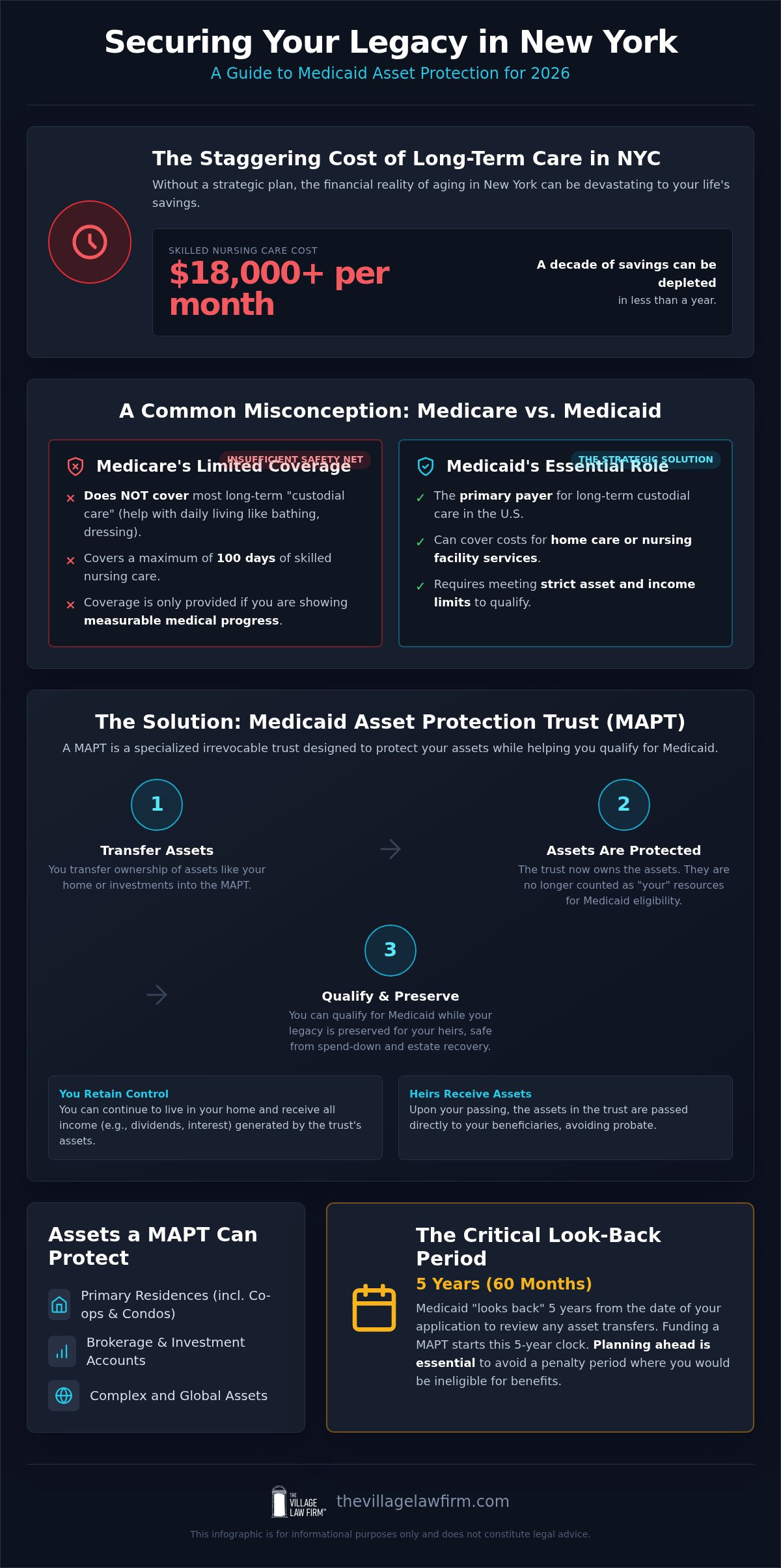
Living in New York offers a vibrant, unparalleled lifestyle, but the cost of aging in the city is staggering. In 2026, the price of skilled nursing care in the NYC metro area frequently exceeds $18,000 a month. This isn’t just a number on a spreadsheet; it’s a direct threat to the inheritance you’ve spent a lifetime building. Without a strategic plan, a decade of hard-earned savings can vanish in less than a year. This financial drain often forces families into a “spend-down,” a process where assets must be liquidated until you’re nearly destitute to qualify for help. It’s a cycle of chaos that a Medicaid asset protection trust NY is specifically designed to stop.
The emotional weight of this reality is heavy. Many parents fear becoming a financial burden on their children or, worse, seeing the family home sold to cover medical bills. As the 2026 legal landscape shifts, the window for effective planning is narrowing. Waiting until a crisis hits is no longer a viable strategy. You need a sanctuary of order to protect your legacy from the rising tide of long-term care costs.
Medicare vs. Medicaid for Custodial Care
Many professionals believe Medicare provides a safety net for long-term care. It doesn’t. Medicare covers exactly 100 days of skilled nursing care, and only if you’re making measurable medical progress. Most aging needs fall under “custodial care,” which includes help with daily living like dressing, bathing, or eating. Since the Medicaid program is the primary payer for custodial care in the U.S., relying on Medicare is a dangerous gamble. Proactive planning acts as a barrier between financial stability and total depletion. It ensures you don’t have to choose between high-quality care and your children’s inheritance.
Defining Medicaid Asset Protection in 2026
Shielding your wealth requires more than a simple Will; it requires a sophisticated legal structure that balances your current lifestyle with future care requirements. By using a Medicaid asset protection trust NY, you create a secure harbor for your property and savings. You stay in control of your life while the trust protects the principal from being counted toward Medicaid’s strict asset limits. An authoritative guide who understands the nuances of NYC real estate, from co-ops to condos, is essential for this process. This meticulous approach ensures your New York estate tax exemption strategy and Medicaid goals work in perfect harmony to secure your family’s future.
The Medicaid Asset Protection Trust (MAPT) Explained
A Medicaid Asset Protection Trust (MAPT) is a sophisticated legal instrument designed to reconcile two seemingly opposing goals: qualifying for long-term care benefits and preserving your family’s wealth. At its core, this is an irrevocable trust that functions as a protective shield around your assets. By transferring ownership of your property or savings to the trust, these items are no longer counted as “available resources” by the New York State Medicaid program. This shift is what allows you to meet the strict asset limits required for eligibility without first spending down your life’s work to nothing.
A Medicaid asset protection trust NY serves as a legal sanctuary for your family home, ensuring it remains an inheritance rather than a resource for the state. While the trust owns the principal, meticulous drafting allows you to continue receiving any income the trust assets generate. You don’t lose the benefit of your investments; you simply change how they are held to satisfy legal requirements. Precision in this drafting stage is vital. A poorly constructed trust can lead to future estate litigation or a denial of benefits, which is why a partnership with a dedicated expert is the only way to ensure the structure remains a sanctuary of order.
Preserving Your Home and Wealth with a MAPT
For many New Yorkers, the primary residence is their most significant asset. Whether you own a brownstone in Brooklyn or a condo in Manhattan, you can transfer the title into a sophisticated irrevocable trust while retaining the absolute right to live there for the rest of your life. This strategy isn’t limited to local real estate. It can effectively manage:
- Primary NYC residences including co-ops and condos.
- Brokerage accounts and diversified investment portfolios.
- Complex global assets and international holdings.
One of the most significant advantages is the “step-up” in basis. When your heirs eventually receive the property through the trust, they inherit it at its current market value rather than what you originally paid. This meticulous detail can save your family hundreds of thousands in capital gains taxes.
Maintaining Control and Choice
The word “irrevocable” often sparks concern, but it doesn’t mean you lose your voice. You maintain control by carefully selecting your trustee, often a child or a trusted family partner. Through a “limited power of appointment,” you also retain the right to change who eventually inherits the trust assets. This flexibility ensures you aren’t locked into a decision made years ago if family dynamics change. It replaces the chaos of uncertainty with a methodical plan. If you’re ready to move from anxiety to a position of strength, exploring these options with an experienced Medicaid planner is your next logical step.
Navigating the 5-Year Look-Back and 2026 Eligibility Rules
Timing is the most critical element of any asset protection strategy. For nursing home care, New York enforces a 60-month look-back period. This means the state scrutinizes every financial transaction you’ve made in the five years preceding your Medicaid application. Any assets transferred out of your name during this window, including gifts to family or funding a trust, can trigger a penalty period of ineligibility. A Medicaid Asset Protection Trust acts as a countdown. The moment you transfer your assets into the trust, the five-year clock begins. Waiting until a health crisis occurs is a gamble that often results in the total depletion of your wealth before help arrives.
Calculating the penalty period is a cold mathematical reality. The state divides the value of the transferred assets by a regional “nursing home rate” to determine how many months you must pay out of pocket. However, certain transfers are exempt from these rules. You can generally transfer assets to a spouse or a child with special needs without triggering a penalty. For everyone else, a Medicaid asset protection trust NY provides the only reliable way to move assets out of your “countable” estate while the clock runs toward safety.
Institutional vs. Community Medicaid in New York
The 2026 landscape introduces a significant shift for those who wish to age in place. While the five-year look-back has long applied to nursing homes, New York is finally implementing a 30-month look-back period for Community Medicaid, which covers home care services. This change means that even staying in your NYC home now requires advanced planning. By starting early, Medicaid planning for seniors creates a calming care environment where you can receive professional assistance without the fear of immediate financial ruin. It allows you to remain in the neighborhood you love while the trust shields your property from future claims.
NYC Income and Asset Limits for 2026
Qualifying for Medicaid in New York City requires meeting strict financial thresholds. In 2026, the individual asset limit remains remarkably low compared to the high cost of living in the five boroughs. Many NYC professionals find that their monthly income also exceeds the eligibility cap. This is where a Pooled Income Trust becomes essential. It allows you to “spend” your excess income on your own living expenses, such as rent, utilities, or groceries, while still qualifying for Medicaid benefits. Using a Medicaid asset protection trust NY alongside a pooled trust ensures that neither your savings nor your monthly cash flow is sacrificed. This meticulous coordination replaces the chaos of changing rules with a steady, predictable path forward.
Securing Your New York Home from Estate Recovery
Many New Yorkers are surprised to learn that Medicaid isn’t always a gift; it’s often a loan the state expects to be repaid. After a recipient passes away, the state’s “estate recovery” unit seeks reimbursement for the total cost of care provided. If your home is your most significant asset, it becomes the primary target for these claims. A standard Will is insufficient to stop this process. Since a Will only governs assets that pass through probate, the state can easily place a lien on a property held in your individual name. A Medicaid asset protection trust NY serves as a definitive shield against this outcome. By removing the home from your probate estate, you ensure it passes directly to your heirs, untouched by state reimbursement claims.
Some property owners consider a “Life Estate” as an alternative, but this often falls short in the complex NYC market. While a Life Estate might avoid probate, it doesn’t offer the same level of creditor protection or tax flexibility as a trust. A trust allows you to maintain the “step-up” in basis, which protects your children from massive capital gains taxes when they eventually sell the property. It’s a more meticulous, high-end solution for families who value long-term stability over a quick fix. Don’t leave your legacy to chance. Plan ahead to keep your home in the family.
Strategies for NYC Co-ops, Condos, and Brownstones
Protecting an apartment in Manhattan or a brownstone in Brooklyn requires an intimate knowledge of local real estate. Transferring a co-op into a trust, for instance, requires board approval and specific legal language that satisfies the building’s bylaws. These hurdles can be daunting without a steady guide. A Medicaid planning attorney in New York manages these nuances, coordinating with boards and management companies to ensure the transfer is seamless. We treat your residence as the sanctuary it is, preventing it from becoming a source of debt for your children. This attention to detail is what separates a transactional document from a true protective shield.
Planning for Families with Children
For parents, the goal is rarely just about qualifying for benefits; it’s about the emotional significance of the family legacy. Our approach to NYC estate planning for parents integrates Medicaid goals with guardianship and inheritance protection. By using strategic, pre-funded trusts, we help you avoid the unpredictability of probate court. This methodical structure ensures that your children are cared for and your assets are distributed exactly as you intended. It replaces the weight of complexity with a clear, reassuring path forward. If you want to ensure your home remains a gift for the next generation, contact The Village Law Firm to begin building your custom asset protection strategy today.
Strategic Asset Protection with The Village Law Firm
Moving from the weight of legal complexity toward a methodical solution requires more than just a document. It requires a partner who understands the high stakes of your family’s narrative. At The Village Law Firm, we specialize in transforming the anxiety of long-term care into a structured sanctuary of order. A Medicaid asset protection trust NY is a powerful tool, but its effectiveness depends on how well it integrates with your broader financial life. We don’t just draft trusts; we harmonize your Medicaid goals with your New York estate tax exemption strategy. This ensures that while you’re qualifying for care, you’re also avoiding the “tax cliff” that 2026 brings to many high-net-worth NYC families.
Our white-glove experience is designed for busy professionals who value efficiency and meticulous attention to detail. We recognize that many New Yorkers hold assets across borders. Our specialized expertise in international estate planning allows us to protect global wealth while ensuring you remain eligible for local benefits. We replace the chaos of conflicting regulations with a single, cohesive plan that shields your legacy from every angle. It’s a premium level of service that treats asset protection as an act of stewardship rather than a mere transaction.
A Partnership Mindset for Long-Term Security
We view our clients as partners in legacy, not just legal cases. This mindset drives our commitment to transparency and directness. In a field often clouded by dense legalese and shifting rules, we provide a clear, steady voice. We walk alongside you, explaining the practical benefits behind every provision in your Medicaid asset protection trust NY. Our goal is to remove the fear of the unknown. By creating a pre-emptive, meticulously drafted plan, we help you avoid the litigation risks that often plague less thorough approaches. You gain a sanctuary of calm in a fast-paced city.
Your Next Steps Toward Protection
Securing your future shouldn’t be a source of stress. It starts with a simple, sophisticated conversation about where you are and where you want to be. We invite you to schedule a comprehensive review of your current holdings to identify potential vulnerabilities. Taking action today is the only way to outpace the look-back periods and tax changes on the horizon. By finalizing your New York estate plan now, you’re not just signing papers; you’re securing a promise for the next generation. Let us be your guide through the complexity toward a legacy of absolute security.
Your Path to Lasting Financial Peace
The journey toward securing your legacy doesn’t have to be defined by anxiety or the fear of rising care costs. By establishing a Medicaid asset protection trust NY, you transform potential financial chaos into a sanctuary of order. You’ve worked too hard for your home and savings to let them be consumed by the escalating costs of long-term care. As New York’s 2026 eligibility rules and look-back periods evolve, taking a proactive step today is the most compassionate gift you can give your children. It ensures you receive the care you deserve without sacrificing the inheritance you intended for the next generation.
The Village Law Firm offers a meticulous, white-glove experience tailored to the unique needs of NYC professionals. Whether you’re managing local real estate or complex international holdings, we serve as your calming, authoritative guide through the intricate world of Medicaid and probate. Secure your family legacy with a sophisticated Medicaid planning strategy from The Village Law Firm. You’ve built a remarkable life in this city; let’s work together to protect it with absolute precision and a deeply human touch.
Frequently Asked Questions
What is a Medicaid Asset Protection Trust and how does it work in NY?
A Medicaid asset protection trust NY is an irrevocable legal structure designed to hold your property and savings so they aren’t counted toward Medicaid’s strict asset limits. By transferring ownership to the trust, you effectively shield these resources from being “spent down” on long-term care costs. While the trust owns the principal, you can still receive the income it generates. This methodical approach ensures you qualify for benefits while preserving a legacy for your family.
Can I still live in my New York home if I put it in a Medicaid trust?
Yes, you retain the absolute legal right to live in your primary New York residence for the rest of your life. When you transfer a brownstone, condo, or co-op into the trust, the deed is updated to reflect trust ownership, but your right of occupancy remains undisturbed. This allows you to maintain your current lifestyle and community connections while knowing the property is shielded from future Medicaid liens or state estate recovery claims.
How long is the Medicaid look-back period in NY for 2026?
In 2026, New York enforces two distinct look-back periods depending on the type of care required. For nursing home care, the look-back remains 60 months. For Community Medicaid, which covers home care services, New York has implemented a 30-month look-back period. These rules mean the state reviews all financial transfers made within these specific windows. Starting your plan early is essential to ensure your assets are protected before you ever need to apply for benefits.
Will I lose control of my finances if I set up a Medicaid trust?
You don’t lose total control, but you do shift how your assets are managed. While you cannot be the trustee of your own Medicaid asset protection trust NY, you can appoint a trusted family member or professional partner to fill that role. You retain the right to receive income from trust assets and can even change the eventual beneficiaries through a limited power of appointment. This structure replaces the chaos of uncertainty with a high-end, protective framework.
What assets are considered exempt from Medicaid in New York?
New York Medicaid considers several assets “non-countable” for eligibility purposes. These generally include:
- Personal belongings and household goods.
- One primary vehicle used for transportation.
- Retirement accounts like IRAs if they are in periodic payment status.
While a primary home is often exempt during your lifetime, it remains vulnerable to estate recovery after death. This is why a trust is necessary to provide a complete sanctuary for your family’s real estate.
Is it too late to start Medicaid planning if I already need care?
It’s rarely too late to take action, though your options become more specialized if you already require care. Even if you’re facing an immediate need, “crisis planning” strategies can often protect a significant portion of your assets. However, these late-stage maneuvers are more complex and less efficient than proactive trust funding. Engaging a steady guide as soon as possible allows for a more methodical and reassuring transition into a protective legal state for your wealth.
How does a Medicaid trust affect my 2026 New York estate taxes?
A properly drafted Medicaid trust is typically designed as a “grantor trust” for tax purposes. This means it’s neutral for income taxes but can be strategically coordinated with your New York estate tax exemption. In 2026, navigating the “tax cliff” requires meticulous drafting to ensure assets in the trust aren’t unnecessarily increasing your taxable estate. We harmonize these two goals to protect you from both the high cost of care and excessive taxation at the state level.
What is the difference between Community Medicaid and Institutional Medicaid in NYC?
The primary difference lies in the setting and level of care provided. Community Medicaid covers services that allow you to age in place, such as home health aides or adult day care in your NYC residence. Institutional Medicaid covers the comprehensive costs of a skilled nursing facility. Each has its own income and asset requirements, as well as distinct look-back periods. Understanding these nuances is vital for creating a plan that reflects your personal preferences for future care.