
What if the profound responsibility of settling a loved one’s legacy felt less like a bureaucratic burden and more like a structured path toward peace? You’ve been entrusted with a significant fiduciary role, yet the reality of managing assets across different jurisdictions and the intricacies of the NYC Surrogate’s Court can quickly become overwhelming. Partnering with a sophisticated executor of estate attorney New York transforms this complex legal mandate into a manageable, orderly process. You shouldn’t have to carry the weight of potential personal liability or family disputes on your own.
We understand that you want to honor your loved one’s wishes while protecting your own professional reputation and mental space. It’s natural to feel anxious about making a technical mistake or getting lost in the paperwork. This guide provides the clarity you need to fulfill your duties with the confidence of a steady legal partner by your side. We’ll walk through the essential steps of estate administration in 2026, from efficient asset distribution to mastering the latest court requirements, ensuring a calm and dignified transition for your family.
Key Takeaways
- Define your legal standing and the ethical obligations inherent in your role, whether you’re named in a Will or appointed by the court.
- Navigate the specific timelines and filing requirements of Manhattan, Brooklyn, and Queens Surrogate’s Courts with technical precision.
- Protect your personal assets by understanding why an executor of estate attorney New York is vital for avoiding costly fiduciary “surcharges.”
- Solve the complexities of managing international properties and cross-border assets through a structured, white-glove administration process.
- Establish a legacy of order and peace for your family by replacing legal chaos with a methodical, professional partnership.
Navigating Your Role as an Executor in New York
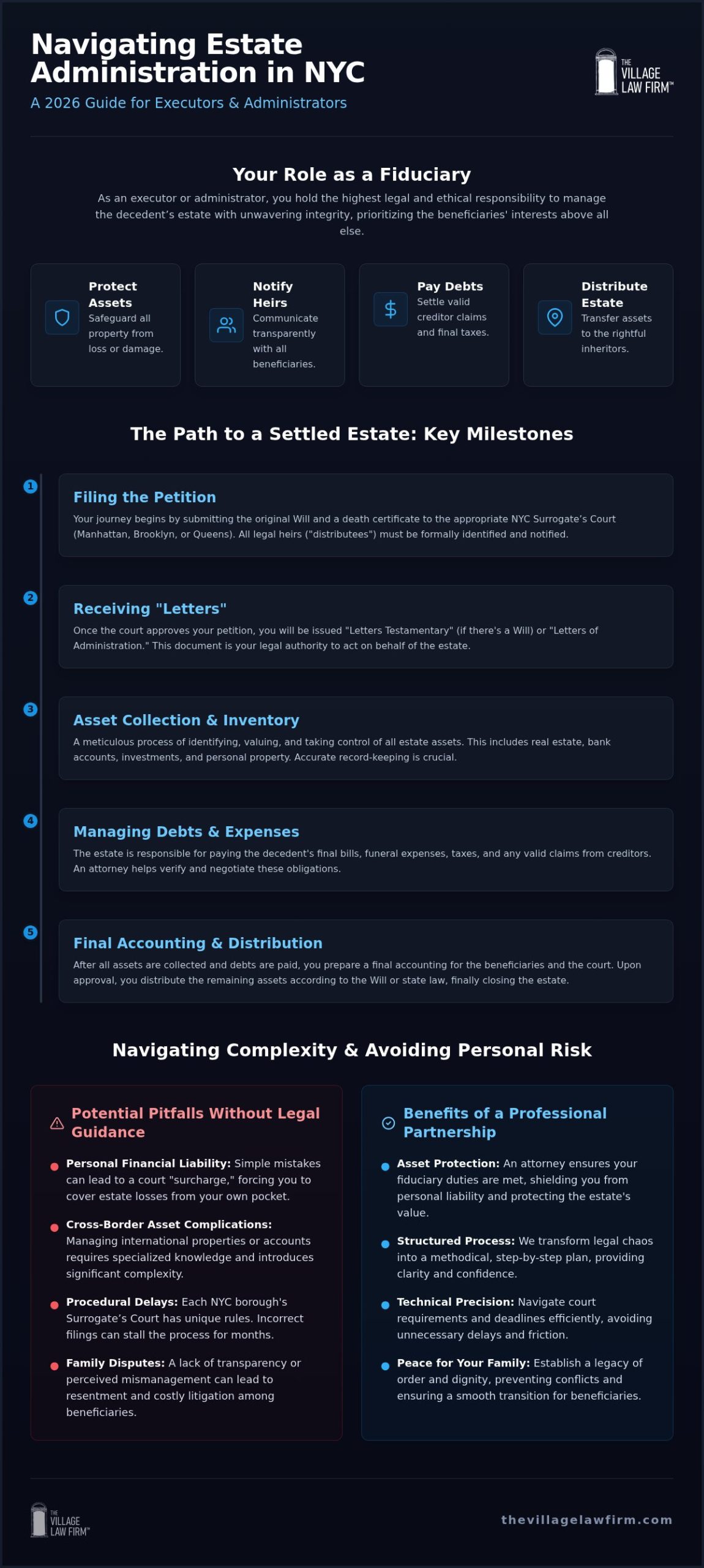
When you are named an executor in a New York Will, you step into a role that is both deeply personal and strictly legal. You are now a fiduciary. This means you hold the legal and ethical responsibility to manage the decedent’s estate with unwavering integrity. It’s a position of trust that requires you to prioritize the interests of the beneficiaries above your own at every turn. If there is no Will, the court appoints an Administrator to fulfill these same duties. Regardless of your specific title, the standard of care remains exceptionally high. You are the steward of a legacy.
New York is a fast-paced environment where legal complexity can quickly spiral into chaos. Managing a decedent’s estate involves more than just reading a document; it requires meticulous attention to real estate, financial accounts, and tangible property. This is where a sophisticated executor of estate attorney New York serves as your steady urban guide. We provide a sanctuary of order, ensuring that every asset is protected and every court filing is precise. The probate process can be a labyrinth of specific rules and local customs. You don’t have to navigate it alone. Our partnership transforms a daunting legal mandate into a structured, calm journey toward settlement.
The Fiduciary Duty: Why “Good Enough” Isn’t Enough
In the eyes of the law, a simple mistake is rarely seen as an accident. Executors face significant personal liability for mismanagement, unnecessary delays, or even a perceived lack of transparency. If you fail to protect the estate’s value, beneficiaries can seek a surcharge. This is a court order requiring you to pay for those losses out of your own pocket. Honesty and meticulous record-keeping are your best defenses against conflict. Clear communication with family members prevents the seeds of resentment from growing into litigation. In New York, fiduciary duty is defined as the highest legal standard of care one person can owe to another.
Executor Commissions in New York (2026)
Your time and effort are valuable, and the law recognizes the weight of your contribution. In 2026, New York continues to provide statutory commissions to compensate executors for their work. These fees are calculated as a percentage of the estate’s total value. It’s vital to remember that these commissions are considered taxable income. Many family members choose to waive their commission to preserve more of the estate for the group, but the choice is yours. For a deeper look at the financial side of these proceedings, see The Real Cost of Probate in New York: A 2026 Comprehensive Guide. Understanding these figures early helps you plan for a transparent and orderly distribution.
The New York Probate and Administration Timeline
The journey from the loss of a loved one to the final distribution of their assets is rarely a straight line. In New York, this chronological path is governed by the Surrogate’s Court, whether you are filing in Manhattan, Brooklyn, or Queens. Each borough has its own local nuances and current backlogs that can influence your progress. This timeline is where the transition from chaos to order truly happens. Without a clear map, executors often find themselves stalled by procedural hurdles or missing documentation. A seasoned executor of estate attorney New York acts as your navigator, ensuring that every deadline is met with technical precision. Meticulous record-keeping from day one is your greatest asset in preventing delays and maintaining the trust of everyone involved.
While the law provides the framework, the actual pace of administration often depends on the complexity of the assets and the clarity of the initial filings. Many people underestimate the sheer volume of executor of estate responsibilities required during the first few months. By establishing a methodical rhythm early on, you protect the estate from unnecessary legal friction and ensure a smoother transition for the family. If the weight of these steps feels heavy, partnering with a professional firm can provide the sanctuary of order you need during this transition.
Step 1: Filing the Petition for Probate
Your first priority is obtaining the original Will and a certified copy of the death certificate. These documents form the foundation of your petition to the Surrogate’s Court. You must identify and notify all “distributees,” who are the heirs-at-law entitled to notice under New York law. This step is often where families encounter their first delays, especially if heirs are difficult to locate or reside in different jurisdictions. Once the court is satisfied, you receive “Letters Testamentary.” Think of these letters as your official shield. They grant you the legal authority to move assets, speak with financial institutions, and act decisively on behalf of the estate.
Step 2: Marshaling Assets and Paying Debts
With your Letters in hand, the process of inventorying begins. You must secure everything from high-value NYC real estate to digital accounts and sentimental personal property. This stage requires an estate bank account to keep estate funds entirely separate from your own. This isn’t just a suggestion; it’s a requirement for meticulous financial tracking. New York law also provides a seven-month period for creditors to come forward with claims against the estate. Distributing assets too early can leave you personally liable for these debts. Patience during this window ensures that when you finally close the estate, you do so with the confidence that no lingering liabilities remain.
Managing Cross-Border and High-Complexity Estate Assets
Many New Yorkers lead lives that span continents, and your role as executor doesn’t stop at the state line. If the decedent owned a flat in London, a vineyard in Italy, or even a vacation home in Florida, you face a distinct set of legal hurdles. Ancillary probate in New York is the secondary court process required to manage property located outside the primary jurisdiction. It effectively mirrors the New York process in another court, adding layers of paperwork and significant potential for delay. Partnering with a specialized executor of estate attorney New York ensures these global threads are woven together seamlessly rather than becoming a tangled web of conflict and confusion.
In 2026, the global tax environment is more transparent and interconnected than ever before. This transparency brings a heightened risk of double taxation if international tax treaties aren’t meticulously applied to the estate’s assets. You need a partner who understands the strategic importance of these agreements to protect the legacy’s total value. Specialized counsel is no longer a luxury for these estates. It’s a necessary shield against legal conflicts and unnecessary financial loss. We help you navigate these high-stakes requirements with the confidence of an expert who understands both the local Surrogate’s Court and the global stage.
International Estate Administration: The Village Law Firm Advantage
Handling foreign bank accounts or international real estate requires more than just a standard filing. It requires a coordinated network. We work directly with foreign legal counsel to streamline global distribution, ensuring that every asset is accounted for according to both New York and local laws. This high-level coordination is built upon the strategic foundation of International Estate Planning for Global Citizens. By treating the estate as a unified whole, we remove the complexity that often paralyzes executors who are dealing with cross-border administration for the first time.
Complex Assets: Digital Legacies and Business Interests
Not every asset is tangible or easily appraised. New York is a hub for entrepreneurs and creators, meaning many estates include closely-held business interests, intellectual property, or high-value art collections. Managing these requires precise valuation and sophisticated reporting to satisfy both the beneficiaries and the IRS. Digital legacies, including cryptocurrency and private online accounts, present their own unique access and security challenges. We provide the technical precision needed to manage these modern assets, ensuring they are transferred or liquidated with the same meticulous care as a Manhattan penthouse.
The Risks of DIY: Why You Need an Estate Administration Attorney
It’s understandable to view legal fees as an additional burden on a decedent’s estate. You might believe that filing a few forms at the Surrogate’s Court is a task you can handle alone. However, this perspective often overlooks the significant personal risk involved in estate settlement. In New York, the court holds you to a standard of technical perfection. An honest mistake in an accounting or a missed deadline for a tax filing isn’t just a minor error; it’s a breach of fiduciary duty. Choosing a sophisticated executor of estate attorney New York is an investment in your own protection. We provide the meticulous oversight needed to ensure you never have to face these complexities without a legal shield.
One of the most sobering realities for any executor is the risk of a “Surcharge.” If a beneficiary or creditor proves that your actions, or your inaction, caused a loss to the estate, the judge can order you to repay that amount from your own personal bank account. This isn’t a theoretical threat. It’s a common outcome in contested estates. While some firms take a purely transactional approach to these cases, we prioritize a partnership-focused model. We don’t just process paperwork. We act as a buffer between you and the emotional volatility of family dynamics, preventing disputes from escalating into costly litigation.
DIY Administration vs. Professional Legal Support
- Personal Liability: DIY executors carry the full weight of legal errors. Professional counsel mitigates this risk by ensuring every step follows strict New York protocols.
- Speed of Distribution: Without a guide, the probate process is often slow and error-prone. A methodical legal partner streamlines the timeline, moving from filing to final distribution with efficiency.
- Tax Optimization: Many DIY executors miss opportunities to minimize estate or income taxes. We strategically manage these filings to preserve the maximum value for beneficiaries.
Medicaid Recovery and the Estate
Estate administration often intersects with complex prior planning, particularly regarding long-term care. A dedicated executor of estate attorney New York ensures that any recovery claims are handled with the necessary legal foresight. If the decedent received benefits, the state may attempt to recover costs from the estate assets. This is a delicate area where a Medicaid Planning Attorney New York becomes essential. We understand how to protect the family home and other exempt assets from recovery actions during the administration process. If you are concerned about protecting a legacy from state claims, schedule a consultation with our team to discuss your specific situation.
Partnering with The Village Law Firm for Seamless Estate Settlement
Settling an estate in a city as fast-paced as New York requires more than just legal knowledge. It requires a partner who understands the rhythm of your life and the weight of your professional commitments. We recognize that your time is your most precious asset. Our firm provides a white-glove service model specifically designed to lift the administrative burden from your shoulders. By serving as your executor of estate attorney New York, we transform a period of potential legal chaos into a methodical, orderly transition. We don’t just process paperwork. We act as a protective shield, standing between you and the unpredictability of the Surrogate’s Court. Our commitment is to replace your current anxiety with a profound sense of security and clarity.
The transition from a named executor to a fully discharged fiduciary is a journey that demands unwavering integrity and technical precision. We offer a sanctuary of order amidst the complexities of local and international law. Our approach is built on a foundation of partnership rather than transaction. We walk alongside you, ensuring that every asset is accounted for and every beneficiary is treated with transparency. This high-end level of service ensures that you can fulfill your duties without sacrificing your own peace of mind or professional focus. You’ve been entrusted with a legacy. We provide the structure to honor it.
A Compassionate Approach to Complex Legalities
Probate is rarely just about the mechanics of the law. It’s about the people involved and the legacies they’ve left behind. We bring deep emotional intelligence to every interaction, acknowledging the profound responsibility you carry. Our team maintains a meticulous focus on every filing, ensuring that technical precision never comes at the expense of human empathy. We view our role as a bridge. On one side are the high-stakes legal requirements of the New York courts; on the other is the enduring harmony of your family. By managing the complexities of asset valuation and cross-border distribution with honesty, we prevent the misunderstandings that often lead to conflict. Order isn’t just about spreadsheets. It’s about peace of mind.
Get Started with Your New York Estate Administration
The path toward a seamless settlement begins with a single, methodical step. We invite you to a consultation where we will conduct a thorough assessment of the estate’s specific needs and your unique concerns. This is where we begin to streamline the NYC Surrogate’s Court process for you, identifying potential hurdles before they become delays. You deserve a legal partner who offers the sophisticated guidance necessary for modern, complex estates. Don’t let the weight of administration pull you away from your life. Replace unpredictability with professional order and start your journey toward a calm and dignified estate resolution today.
Secure Your Legacy with Professional Guidance
Navigating the probate process in New York is a heavy responsibility, but you don’t have to carry it alone. We’ve explored how your fiduciary duty requires technical precision, from managing the strict Surrogate’s Court timelines to handling the intricate requirements of cross-border assets. By choosing to work with a sophisticated executor of estate attorney New York, you gain a meticulous shield against personal fiduciary liability and a partner who understands the high stakes of legacy administration. Our firm specializes in international and cross-border probate, providing a white-glove service tailored for busy NYC professionals who value order and efficiency.
You have the power to replace the unpredictability of legal bureaucracy with a sense of calm and structured progress. It’s time to transition from the stress of the unknown to the security of expert guidance. Schedule a Calming Consultation for Estate Administration to ensure your loved one’s legacy is settled with the dignity and precision it deserves. We are here to guide you through every step, protecting your interests while honoring the family’s transition with compassion and excellence.
Frequently Asked Questions
How long does the probate process typically take in New York in 2026?
The probate process in New York typically spans nine to fourteen months in 2026, though specific timelines vary by borough. While a simple estate might conclude sooner, backlogs in the Manhattan or Brooklyn Surrogate’s Courts can extend the journey. Complexities like real estate sales or creditor negotiations often lengthen the process. A structured approach ensures that you meet every deadline without unnecessary delays.
Can an executor be held personally liable for mistakes made during administration?
Yes, you can be held personally liable for financial losses caused by mismanagement or procedural errors. This risk, known as a surcharge, means a judge can order you to repay the estate from your own funds. It’s a sobering reality that underscores the need for meticulous oversight. Partnering with a sophisticated executor of estate attorney New York provides a vital shield against these personal financial risks.
What are the statutory executor commissions in New York?
New York law sets statutory commissions based on a sliding scale according to the value of the estate. For instance, you are entitled to 5% on the first $100,000 and 4% on the next $200,000. These commissions are considered taxable income and must be reported to the IRS. You have the option to waive these fees if you prefer to preserve more assets for the beneficiaries.
Do I need a New York attorney if the decedent lived in NYC but I live out of state?
You absolutely need local counsel because the probate process must occur in the county where the decedent resided. Even if you live across the country, New York law governs the administration and the Surrogate’s Court requires specific local filings. An executor of estate attorney New York serves as your steady urban guide, managing all court appearances and local requirements so you don’t have to travel to the city repeatedly.
What happens if a family member contests the Will during probate?
A Will contest triggers a formal legal challenge that pauses the standard administration process. The court will oversee “1404 examinations” where witnesses and the attorney who drafted the Will are questioned. These disputes often arise from claims of undue influence or lack of capacity. Having a protective partner is essential to mediate these family dynamics and defend the integrity of the decedent’s final wishes.
How does international property affect the New York estate administration process?
International property requires a secondary legal process known as ancillary probate New York in the country where the asset is located. This adds layers of complexity, as you must navigate foreign laws and potential double taxation issues. We coordinate with international counsel to ensure these global assets are integrated into the overall estate plan. Meticulous attention to tax treaties is required to protect the legacy’s total value.
Is an attorney required for small estates in New York?
While not legally mandated for “small estates” under $50,000, professional guidance is often still a wise investment. These simplified proceedings, called Voluntary Administration, still require accurate filings and debt resolution. Even in smaller estates, hidden complexities like Medicaid recovery claims or disputed personal property can arise. Having a professional bridge the gap between legal mechanics and family harmony prevents minor issues from becoming major burdens.
How much does an estate administration attorney cost in NYC?
Legal fees in New York vary depending on the estate’s complexity and the specific needs of the family. For estates involving NYC rental properties, specialized Legal Representation and Litigation Fees may also apply. Most firms utilize either an hourly rate or a flat fee for defined services. It’s important to remember that these professional fees are generally considered an administrative expense of the estate. This means the costs are paid from the estate’s assets rather than your personal bank account.