

Did you know that a New York estate valued at $1 million carries a mandatory executor commission of $34,000 before a single dollar reaches a beneficiary? When you’re mourning a loss, the last thing you want to calculate is how much of a legacy will be consumed by court fees and legal billing. It’s natural to feel a sense of unease as you look at the cost of probate in NY, especially when the New York estate tax cliff threatens to erase liquidity if your valuation crosses an unforgiving threshold. You deserve a sanctuary of order during this chaotic time.
We understand that transparency is the first step toward peace of mind. This article promises to replace your anxiety with a predictable budget by providing a meticulous breakdown of the 2026 Surrogate’s Court fees and legal costs. We’ll explore the rigid statutory formulas that govern executor pay, explain the impact of the current $7,350,000 tax exemption, and share strategic methods to protect your inheritance from unnecessary depletion. We’ll examine exactly how court intervention can be minimized so that your family’s legacy reaches its intended destination intact.
Key Takeaways
- Learn how SCPA 2402 filing fee tiers are calculated and which specific assets are exempt from this initial court expense.
- Understand the mandatory sliding scale for executor commissions to accurately project the total cost of probate in NY for any estate size.
- Discover why international assets and complex family dynamics can shift legal billing from a predictable flat fee to an hourly model.
- Identify the hidden administrative costs, such as professional appraisals and surety bonds, that often surprise unprepared fiduciaries.
- Explore strategic estate planning tools, including revocable living trusts, that can move assets outside the reach of the Surrogate’s Court entirely.
The Baseline: New York Surrogate’s Court Filing Fees
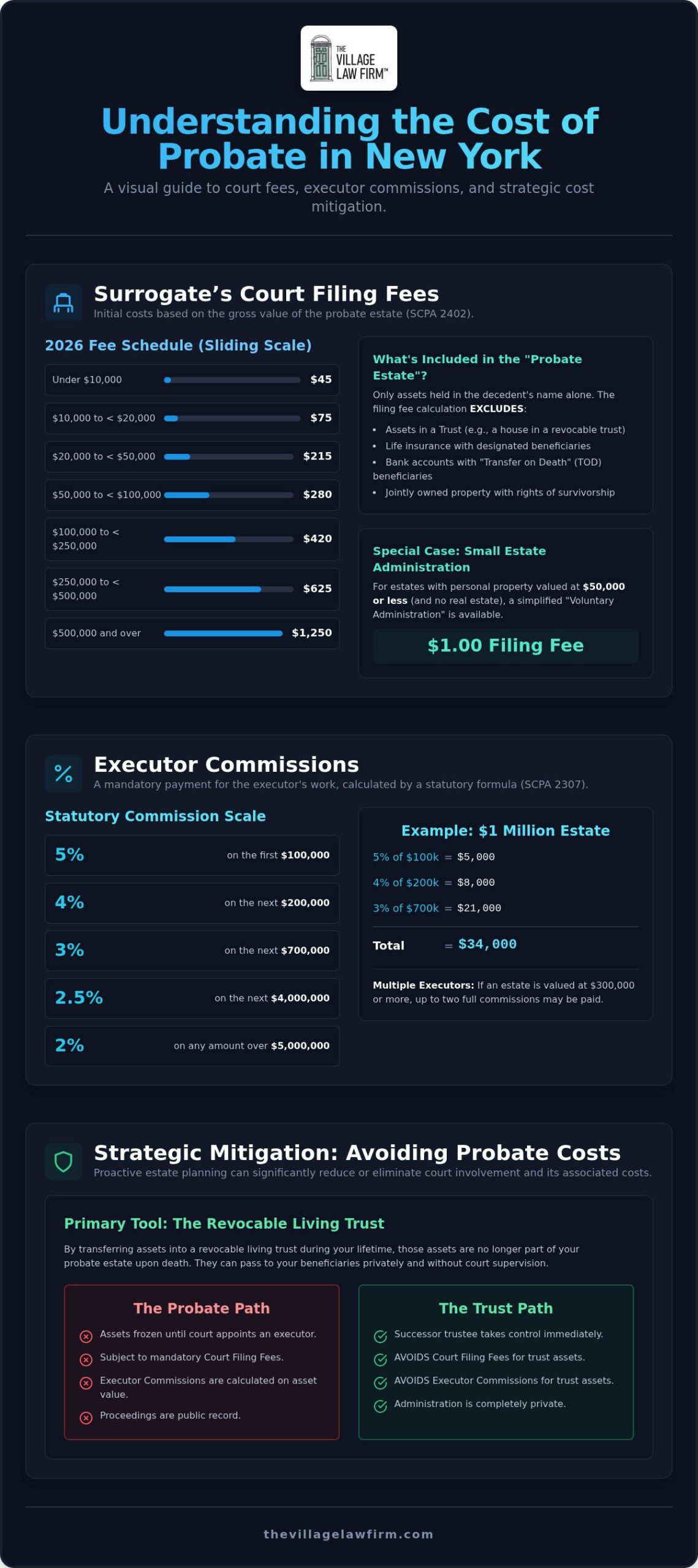
The financial journey through the New York Surrogate’s Court begins with a mandatory filing fee. This isn’t a hidden cost. It’s a structured payment dictated by Surrogate’s Court Procedure Act (SCPA) 2402. This statute provides the framework for the initial cost of probate in NY, scaling the fee based on the total value of the estate. For a family seeking order in a time of grief, knowing these numbers upfront offers a small but vital sense of control. The court remains consistent in its 2026 fee schedule, ensuring that every petitioner faces a transparent, sliding scale.
The fees for 2026 are categorized into the following tiers:
- Under $10,000: $45
- $10,000 to under $20,000: $75
- $20,000 to under $50,000: $215
- $50,000 to under $100,000: $280
- $100,000 to under $250,000: $420
- $250,000 to under $500,000: $625
- $500,000 and over: $1,250
Probate vs. Non-Probate Assets: What Determines Your Fee?
A common misconception is that the court taxes the entire value of everything a person owned. This isn’t true. The filing fee applies only to the “Gross Probate Estate.” A Gross Probate Estate consists of all assets held exclusively in the decedent’s name that pass through a Will or intestacy laws. If a $2 million Manhattan townhouse is held within a trust, it bypasses this calculation entirely. Similarly, life insurance policies with designated beneficiaries or bank accounts with “Transfer on Death” (TOD) instructions don’t contribute to the filing fee. By meticulously organizing assets into non-probate categories, you can significantly reduce the “official” value the court sees. This is how a multi-million dollar estate might only trigger a $215 filing fee.
Small Estate Administration (Voluntary Administration)
Efficiency is a hallmark of a well-planned estate. If the personal property in an estate totals $50,000 or less, New York offers a streamlined path called Voluntary Administration. This process is designed for speed and simplicity. One of the most significant benefits is the filing fee, which is a flat $1.00 regardless of the value within that $50,000 range. However, this path has strict boundaries. It only applies to personal property, such as bank accounts, jewelry, or vehicles. If the decedent owned real estate in their name alone, you must use the standard probate process, regardless of the property’s value. In the fast-paced environment of NYC, using the small estate affidavit can save months of administrative delays and hundreds in court costs.
Calculating your tier requires a clear inventory. Start by listing all accounts without beneficiaries and any real property held solely by the decedent. It’s important to remember that the court calculates the fee based on the gross value, not the net value after mortgages or debts are paid. Once you have that total, you can write your check to the Surrogate’s Court with confidence, knowing exactly where you stand in the 2026 fee schedule. This clarity is the first step toward protecting the legacy you’ve been entrusted to manage.
Executor Commissions: Understanding the SCPA 2307 Formula
While court filing fees are relatively modest, the compensation for the executor often represents a much larger portion of the total cost of probate in NY. New York law provides a rigid statutory formula under SCPA 2307 to ensure that executors are fairly compensated for the significant responsibility of settling an estate. According to the New York City Bar Association, an executor’s role involves everything from inventorying assets to paying final debts, and the law recognizes this labor through a sliding commission scale. This commission isn’t a gift; it’s earned income for the meticulous work of estate administration.
The Statutory Sliding Scale Breakdown
The commission is calculated based on the value of the assets the executor handles. It follows a specific, non-negotiable scale:
- 5% on the first $100,000
- 4% on the next $200,000
- 3% on the next $700,000
- 2.5% on the next $4,000,000
- 2% on any amount exceeding $5,000,000
To put this into perspective, a $1 million NYC estate generates a statutory commission of $34,000. It’s also vital to consider the number of people serving in this role. If an estate is valued at $300,000 or more, New York law allows up to two full commissions to be paid out. If three executors are named, they must share those two commissions. This can significantly increase the financial burden on the estate’s remaining assets.
Tax Considerations for the Executor
The “Receiving and Paying Out” rule dictates that an executor earns half of their commission for taking control of the assets and the other half for distributing them to beneficiaries. This distinction is more than just a timeline; it reflects the ongoing nature of the commitment. For family members serving as executors, the decision to accept these funds requires careful thought. Commissions are treated as ordinary income and are subject to standard income tax. In contrast, a direct inheritance is typically received tax-free.
If you’re both the executor and a primary beneficiary, waiving the commission often keeps more of the legacy within the family by avoiding that income tax hit. However, in estates approaching the “tax cliff,” taking a commission might be a strategic way to reduce the overall taxable value of the estate. Every family’s situation is unique. Engaging in professional estate administration can help you determine the most tax-efficient path forward, ensuring that the transition of wealth is as seamless and protective as possible. Whether you choose a professional or a loved one, understanding these costs replaces uncertainty with a clear financial roadmap.
Attorney Fees and Complexity Drivers in NYC
Attorney fees are the most variable component of the total cost of probate in NY. Unlike court fees, which are fixed by statute, legal billing reflects the specific “chaos level” of an estate. A straightforward, uncontested filing might fit within a flat fee structure, providing families with immediate budgetary clarity. However, when an estate involves uncooperative heirs or missing records, hourly billing becomes the standard. For families with minor children, the complexity increases. The court often requires the appointment of a Guardian ad Litem to protect a child’s interests, and setting up minor’s trusts adds necessary layers of protection. Our firm prioritizes removing this complexity early, acting as a steady guide to prevent the billable hour bloat that often plagues unmanaged administrations.
Cross-Border and International Asset Costs
Managing a legacy that spans continents requires a specialized, white-glove approach. If the decedent owned property in London or accounts in Paris, the process often requires ancillary probate to bridge the gap between jurisdictions. These cross-border cases multiply costs through the coordination of foreign counsel, document translations, and the authentication of wills via Apostilles. Proactive planning is the only shield against these international hurdles. Our 2026 Guide: International Estate Planning in New York details how to structure these assets to avoid the high price of administrative friction later.
Contested Wills and Family Disputes
For estates involving assets or legal requirements in the United Kingdom, you can discover North East Barristers Chambers to access direct legal support and simplify the complexities of international probate.
Emotional friction is the most expensive driver of legal fees. A single “Notice of Appearance” from a disgruntled heir can triple the cost of probate in NY almost overnight. This filing signals the start of potential litigation, often leading to SCPA 1404 examinations. These are formal depositions of the witnesses and the drafting attorney, requiring hours of preparation and court time. We often recommend mediation as a sophisticated, cost-saving alternative to full-scale Surrogate’s Court litigation. It preserves both the estate’s liquidity and the family’s long-term relationships, turning a potential battlefield back into a place of resolution. By addressing these disputes with empathy and precision, we ensure the legacy remains focused on the beneficiaries rather than the conflict.
Hidden Administrative Expenses: Appraisals, Bonds, and Taxes
Beyond the statutory fees and commissions, several less visible expenses significantly impact the total cost of probate in NY. These administrative costs are the logistical gears of the process. They ensure the estate is valued correctly and protected from mismanagement. While they may seem minor individually, they can accumulate quickly in complex NYC estates involving co-ops, private businesses, or extensive collections. Ignoring these details often leads to delays that increase legal billing and administrative friction.
Valuing Assets for Tax and Distribution
Precision is paramount when valuing a legacy. While online estimates like Zillow provide a casual glance at property value, the IRS and the Surrogate’s Court require formal, professional appraisals. For a standard New York home, these generally cost between $500 and $800, though unique NYC properties or commercial holdings often command higher fees. This isn’t just a hurdle; it’s a strategic benefit. A professional appraisal establishes a “step-up in basis,” which can save beneficiaries thousands in future capital gains taxes by resetting the asset’s tax value to its current market price.
Valuation becomes even more critical as you approach the New York Estate Tax Exemption 2026: Navigating the Cliff. In 2026, the exemption sits at $7,350,000. If an estate’s value exceeds this by just 5%, the entire exemption is lost, and the entire estate becomes taxable. Accurate appraisals for art, jewelry, and family businesses are your primary defense against this “cliff,” ensuring you don’t inadvertently trigger a massive tax bill through sloppy math or outdated estimates.
The Cost of Protecting the Estate (Bonds and Insurance)
The court often requires a surety bond to protect beneficiaries against potential executor misconduct or errors. Think of this as an insurance policy for the estate’s liquidity. Standard premiums are approximately $5 per $1,000 of the bond amount. On a $1 million estate in liquid assets, this adds a $5,000 annual expense until the case reaches its final accounting. You can avoid this cost entirely by drafting a Will that specifically waives the bond requirement, a simple step that saves the estate thousands in unnecessary premiums.
Other miscellaneous expenses include:
- Certified Death Certificates: Typically $15 per copy in NYC; you’ll likely need ten or more for various financial institutions.
- Publication Costs: Fees for “Notice to Creditors” or citations in local newspapers, which are sometimes required by the court.
- Process Servers: The cost of formally notifying heirs and interested parties of the probate proceeding.
Managing these moving parts requires meticulous attention to detail to prevent “cost creep.” If you’re concerned about how these hidden fees affect your family’s inheritance, our experts can help you implement strategic estate administration to minimize waste. By addressing these logistical needs with a professional partner, you replace potential chaos with a structured, predictable plan that honors the decedent’s legacy.
Strategic Mitigation: How to Reduce or Avoid Probate Costs
Understanding the potential cost of probate in NY is the first step toward reclaiming control over your legacy. While statutory fees and commissions are fixed, your exposure to them is not. By implementing a proactive strategy, you can shift assets from the court’s jurisdiction to a private, streamlined transition. This isn’t just about saving money. It’s about preserving the emotional energy of your family during a vulnerable time. Effective estate planning for NYC families often pays for itself by eliminating the need for court-supervised administration entirely. Simple tools like “Transfer on Death” (TOD) accounts and updated beneficiary designations on life insurance can remove thousands from the probate tally with minimal effort.
Trust-Based Planning to Bypass Probate
The Revocable Living Trust is the premier tool for avoiding court intervention. When you transfer assets into a trust, they no longer belong to you individually; they belong to the trust entity. This means they are excluded from the Gross Probate Estate calculation we discussed earlier. While setting up a trust involves an upfront legal investment, it’s often significantly less than the 3% to 7% of estate value typically lost during probate. Beyond the math, trusts offer a level of discretion that the Surrogate’s Court cannot. Because a trust is a private contract, your family’s financial details remain shielded from public record. This prevents disgruntled parties from easily viewing your assets and filing a “Notice of Appearance” to contest the estate. Consulting an estate planning attorney in New York ensures your trust is funded correctly to maximize these protections.
Medicaid and Asset Protection Integration
For many New Yorkers, the family home is their most significant asset. Protecting it requires a dual-track approach that considers both probate and long-term care. An irrevocable trust can shield your residence from the high costs of nursing home care while simultaneously removing it from the probate footprint. This strategy requires foresight, particularly due to the five-year lookback period for Medicaid eligibility. Assets transferred within this window may still be subject to penalties, which can complicate estate administration. By integrating Medicaid planning with probate mitigation, you create a comprehensive shield against future uncertainty. It’s about building a bridge between chaos and order. If you’re ready to secure your family’s future, schedule a consultation to streamline your estate and ensure your legacy reaches its destination intact.
Protecting Your Legacy in an Unpredictable World
Managing an estate in New York doesn’t have to be a source of anxiety. By demystifying the statutory math behind filing fees and executor commissions, you’ve already taken the first step toward a predictable budget. We’ve explored how professional appraisals and strategic trust-based planning can shield your family from the tax cliff and the high cost of probate in NY. Whether you’re managing cross-border assets or seeking compassionate guidance for your children’s future, the right partnership transforms administrative chaos into a lasting sanctuary of order.
Our firm specializes in NYC cross-border estate administration and provides dedicated support for local families. We offer transparent, white-glove legal service designed to ensure your legacy reaches its intended destination without unnecessary loss. You don’t have to navigate the Surrogate’s Court maze alone. Every step you take today is a shield against future uncertainty.
Secure your family’s future; schedule a strategic probate consultation with The Village Law Firm today. Your peace of mind is the most valuable asset you can leave behind.
Frequently Asked Questions
Is probate expensive in New York compared to other states?
Probate in New York is often perceived as expensive because the state uses a mandatory statutory formula for executor commissions. While some states allow “reasonable” compensation that can be negotiated, NY law sets a rigid scale. When you combine these commissions with court filing fees and legal expenses, the total cost of probate in NY typically ranges between 3% and 7% of the estate’s value. This makes proactive planning essential for preserving family liquidity.
How much does a probate lawyer cost in NYC in 2026?
Legal fees in NYC are not set by law and vary based on the complexity of the assets. In 2026, experienced probate attorneys in the city generally charge between $350 and $650 per hour. For straightforward, uncontested estates, some firms might offer a flat fee ranging from $3,500 to $8,000. These costs cover the preparation of court petitions, creditor notifications, and the final distribution of assets to your chosen beneficiaries.
Can an executor be held personally liable for probate costs?
An executor is typically not personally responsible for the estate’s debts or probate costs. These expenses are paid directly from the estate’s assets. However, an executor can be held personally liable if the court finds they acted with gross negligence or committed fraud. If an executor pays beneficiaries before settling tax debts or court fees, the Surrogate’s Court may issue a surcharge, requiring the executor to repay the estate from their own pocket.
What happens if the estate doesn’t have enough cash to pay probate fees?
If an estate lacks immediate liquidity, the executor or a family member often pays the initial filing fees out of pocket. They are then entitled to a full reimbursement once assets are liquidated or bank accounts are accessed. In cases where the estate is truly insolvent, the court may authorize the sale of real estate or personal property to cover administrative costs. It’s vital to prioritize these payments, as they are considered top-tier obligations.
Does a Will avoid probate costs in New York?
A Will does not avoid probate; it actually guarantees it. In New York, a Will must be “admitted to probate” by the Surrogate’s Court before an executor has the legal authority to act. This process triggers the filing fees and executor commissions discussed earlier. To truly bypass the cost of probate in NY, assets must be held in a Revocable Living Trust or have direct beneficiary designations, which allow funds to transfer automatically without court intervention.
How much are Surrogate’s Court filing fees for a $1 million estate?
For an estate valued at $1 million, the Surrogate’s Court filing fee is $1,250. This is the highest tier in the SCPA 2402 fee schedule, which applies to all estates valued at $500,000 or more. This fee must be paid at the time the probate petition is filed. It’s important to remember that this cost only covers the court’s administrative processing and does not include attorney fees, appraisals, or the mandatory executor commissions.
Can I deduct probate and attorney fees from the estate taxes?
Yes, most administrative expenses are deductible. You can generally deduct attorney fees, executor commissions, and court filing fees from the gross estate when calculating New York or federal estate taxes. This is a significant advantage for estates approaching the $7,350,000 New York tax cliff. Deducting these costs reduces the taxable value of the estate, potentially saving the family from a much higher tax burden if the valuation is near the threshold.
How can I avoid the high cost of ancillary probate for out-of-state property?
The most effective way to avoid the cost of ancillary probate is through a Revocable Living Trust. When a trust owns property in multiple states, such as a New York apartment and a Florida vacation home, the property passes according to the trust’s terms rather than through separate court proceedings in each state. This eliminates the need for multiple filing fees and out-of-state legal counsel, saving the estate thousands in redundant administrative expenses.