
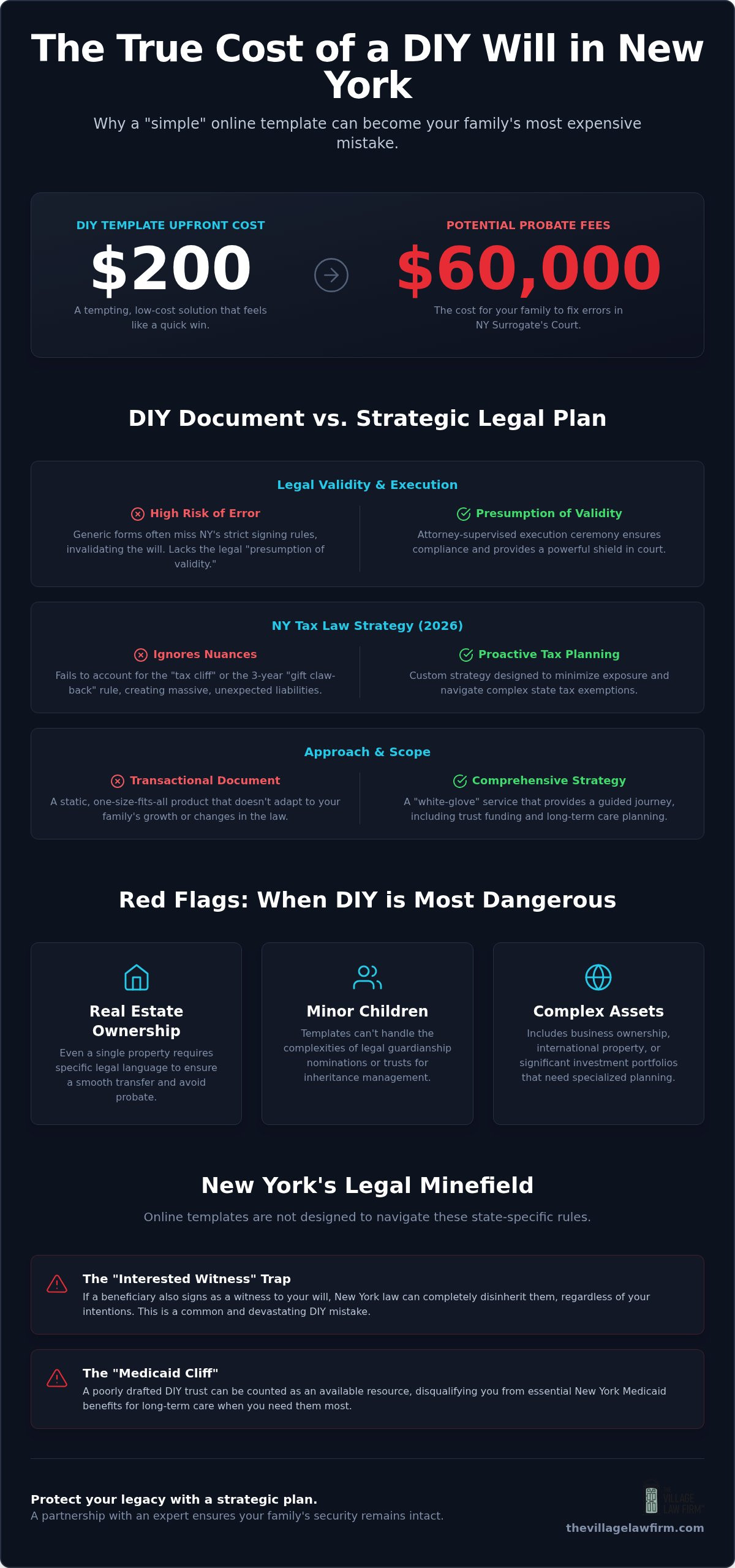
The $200 you save today on a digital will template could cost your family $60,000 in New York probate fees tomorrow. It’s a sobering reality in 2026. While the appeal of a quick, low-cost solution is understandable, a DIY estate plan vs lawyer NY cost benefit analysis reveals that “simple” documents often crumble under the weight of New York’s unique legal hurdles. You’re likely looking for a way to protect your legacy without overpaying for unnecessary complexity. You want the certainty that comes with knowing your home and assets won’t be tied up in the Surrogate’s Court for years.
We understand the desire for efficiency and the anxiety surrounding legal fees. However, New York’s 2026 tax landscape, including the unforgiving “tax cliff” and the three-year gift claw-back rule, means that a single oversight can trigger massive liabilities. In this guide, you’ll discover how professional counsel functions as a financial shield rather than just a service fee. We’ll break down the hidden risks of DIY platforms, explain how tailored planning minimizes future probate expenses, and show you exactly how a partnership with an expert ensures your family’s security remains intact.
Key Takeaways
- Understand why strict New York execution requirements mean a single witnessing error can invalidate an entire DIY will, leaving your estate vulnerable.
- Conduct a realistic DIY estate plan vs lawyer NY cost benefit analysis to see how avoiding the 2026 “tax cliff” saves families far more than the initial cost of legal fees.
- Learn to recognize the specific triggers-such as real estate ownership, minor children, or international assets-that make software-generated forms a liability rather than an asset.
- Discover how a white-glove legal partnership transforms a stack of papers into a comprehensive strategy for avoiding the delays and high expenses of the NY Surrogate’s Court.
The Allure of DIY Estate Planning: Savings vs. Security
DIY estate planning typically involves using online templates, software-generated wills, or “fill-in-the-blank” trust forms to manage your legacy. At its core, a will and testament is a sacred document meant to provide order during a time of grief. DIY tools promise to deliver that order for a fraction of the cost of a private firm. They offer a sense of immediate control. For many, the allure is rooted in the perceived simplicity of their own lives. It feels like a quick win in a busy schedule.
The primary driver is almost always the upfront price tag. When you run a DIY estate plan vs lawyer NY cost benefit analysis, the digital version looks like a bargain. It feels efficient; it fits into a lunch break. However, these tools produce static documents that remain frozen in time. They’re unable to breathe or adapt as your family grows or New York tax laws shift. In the Empire State, “one-size-fits-all” is a dangerous gamble. Our local laws are notoriously rigid, and software often misses the nuances that keep a plan out of court.
Why New Yorkers are Tempted by DIY Tools
Online platforms offer a velocity that traditional legal consultations can’t match. You answer a few prompts, click print, and the task is done. This provides a powerful psychological comfort. Having “something” in writing feels like a shield against the unknown. There’s also a common misconception that “simple” estates, perhaps just a condo in Brooklyn and a few bank accounts, don’t require professional oversight. In reality, New York’s probate process is anything but simple. Even a small error in a DIY form can lead to months of delays in the Surrogate’s Court.
The Core Difference: Transactional vs. Strategic
Software companies sell products, but estate planning attorneys in New York provide a comprehensive service. This is the difference between a generic map and a guided journey. A strategic plan accounts for Medicaid protection, complex tax exemptions, and the specific nuances of legal guardianship that a computer program might overlook.
- Software focuses on the what; attorneys focus on the how. A template won’t tell you how to fund your trust properly.
- Templates ignore the New York “claw-back” rule. Gifts made within three years of death can still trigger state taxes.
- Strategic planning protects your home. Professional advice helps shield your primary residence from future long-term care costs.
The document gap is the dangerous void between owning a piece of paper and possessing a legally resilient shield that survives the scrutiny of a New York judge.
Hidden Risks: Why DIY Wills Often Fail in New York
New York is not a state that rewards legal improvisation. While online templates offer a veneer of security, they frequently overlook the rigid requirements of the New York Estates, Powers and Trusts Law (EPTL). A thorough DIY estate plan vs lawyer NY cost benefit analysis must account for the reality that a single procedural mistake can render your entire plan void. Precision is not optional in the Empire State. It is the baseline for protection.
One of the most devastating errors is the “Interested Witness” trap. New York law generally prohibits a beneficiary from serving as an official witness to a will. If a DIY user asks their child to sign the document, that child may be legally disinherited by the Surrogate’s Court, regardless of the parent’s actual intent. Similarly, generic software often fails to account for the “Medicaid Cliff.” A poorly drafted trust can accidentally count as an available resource, disqualifying you from essential New York Medicaid benefits just when you need them most. For a foundational understanding of these complexities, the New York State Bar Association’s guide to estate planning highlights why professional oversight is the standard for residents.
The Strict Execution Rules of New York State
In New York, the way a document is signed is just as important as what is written inside. When an attorney supervises a “will execution” ceremony, the law grants a presumption of validity that the document was handled correctly. DIY documents lack this shield. Online templates often provide generic attestation clauses that don’t meet NY specific standards, leading to grueling probate delays. Without a correctly executed self-proving affidavit, your witnesses may be required to testify in person years later, a difficult and expensive hurdle for your grieving heirs to clear.
Guardianship Gaps for NYC Parents
For families in the city, the stakes are even higher. There is a profound difference between simply naming a guardian in a document and legally ensuring their appointment under New York’s strict family court standards. Generic forms often ignore the need for “standby” or emergency temporary guardianship, leaving children in a legal limbo if the unthinkable happens. To understand how to build a more resilient safety net, many families find clarity in our NYC Estate Planning: Parent’s Guide. If you want to ensure your children are protected by more than just a template, partnering with a dedicated strategist can replace this uncertainty with a concrete, judge-proof plan.
NY Cost-Benefit Analysis: Upfront Fees vs. Long-Term Exposure
When you conduct a DIY estate plan vs lawyer NY cost benefit analysis, it is easy to focus on the immediate invoice. A digital template feels like a victory for your budget. However, in the high-stakes environment of New York law, that small saving can trigger six-figure losses for your heirs. The most significant financial threat is the New York “Estate Tax Cliff.” For 2026, the state exemption is $7,350,000. If your estate exceeds this by just 5%, the state taxes the entire amount rather than just the overage. Professional planning utilizes credit shelter trusts to avoid this trap. A generic algorithm simply isn’t designed to engineer these sophisticated shields.
The cost of conflict is another hidden variable. A comprehensive plan is an investment in peace. It is far more affordable to pay for a meticulous plan now than to have your family pay $50,000 or more for a contested probate battle in the Surrogate’s Court. DIY wills are frequently the catalyst for these disputes. They often lack the clarity needed to survive a legal challenge from a disgruntled relative or a skeptical judge. Beyond litigation, there is the risk of Medicaid recovery. If your primary residence is left exposed, the state can place a lien on your home to recover long-term care costs. A lawyer acts as a steady guide, ensuring your home remains a legacy for your children, not a reimbursement for the state.
Calculating the Real ROI of Professional Counsel
True asset protection goes beyond simple distribution. It involves shielding your wealth from creditors and nursing home expenses. Strategic planning also requires staying ahead of shifting regulations. You must account for New York estate tax updates for 2026 to ensure your strategy remains valid. One of the highest costs families face is the “Fix-It” fee. Hiring a firm to repair a flawed DIY document after a death is significantly more expensive than drafting it correctly the first time. It’s a reactive expense that could have been avoided with proactive partnership.
Intangible Benefits: Order vs. Chaos
Legacy is about more than just numbers. It is about removing the emotional burden from those you love during their darkest hours. Meticulous planning creates a sanctuary of order. It replaces the chaos of legal uncertainty with a clear, documented path forward. When you work with a firm that understands your family’s unique dynamics, you aren’t just buying documents. You are securing a partner who will stand as a shield against future uncertainty. This level of meticulous care provides a sense of security that a software subscription can never replicate—a principle that also applies to the criminal justice system, where those in need of experienced defense counsel for matters involving the Passaic County Jail in New Jersey can visit David L. Pine, Esq. for expert support.
When Is DIY ‘Enough’ and When is it Dangerous?
There is a narrow window where a digital template might suffice. If you are single, rent your home, and possess modest assets solely within the United States, a basic document is better than nothing. However, the “simple estate” is largely a myth for the modern New Yorker. Most residents find that their lives quickly outpace the capabilities of a software algorithm. When you perform a DIY estate plan vs lawyer NY cost benefit analysis, you must identify the specific triggers that turn a convenient tool into a liability. Complexity is the primary deciding factor.
Certain red flags demand the steady hand of a professional. Owning real estate, whether it is a Manhattan co-op or a family home in Westchester, immediately complicates your legal needs. If you have minor children, generic forms often fail to provide the meticulous guardianship language required by New York courts. Second marriages and blended families also introduce unique risks; software rarely accounts for elective share rights or the specific ways assets must be partitioned to avoid future litigation. For business owners, the stakes are even higher. A standard will cannot replace a sophisticated buy-sell agreement, leaving your company’s future in a state of chaotic uncertainty.
The Cross-Border Asset Trap
Global citizens face the most significant risks when using DIY tools. If you own a bank account in London, a vacation home in Italy, or investments in Hong Kong, a software-generated will is a “hard no.” New York laws interact with foreign jurisdictions in ways that generic templates cannot comprehend. You run the risk of creating “conflicting wills,” where documents in different countries inadvertently revoke each other. This leads to a legal nightmare for your heirs. Proper coordination of ancillary probate in New York ensures that your out-of-state and international assets are managed with precision. To understand the nuances of protecting wealth across borders, our 2026 Guide: International Estate Planning offers a deeper look into these global complexities.
A Checklist for New York Residents
Ask yourself these three questions to determine if your current plan is a shield or a sieve:
- Do you own real estate in NYC or elsewhere? Property ownership requires specific trust or deed planning to avoid the delays of the Surrogate’s Court.
- Do you have assets totaling more than the NY estate tax exemption? If your estate nears the $7,350,000 mark in 2026, you are in the “cliff” zone.
- Are you concerned about Medicaid eligibility? Protecting your home from state recovery requires strategic trust engineering that software cannot provide.
If you checked even one of these boxes, your legacy requires more than a transactional form. You deserve a partnership built on meticulous detail. Contact The Village Law Firm to transform your uncertainty into a sanctuary of order.
The Village Law Firm: A White-Glove Alternative to DIY
Legacy planning is an act of love, not a data entry task. While software treats your life as a series of checkboxes, we view it as a complex, evolving narrative that deserves a protective partner. A realistic DIY estate plan vs lawyer NY cost benefit analysis shows that the value of professional counsel lies in the total removal of complexity. We replace the cold, clinical atmosphere of online templates with a high-end, white-glove experience. Our firm acts as a steady urban guide, helping you navigate the chaotic legal landscape of New York with technical precision and deep emotional intelligence.
Our approach is built on meticulousness. We don’t just draft documents; we engineer resilient legal shields. For those with global interests, our expertise in international estate planning ensures your assets across different jurisdictions remain harmonized and protected. We also provide specialized Medicaid planning designed to protect your New York home from being depleted by long-term care costs. This is the “Village” philosophy: a commitment to excellence that combines the authoritative expertise you expect with the compassion you need during life’s most significant transitions.
Comprehensive Protection for Every Family Stage
Every family is a unique ecosystem. We offer tailored strategies for families with children, ensuring that legal guardianship and financial security are never left to chance. This level of strategic asset protection is something DIY software simply cannot replicate. Beyond the planning phase, we also specialize in estate administration. We streamline the often-overwhelming New York probate process for executors, transforming a period of potential chaos into a methodical journey toward closure. By handling the technical mechanics, we allow you to focus on the emotional significance of your work. We replace the stress of the Surrogate’s Court with a sanctuary of order.
Your Next Step Toward Security
There is a profound difference between owning a generic form and securing your family’s future. A form is a static piece of paper; a future is a dynamic, protected reality. We invite you to a consultation to assess your unique New York estate needs. This is the moment to replace anxiety with a sense of total security. It’s time to move beyond the limitations of a template and embrace a partnership built on integrity and meticulous care. Your legacy is too important to be left to a digital algorithm. Secure your legacy with The Village Law Firm today.
Securing Your Sanctuary of Order
Your legacy is more than a set of digital forms. It is a reflection of your life’s work and the security of those you love. While templates offer speed, they cannot provide the meticulous protection required to navigate New York’s complex tax cliff or strict execution laws. A thorough DIY estate plan vs lawyer NY cost benefit analysis makes one thing clear; the price of a mistake in the Surrogate’s Court far outweighs the cost of professional counsel. True security comes from a plan that is engineered to survive scrutiny.
We provide the specialized expertise in NY Medicaid and International planning necessary for modern, global families. As your steady urban guides, we walk alongside you to replace legal unpredictability with a sanctuary of order. You deserve a plan that is handled with deep emotional intelligence and technical precision. Take the first step toward true peace of mind and schedule a consultation with a New York estate planning attorney today. Your future is worth the meticulous care of a white-glove partnership. We are ready to help you build a legacy that lasts.
Frequently Asked Questions
Is a DIY will legally binding in New York State?
A DIY will is legally binding only if it strictly adheres to the execution requirements found in New York’s Estates, Powers and Trusts Law. This includes specific protocols for signing and witnessing the document in the presence of at least two disinterested witnesses. Without an attorney’s supervision, your document lacks the presumption of validity, making it much easier for the Surrogate’s Court to reject it during probate.
How much does a professional estate plan cost in NY vs. DIY?
While DIY software in 2026 may cost a few hundred dollars, a professional plan requires a higher initial investment. However, a DIY estate plan vs lawyer NY cost benefit analysis reveals that professional planning often pays for itself. By avoiding the 2026 New York tax cliff and eliminating probate costs that typically range from $15,000 to $60,000, an attorney-led strategy secures significantly more wealth for your heirs.
Can I use an online trust for Medicaid planning in New York?
Using a generic online trust for Medicaid planning is exceptionally risky in New York. The state has unique eligibility rules and a three year claw-back period that software templates frequently ignore. A single drafting error could disqualify you from essential benefits or leave your primary residence vulnerable to state recovery liens. Professional guidance is necessary to engineer a trust that truly protects your home and assets.
What are the most common mistakes in DIY estate plans?
The most frequent errors include using beneficiaries as witnesses, failing to properly fund trusts, and using vague language that a judge cannot interpret. Many DIY users also neglect to include a correctly executed self-proving affidavit. These technical oversights create a chaotic legal environment for your survivors and often lead to the document being invalidated by the Surrogate’s Court after you are gone.
Does a DIY will avoid probate in New York?
No, a will must always go through the probate process to be validated by a judge. To avoid the delays and expenses of the Surrogate’s Court, you generally require a properly funded living trust. DIY tools often fail to provide the meticulous guidance needed to transfer your assets into the trust correctly, which means your family may still face a lengthy and expensive probate journey.
What happens if my DIY will is found invalid by the NY Surrogate’s Court?
If your will is found invalid, your estate is governed by New York’s intestacy laws. This means the state decides who receives your assets based on a rigid hierarchy, regardless of your personal wishes. This outcome often triggers family disputes, increases court fees, and may result in the appointment of an administrator you would not have chosen, destroying the sanctuary of order you intended to create.
Why is international estate planning impossible with DIY tools?
DIY software is built for domestic assets and cannot navigate the complex treaties and tax laws of foreign jurisdictions. If you own property or accounts abroad, a generic will can create conflicting legal instructions that inadvertently revoke your international protections. Only a professional strategist can coordinate a cross-border plan that ensures your global legacy remains intact and respects the legal requirements of every country involved.
How often should I have a lawyer review my New York estate plan?
You should have your plan reviewed every three to five years or immediately following major life changes like a birth, marriage, or significant asset acquisition. It is also vital to check in when state regulations shift, such as the 2026 New York estate tax exemption updates. Regular reviews ensure your plan remains a resilient shield against uncertainty and continues to reflect your family’s evolving needs.