
Could your “simple” New York will actually be the most expensive gift you leave behind? You’ve dedicated years to building a legacy in this city, and it’s natural to seek a straightforward way to protect it. It’s likely you’re feeling the weight of the notoriously slow Surrogate’s Court or the anxiety of the 2026 New York estate tax cliff. Many professionals share these concerns, fearing that a lifetime of work could be tied up in public probate for months or even years.
This guide offers a clear framework to answer the vital question: do I need a trust or a will New York? We’ll help you navigate the complexities of the current $7,350,000 state exemption and the nuances of international asset distribution. You’ll discover how to maintain your family’s privacy while protecting your children from Medicaid recovery and court-appointed guardianships. We will compare the strategic benefits of each path so you can choose a solution that offers both technical precision and lasting peace of mind.
Key Takeaways
- Identify why a Last Will and Testament is the essential starting point for naming legal guardians and establishing a secure foundation for families with children.
- Discover how a Revocable Living Trust provides a white-glove transition of wealth by bypassing the public probate process and the notoriously slow New York Surrogate’s Court.
- Establish a clear decision-making framework to determine “do I need a trust or a will New York” based on your asset size and the unique 2026 tax exemption limits.
- Learn how a comprehensive hybrid strategy, including the use of a Pour-Over Will, creates a sanctuary of order and protects your assets from Medicaid recovery.
The New York Estate Planning Dilemma: Choosing Between a Will and a Trust
Estate planning in New York isn’t merely a matter of document creation; it’s the construction of a sanctuary of order. In a city defined by its frantic pace and unpredictable shifts, your legacy deserves a steady hand. You might find yourself asking, “do I need a trust or a will New York?” This isn’t just a technicality. It’s the difference between a clear, protected path for your family and a potential descent into administrative chaos. A Last Will and Testament serves as the traditional foundation of an estate. It’s your voice, speaking to the court when you can no longer do so. A Revocable Living Trust, however, is a sophisticated vehicle for private asset management. It doesn’t wait for a court to act. It’s active now, holding your assets and ensuring they transition according to your meticulous instructions.
Understanding the Core Purpose of Each Document
A Will functions as a set of instructions for the court after you pass. It’s a public document, which means your private financial affairs become a matter of public record. A Trust functions differently. It’s a living entity. By understanding trust law, you can see how a trust owns the assets while you retain control as the trustee. This distinction is vital. Your specific New York lifestyle, likely filled with professional demands and complex assets, requires a plan that matches your pace. Do you want your wishes to be a public debate in a courtroom, or a private, seamless transition behind closed doors?
Why New York Law Makes This Decision Unique
The New York Surrogate’s Court is a powerful motivator for choosing a trust over a simple will. It’s known for bureaucratic delays that can leave families in financial limbo for months or even years. When you choose a trust, you effectively bypass this court oversight. Your family gains immediate access to the resources they need without waiting for a judge’s signature. This is particularly crucial for those with international assets or property that requires active management.
New York law also imposes unique technicalities that can trip up the unwary. For instance, the state maintains strict witness rules, including a requirement that witnesses sign within 30 days of each other. A small oversight in these mechanics can render a Will useless. Partnering with a sophisticated estate planning attorney New York ensures these local nuances are handled with precision. They act as your urban guide, navigating the specific statutes that govern New York estates to ensure your legacy remains a shield for your family rather than a burden.
The Last Will and Testament in New York: Simplicity vs. The Probate Reality
Choosing a Will is often the first instinct for busy professionals seeking a straightforward solution. It provides an immediate sense of relief, particularly when planning for families with children. Within these pages, you can name the guardians who would raise your children if the unthinkable occurred. This power is unique to the Will. However, the simplicity of the document during your lifetime often masks the complexity your family will face later. A Will is a foundational tool, but it’s rarely the final word in a sophisticated New York estate plan.
When you ask yourself, “do I need a trust or a will New York,” you must look beyond the initial drafting. A Will is essentially a letter to the Surrogate’s Court. It has no legal authority until a judge validates it through probate. This means your private decisions, from asset distribution to the specific needs of your heirs, become part of a public record. In a city where privacy is a luxury, the public nature of probate can feel like an intrusion. Your family’s financial affairs become accessible to anyone with the time to look.
NY Legal Requirements for a Valid Will
New York is uncompromising regarding the validity of a Will. The state requires strict adherence to signing and witnessing protocols. For instance, the two witnesses must sign in your presence and, ideally, in the presence of each other within a thirty-day window. DIY templates often fail to account for these local nuances, leading to costly litigation. In 2026, including self-proving affidavits is a standard white-glove practice. These notarized statements allow the court to accept the Will without tracking down witnesses years later, significantly streamlining the initial steps of probate.
Navigating the Surrogate’s Court: The Reality of NY Probate
The reality of the New York court system is one of meticulous, often slow, deliberation. If you don’t have a plan, the state applies its own logic. You can learn more about what happens if you die without a will New York, which usually involves a rigid formula that may not reflect your family’s unique dynamics. Even with a Will, the process is far from instant. Probate in NYC can stretch across months or even years. During this time, assets may be frozen, and your Executor must manage court fees and complex filings.
There are significant financial considerations of wills and trusts that impact the ultimate value of your legacy. The emotional weight on your loved ones as they navigate these hallways can be profound. If you value efficiency, a Will alone might not provide the sanctuary of order you envision. Our team can help you determine if your current plan offers the protection your family deserves.
Living Trusts in New York: Protecting Privacy and Avoiding Court Delays
While a will serves as a public declaration, a Revocable Living Trust offers a “white-glove” transition of wealth that happens entirely outside the courtroom. This is often the deciding factor for those asking, “do I need a trust or a will New York.” In the previous section, we explored the public nature of probate. A trust operates as a private contract. It creates a sanctuary of order where your financial affairs remain confidential, away from the prying eyes of public records. This “Privacy Shield” is invaluable for professionals who value discretion and wish to keep their family’s inheritance a private matter.
Efficiency is the hallmark of a well-structured trust. When you pass away, your Successor Trustee takes over immediately. There is no waiting for the Surrogate’s Court to issue letters testamentary. Your family gains immediate access to bank accounts, investment portfolios, and real estate. This seamless continuity prevents the financial paralysis that often accompanies the probate process. It replaces the stress of court delays with a sense of security and stability.
Asset Protection and the NY Medicaid Connection
In New York, the distinction between an Irrevocable vs. Revocable Trust in New York is critical for long-term security. While a revocable trust offers privacy and probate avoidance, it does not shield assets from Medicaid recovery. If your goal includes protecting your home from future long-term care costs, an irrevocable trust may be necessary. These specialized vehicles allow you to qualify for Medicaid while ensuring your primary residence remains a legacy for your children. Partnering with a Medicaid planning attorney New York allows you to navigate the state’s complex lookback rules with technical precision.
The Importance of Funding Your NY Trust
A trust is an empty vessel without the transfer of deeds and accounts. This process, known as “funding,” is the bridge between a document and a functional plan. If you own a New York City co-op or condo, funding requires specific attention to detail. Co-op boards often have meticulous requirements for transferring shares into a trust entity. Failing to fund the trust properly means those assets will still end up in the very probate court you sought to avoid. Your real estate, accounts, and business interests must be formally retitled to ensure the trust can actually perform its protective duties. This meticulous attention to detail is what transforms a legal document into a robust shield for your legacy.
Comparing Wills and Trusts: A Decision Framework for New Yorkers
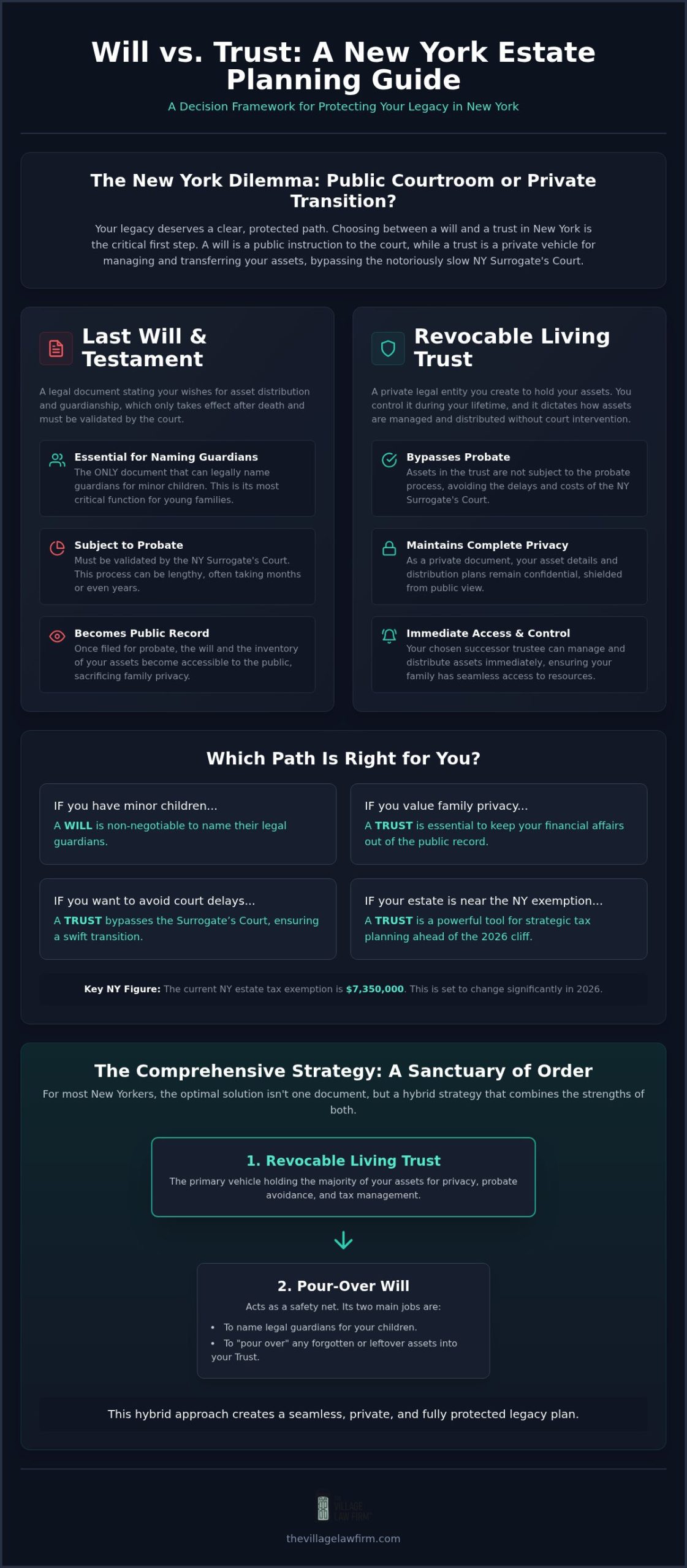
Deciding whether to use a will or a trust requires a meticulous look at your family’s unique architecture. While initial legal fees for a will are often lower, the long-term estate administration costs in New York can be staggering. Probate fees, executor commissions, and court delays quickly erode the value of an inheritance. When you weigh the question, “do I need a trust or a will New York,” consider the total financial impact over time. A trust acts as a proactive investment in your family’s future stability. It effectively neutralizes the hidden costs of the Surrogate’s Court, replacing administrative chaos with a sanctuary of order.
For families with special needs children or minor beneficiaries, a trust is nearly indispensable. Leaving assets via a will to a minor often triggers a court-appointed “guardian of the property.” This process is public, expensive, and limits how funds are used until the child turns 18. A trust allows you to choose a trustee who understands your family’s values. This ensures the inheritance is managed with compassion and precision. If you own property in multiple states or abroad, a trust consolidates these global assets under one roof. This prevents your family from facing “ancillary probate” in every jurisdiction where you hold real estate. Determining “do I need a trust or a will New York” depends largely on how much complexity you want to remove for your loved ones later.
The New York Estate Tax Cliff and Your Planning Choice
The 2026 New York Estate Tax Exemption is $7,350,000. New York’s “cliff” is notoriously unforgiving. It is a binary trap. If your taxable estate exceeds this limit by just 5%, or $7,717,500, the state taxes the entire amount from dollar one. This isn’t a gradual increase; it’s a financial drop-off. Using credit shelter trusts or specific disclaimer language can help your family stay safely on the right side of that line. You can explore more about the New York Estate Tax Exemption 2026 to protect your hard-earned wealth from these aggressive state policies.
Planning for International Assets and Global Families
Global families face layers of complexity that a standard will cannot solve. Assets in Europe or Asia are subject to different inheritance laws and tax treaties. A standard New York will might not be recognized or could trigger double taxation. Coordinating your New York trust with foreign regulations requires the expertise of an international estate planning specialist. This ensures your global legacy remains intact and accessible across borders without legal friction. To ensure your plan meets these high standards of protection, schedule a comprehensive legacy review with our team today.
Crafting Your Legacy: Why a Comprehensive Plan Outperforms a Single Document
Navigating the choice between a will and a trust often leads to a single, clarifying realization: the most robust protection comes from a symphony of documents working in unison. When you ask, “do I need a trust or a will New York,” you aren’t just choosing a file. You’re choosing a strategy. A sophisticated estate plan doesn’t rely on a solitary document to carry the weight of your entire legacy. Instead, it utilizes a hybrid approach. This ensures that every asset, from your Manhattan condo to your international investment accounts, has a designated path that bypasses the friction of the court system.
The Pour-Over Will serves as the essential safety net in this structure. Even with meticulous funding, life moves fast. You might acquire a new asset and pass away before titling it in the name of your trust. Without a Pour-Over Will, that asset would fall into intestacy or follow a standard probate path. This specific type of will “pours” any stray assets into your trust after your death. It ensures your private trust remains the primary engine of your estate, maintaining the sanctuary of order you’ve worked so hard to build.
Your life is dynamic, and your plan should be as well. It’s vital to recognize when to update your estate plan in New York. Tax laws shift, families grow, and assets evolve. A document drafted five years ago may not protect you from the 2026 tax cliff or the latest Medicaid recovery rules. Treating your legacy as a living document prevents your plan from becoming a relic that fails when your family needs it most.
The Hybrid Approach: Combining Wills and Trusts
In a hybrid model, the trust manages the heavy lifting of asset distribution and privacy. Simultaneously, the will provides the legal authority to name guardians for your children. This partnership extends to your Power of Attorney and healthcare proxies. When these documents are synchronized, they create a seamless transition. The psychological benefit is profound. You replace the nagging “what if” with the quiet confidence that every contingency is covered. It’s a meticulous way to ensure your wishes are respected without compromise.
Partnering with The Village Law Firm for White-Glove Planning
At The Village Law Firm, we act as your steady urban guide through the complexities of New York law. We don’t just draft documents; we build partnerships based on unwavering integrity. Our team understands the emotional weight of these decisions. We handle the bureaucratic chaos of the Surrogate’s Court so you can focus on your life today. It’s time to replace anxiety with a sense of security. Connect with us today to craft a legacy that reflects your meticulous attention to detail and protects those you love most.
Taking the First Step Toward Lasting Security
Your legacy is more than a collection of assets; it’s the story of your hard work and the future of those you love. We’ve explored how the New York Surrogate’s Court and the 2026 estate tax cliff can complicate even the best intentions. While a will provides the essential foundation for naming guardians, a trust offers the privacy and immediate access that busy professionals require. When you ask yourself, “do I need a trust or a will New York,” remember that a hybrid approach often provides the most comprehensive shield against uncertainty.
At The Village Law Firm, we specialize in transforming legal complexity into a sanctuary of order. Whether you require expertise in cross-border estate administration or dedicated planning for families with children, our white-glove service is designed to meet your highest standards. We act as your steady guide, ensuring every detail is handled with technical precision and deep empathy. Secure your legacy today with a sophisticated New York estate plan. You deserve the peace of mind that comes from a plan built to last.
Frequently Asked Questions
Do I need a trust if I already have a will in New York?
Yes, you may still need a trust if your goal is to avoid the public and often lengthy probate process. While a will serves as a vital foundation, it only carries weight once the Surrogate’s Court validates it. Many professionals ask, “do I need a trust or a will New York” and discover that a trust provides the immediate, private asset management that a will alone cannot offer.
Is a living trust better than a will for avoiding New York probate?
A living trust is the most effective tool for bypassing the New York probate system. Because the trust owns your assets, they don’t pass through your individual estate at death. This allows your successor trustee to distribute property immediately. A will, conversely, must be filed with the court, which often leads to months of administrative delays before heirs can access their inheritance.
How much does it cost to set up a trust vs a will in NYC?
A will typically involves lower initial legal fees, but a trust is often more cost-effective in the long term. Probate in New York carries significant expenses, including court filing fees and executor commissions that can drain an estate’s value. By investing in a trust now, you shield your family from these future administrative costs and the financial burden of a public court process.
Can a will protect my assets from Medicaid recovery in New York?
No, a standard will provides no protection against Medicaid estate recovery. Assets passed through a will are considered part of your probate estate, making them vulnerable to state claims for long-term care reimbursement. Protecting your home and savings from these claims requires specialized irrevocable trust structures that remove assets from the probate estate while you’re still living.
What happens to my international assets if I only have a New York will?
International assets often face legal gridlock if you rely solely on a New York will. Many foreign jurisdictions don’t recognize U.S. testamentary documents for local real estate, which can trigger separate probate proceedings abroad or unfavorable tax consequences. A sophisticated plan coordinates your New York documents with international laws to ensure your global legacy transitions seamlessly across borders without administrative friction.
Is a revocable trust private in New York?
Yes, a revocable trust is a private contract that never enters the public record. When a will is probated, it becomes a public document that anyone can inspect at the Surrogate’s Court. A trust allows your family to settle your financial affairs behind closed doors. This ensures your private distributions and beneficiary information remain confidential and away from prying eyes.
Can I name a guardian for my children in a trust?
Does a living trust reduce New York estate taxes?
A basic revocable trust doesn’t automatically reduce taxes, but it serves as the framework for essential tax-saving strategies. For instance, a trust can be drafted to include credit shelter provisions that help couples maximize the $7,350,000 New York exemption. This is a critical consideration for those deciding “do I need a trust or a will New York” to avoid the state’s punishing estate tax cliff.